A few weeks ago I received an email from a “well meaning” individual I did not know. He was writing to inform me that based on my DNA results, I am in the “same tribe” as a wealthy man who went missing in Saudia Arabia about 10 years ago and the bank is ready to close his accounts and disburse the vast amounts of stock he earned from oil revenue.
Wow, I’m so lucky that this person found my DNA and linked me to a wealthy relative I didn’t know existed, NOT! This letter was clearly a take on the old Nigerian banking scam that still circulates today.
Another genealogy scam making the rounds that I never receive is one I found on Wikipedia. The “Death Certificate Scam: Person will get an obituary off Internet. Find out relatives related. Get their emails. Contact them with fake story of another family member near death, which of course, is only told in ambiguous language. It originates out of Ethiopia with the “makelawi” tag in the email, but it can have de (German free email tag) along with it.”
I’m not sure how many people fall for these poorly worded (in English) emails. I know several of my colleagues weren’t happy to get the DNA scam as they felt that it will make more people hesitant to have their DNA tested. Although that may make someone pause before spitting, being able to make your results private would lessen the likelihood of fraudulent people contacting you because of your test results, if that is your concern. (I’ve had people tell me they were hesitant to take a DNA test because they didn’t want the insurance company to get the results and deny them coverage which would be illegal but we all know how that goes.)
My concern is different then my colleagues; as I blogged a few weeks ago, I have been volunteering with an organization trying to obtain photos of American service people who were killed in Europe during World War II. In contacting a small public library in rural Indiana for assistance, I was surprised to hear back that the family of the killed in action serviceman was found but they were hesitant to provide a photo because they had several questions about the reasons the photo was needed.
I, too, check out organizations before I affiliate with them so the inquiry was probably a wise course of action. I forwarded the email to the person I had been working with and the library staff received a detailed explanation, an offer to provide the name and contact information of the local individual who had been maintaining the grave for the past several years, an invitation to attend the upcoming memorial service and the organization’s goal as the 75th anniversary of the deaths approaches.
I was impressed with the response less than 24 hours after the questions were received but disappointed that the family decided to ignore the information. This reminds me of a distant cousin I have who absolutely refuses to share photos of our shared ancestor because, well, there is no reason.
Not every query is a scam. If you are concerned that you received a possible nefarious email, check out the FTC’s recommended ways to recognize and avoid scams. If you are contacted for a picture of your great great grandma by someone who writing a history of the town she lived in, most likely it’s a legitimate request. Check it out and after making a decision, respond to the inquirer with your answer. It’s the right thing to do.
Notice the new Hints feature on Ancestry? It appears at the top of the Hints page in the middle below the ribbon:
To become a part of the Beta test group, simply toggle the button “BETA OFF” to the right to become “BETA ON.”
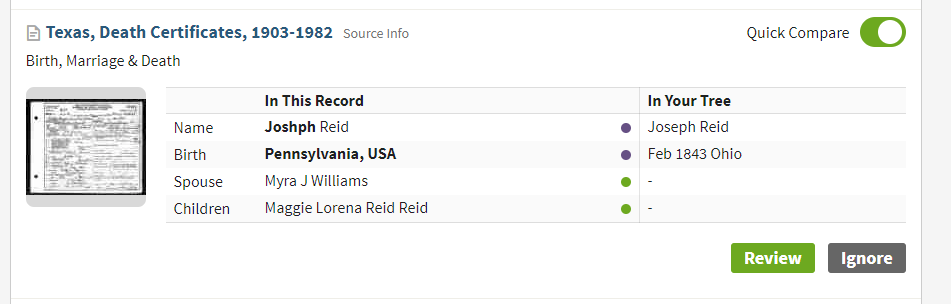
If you aren’t into Beta testing, here’s what changes you would see – after the two pictures of Joseph Reid, notice there is a “Quick Compare” toggle on the right side of the screen. I have the feature disabled below so all you see in the last column for the Texas, Death Certificates, 1903-1982 is Different and New:
What was different and new? Joseph was misspelled on the Texas Death Certificate as Joshph which is why it is noted as different from what I have in my tree, Joseph. I did not have Joseph’s spouse and children so that information would be “New” to me. Other options are Same (for the named individual) and Match (for a spouse or child).
When you toggle from right to left the Quick Compare button, you see the following:
So now I see what exactly is the difference from my tree and the record (which was what I figured – Joseph was spelled differently, duh!). It also provides the birth date and place I had in my tree. I had Ohio but the death record stated Pennsylvania, USA.
Compare is a nice feature as you can see the differences between the new record and what’s already saved in your tree without having to leave the Hints page. I don’t use Hints often, though, so it’s not likely I’ll be toggling for Quick Compares frequently.
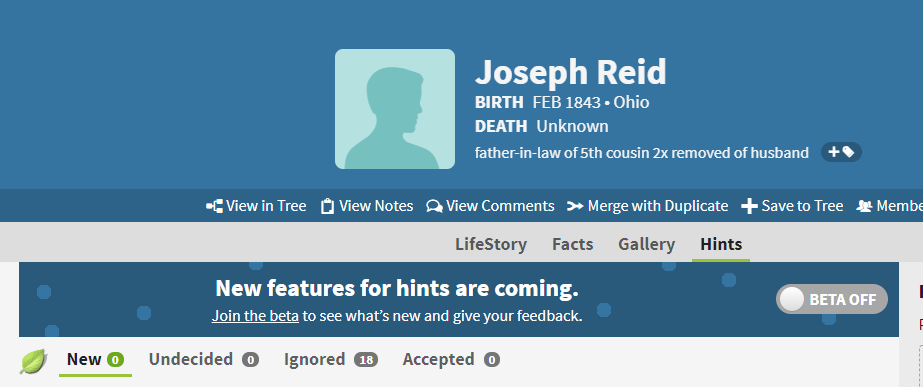
This is how I use Hints – If I have Hints on, I always click Ignore. I do this because the Hint never goes away, it simply disables the waving leaf. If I ever want to see the Hint I ignored, all I need to do is go to the Hints section of an individual as seen below (Click on Hints, it’s in the same line with LifeStory):
Clicking on Ignored will allow me to look at those Ignored Hints again.
If you are looking at Hints for everyone in your tree (by clicking the leaf on the upper right hand corner and selecting your tree) in the Beta option, when you click Ignore you get the following:
I would click “I already have this information.” as I don’t need the same picture saved twice.
If you’d like to offer your input in making Ancestry.com’s Hints better, give the Beta test a try.
Next week, I’m going to blog about why I have Joseph Reid, the father-in-law of my husband’s 5th cousin twice removed. Stay tuned.
I just read an article that I think you might find interesting – Lost Rolls America is about those rolls of film you have hanging around the house that you never take to get developed.
A few years ago I had developed all of the rolls and disposable cameras (remember those?!) that were in my home. Most of the photos were field trips my children went on and the pictures weren’t all that exciting. My family still laughs, though, at the weird occurrence that happened when I took the films in to be developed.
I was next in line at the camera counter at my neighborhood Walgreens when a woman came in and sighed loudly behind me. Turning, I saw she was clearly in a hurry. I smiled and said something about the line was moving quickly. She said she was late and hoped it did. Then she saw all the film and disposable cameras I had in a gallon size baggie. I told her she could go ahead of me.
Just at that moment the customer who was being waited on finished. The hurried woman needed to buy batteries but the kind she needed they didn’t have. She said something like, “That’s just great, now what am I gonna do?” I suggested she run to the Battery Store a few miles away as they seem to have every kind imaginable. I added, “Just be careful driving;” as she did seem to be in such a hurry. She said “Thanks,” walked away and as I started dumping the contents of the baggie on the counter she came back. “Excuse me,” she said. Both the clerk and I looked up. “I know this will sound strange, but you have a lot of dead people following you.” The clerk looked at her like she was out of her mind. I just laughed and said, “I’m sure I do. I’m a genealogist and it’s probably family.” Turns out she was a fortune teller. She gave me her card and told me she’d give me a free reading for my kindness. I never took her up on it.
Maybe I should have; those dead people following me sure didn’t answer my genealogical questions! Perhaps you’ll get lucky and those rolls of film will help you answer yours. Happy Hunting!
Since returning home from vacation, I have been on a genealogy cleaning spree. Although I hadn’t planned for this, I discovered a few days before I left that I really had to make it my priority when I returned. While packing, I was frantically looking for items in the closet when I got hit in the head by falling journals. Ouch! If that wasn’t a wake up call I don’t what would be.
Cleaning is not fun but the results are wonderful! I have also been fortunate that the heat index has been in the extreme and when the temperature drops, it’s pouring. With both of those curtailing my outside activities, I hit the office closet first for a redo. Because I live in an area prone to hurricanes, I keep records in either plastic tubs that I can quickly transport to the car when we evacuate, or in binders high up on a shelf. The binders contain vitals by surname and though they would be a loss, the original exists safely elsewhere with a scanned copy I placed online, on my computer and backed up on a portable device. I’ve tried various organizational methods but found this one works best for me.
Recently, I switched my journal and magazine preferences to online only; no point in killing trees when I can access and read the articles anywhere. I decided to donate my saved hard copies to my library. That helped clear the shelf and gave me more space to acquire more vitals! (Family eye rolls here).
I also keep office supplies in this closet so it was a great time to take an inventory. I made a list of items I’m getting low on, such as labels, that I can acquire at sale prices hits.
Once the closet was done, I tackled a file cabinet I use for business projects. I updated my portfolio of work samples to include recent projects and replenished forms. I don’t keep many copies of forms but I like to have a few available in case the printer is down or electricity out. (In my area, the electricity goes out frequently – 3 times in the last 5 days due to severe electrical storms.)
I then tackled the electronics which was the least favorite part and took the longest of this process. I started with thumb drives. I have a lot of them and I decided I really needed to go through and make sure that I had saved to the appropriate place. After checking that I had, I deleted the files from the thumb drive so I have a clean one to use on my next research trip.
Actually, looking through the drives was a wonderful walk down memory lane. I discovered several drives that held a probate record from colonial New Jersey that is the only record that shows two generations of Duers connected. The reason I had the document on different drives was because of unusual events at the time I discovered the document’s existence. I had been researching at a local library a different ancestor when I struck up a conversation with another researcher who was working on DAR lineage paperwork. I mentioned my desire to prove the Duers and she brought up the document – she had remembered the name as she was working on a different New Jersey family from the same area. It was the first time I had known of this document’s existence and I copied her copy to a thumb drive but she did not have the complete document. I then began my search for the original which wasn’t on FamilySearch.org but was available at LDS sites. Of course, the nearest LDS Family History Center to where I was would close in a few minutes so there was no way I would get there in time. The next day, I grabbed a different thumb drive and drove to the site, found the record and thought I had saved it all but when I returned home discovered one page was missing and oddly, it was the page she had missed. That meant I had to return and save again. A few days later I was back and again resaved. I was so paranoid I brought the page up twice from the thumb drive before I left to make sure it was saved correctly. Even though it appeared at the LDS library, it disappeared by the time I got home. This happened before clouds so thumb drives were the best option for saving. Hubby suggested that maybe something was wrong with the thumb drive so I grabbed two others and we headed out, in a violent thunderstorm, to another LDS site much further from our home as that was the only one open. The volunteer said he was about to close as he didn’t think anyone would have ventured out in the inclement weather. I again located the document and this time, saved it to two different drives. For whatever reason, it saved correctly and I was able to open it when I returned home. Now on this cleaning spree, I deleted them off four different drives.
Next, I cleaned my download file on my computers, then cleaned the desktop. Next, I went on my three clouds and placed documents I had saved over the past year into folders. I then logged on to various organization to which I belong and downloaded and saved syllabuses for workshops that interested me but I hadn’t had time to attend. I plan to review them and watch the saved webinars if I needed more information.
This was followed by cleaning up my email account. I sent some follow up emails regarding projects that I haven’t gotten responses from in the past month and put mail I was done with in the appropriate folder.
I was feeling quite proud of myself so I went on to perform updates, which I hate doing because I’m inpatient of the time spent and the possible problems that result; for some reason, updates to our printer sometimes freezes the computer. While doing the updates, I realized I had neglected updating several of my tree software programs as new versions were available. All was well until I remembered that Roots Magic was linked to Ancestry and I hadn’t bothered to update changes I made to Ancestry in the past year. I almost had a heart attack when I clicked “Only show changed people” on Roots Magic. On a positive note, I was able to see how much progress I’ve made in my family tree but on a negative note, my goodness did I have a lot of work ahead of me to get the files saved to my personal computer. I seriously considered just redownloading my entire Ancestry tree but I knew with all the media I had, it would take at least a week as it had the first time I did it. I worried that the program would crash, especially with the electrical outages so I opted to painstakingly go through every individual and update. The majority of my cleaning time was completing this project. but I think it was worth it as I’d be crushed if something happened to my online tree at Ancestry. Having a backup, with all the media, is vitally important to me. Having it saved in numerous places is also worth the effort.
I am happy to report that I am ready to return to researching, my true love. I can’t wait!
As I mentioned in my previous blog article, last summer I had the opportunity to visit the beautiful island of Cuba. At the time, I didn’t realize how fortunate I was since travel has now recently been rescinded. In my opinion, that’s a shame. I do understand it’s a political decision although I do not agree that we should not be on speaking terms with a neighbor. Cuba is only 90 miles from our nation and populated with people who are family to many of our citizens. Genealogywise, this separation saddens me.
I have not previously blogged about my trip because it was for pleasure only. I longed to go there since I was three years old; my parents used to watch I Love Lucy and although Lucy’s fake crying set me off, I was enchanted with Desi’s accent and musical skills. My mother told me he was from Cuba and in my preschool mind, everyone on the island – an island, no less – now that added to the mystique! – was as talented as Desi. Someday, I was sure to visit.
Unfortunately, as I grew up, our countries grew apart. Sure, I spent every Wednesday at 10 AM hiding under my desk at school under the false pretense of being protected from a nuclear blast that was certain to hit the Chicago area from the disagreement but I still longed to go there. (As a side note, I realized how stupid the idea of these drills were one June morning after school had just closed for the summer. I was sitting on the back porch swing of my grandparent’s home reading a Nancy Drew mystery when the air raid siren blasted. On that beautiful late spring day it occurred to me that if a real nuclear event happened, I’d not likely have the protection of my school desk. I only lived one block from my elementary school, I could even see my first grade classroom’s windows from my bedroom, and I felt quite safe on the swing at home. I went inside and asked my grandmother what she did when the siren went off and she said she ignored it. My immigrant grandmother was a wise woman and I decided she was correct; hiding under a desk wasn’t going to spare my life. That was the day I started questioning authority.)
Fast forward to last year when a family member decided to take a continuing education course on a cruise ship sailing from my area. I eagerly agreed to go even though we’d only be in the city of Havana for about 8 hours. I scheduled an almost all-day tour for several reasons; the primary being I wanted to hear about the island from a native’s standpoint and not from my country’s. I also knew that like other Caribbean nations, Cuba operates on its own time so if I wanted to go to the fort, for example, it might just be closed at the time of my arrival even though it’s supposed to be open. (You live in Florida long enough and you get used to this concept but I understand it’s maddening if you aren’t used to it.) I figured a tour group would know what was open so I didn’t waste time. I also wanted to insure safety as my Spanish stinks and I’ve been known to say things that was not what I intended. I definitely did not want to be an ugly American.
I’m going to spare you my travelogue of that day and get to why I’m writing about Cuba now – this is what you need to know if you are of Cuban ancestry and unfortunately, didn’t go when you could to research your family. Although it will be more difficult now, it’s still doable with some work arounds.
Do not beat yourself up because you missed the chance. I once had lunch with a Russian genealogist who told me he had difficulty obtaining records back when his country was an ally. One morning on a visit to an archive he was told the records he sought weren’t available. He told a Cuban colleague and later that day, the colleague went to the same repository and came out with the records the Russian had requested. If you’ve been into genealogy for any length of time you probably had a similar situation like this happen to you. Get a different government employee and you get a different answer. Sure, prejudice could have been involved but I’m sticking to the first scenario as it’s happened to me.
I am no expert in Cuban genealogy although living in my area, I have friends and colleagues of Cuban descent who have shared how they have gotten the information they needed. My visit confirmed what they have told me. Here’s my advice, which is mostly commonsense genealogy practices:
· Make sure you get all the information you can about your ancestors’ FULL names and location before beginning so you aren’t contacting the wrong archives and wasting time. By full name, I mean the hyphenated Hispanic name. You don’t have to have the complete name but the more you have the better. (For example, Pablo Picasso’s complete name was Pablo Diego Jose Francisco de Paula Juan Nepomuceno Maria de los Remedios Cipriano de la Santisima Trinidad Ruiz y Picasso. If you only had Pablo Ruiz y Picasso that’s fine).
· If you don’t write well in Spanish, hire a translator. Although most people I encountered spoke English well, that doesn’t mean they read it well so you’ll increase your chances of getting the information you request by clearly communicating in their first language. Don’t rely on online translators; you want to be clear in the Cuban dialect so hire someone.
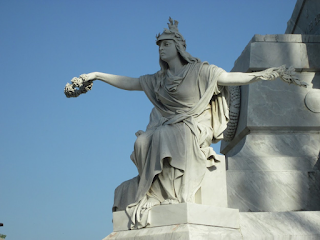
· Be patient, like I said earlier, Caribbean time is not the same as U.S. time so you may have to wait a LONG TIME for a response. Include a self-addressed stamped envelope to increase your chances of success. How long will you wait? According to my guide, months. This was regarding my question about obtaining cemetery records to the main cemetery in Havana pictured above. As it is still being used, going through old records is not considered important and the request will be filled when burials slow down. No telling when that would be; there was funeral mass in the chapel when we were visiting. (Here’s another aside – if you’ve been following me for years and realize that every time I go on vacation I end up at a cemetery you are correct. I can’t explain it – I just do!)
· It is not recommendable to go online and hire a genealogist. First, there isn’t a lot of trust between our countries which filters down to individual interactions. There is also the economic impact of the most recent decision that clouds the situation. Looking at the list on the Association of Professional Genealogists you will not find one genealogist who resides in Cuba so I advise you to not find someone online who says they’re going to help you. If you have no family members in Cuba you can contact to go and obtain the document you seek, contact the CubanGenealogy Club of Miami who can guide you. (I have attended one of their workshops and was impressed)
· Be prepared to be disappointed as most buildings in the country are not air conditioned so time, humidity, and flooding are just some of the issues that affect the document’s condition, especially in the rural areas. It would have been nice if the Vatican had copies of the church records, since the country was predominantly Roman Catholic but that’s not the case. (Come to think of it, it would have been nice if the Vatican had copies of my needed Croatian records that aren’t on Familysearch so know this isn’t just a Cuban records problem.)
· IMPORTANT CAVEAT – don’t bother trying to get property records. Why? My guide mentioned that there was a concern that Americans were going to try to reclaim the property that their ancestors left behind. I assured her that was not what was the motive is in obtaining property records from a genealogical standpoint. My family member had witnessed this comment and reminded me last month that one of the new U.S. decisions was to support reclaiming property. Personally, I just don’t understand that – I’ve got family that fled lots of wars and rebellions across the globe and I’d never go after their former farms and homes. If a dear reader would like to help me understand the logic in suing for what was abandoned, please comment. I see this as the large impediment of obtaining genealogical records.
If the recommendations above are overwhelming, realize the information you seek may not even be available in Cuba. Cuba was a Spanish colony until 1898 so you’re only looking for Cuban records between 1898 and whenever your family arrived in the U.S. Many of the Spanish records are in Spain. Personally, I’d start there.
Sometimes, it takes a village to solve a genealogy mystery. Thanks to all for sharing their ideas regarding identifying my mystery man, Anton “Tony” Kos, who is buried next to my great grandfather Josip “Joseph” Kos in Gary, Indiana. An extra special thanks to research librarian Marilyn in Lake County, Indiana, who went above and beyond my request for Tony’s obit.
Since the rainy season has officially begun in Florida this morning, I’m planning on spending the weekend further researching Tony and Joseph’s relationship, if any.
Here’s some great ideas that genealogists recommended:
People did not always stay in one place for long. That’s especially true for laborers who went wherever work was available. Joseph arrived in New York, traveled to Detroit, Michigan where he got a job with the railroads, relocated to Pennsylvania and followed the lines to California and then back to Chicago, Illinois where he lived in Pullman housing with his wife and children he sent for years later. When the work ended in digging ditches, he moved to Gary, Indiana to work for U.S. Steel. My Tony could be anywhere in the US at any time.
Linda reminded me that immigration was not a one way route – people came and went across the pond. My grandparents ended up married because they crossed paths in Chicago. Grandpa Ivan “John” Kos was a second cousin to Joseph Kos. John emigrated with his brother, Stephen. Stephen had a wife and child remaining in Austria-Hungary and had come previously to work but returned to the old country. When money became tight again, he opted to return and brought John with him. When the railroad job ended in California, Stephen decided to return to Austria-Hungary while John took work in Chicago. This means that Tony may have moved back and forth, too.
Marilyn pointed out that people often relocated together. I know that’s a duh but rechecking immigration lists might be helpful in determining other’s with the same surname or surnames of related families I’ve previously identified. For example, when Joseph emigrated he came with a Franjs and Embro. Embro went with Joseph to Detroit while Franjs went to Pennsylvania. I’m not sure who Embro and Franjs were in relation to Joseph other than they were listed together and all came from Austria-Hungary in January 1910. Tracing Franjs and Embro may be beneficial in determining Joseph and Tony’s relationship.
City Directory dates are not the date the data was accumulated. Back in the day, the information for a City Directory was compiled by workers going door to door across the city. Then it was published, perhaps the following year. So the 1918 City Directory most likely had entries that were from 1917. Since there is no way to know the exact date when a particular entry was recorded, there’s no way to be certain in years between censuses when a family actually resided at the listed residence.
Sometimes the answer is not where you think so I may just need to broaden the search back to the old country. Unfortunately, Familysearch.org does not have the Roman Catholic parish records for the village by people came from so I may need to contact a genealogist in Croatia to shed light on the family.
Next week, I’ll be on the road so there will be no blog post. Happy Hunting!
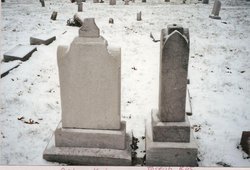
I’ve been researching a mystery man, Anton “Tony” Kos, who was buried in 1934 next to my great grandfather, Joseph Koss, in Oak Hill Cemetery in Gary, Indiana. You can see from the above pic I took in December 2001 how close the stones are compared to the next stone to the right. Looks to me like the plot was one.
I never got a straight answer regarding how Tony and Joseph are related, if at all. I’d love to find out if they were related, which I strongly think is possible, and why my mother and grandmother refused to verify that.
Here’s what I know…I used to accompany my mom and grandma to the family cemetery around Memorial Day to tend to the graves. We’d always go to the old part of the cemetery first, to clip the grass around the gravestone of my great grandfather, Joseph Kos[s] who died in 1919 during the Spanish flu pandemic. When I was old enough to read, I noticed that next to his grave was an Anton Kos. I knew the family name was originally spelled with one “s” but I had never heard of Anton so I asked how he was related and never got an answer. I recall my mother just looking at my grandmother and my grandmother looking down and continuing to tidy up her father’s grave. So, as only a small child will do, I asked again. I never got a straight answer. I tried several other times over the years and got various answers; that Kos is a very common Croatian name like Smith is in Great Britain. That didn’t tell me if Tony was related. It also didn’t explain why I never saw another grave in the cemetery with the original spelling of the surname. When I asked about that, I got, “I don’t know why.” as a response. (There actually is another Kos, John, who died in 1934 buried in the cemetery but as a child, I had never seen that grave.)
I tentatively placed Anton as a sibling of my great grandfather Joseph. Joseph was born in 1875 and Anton, in 1879. I had called the cemetery in 2012 to ask who purchased Anton’s plot and was told that no one did because the cemetery records don’t have an Anton Kos. I told the clerk I knew where he was buried, immediately south of my great grandfather. They insisted no one was buried there. Looking at the records, I understand what happened. Anton is listed as Tony in cemetery records, even though Anton is chiseled on his tombstone. Tony was what was recorded on his death certificate and the cemetery must have listed him under that name. My great grandfather’s tombstone has his Americanized name, Joseph Kos and not his birth name, Josip Kos so there was another possible clue that my family was involved. These folks Americanized as soon as they arrived in 1910.
As an adult, I can see another family trait that gives credence to a relationship; my family plans for their deaths. I could see that they would have purchased two plots when my great grandfather died in 1919 expecting that his wife would be buried next to him. But she lived on until 1966. I’m thinking when a family member who was in need of the plot died, the family buried him instead. My family always helped out a relative in need, be it sending care packages back across the pond, fronting them money or taking them into their home for awhile. My grandparents had purchased a larger plot in the newer section of the cemetery that was the intended burial site for them and my great grandmother. It is also where I buried my mother’s cremains.
After we tidied the old section (but we never touched Anton’s stone, which is interesting), we’d move to the new section to trim the grass around the Koss stone. No one was yet buried there but my forward thinking grandparents had enough sense to purchase the stone while they were still employed. (And thanks, mom, for taking care of your end of life stuff prior to your death. Hope our kids appreciate we did the same – yes, you can already find me on Find-A-Grave.)
So getting no where with the cemetery, I decided to try to research Anton Anthony Tony to find a connection.
From Ancestry.com, you can see his death certificate below:
No help with his parents info but it does say he was born in “Yugo Slavia” just like Joseph Koss. He also died of lung issues, just like Joseph. Joseph’s whole family had lung issues, hmm. Not a smoking gun but certainly gives one pause to consider a relationship as they all died young. He also was a laborer in a steel mill, though not the same one where Joseph worked. Granted, most immigrants at the time were laborers and steel mills offered good wages.
I have never been able to find Tony in any census – having checked 1920-1940 under Anton, Anthony and Tony Kos, Koss and Ross (as my own people have been enumerated as).
There is another mystery – who was Steve Sesta who provided the death certificate info? I’ve never heard of him.
The death certificate gives me a clue to look at the address where Tony was living when he died, 35 East 39th Street, Gary, Indiana.
So here’s a tip – I want to use the 1940 census to find who was living at Tony’s address. It could take quite some time using Ancestry.com because I would need to click on every enumeration area and Gary was a large city so there are many. To save time, I used the National Archives site (just Google 1940 U.S. Federal Census enumeration map and you’ll be taken directly to it or use my link).
Since I grew up in the city, I know the layout of the street and avenue names, which saved me time. If you are researching an area you aren’t familiar with, simply use Google earth to get a better idea. In my case, I knew that streets ran north and south, avenues ran east and west. Street names west of Broadway used the president’s names in order (Washington, Adams, Jefferson, no repeat of Adams, etc.) and east of Broadway used states’ names, in no particular order. So, I was looking for 39th Street and could eliminate all of the western side of Broadway simply by identifying if the first page of the census had a presidents name or not.
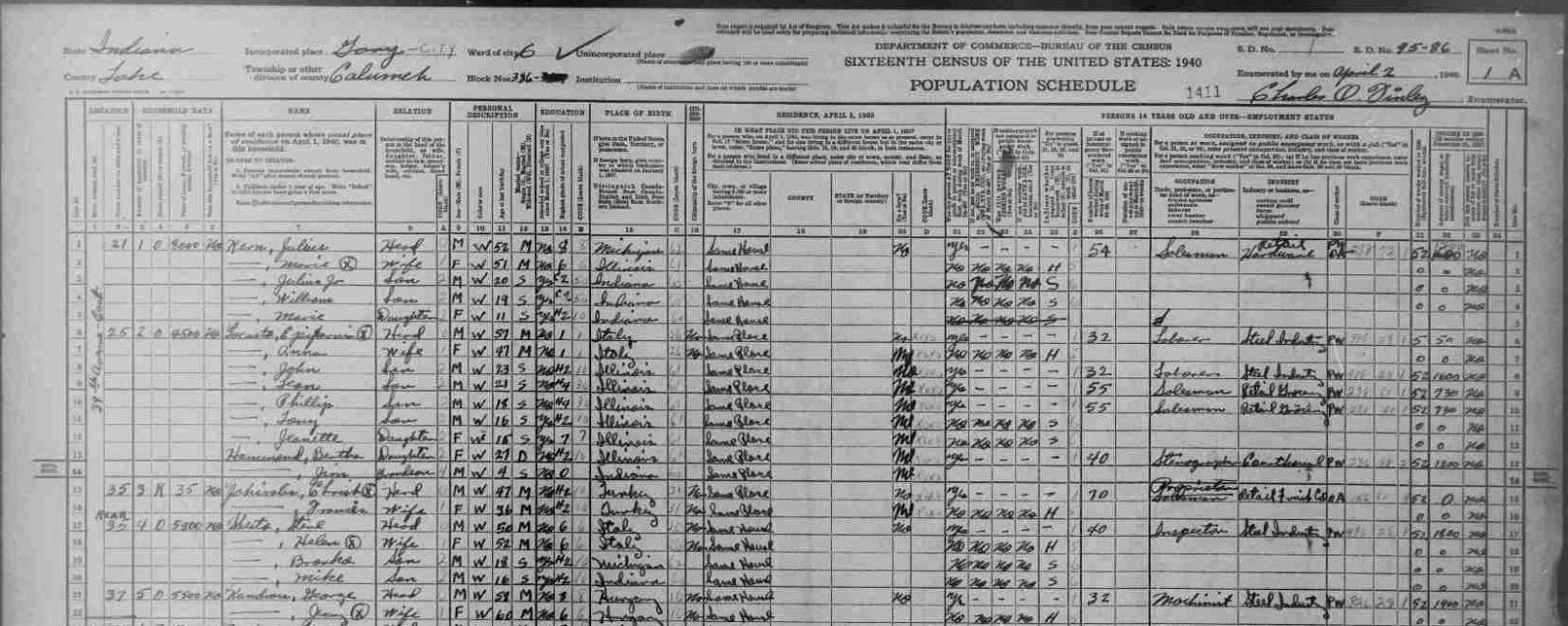
After going through 3 enumeration areas, I found the address:
The address was divided into two housing units, front and rear. Steve, who had provided the death certificate info, lived in the rear. That means Tony was living in the front but he wasn’t there in 1940. It also explains why there is no parent information for Tony, neighbor Steve did not know that information. (I know, you’re thinking I should check property records to see who owned the residence but the problem is most of Gary’s records were “lost” according to the Lake County, Indiana property appraiser’s office. I suspect they’re somewhere in Gary and just weren’t turned over to the county when the law changed but I don’t live anywhere close to be able to hunt around for them so that’s a dead end for me.)
The death certificate did state Tony had worked for 1 year as a laborer for Illinois Steel. He may have only arrived in the area in 1942, during World War II.
I checked immigration records but there are many Anton Kos’ who emigrated from Austria-Hungary/Yugoslavia so I’m unable to pinpoint one of them as my mystery man.
I know, from a recent DNA match with another relative, that during World War II, my Cvetkovic relatives were displaced to another part of what is now Croatia, due to mayhem in the area where the family originally resided in Velika Gorica. It certainly is possible that Tony had left the area because of the war and came to the U.S. to a place where family already resided.
Tony was survived by a wife, Anna, who was born in 1878. Perhaps she remarried as she is not listed in cemetery records by the last name Kos or Koss or like Tony, she wasn’t entered in the cemetery database correctly. Unfortunately, only 30% of the cemetery is listed on Find-A-Grave. There’s nothing on Billion Graves either.
Somehow, I have a maiden name for her as Smolkovic but I have no idea where I got that info. I also have a marriage date, but no place, and two children residing in Rhode Island. That info was obtained years ago before I carefully sourced (shame on me!). This is an area I need to further research.
I checked City Directories and there is only one Anthony in Gary but he was married to a Mary living on Filmore Street in Gary in 1918. He never appears in any other directory. My Kos line doesn’t arrive in Gary until 1919 so I suspect he wasn’t the my Tony. There is no Tony or Anton ever in any City Directory for Gary. I got his obituary thanks to the Ask-A-Librarian link on the Lake County library site but it provides basically no information other than he had died after a long illness, which disputes the information on the death certificate. Or, maybe not. Perhaps he suffered from lung problems for years but the incident that caused his death had been short.
There is no one in my family much older than me left who would know – definitely no one who was alive in 1943 that would remember. Decided I’d try the cemetery again since it’s recently been sold and maybe the new owners have done an inventory of grave sites. Sent an email on Sunday and haven’t gotten a response so will follow up with a phone call this week.
If that falls through, I’m going to attempt to check Baptism records for Velika Gorica to see if I can link Anton to Joseph’s parents. Unfortunately, they aren’t on Familysearch.org so I’ll have to email a genealogist in Croatia to do some digging.
Connecting Tony and Joseph would be awesome but I’ll most likely never get the story of why he was not discussed since dead men tell no tales!
Happy Memorial Weekend! Although I won’t be spending time caring for family members’ graves this weekend because no family member is buried close to where I currently reside, I have memories as a child of going to the grave sites of long dead relatives at this time of year. Grandma Koss would keep a small gardening kit in her car trunk so whenever she passed the cemetery during the warmer months of the year, she could tend to the graves. It contained gardening gloves, small grass clippers, a bakery paper bag to put weeds in, and a small spade to help dig up flowers and replant.
Last weekend I was reminded of a genealogical family mystery. My great grandfather, Josip “Joseph” Kos[s] died in 1919 in the Spanish flu epidemic. He was buried in the old part of Oak Hill Cemetery in Gary, Indiana. His gravestone, in Croatian, was next to a Tony Kos. I asked how we were related to Tony and I never got an answer.
Out of the blue last week, I received an email to my Ancestry account from a possible relative whose father had been orphaned in Pennsylvania in the 1930’s. Since both his parents died when he was young, the family has no stories. His father’s place of birth was in the same general area in Croatia that my Kos’ were from. I had placed him in my tree years ago in the hopes of locating a living relative who might have some knowledge. We’re awaiting DNA results to see if we match.
We all have genealogy mysteries but the most vexing are those that are fairly recent. I don’t know about you, but I tend to jump to a dramatic conclusion – must have been an out of wedlock birth, an against the then norms of society situation or a major disagreement that makes the information remain secret. Never dawned on me it could have been as simple as two early deaths of parents that had moved from the area and family lost touch with the remaining children.
Hopefully, I’ll soon have an answer to how the mysterious Tony was related to me and why the Pennsylvania branch of the family was disconnected. Now if I could just discover someone who knows how the Massachusetts branch lost touch I’d hit the trifecta.
When I was a newbie genealogist I loved the hints that Ancestry.com provided. Now all of the online sites offer the same. I was surprised to recently hear that a colleague of mine still happily accepts every hint that is shown. Her reasoning was that she could always sort out later if something was amiss.
“Later” like in never is what I say. Here’s a perfect example of why you need to be careful of those hints:
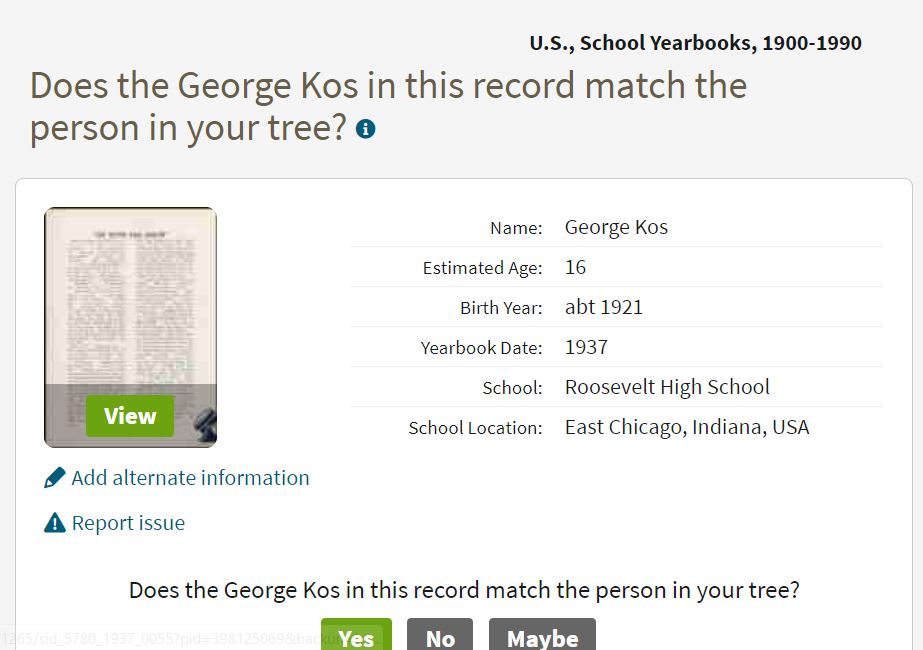
The hint above flagged for my uncle, George Joseph Kos who did live in northern Indiana and was born in 1921. Family stories say that, although his attendance area high school was Lew Wallace in Gary, he somehow un-enrolled himself and re-enrolled in another high school at the urging of a football coach. Of course, his parents found out about it and my grandmother was livid with all parties – the zoned school who allowed a minor to remove himself, the new school and coach for enrolling him without permission and my uncle, well, for being my uncle. So, the hint looks legit.
My trusting colleague would have clicked “save” while I would have clicked “ignore” if I didn’t have time to check it out. Ignore is a way to really save the hint to look at later while getting the leaf to disappear.
Now I’m going to analyze if this is a correct document for my uncle so I click “Review” on the hint and this displays:
Wow, that does look legit. According to the family story, it was Roosevelt High School where he wanted to play football but he was 15 when that happened. I could rationalize that he was 15-16 years old during the 1936-1937 yearbook so the age is feasible. But Roosevelt High School was in Gary, not East Chicago, a nearby town. Could the towns boundaries have changed? We see that so often in genealogy. I’m still wary so I’d click view and this is what is displayed:
So, the Hint was really for a George KOSTIN not George Kos. This was not my uncle. Then I remember, there were two Roosevelt High Schools. Duh!
Hints are just that – hints – they are not guaranteed correct information. Use with caution.
Recently, I volunteered to provide free genealogy assistance through a local genealogy society to which I belong. I try to help twice a year – fall and spring – which is advertised throughout our county. Every time I attend, I learn something new about genealogy practices. Here’s my latest revelations:
1. Keep your email accounts current – My first “client” had gotten everyone in her family to test. That included her siblings, children and herself. She had a DNA question for me but she couldn’t readily access any of her accounts because she had used an old email address she no longer had. I recommended she contact the DNA test companies to update her records. But that led to the next problem:
2. Know where you did your DNA test and when – She recalled she had last tested with 23andMe but when we clicked “Forgot your password?”, it was sent to her current email The problem was that kit was for her daughter. She then recalled she had purchased the kit two Christmas’ ago intending to use it but gave it to her daughter instead. We tried FTDNA, but couldn’t get in because that was the older email account. She thought she had used Ancestry.com for her sister but it turned out those were her results. Clicking around used up a good deal of time we could have spent analyzing the results. I shared how I save my info; I use Excel to keep a list of the Kit numbers, date the test was ordered, who the test was for and the company that was used. On a second tab, I record contact information from others after the results are returned. This way, I avoid duplication of effort.
3. Try, Try Again – Last fall I assisted a woman trying to find an obituary from the mid-1950’s. Her grandmother had been active in the community where she resided but she couldn’t find the obit in the nearest big city newspaper. I had recommended she contact a research librarian to find out the names of newspapers that were publishing at the time in that location and where the microfilm of those papers were held. She said, “I called and someone said they’d get back with me but nobody did.” Here’s a lesson we all need to heed, don’t think that call is going to happen now, months later. Call again. Ask to be connected with the Reference Desk. If a few days pass with no results, email. I love the Ask-A-Librarian online contact. Not only do you have a record that you made the request, it saves you a phone call and having to spell out the surname while the librarian is trying to take notes.
4. Two Heads Are Better Than One – I love paper but I don’t love having to sort through a ream and a half of every item ever discovered on a brick wall ancestor. In other words, be organized. If the information had been presented in time line order, we could have gotten through it much more expeditiously. The woman used the method of last found information was placed on top. I recommended she sort the information on a table by the year that the record was created. Sure, the immigration paperwork completed when the ancestor was in their mid 30’s had the date and place of birth but keeping the documents in created age order helps to determine the accuracy of the information found. She told me her method drove her uncle nuts but she was so into the hunt for records she didn’t like to take the time to organize them. I recommended she get with her genealogy buddy, the uncle, and see if he was more adept at organization. Then, they could put their heads together and make a timeline on paper (she hates software programs) to find holes. This approach also helps in finding information that was out there that you initially glossed over because you focused on something else. For example, she had the ship manifest so she knew where the ship sailed from. She also had a birth location from the immigration record. She had scant information between the birth and the immigration. I recommended reading the history of the area at the time the ancestor was born to determine if the family had relocated soon after (hint, it was probably the potato famine). If she wasn’t interested in that type of research, her partner could do it and then they could discuss where she could research further.
5. Know What You Want to Know – Your research question is imperative. “I want to know everything about my great grandfather” is not a question. You might be able to eventually get to the point where you know a lot about your great grandfather but to do so, you’ve got to start with a name or a place and a time from which to build. If you start small, you don’t get overwhelmed and quit. INMHO, that’s why people give up on genealogy. It is a practice in patience, analysis, and sometimes, dumb luck. You can control two of the three components. My recommendation for this individual was to focus on one area of a person’s life, like their career, and see what you can find. Then move to why that individual held that job. Perhaps there was indentured or apprenticed paperwork. Maybe the great grandfather or another relative was in the same line of work. Here’s an example I shared; my husband comes from a long line of carpenters. The original carpenter, however, didn’t build homes. He was a ship’s carpenter. That would have been a modern job when ships provided the largest means of transportation. His son was a ship’s carpenter early on in his career but switched as he aged to building homes. That man’s son moved farther inland and continued with the trade. That original research question could disclose a wealth of family information over generations. It pays to be specific about what you’re looking for.