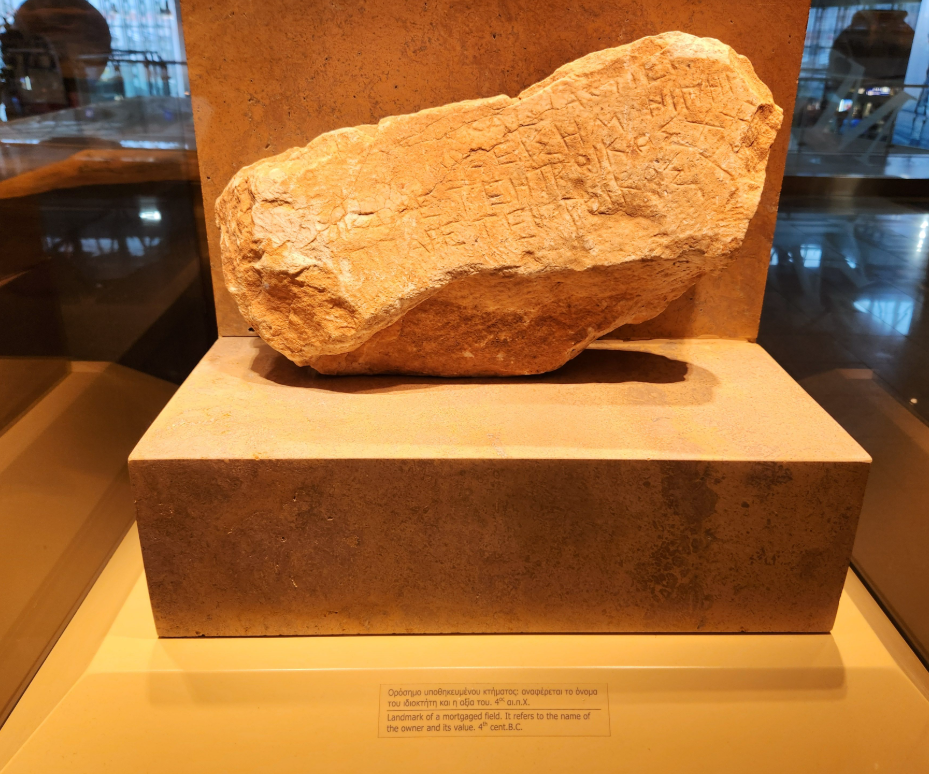
Landmark of a mortgaged field, c. 4th century BCE, Athens, Greece Airport Museum, photo by Lori Samuelson 3 April 2026.
I didn’t expect to find a mortgage record at the Athens, Greece Airport Museum.
But there it was, carved in stone.
Not a scroll. Not a document tucked into an archive. Not something filed away in a courthouse.
A rock. Sitting out in the open for the world to see.
The ancient Greeks called these markers horoi, boundary stones that recorded debt. They were placed directly on the land itself, announcing that the property had been pledged as collateral. The inscription would typically include the name of the owner and the value of the obligation.
In other words, this wasn’t just a marker. It was a public declaration: “This land is mortgaged.”
Now imagine that for a moment.
Imagine your mortgage, not buried in paperwork or hidden behind passwords but carved into a stone and planted in your front yard.
No privacy. No discretion. No quiet understanding between borrower and lender.
Everyone who passed by would know. Your neighbors. Strangers. Anyone walking down the road. Your financial situation on display. And we so get up tight about privacy today!
As a genealogist, I didn’t just see a stone. I saw a record. A remarkably rich one.
Here, in a single object, was evidence of:
Property ownership
Economic status
A named individual tied to a specific place
Participation in a financial system that feels surprisingly familiar
This was, quite literally, a land record and a lien combined, preserved not in ink, but in stone.
And then, of course, my mind went where it always goes. I found myself wondering…
Could one of these have held my family’s name?
It’s a long stretch, I know. My own lines don’t trace back to ancient Greece through paperwork but through maternal DNA. But that thought, that somewhere, someone’s ancestor is named on one of these stones, stopped me.
Because for that family, this isn’t just an artifact. It’s a record.
A tangible, physical link to a moment in time when land was pledged, risk was taken, and a name was important enough to be carved for all to see.
We often think of the past as distant, disconnected from our modern lives. But standing there, looking at that stone, I realized just how familiar it all felt.
People borrowed money. They leveraged what they owned. They took risks. They worried about outcomes.
The tools have changed.
The systems have evolved.
But the human story?
Not so much.
Today, our mortgages live in digital files and legal documents. They’re processed quietly, stored securely, and largely invisible to the outside world.
In ancient Greece, they were anything but invisible. They were meant to be seen. There’s something striking about that difference.
Not just the lack of privacy but the permanence. Paper can be lost. Files can be deleted. Systems can change.
But stone? Stone remains.
As someone who spends her time digging through land records and probate files, I never expected to encounter a mortgage like this, one that didn’t require deciphering handwriting or chasing down courthouse copies.
It was simply there to be translated. Clear. Direct. Enduring.
Long before courthouses and filing cabinets, before clerks and digital databases, people marked their obligations in the most permanent way they knew how. They carved them into stone.
And standing there, I realized the past isn’t as distant as we think.
For years, genealogy has been dismissed by some as storytelling. Another study I blogged about last week says otherwise. (Genetic genealogy of the Piast dynasty and related European royal families) Done correctly, genealogy is history, biology, and evidence all working together. The study teaches us the following lessons we must adhere to:
1. One record is never enough Even kings couldn’t be identified from a single source. It took DNA, archaeology, and documentation working together. If you’re relying on one census or one tree, you’re not done. (GPS 1 – Conduct reasonably exhaustive research)
2. Biology and paperwork are not always aligned Non-paternity events didn’t start in modern times. They’ve always been part of family history. The difference now? We can detect them. (GPS 3 – Analyze and correlate evidence)
3. Geography can mislead you The Piasts ruled Poland but their origins likely trace to Western Europe. Don’t assume origin based on where someone lived or held power. (GPS 3 – Analyze and correlate evidence)
4. Build your work to withstand revision This study didn’t “destroy” history it refined it. Good genealogy should do the same. Leave room for new evidence without collapsing your conclusions. (GPS 4 – Resolve conflicting evidence & GPS 5 – create a well-reasoned, written argument that explains how the evidence supports the conclusion)
5. Genealogy is moving toward synthesis, not silos The future isn’t records or DNA it’s both, plus context. The genealogists who thrive will be the ones who can integrate all three. (and make sure to GPS 2 – Maintain complete and accurate source citations)
The study confirms something many of us already suspected: The paper trail isn’t the final word.
A recent scientific study analyzed the DNA of the medieval Piast dynasty, the ruling family that built early Poland.
Not one king. Not one tomb.
An entire dynasty.
Researchers examined skeletal remains from multiple burial sites, applied DNA analysis, and combined it with historical and genealogical data.
And what they did should make every genealogist pause:
They identified specific historical individuals using DNA
They reconstructed relationships across generations
They confirmed some lineages and quietly broke others
This wasn’t theory.
This was proof.
For decades, historians debated where the Piasts came from.
Local Slavic rulers? Foreign elites? Legendary founders?
DNA answered the question. They were not local.
Their Y-DNA traces back to a lineage far more common in Western Europe, places like England, France, and the Netherlands.
In other words, One of Europe’s foundational royal families likely came from somewhere else entirely. And then it gets even more interesting. The researchers didn’t stop at origin. They reconstructed family relationships and found something genealogists know all too well: Not every father in the records was the biological father.
At least one individual inherited royal DNA through the maternal line (mtDNA) instead of the documented paternal line (YDNA).
No scandal headline. No dramatic accusation.
Just quiet scientific correction.
Let’s say that again: A medieval royal pedigree…Was wrong.
Now here’s where this connects directly to my work and to yours.
Because this study didn’t succeed with DNA alone.
It required:
Historical records
Burial context
Chronology
Genealogical reconstruction
Sound familiar? It should. Because this is exactly what serious genealogists do.
When I began building my books, Echoes of Britannia, my goal wasn’t just to collect names.
It was to create something durable. Something that could stand even when new evidence emerges. This study confirms that approach.
Because what they built scientifically is what we aim to build genealogically, astructure where evidence supports identity across generations.
Not just “Here’s who someone might be,” but “Here’s who they were and why we know it.”
European royal families were never isolated, pure, or static.
They were:
interconnected
mobile
politically strategic
and sometimes… biologically inconsistent
DNA is now proving what the records only hinted at and that’s powerful.
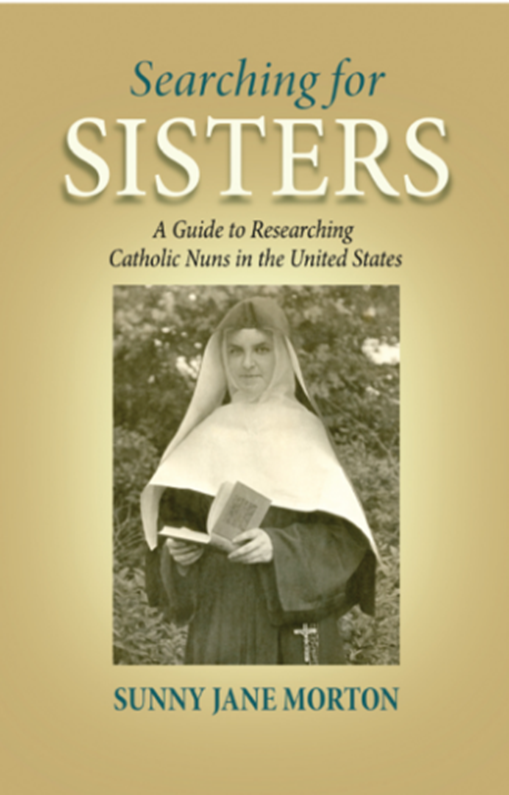
Recently, I obtained a copy of Sunny Jane Morton’s newest work. If you already own her earlier book co-authored with Harold Henderson, How to Find Your Family History in U.S. Church Records, you’ll want to add this one to your collection.
While the book is designed for researchers with a religious sister in their family tree, I would argue it extends beyond that audience. Anyone who has known a Roman Catholic nun, even casually, will find value here.
Although my maternal line has been Roman Catholic for centuries, I’ve uncovered no nuns in recent generations. My husband’s predominantly Lutheran line, however, includes several Harbaugh women who entered religious life between 1880 and 1913 in the United States.
Like many who grew up in parochial schools, I had frequent contact with sisters, as teachers, colleagues, even supervisors. And yet, it never occurred to me to ask what became of them. No long-term correspondence, no reconnection later in life. I simply moved on. In some cases, that’s a blessing. In others (I’m thinking of former Sr. Jeanne Hiller) it feels like a missed opportunity.
Morton’s book brought that realization into sharp focus.
She also presents statistics that genuinely surprised me. In the United States, women religious outnumbered men as early as 1820. By 1965, the height of my own parochial school years, there were an estimated 209,000 nuns, marking their peak. At that time, the Roman Catholic school system was the largest private educational network in the country.
I was aware that historically widowed women could enter religious life once their children were grown, but I hadn’t realized that this practice continues today or that divorced women, following annulment, may also join. Nor had I fully appreciated the role of the dowry in entering a convent.
Even terminology challenged my assumptions. Like many, I used “nun” and “sister” interchangeably, unaware that in the past they carried distinct meanings. The discussion of naming practices was particularly valuable, especially the possibility that a woman might retain her surname. For genealogists, that detail alone has real research implications.
Some of the sisters I remember most vividly, Sr. Martina, Sr. Aloise, Sr. Jerome, Sr. Roserita, carried pre–Vatican II names that now feel like artifacts of another era. Yet I cannot recall the name of my sixth-grade religion teacher, nor my overwhelmed but kind eighth-grade principal. Memory is selective and often unfair.
Morton provides numerous strategies for tracing these women, including those who left religious life. Her success in accessing diocesan records stands in contrast to my own experiences, which have been far more restrictive. (You can read about it here, here, and here.)
She notes that some baptismal records include annotations when individuals later entered religious life, an invaluable clue, when available.
As many religious communities close or consolidate, this book becomes not just useful, but necessary.
Importantly, the scope extends beyond convent records. It hadn’t occurred to me that school or employment records, my own included, might someday reside in an archive, waiting to be discovered. Morton also raises the possibility of wills written by nuns, which initially struck me as puzzling given that income was typically directed to the convent. Yet, as she demonstrates, even this avenue can yield results.
Her observations about the historical marginalization of sisters resonate deeply. In the commemorative history of St. Mark’s Roman Catholic Church in Gary, Indiana, the sisters, who formed the backbone of the parish school, are nearly invisible.[1] A single photograph of the convent. A group faculty image. Minimal acknowledgment. Even the name of their order is omitted; I only know it from a report card: the Poor Handmaids of Jesus Christ.
Morton closes with a call to recognize the humanity of these women, a point I wholeheartedly support. Childhood impressions often obscure the fuller truth. As adults, we are better positioned to ask: who were these women, really? What shaped them? What did they give up and what did they gain?
The book concludes with case studies that walk readers through the research process. In her acknowledgments, Morton mentions a proposed database, introduced at a June 2025 conference, intended to honor these women collectively. As of now, it has not materialized.
That’s a missed opportunity.
If ever there were a moment for the Roman Catholic Church to formally preserve and elevate the legacy of these women, who labored largely unseen, it is now.
This is a practical, eye-opening guide that fills a genuine gap in genealogical research. Even if you think you don’t have a nun in your tree, you may find yourself reconsidering and looking a little harder.
[1] Leo J. Armbruster. History of St. Mark’s Parish, No publishing info, 1958, digital image; archive.org: accessed 21 Apr 2026.
I attended an interesting lecture on a man named Edwin Butterworth. He died young, about 35, in a small village in Great Britain. I was not aware that the famous Baines historian hired local folks to gather information for his works. Baines was a non-conformist so he had difficulty gaining access to many of the English churches. He was a man of considerable means as he owned newspapers so he used his money to hire people to dig into the local records. One of those men was Edwin Butterworth. I absolutely love this quote he wrote in a letter to Peter Whittle, Editor of the Preston Chronicle published in 1836:
“The sons of this ‘degenerate age’ have I fear too little taste for the interesting details of Antiquarian publications. It is a well founded complaint that the majority of books now published are flimsy, slight and too imaginative. Works abounding in matters of fact useful knowledge and pure style are few. Utility is sacrificed to the rage of things for specious nothingness. This is an era of brief ostentation not of standard excellence – periods more brilliant in elaborate literature than the present have occurred in English history.”
Umm, so I guess things haven’t changed much since 1836?! If you are finding your family’s eyes glaze over when use try to tell them about your awesome genealogical find – know that you aren’t alone. Edwin felt the same way nearly 200 years ago.
I will be heading off on an adventure for the next two weeks so no blogs until I return. Happy Hunting!
While researching the dynastic connections for Volumes 3 & 4 of Echoes of Britannia, I kept having the same reaction over and over again: Wait… they were connected to where?
Britain was tying into Iberia. Then Italy. Then Hungary. Then Byzantium. Then Slavic territories far beyond anything that felt intuitively “British.”
I knew the Vikings went everywhere, that part wasn’t surprising. But what caught me off guard was just how deeply Saxons, Normans, Franks, Iberians, Italians, Hungarians, and Byzantine-linked elites were woven into Britain’s ruling families. These weren’t isolated marriages or rare diplomatic curiosities. They were part of a broad, sustained network.
Which raises the obvious question modern minds struggle with:
How did this actually work? No phones. No email. Limited literacy. Slow travel. Dozens of spoken languages.
And yet, it worked.
Genealogy, once again, forced me to rethink my assumptions.
There Was No Single Spoken Language But There Was a System!
The medieval world did not rely on one universal spoken language. What it relied on instead was a layered communication system, where different languages served different purposes.
At the center of that system was Latin.
From roughly the ninth century through the late Middle Ages, Latin functioned as the administrative glue of Europe. It was the language of:
diplomacy
treaties
royal charters
marriage contracts
ecclesiastical records
legal proceedings
If something mattered across borders, it was written in Latin.
That doesn’t mean kings and queens sat around conversing fluently in Latin over dinner. It means their administrations could communicate seamlessly even when rulers themselves spoke different vernaculars.
This is an important distinction genealogy makes visible: rulers did not need to be literate if their systems were.
2. The Clergy Were the Communication Network
In a world without technology, communication was human and the most mobile, educated humans were clergy.
Priests, monks, bishops, and notaries:
were trained in Latin
moved between courts, monasteries, and dioceses
served as scribes, translators, advisors, and diplomats
maintained correspondence across thousands of miles
A bishop in England could correspond with a monastery in Italy or a royal court near Hungary with little difficulty because they shared the same educational foundation.
This clerical network is one of the most underestimated forces in medieval connectivity. It never truly collapsed, even in times of political chaos. Genealogy doesn’t always spotlight it because clergy leave fewer descendants but their documentary footprints are everywhere.
3. Vernacular Languages Were Not the Barrier We Imagine
Another modern assumption genealogy dismantles is the idea that language differences must have made communication nearly impossible.
In reality, elite multilingualism was normal.
Consider:
Norman rulers spoke Old French, governed English speakers, and relied on Latin documentation
Scandinavian elites blended Old Norse and Old English
Iberian courts operated in early Romance languages alongside Latin and often Arabic or Hebrew
Byzantine elites used Greek internally but communicated externally through Latin-trained intermediaries
Royal and noble children were frequently raised multilingual. They were fostered in foreign courts, educated by clerics, and married into households where new languages were learned as a matter of survival.
When a British noblewoman married into Castile or Lombardy, she didn’t arrive linguistically isolated. She arrived with tutors, chaplains, ladies-in-waiting, and clerks who maintained continuity while adaptation occurred.
4. Marriage Was a Communication Technology
Genealogy makes one thing clear over and over again: marriage carried infrastructure with it.
A dynastic marriage wasn’t just a bride and groom. It was:
an entourage
translators
administrators
cultural intermediaries
Courts didn’t become multilingual accidentally. Marriage imported language, customs, and political intelligence.
This is one reason Britain’s links to Iberia, Italy, and the Slavic world feel so sudden when viewed casually but look entirely logical when traced through families. Every marriage was also a conduit.
5, Trade Routes Were Information Routes
It’s impossible to separate genealogy from geography and this is where the Vikings stop being the “exception” and start being the illustration.
Trade routes across:
the North Sea
the Baltic
the Mediterranean
major river systems like the Rhine and Danube
moved more than goods. They moved ideas, norms, stories, political knowledge, and people.
England wasn’t at the edge of Europe. It was part of a maritime and river-based world that connected Britain to Byzantium more reliably than many inland regions.
By the time dynasties intermarried, the world they were entering was already familiar.
Byzantium Only Feels Distant Because We Were Taught It Was
For modern audiences, Byzantine connections often feel the most shocking. That’s largely because our historical narratives split “East” and “West” far earlier than medieval reality did.
In the medieval mind, Byzantium was:
Christian
imperial
diplomatically engaged
genealogically relevant
Byzantine elites used Greek internally and Latin externally. They intermarried with Slavic, Hungarian, and Western ruling houses. These connections didn’t feel exotic at the time, they feel exotic now because modern history textbooks simplified them away.
So Was There a Common Language?
Functionally, yes — Latin.
Practically, it depended on context.
Administration and law: Latin Religion: Latin in the West, Greek in the East Court life: local vernaculars and French Diplomacy: Latin Daily life: regional languages
This layered system worked because everyone understood its rules.
6. Why This Matters for Echoes of Britannia
Volumes 3 & 4 of my book didn’t uncover anomalies. It uncovered how Europe functioned.
Britain was not shaped in isolation. It was shaped through:
marriage networks
clerical communication
trade routes
multilingual courts
What feels astonishing now is only astonishing because modern narratives falsely emphasize fragmentation. Medieval Europe was plural but integrated.
7. The Larger Genealogical Lesson
Technology didn’t create connectivity. People did.
Systems built on education, mobility, and shared administrative languages connected continents long before cables and satellites existed.
Genealogy reminds us of this quietly and persistently. Every marriage record, charter, and dynastic link tells the same story: the medieval world was more interconnected and more functional than we were taught to believe.
I’ll be honest, Veterans Day is not my favorite holiday. It feels inappropriate to say “Happy Veterans Day” the same way we say Happy Thanksgiving, Happy New Year, or Happy Valentine’s Day. What’s happy about it? The veteran made it through a horrible time, likely suffered PTSD, and then once a year gets a parade?
Although I am anti-war, I understand why war occurs because grown men, historically, have struggled to use their words to solve disagreements. Yet I still pause today to think about the countless past conflicts that drew ordinary, decent people into sacrifices no one should ever have to make.
This year, an article from AMAC captured that tension beautifully. “Remembering the World War I Generation This Veterans Day” reminds us that time has nearly erased the memory of those who served in the Great War, young men and women who endured unimaginable hardship, then quietly returned home to rebuild their lives.
Ironically, responses to that post weren’t about remembrance at all, but about which politician dodged which draft. That, in itself, says everything about why wars persist. We’re still fighting instead of mourning who’s lost.
Their generation is gone, but their stories are not. Some of those stories live on in the letters, journals, and memories families still hold. I was honored that my book, Thanks to the Yanks: World War I Letters from an Indiana Farm Boy to His Sweetheart, was featured in that piece. It follows one soldier’s journey from the Indiana fields to the battlefields of France and back again offering a glimpse into the humanity behind the headlines.
So today, I don’t celebrate. I remember. I think about the courage it takes not just to fight, but to return, to heal, and to live. And I’m grateful for every preserved letter and faded photograph that helps us remember those who did.
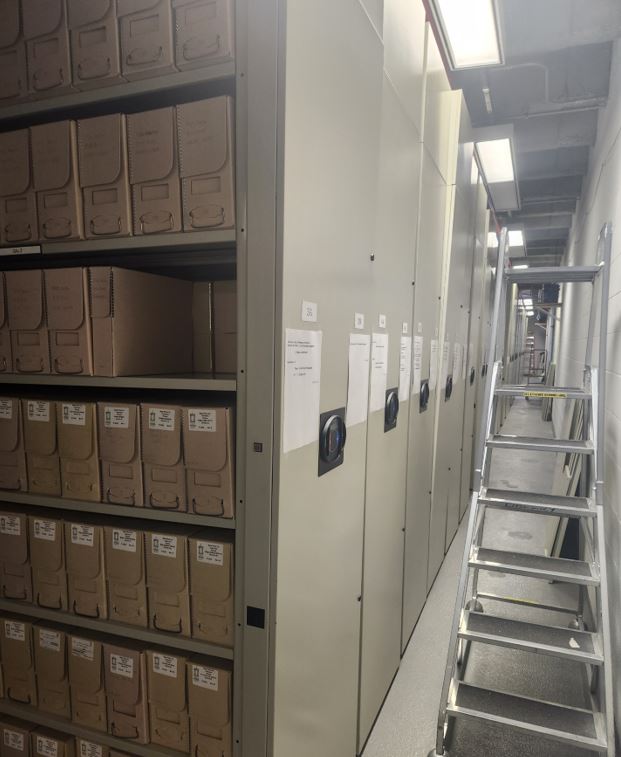
Indiana Historical Society Archives, Indianapolis. Photo by Lori Samuelson
In June I had the pleasure of taking a behind the scene archive tour at the Indiana Historical Society in Indianapolis. This was a field trip sponsored by the Society of Indiana Pioneers. It is a lovely archive with interesting and informative exhibits. Different than most archives I’ve visited, I was permitted to touch the items in their collection. That included a 2500 year old Akkadian cuneiform tablet, an original copy of Thomas Paine’s Common Sense, and one of only three Book of Enoch circa 1450-1500 written an ancient South Semitic language known to be in existence. We also saw the box in the archives that held President William Harrison’s quilt, several busts of Abe Lincoln, and loads of photos and postcards.
Do you have enslaved or enslavers in your family tree? If so, your research is needed in support of the 10 Million Names Project. The project is supported by the New England Historic Genealogical Society (American Ancestors) to create a FREE searchable online database of the estimated 10 million people of African descent who were enslaved between the 1500s-1865.
I submitted to the project an updated report I had done on one of my ancestors, Daniel Hollingshead. I’ve blogged about Daniel previously here, here, here, here, and here. I don’t want my research to be lost and I want it to be of value to others so I updated a report I wrote about Daniel and uploaded it to the project.
Here’s the link to the website. It’s simple to contribute! I saved my report as a .pdf, clicked “I’d like to upload family notes or a genealogy,” typed in my email, what the submission was regarding (info about enslaved and enslavers), typed in the title, added a brief description of what I was uploading, clicked that I agree to share, and then attached my report. Don’t forget to press Send! I received a submission number and and an email confirming the information was received.
You may have seen the recent RootsTech talk about this project. Now you can be a part of it!
I’m calling what happened a two for one. This week, I was able to resume visiting local archives. Oh, what a feeling!
I scheduled a visit with the first archive to review their holdings on a pioneer of my town who I’m writing a journal article about. After spending three hours reviewing the documents I was stymied by one that was a bibliography missing the previous page. I took a note to find the information elsewhere.
Since it’s been a long time since I visited the museum part of the archive I decided to take a look around. One of the docents saw me pondering an exhibit and we got to talking. I mentioned how I was confused by the display as I’d never seen a setup like it was (a barbershop in the same room with a post office in the back and a general store adjacent to the barbershop). He said he thought it was off, too, and said he assumed it was due to space limitations.
One thing led to another and the topic turned to a Super Fund site located in my city. He was knowledgeable as to what had occurred as he had been employed there for 10 years as a chemist. Honestly, I don’t recall many details as I was living in another part of the county when the plant closed so I hadn’t followed the story closely.
The man claimed that the company had followed all federal guidelines and explained the process that had been used to work with the lower grade phosphate; they incinerated it at a high temperature so it would form a softball size structure. He did say that when the plant first opened in the late 1940s that process hadn’t been used and some chemicals had been discharged into the ground. Over the years, he claimed, the company had corrected that problem.
The clincher to the story is that he claimed the company was shut down when a finding of arsenic was discovered when an elementary school across the street from the plant was going to install playground equipment. The company was blamed for the arsenic though they never used it.
I asked how the arsenic possibly got there and he didn’t know. Then it hit me; it was the site of a former sawmill from the late 1800s. Arsenic was used to treat wood to preserve it from insects.
I told the gentleman that I thought he should record his memories of working at the plant but he declined. My take is he was still bitter over his job loss. I decided to blog the story, keeping him anonymous at his request, because there should be a record of his insider view of what occurred.
I discovered after I got home that the missing bibliography page was housed in a book in a university’s special collections department. Two days later I arrived to find the information.
Somehow, when I went online to check holdings I did not see a button that I was now supposed to make an appointment to view the book. Luckily for me, the kind student who was tending the desk helped me so I was able to find the information. Eureka! The page contained a name of an author for a book I had at home that had reported the story I was writing about but added where she had found the information – in an unpublished, undated manuscript held at a museum that was now permanently closed. The author mentioned it was missing when she was seeking it, probably in the late 1960s. So, now I’m on the hunt for a missing manuscript.
While I was at the second archive, the student brought out a book I hadn’t asked to see and said he thought I might be interested in it. I looked through it and got some ideas for future research.
Boots on the ground enabled me to get additional information about topics I might investigate someday. That was value-added that I find well worth the trip.