For the past two weeks I’ve been blogging about the importance of personalizing your AI. Last week I wrote how to accomplish that with ChatGPT. Even if you only have a free version, it’s important for you to customize. I also strongly encourage you to have a free account with all of the AIs so you can check their work as some are stronger in one area than another.
Here’s how to personalize with
CLAUDE:
Click on the lower left circle that is your profile icon. Select Settings. Click General. In the box, tell Claude your instructions to use every single time you being a chat.
GEMINI:
Click on the lower left profile icon. Then click on the right setting icon for new pop up window seen above, look for Personal Intelligence. Next click Instructions for Gemini. Insert your instructions in the box.
PERPLEXITY:
Like, ChatGPT and Claude, click on the lower left profile icon then click Account. Next click Personalization. Complete the information under Custom Instructions
Now you’ve saved yourself from having to retype the same instructions repeatedly. Remember, if you provide a conflict in an instruction in the chat box from what you’ve written under personalization, no worries! The prompt box will override what you have in personalization. If you do find yourself having to give the AI repeated instructions, then go back to the personalization setting and update. Happy Researching!
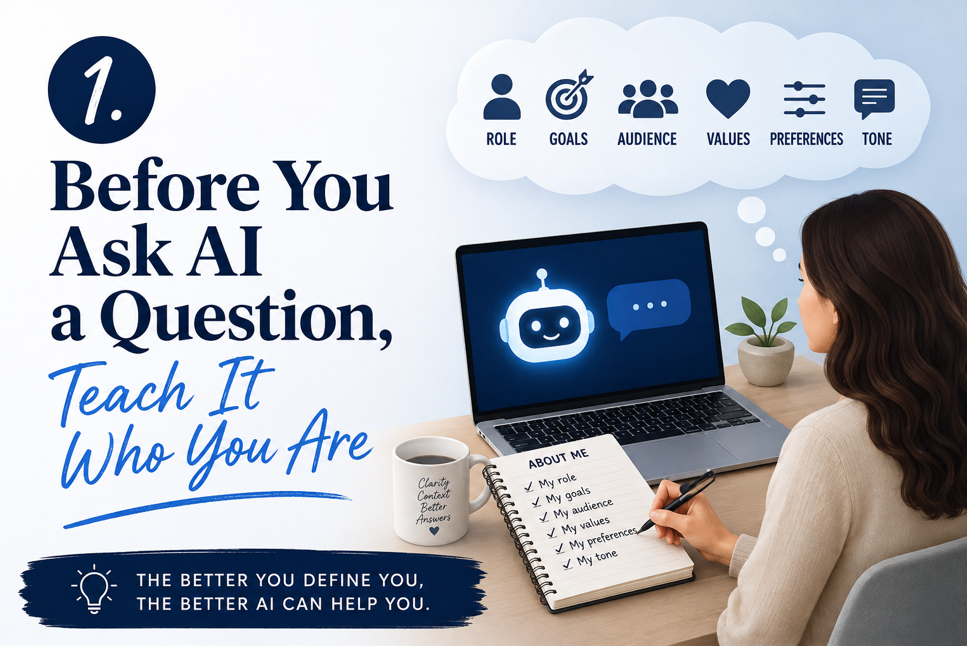
In my last article, I explained why every genealogist should customize their artificial intelligence assistant before asking it to help with research. Think of it as introducing a new research assistant to your way of working.
Now let’s put that idea into practice with ChatGPT.
The entire process takes only a few minutes, yet it can dramatically improve the quality and consistency of the responses you receive.
Step 1: Open Your Settings
Sign in to ChatGPT.
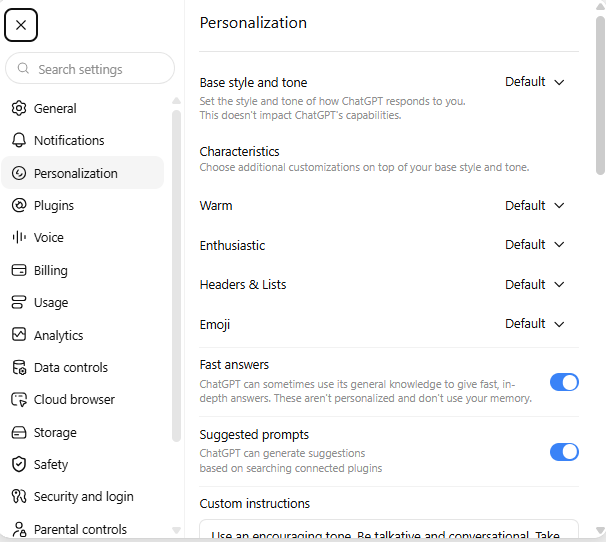
Select your profile icon in the lower left corner of the screen, clicking on the circle.
From the dropdown, select Personalization. This is where you’ll find the options that allow ChatGPT to adapt to the way you work.
Click on Personalization and scroll down to the box under Custom Instructions. That’s where you will put in your directions.
Step 2: Tell ChatGPT About Your Work
Don’t write a biography.
Instead, tell ChatGPT what it needs to know in order to work effectively with you.
For example, you might include:
• I am an intermediate genealogist researching families in Ohio and Pennsylvania.
• I prefer Chicago-style source citations.
• Always distinguish between facts, evidence, assumptions, and hypotheses.
• Never invent missing information.
• State clearly when evidence is inconclusive.
• Use military-style dates such as 21 March 1850.
• Write in a conversational but professional tone.
Notice that none of these instructions reveal private information. They simply describe how you want your AI assistant to approach its work.
Step 3: Explain How You Like Information Presented
Formatting matters.
If you frequently ask ChatGPT to create timelines, research plans, proof summaries, tables, or blog posts, mention that in your instructions.
For example:
“I prefer timelines arranged chronologically.”
“Separate proven facts from working hypotheses.”
“Use headings and short paragraphs for readability.”
The more consistently you work, the more useful these instructions become.
Step 4: Don’t Try to Tell It Everything
One mistake I often see is people creating pages and pages of instructions. My research assistant, Geni, informed me that someone uploade 60 pages here.
Resist the temptation.
Long instruction lists often include information that is rarely used or eventually becomes outdated.
Instead, include only those preferences that affect most of your conversations.
You can always provide additional instructions for a particular project when needed.
Don’t forget to hit SAVE!
Step 5: Update Your Settings Over Time
Your settings should evolve.
Whenever you notice yourself making the same correction repeatedly, consider adding that instruction to your saved preferences.
Perhaps you always ask ChatGPT to avoid speculation. Maybe you repeatedly remind it to cite sources or to identify conflicting evidence.
If you’re saying the same thing over and over, your settings probably need an update.
Remember: Settings Are Not Magic
Custom instructions improve consistency, but they do not replace careful review.
I still verify every citation, read every record myself, and evaluate every conclusion before I publish or share it with a client.
AI is an assistant, not a substitute for genealogical judgment.
A few minutes spent customizing ChatGPT today can save hours of rewriting tomorrow.
In the next article, we’ll compare how Gemini, Claude, and Perplexity allow you to personalize their responses and discuss which features are most useful for genealogists.
When someone tells me they’ve tried artificial intelligence and “it wasn’t very good,” my first question is simple:
“Did you customize it?”
Most people answer no.
That’s a little like hiring a brand-new research assistant, handing them a box of family papers, and expecting them to instantly know your research methods, writing style, citation preferences, and standards of proof. Of course they won’t.
Artificial intelligence works much the same way.
Think of It as Training a New Research Assistant
Every genealogist develops habits over time.
Perhaps you always cite your sources in Evidence Explained style. Maybe you write dates as “21 March 1850” instead of “March 21, 1850.” You might insist that every statement be supported by evidence, or refuse to identify someone as a parent without a convincing proof argument.
None of that is obvious to an AI unless you tell it. The more it understands your expectations, the less time you’ll spend correcting its work.
What Should You Tell It?
Each AI platform has a place where you can save instructions that will be used in future conversations. Although every platform calls it something slightly different, the idea is the same.
Consider including information such as:
• Your experience level in genealogy.
• Your preferred citation style.
• How you like dates written.
• Whether you want the AI to distinguish clearly between facts, assumptions, and hypotheses.
• Whether you prefer concise answers or detailed explanations.
• Your preferred writing tone.
• The kinds of records you most frequently research.
• Any formatting preferences you use consistently.
Think carefully before adding information. These instructions should describe how you want the AI to work with you, not every detail about your personal life.
My Own Instructions
Over time I’ve taught my AI assistant quite a bit about how I work.
It knows that I expect evidence-based genealogy rather than speculation. It knows I prefer military-style dates and Chicago citations because Evidence Explained is under copywrite. It understands that if a record doesn’t support a conclusion, it shouldn’t invent one. It also knows I write for an educated audience and prefer engaging narratives instead of dry reports.
As a result, much of what it produces already looks remarkably close to something I would write myself.
Is it perfect? No. I still verify every fact, examine every citation, and edit every piece of writing before anyone else sees it. That’s exactly what responsible genealogists should do.
Your Instructions Will Change
Don’t think of these settings as permanent.
As you discover new ways to work with AI, you’ll probably update them.
I add new instructions whenever I notice I’m making the same correction repeatedly. If I find myself saying, “Please don’t use em dashes,” or “Always distinguish evidence from inference,” that’s usually a sign the instruction belongs in my saved settings.
Over time your AI becomes a better research partner because you’ve taken the time to teach it how you work.
One Important Reminder
Customizing your AI does not replace critical thinking.
AI can summarize records, organize timelines, suggest research strategies, draft narratives, and help identify conflicts in the evidence. It cannot determine whether a conclusion is genealogically sound.
That responsibility remains yours.
Think of AI as an exceptionally fast assistant, not an expert witness.
Teach it well, supervise it carefully, and you’ll likely discover that it becomes one of the most useful tools in your genealogy toolbox.
In my next article, I’ll show you exactly where to find these settings in ChatGPT, and I’ll also compare the equivalent features in Gemini, Claude, and Perplexity so you can customize whichever AI assistant you use.
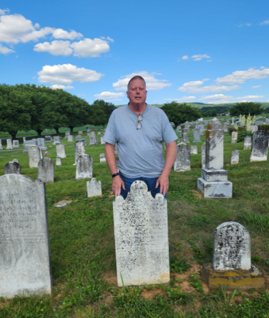
Jim Samuelson in front of Mary Harbaugh’s grave, Harbaugh Church Cemetery, Rouzerville, Franklin, PA Photo by Lori Samuelson 16 June 2026.
Every genealogist knows the thrill of finding a gravestone that has been hiding in plain sight and every genealogist knows the disappointment that sometimes follows.
Recently, while visiting Harbaugh family cemeteries in Pennsylvania and Maryland, I experienced both emotions on the same day.
The discovery began in Harbaugh Church Cemetery in Rouzerville, Franklin County, Pennsylvania.
I had visited the cemetery nearly ten years earlier while researching my husband’s Harbaugh family. During that visit, I failed to notice a weathered stone marking the grave of a woman named Mary Harbaugh who died in 1843.
This time, however, my husband Jim spotted it. I should not have been surprised.
Over the years, Jim has developed an uncanny ability to notice things I overlook. Whether it is a partially hidden gravestone, a faded inscription, or a clue buried in plain sight, he often finds what I miss.
Standing in the cemetery, I was delighted by the discovery.
The stone was difficult to read, weathered by nearly two centuries of exposure to Pennsylvania winters and summer heat. Yet enough remained visible to identify the woman as Mary Harbaugh and to establish that she died in 1843.
Naturally, my mind immediately began searching for an identity.
Genealogists are problem-solvers by nature. When presented with an unknown individual, we instinctively begin fitting pieces together. Who was she? How did she fit into the family? Why was she buried here?
Almost immediately, I convinced myself I had the answer.
I recalled that my husband’s third great-grandmother, Mary Garver, had died in 1843. She and her husband had lived in nearby Waynesboro. The dates seemed reasonable. The location appeared plausible.
For a brief moment, I thought the mystery was solved.
Then I looked more carefully. Genealogy has a way of humbling us. The Mary I had in mind was not Mary Harbaugh at all. She was Mary Garver Eyster.
Her gravestone still survives, not in Pennsylvania, but across the state line in the Harbaugh Family Cemetery near Sabillasville, Frederick County, Maryland.
The woman in Rouzerville was someone else entirely. Back to the drawing board.
At first, I was frustrated. After all, identifying an unknown individual is much more satisfying than admitting uncertainty. But the more I reflected on the experience, the more I realized it illustrates one of the most important lessons in genealogy.
A wrong answer is not better than no answer. In fact, one of the greatest dangers researchers face is the temptation to accept a convenient explanation simply because it appears to fit.
Dates align. Locations seem reasonable. Family names match.
Before long, a theory quietly transforms into a fact. Then the mistake gets copied. And copied again. And copied again. Eventually, nobody remembers where the conclusion came from. All they know is that everyone else believes it.
Fortunately, I caught myself before making that mistake.
The truth is simple. I do not know who Mary Harbaugh was.
Not yet.
She does not appear to have a memorial on Findagrave. No immediately obvious record identifies her. The weathered stone provides only a name, a death year, and a question. Yet that question may prove valuable.
Who was she? A wife? A daughter? A widow? A sister? Why was she buried in Harbaugh Church Cemetery? What relationship did she have to the surrounding families?
Somewhere, the answer may still exist. Perhaps a church register survives. Perhaps a probate record remains hidden in an archive. Perhaps a distant cousin will recognize her story. Or perhaps the answer will emerge from a completely unexpected source years from now.
That possibility is one of the reasons I love genealogy.
Not every cemetery visit produces a breakthrough. Not every mystery is solved before we leave the gate.
Sometimes we return home carrying more questions than answers. And that is perfectly acceptable.
Good genealogy is not measured by how many mysteries we solve. It is measured by how honestly we evaluate the evidence.
For now, Mary Harbaugh remains a mystery.
Her weathered stone stands quietly among the graves in Rouzerville, waiting for someone to tell her story. Perhaps one day that someone will be me.
Until then, I am content to leave her where she belongs. Not in the category of “solved.” But in the much more honest category of “still researching.”
Thus ends my cemetery series for the summer. Next week I’ve got some important info to share with you on making your AI experience more effective and efficient.
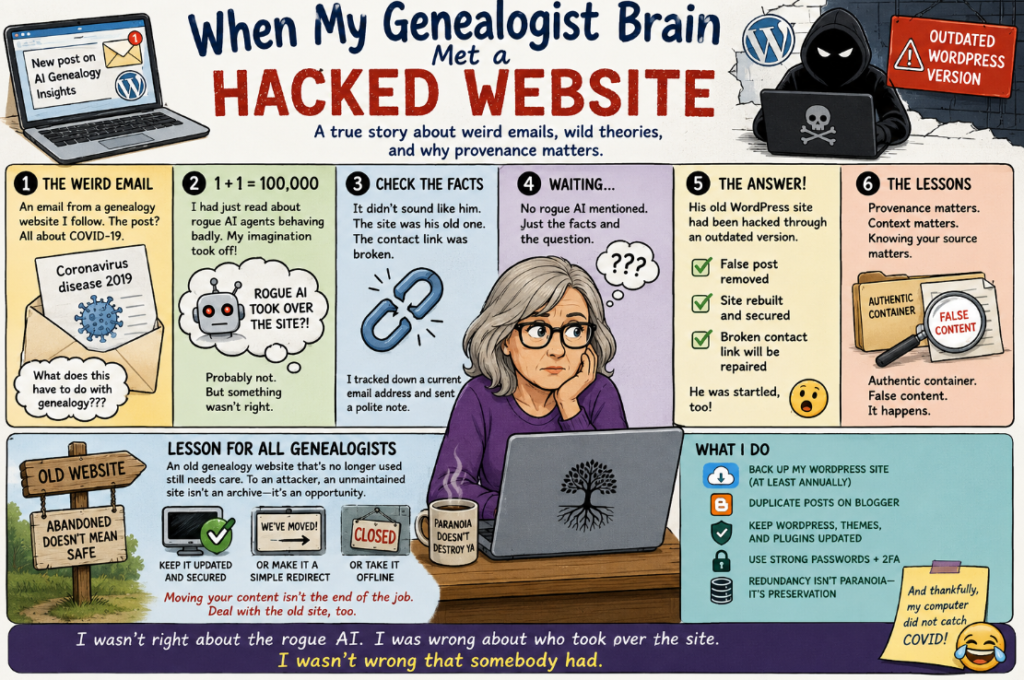
Yesterday, I received one of the strangest genealogy emails I have received in a long time.
It came from an AI genealogy blog I have followed for years. The post was titled “Coronavirus disease 2019.”
That was pretty much what it was about. COVID-19 symptoms. Transmission. Testing. Vaccines. Prevention. Treatment.
I stopped reading.
What in the world did this have to do with genealogy? Or artificial intelligence? More importantly, this did not sound remotely like the person whose work I knew.
It was late, so I decided I wasn’t dealing with it. This morning, I looked at the email again. It was still weird.
Then My Imagination Got Involved
Unfortunately, I had recently read a news article about AI agents behaving in unexpected ways during testing. Claude was mentioned. OpenAI was mentioned. There was even discussion about whether some AI behavior constituted “cheating,” although I wasn’t entirely convinced that was the right word. Perhaps the AIs were simply working very hard to solve the problems humans had given them.
So there I sat with two completely unrelated pieces of information:
AI agents had reportedly done some unexpected things.
An AI genealogy website had suddenly sent me an inexplicable article about COVID-19.
My genealogist brain immediately performed the following calculation:
1 + 1 = 100,000.
Had some rogue AI agent taken over the genealogy website? Had the machines finally escaped? Were my devices now infected because I had read an article about a virus?
Okay, probably not. But something wasn’t right.
Stop. What Do I Actually Know?
This is where being a genealogist finally overcame my imagination.
I had a hypothesis. I did not have evidence.
The article itself wasn’t necessarily the problem. The problem was its provenance and context. It simply didn’t belong where I found it.
I knew the person behind the site and was familiar with his work. This didn’t sound like him. It wasn’t the type of material he normally published. There was no apparent genealogy connection. There was no obvious AI connection.
There was another complication. The author had moved his work to a new website months earlier. The old WordPress site was no longer supposed to be his active publishing platform.
Now I was genuinely curious. I decided to contact him.
That turned into another small adventure. The WordPress notification had come from a no-reply address. I couldn’t immediately locate the email address I had used to correspond with him several years ago. Then I discovered that the contact-email link on the old website wasn’t working.
Eventually, I located a current email address elsewhere. I sent him a simple message. I did not mention rogue AI. I did not tell him I thought someone had taken over his website. I simply explained what I had received, told him it seemed completely unlike his usual material, mentioned the broken contact link, and asked whether he had intentionally posted it.
Then I waited.
The Answer Arrived
He responded. I had been right to be concerned. His old WordPress site had been hacked.
The hacker had gotten in through an outdated version of WordPress. The COVID article was not his. He removed the false post, rebuilt and secured the site, and told me he would repair the broken contact link.
He was startled by what had happened, too.
So no, as far as we know, a rogue AI did not take over a genealogy website. My imagination had gotten considerably ahead of my evidence. But someone really had taken over the website. I was wrong about the culprit. I wasn’t wrong about the anomaly.
Why Did I Notice?
This is the part of the story that I think matters to genealogists.
There was nothing about the appearance of the email that immediately screamed “fake.” It came through the expected WordPress system. It pointed to the expected website. The website was real. What was wrong was the content in context.
I knew the creator. I knew the type of material he produced. I knew what his website was about. The new information didn’t fit what I already knew about the source.
Genealogists encounter this problem constantly.
A document may be authentic while information contained within it is wrong. A record may appear in exactly the repository where we expect to find it while referring to a different person. A perfectly reasonable fact may become unreasonable when placed alongside everything else we know.
Provenance matters. Context matters. Knowing your source matters.
And perhaps most importantly, recognizing an anomaly does not give us permission to invent its explanation. My “rogue AI” hypothesis was entertaining. It was also unsupported.
So I did what genealogists are supposed to do. I went looking for better evidence. In this case, I went directly to the person who could answer the question.
There’s Another Lesson Here
The incident also made me think about something genealogists don’t discuss nearly enough: what happens to our old websites after we move on?
The owner of this site had already moved his material to a new platform. The old WordPress site was no longer needed as his primary home.
But the old software was still there. That distinction matters.
An abandoned website isn’t necessarily an abandoned file. A WordPress installation is software running on a server. If it remains online, it still needs security updates and maintenance even if nobody has written a new post in months.
If you move your genealogy website somewhere else, finish the move.
If the old site no longer serves a purpose, take it offline. If it needs to remain available, keep the software updated and secured. If you want visitors redirected to your new home, consider replacing the old installation with a simple static page rather than leaving an unnecessary content-management system running indefinitely.
And if you still actively use WordPress, keep WordPress itself, your themes, and your plugins updated. Remove what you no longer use. Maintain backups. Protect administrator accounts.
I will be checking my own WordPress installation today. I already back up my site and duplicate my posts on another blogging platform because I have long believed in redundancy.
Or, as I prefer to put it:
Paranoia doesn’t destroy ya.
One Last Thought
This entire episode began because something simply didn’t feel right.
That feeling wasn’t evidence. But it was a reason to investigate. There’s an important difference.
Genealogists develop instincts after years of working with records. We notice names that don’t quite fit, dates that seem slightly wrong, sources appearing where we wouldn’t expect them, and stories that are almost—but not quite—consistent with everything else we know.
Those instincts are valuable. They are not conclusions. Use the instinct to formulate the question. Then find the evidence to answer it.
Yesterday I received an inexplicable COVID-19 article from a genealogy website. For a brief moment, my imagination supplied a rogue AI. Reality supplied an ordinary hacker exploiting outdated software.
The hacker was less exciting. The lesson was considerably more useful.
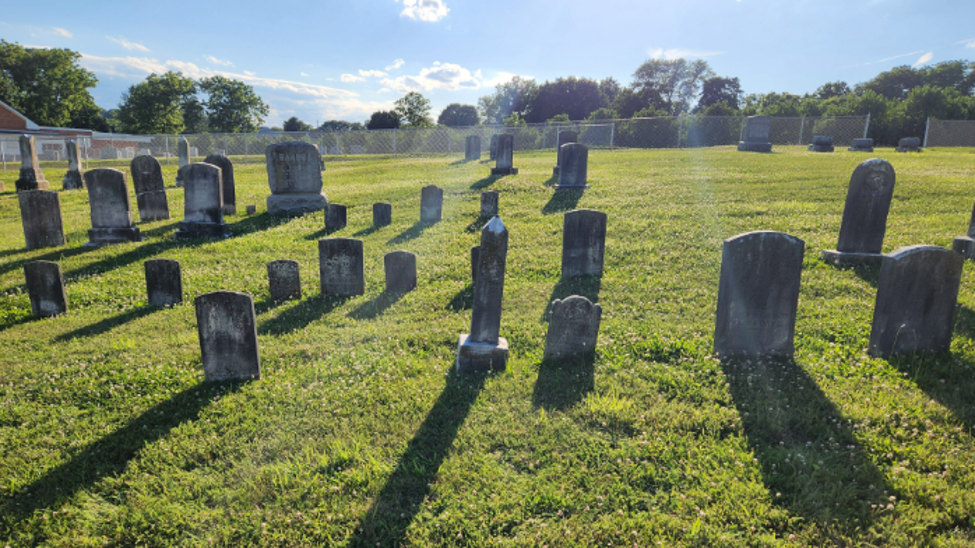
Antietam Church Cemetery, Waynesboro, Franklin, Pennsylvania showing the Harbaugh family burials with spaces for graves missing stones; photo by Lori Samuelson 22 June 2026.
Some discoveries are made by finding something. Others are made by noticing what is missing.
During a recent cemetery-hunting trip through Pennsylvania, Maryland, and Ohio, I visited numerous burial grounds connected to my husband’s Harbaugh family and my own Duer ancestors. Some visits led to new discoveries. Others answered long-standing questions.
One stop left me with neither.
Instead, it left me staring at several empty spaces in a family burial plot and wondering whether the answers had been there all along.
For years, I have searched for the final resting places of Elias Harbaugh and his wife, Mary Magdaline Weaver Harbaugh.
Elias presents a challenge because his probate file no longer exists in Franklin County, Pennsylvania. Based on surviving records, he likely died about 1874. Mary appears to have died around March 1877, her death inferred from a deed recorded by her grandson, George Henry, in 1885.
Like many genealogists, I have spent years piecing together fragments of evidence to reconstruct their lives. What I hoped this trip would provide was something more tangible. A tombstone. A burial record. Some confirmation of where they were laid to rest.
For a long time, I have suspected that Elias and Mary were buried in Antietam Church Cemetery in Waynesboro, Franklin County, Pennsylvania.
The theory is not without support. Their only child who remained in Pennsylvania, Frederick Alexander Harbaugh, was buried there in 1894. The cemetery contains several members of Frederick’s family, suggesting that the Harbaughs used this churchyard for multiple generations.
Ten years ago, I spoke with the church minister regarding burial records. Unfortunately, the surviving records do not extend back to the 1870s. If documentation once existed identifying Elias and Mary’s graves, it has not survived.
Still, I hoped the cemetery itself might provide clues. Cemeteries often tell stories that records cannot.
Families were frequently buried together. Parents, children, spouses, and siblings often occupied adjoining plots. Even when records disappear, burial patterns sometimes survive.
Walking among the Harbaugh stones, I was struck by how weathered many of the markers had become. Time has not been kind to them. Some inscriptions are difficult to read. Others have deteriorated significantly since photographs were taken years ago.
Yet something else caught my attention. Several empty spaces appeared within the family row. Not random gaps. Places that seemed as though stones might once have stood there.
I found myself studying the spaces as carefully as the surviving markers.
Could Elias and Mary have been buried there? Had stones once marked their graves? Were the markers lost to weather, damage, or neglect?
There was no way to know for certain.
My husband, Jim, has an uncanny ability to spot things that others miss. I hoped he might discover a sunken marker, a fragment of stone, or some overlooked clue hidden among the grass.
We searched carefully. Nothing appeared. No broken fragments. No buried marker. No evidence beyond the empty spaces themselves.
We left without answers. Yet I could not stop thinking about what those gaps represented.
Genealogists are trained to focus on evidence we can see and document. We seek records, photographs, inscriptions, and artifacts. We want proof.
But absence can sometimes be evidence, too. An empty place in a family plot may tell a story. A missing probate file may tell a story. A burial record that should exist but doesn’t may tell a story.
None of these pieces alone prove that Elias and Mary rest in Antietam Church Cemetery. Together, however, they create a pattern that is difficult for me to ignore. Sometimes all that remains is a possibility.
I left Antietam Church Cemetery without finding Elias and Mary. Perhaps resting quietly among their family members, their identities lost but their presence still remembered.
Genealogy is often portrayed as a series of discoveries and breakthroughs.
In reality, much of our work involves living with uncertainty.
Not every mystery is solved. Not every ancestor leaves a marker. Not every story reaches a neat conclusion.
For now, Elias and Mary remain missing.
But every time I look at the photograph of that family row, my eyes are drawn not to the stones that remain.
They are drawn to the empty spaces and to the possibility that sometimes what is missing can tell us as much as what survives.
Genealogists spend much of their time searching for things that have been lost.
Missing records. Forgotten stories. Unmarked graves. Destroyed courthouses. Faded photographs.
We become accustomed to loss because loss is woven into the very fabric of family history research. Yet nothing prepared me for returning to a cemetery and discovering that the evidence I had once photographed had disappeared.
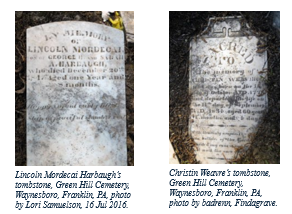
Ten years ago, I visited Green Hill Cemetery in Waynesboro, Pennsylvania, in search of several members of my husband’s Harbaugh family.
Their tombstones had not originally stood there.
The family had first been buried in Old Union Cemetery adjacent to a church. In 1923, after the property changed ownership, the graves were disinterred and reinterred at Green Hill Cemetery. According to cemetery staff, efforts had been made to notify descendants through notices published in local newspapers. Whether family members living elsewhere ever learned of the move is unknown.
By the time I visited in 2016, the stones had already endured one relocation.
They were worn; no longer standing they were placed flat on the earth. I photographed each one carefully.
At the time, I viewed the images as routine documentation. Like many genealogists, I had become accustomed to photographing tombstones whenever I encountered them. The task felt important, but not urgent.
After all, the stones had already survived for more than a century. Surely they would remain there for future visitors. Or so I thought.
This summer, while returning from a genealogy conference, I decided to revisit Green Hill Cemetery. I wanted to see the stones again.
Perhaps I would notice details I had overlooked a decade earlier. Perhaps advances in photography would allow me to capture inscriptions more clearly. Perhaps I would simply enjoy reconnecting with ancestors whose stories I had spent years researching.
Instead, I found an absence.
The hillside where the stones had once stood had been altered. The markers were gone. Completely gone. For several moments I simply stared at the space where I expected them to be. Had I remembered the location incorrectly? Had the stones been moved again? Had they been damaged? Had they been placed in storage?
I had no answers.
The cemetery office was closed, leaving me with questions and a growing sense of unease.
What troubled me most was not simply that the stones were missing. It was the realization that physical evidence we often assume will remain forever can disappear without warning.
Genealogists sometimes treat cemeteries as permanent repositories of history. In reality, they are vulnerable places. Weather damages monuments. Trees fall. Floods occur. Maintenance priorities change. Ownership changes. Records are misplaced. Occasionally, markers simply vanish.
The experience reminded me of the countless records I have searched for over the years that no longer exist. Probate files that disappeared from courthouse shelves. Church registers lost to fire. Family Bibles discarded during estate sales. Letters thrown away by descendants who did not recognize their value.
Every generation inherits responsibility for preserving the evidence left behind by those who came before. Sometimes we fulfill that responsibility. Sometimes we fail.
Fortunately, I had photographed the stones during my earlier visit. What once seemed like routine documentation now feels considerably more important.
Those photographs preserve information that may no longer be accessible in the cemetery itself. That realization changed the way I think about every cemetery visit.
Take the photographs.
Record the inscriptions.
Capture the surrounding landscape.
Document the location.
Don’t assume someone else already has.
Don’t assume the information will still be there next year.
Most importantly, don’t assume that stone is permanent simply because it has already survived for generations.
Family history exists in a delicate balance between remembrance and forgetting. As genealogists, we often focus on discovering the past. Perhaps an equally important task is preserving it.
The missing stones at Green Hill Cemetery reminded me that our ancestors’ stories are not guaranteed to survive. Their preservation depends upon ordinary people who care enough to record them before they disappear.
Sometimes we search for evidence. Sometimes we become its last caretakers. And sometimes, without realizing it, the photograph we take today may become tomorrow’s only surviving record.
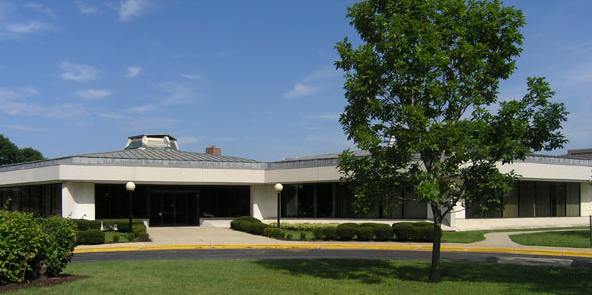
Ironically, photo of NARA Chicago from the National Archives.
On 23 June 2026, the National Archives and Records Administration (NARA) announced plans to close two of its regional archive, Chicago and San Francisco, within the next three years. According to the announcement, the transfer of records could begin as early as August 2026.
For many Americans, this may sound like another government reorganization.
It is not.
It is a decision that could fundamentally change access to some of our nation’s most important historical records.
As genealogists, we understand something many people do not: once access to records is reduced, it is rarely restored.
More Than Buildings
Regional archives are not warehouses filled with dusty boxes.
They are active research centers where historians, attorneys, journalists, veterans, students, tribal researchers, authors, and genealogists access the original federal records that document our nation’s history.
The Chicago and San Francisco facilities preserve millions of records that are unique to their regions. Many have never been digitized. Many exist nowhere else.
These collections include federal court records, naturalizations, military records, customs records, Native American records, immigration files, maps, photographs, engineering drawings, and countless other documents that researchers rely upon every day.
Without these facilities, access becomes more difficult, more expensive, and potentially unavailable for extended periods while records are relocated.
“Everything Is Online”
It isn’t. That may be the biggest misconception surrounding these proposed closures.
Despite remarkable progress in digitization, only a small percentage of NARA’s holdings are available online. Billions of pages remain accessible only by visiting an archive or requesting assistance from knowledgeable archivists.
Even when records have been scanned, researchers frequently need to examine the original document. Marginal notes, seals, handwriting, attached correspondence, paper characteristics, and filing context often provide clues that digital images cannot fully capture.
As every experienced genealogist knows, the answer to a decades-old mystery is sometimes found in a note scribbled in the margin or in the document tucked behind the one you expected to find.
This Became Personal
This issue struck particularly close to home for me.
As many of my readers know, I am currently pursuing Croatian dual citizenship based on my family heritage. One of the requirements for my application involved obtaining federal records from the National Archives at Chicago.
Those records are not simply interesting historical documents.
They are legal evidence.
Without them, my citizenship application could not move forward.
That experience reminded me that regional archives do far more than preserve history.
Every day they help individuals prove history.
Veterans rely upon them to document military service.
Families use them to establish citizenship.
Attorneys obtain records for legal proceedings.
Tribal communities document their heritage.
Historians uncover stories that have remained hidden for generations.
These are working institutions that continue to serve the public every day.
Questions That Deserve Answers
NARA has announced the closures. What researchers still do not know is equally important.
Where, exactly, will every collection be transferred?
Will related collections remain together?
How long will records be unavailable during the move?
Will enough archivists accompany the collections?
Will the receiving facilities have sufficient space and staffing?
Will public access remain at its current level?
These are not minor administrative details. They determine whether researchers can continue their work or whether projects that have taken years to build suddenly come to a halt.
Once Access Is Lost…
History teaches us that reduced access is seldom temporary.
Archives close. Staffing is reduced. Reading rooms become more difficult to use.
Travel costs increase. Fewer people can conduct research.
Eventually, stories remain undiscovered, not because the records disappeared, but because reaching them became too difficult.
History is not lost only when records are destroyed.
It is also lost when people can no longer access them.
Every Box Represents Someone’s Story
Every archival box contains more than paper. It contains a soldier’s pension application. An immigrant’s naturalization papers. A widow’s claim. A Native American land file. A ship manifest. A federal court case. A map that explains why a community developed where it did. A single document that may answer a question a family has been asking for generations.
Collectively, these records tell America’s story, not just the stories of presidents and generals, but of ordinary people whose lives built this nation.
Now Is the Time to Act
Once these facilities close, reopening them is unlikely.
If you believe America’s documentary heritage should remain accessible to future generations, now is the time to speak.
Support the efforts of Save OUR National Archives (SONA).
Encourage your local genealogical or historical society to make its voice heard.
Share this issue with others who value history, transparency, and public access.
The National Archives do not belong to historians. They do not belong to genealogists. They belong to all Americans.
The records entrusted to NARA preserve our collective memory. Let’s not make it harder for future generations to discover who they are or where they came from.
Sources
National Archives and Records Administration. “National Archives Announces Plans for Regional Archives Realignment.” News release, 23 June 2026.
Save OUR National Archives (SONA). “Save Our National Archives.” Accessed 4 August 2026.
Organization of American Historians. “Saving America’s Story.” Accessed 4 August 2026.
Association of Professional Genealogists. Advocacy statement regarding proposed National Archives regional facility closures, 2026.
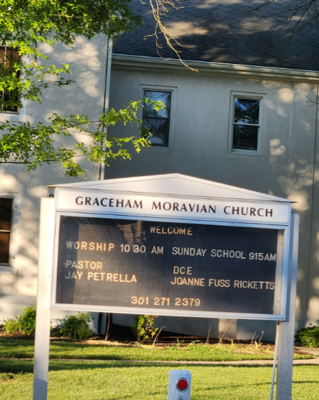
Graceham Moravian Church, 8231 Rocky Ridge Road, Graceham, MD; photo by Lori Samuelson 16 June 2026.
Genealogists spend a great deal of time looking for people who do not want to be found. Sometimes they changed their names. Sometimes records were destroyed. Sometimes a clerk simply failed to record an event. And sometimes, despite our best efforts, we arrive at a place only to discover that what we seek remains elusive.
That was my experience this summer while searching for the grave of my husband’s Revolutionary War ancestor, Christian Harbaugh.
Christian was the son of Ludwig Harbaugh, whose beautifully preserved tombstone still stands in St. John’s United Church of Christ Cemetery in Sabillasville, Maryland. Visiting Ludwig’s grave had been a rewarding experience. The cemetery was well maintained, easy to locate, and offered a tangible connection to a family that arrived in America during the colonial era.
Christian’s story, however, took a different path.
Unlike his father and grandfather, who were associated with the Mennonite faith, Christian became affiliated with the Moravians. That decision immediately caught my attention when I first began researching him years ago. Religious affiliation often shaped where our ancestors lived, whom they married, and where they were buried.
The decision to leave one faith community for another was not always a simple matter in eighteenth-century America.
As I planned my cemetery visits this summer, I hoped to locate Christian’s grave in Graceham Cemetery near Sabillasville, Maryland. Online memorials indicated that his stone existed. A photograph of the marker had even been posted.
How difficult could it be? As it turns out, very difficult. Our first challenge was locating the cemetery itself.
The GPS could not identify Graceham Cemetery. Coordinates listed online were not particularly helpful. Several attempts produced confusing results, and we found ourselves repeatedly circling roads in the area without success.
Rather than continue the search blindly, I decided to try a different approach.
Since Christian had belonged to the Moravian Church, perhaps locating the church would lead us to the cemetery. The strategy seemed sound.
Our GPS quickly located Graceham Moravian Church, a beautiful historic congregation nestled among the rolling hills of Frederick County. Standing in front of the church, I could not help but wonder whether Christian himself had once walked those grounds.
Perhaps he had attended services there. Perhaps family events had been celebrated there. Perhaps he had stood in that very location looking out across the same countryside.
The church connected me to Christian’s life in a way that no document ever could.
But the cemetery remained missing.
We searched nearby roads. We checked maps. We compared information from multiple sources.
Nothing.
Eventually, I had to admit defeat.
The grave I had hoped to visit would remain undiscovered, at least for now.
Driving away, I found myself reflecting on something that genealogy has taught me repeatedly over the years.
We tend to think of research as successful only when we find what we seek.
That is not always true. Sometimes we eliminate possibilities. Sometimes we identify errors. Sometimes we gain a better understanding of an ancestor’s community, beliefs, and daily life. And sometimes we simply learn what does not work.
All of those outcomes have value.
Although I never located Christian’s grave, the trip was not wasted. I walked the grounds of the church that shaped his religious life. I gained a deeper appreciation for the choices he made. I better understood the community in which he lived. Most importantly, I left with new questions.
Why did Christian leave the Mennonite faith of his father? What drew him to the Moravians? How did that decision affect his family and descendants?
The missing grave remains a mystery. Yet some mysteries are worth keeping. They remind us that genealogy is not merely about collecting names, dates, and places. It is about understanding lives.
Christian Harbaugh’s tombstone may have escaped me this summer, but his story did not. Perhaps that is the more important discovery.
Sometimes the journey itself becomes the destination.
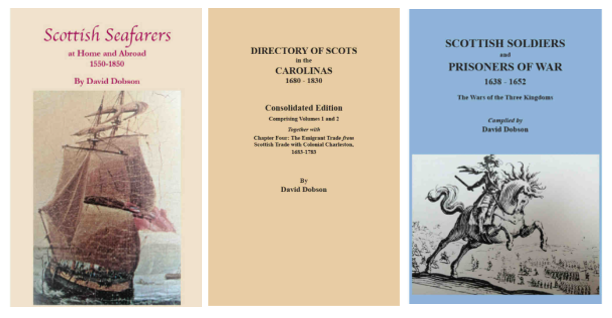
David Dobson has built a well-earned reputation over many years for locating and compiling records relating to Scottish families, migration, military service, and settlement throughout the Atlantic world. Three of his latest publications continue that tradition, each serving as a specialized reference tool for genealogists researching Scottish ancestors.
The first volume, Scottish Seafarers at Home and Abroad, 1550–1850, is exactly what its title suggests. Rather than a narrative history, it is an alphabetical compilation of individuals connected with Scotland’s maritime community over a three-century period. Entries are intentionally brief, typically providing a name, occupation or relationship to a vessel, a date, and a citation directing researchers to the original source. A concise introduction explains the scope of the work, while a bibliography and key to the source abbreviations assist the researcher in locating the original material.
Scottish Soldiers and Prisoners of War, 1638–1652 follows the same format. Researchers interested in Scotland during the turbulent years of the Wars of the Three Kingdoms will find an alphabetically arranged listing of individuals identified in military and related records. As with the seafarers volume, the real strength of the book lies in bringing together names from numerous historical sources into a single, easy-to-use reference.
The largest of the three books is Directory of Scots in the Carolinas, 1670–1830. Spanning over 600 pages, this volume consolidates material from several of Dobson’s earlier publications into one comprehensive reference. In addition to combining previously published directories, it incorporates material from his work on Scottish trade with colonial South Carolina, making this an especially convenient resource for anyone researching Scottish migration and settlement in the Carolinas.
These are not books intended to be read from cover to cover. Instead, they function as finding aids, reference works designed to help researchers quickly determine whether an individual appears in a particular historical record before consulting the original source. For genealogists with Scottish ancestry, that can translate into a considerable savings of research time.
I particularly appreciate having specialized reference works such as these gathered in one place. Many of the original records cited are scattered among numerous repositories and publications in the U.S. and abroad. By compiling them into searchable surname directories, Dobson has made it much easier for researchers to identify promising leads that might otherwise remain undiscovered.
If your Scottish research involves maritime occupations, seventeenth-century military service, or early settlement in the Carolinas, these volumes deserve consideration. While experienced genealogists will still want to examine the original records cited for complete context and analysis, these compilations provide an excellent starting point for identifying those records.
As always, no single reference work contains every answer. However, resources like these can often provide the clue that points us toward the next record and in genealogy, that next record is often where the real story begins.