After reading my recent open letter concerning NARA Notice 2026-037 and the proposed closures of the Chicago and San Bruno facilities, the folks behind AncestorOS reached out with an offer for my readers.
AncestorOS, created by Michael L. Strauss, AG, and his son, includes research logs that record not only what you find, but also partial, not found, and pending results, something particularly important when researching records that may never have been digitized. It also includes a database search log and Evidence Explained citation templates.
They are offering a 7-day free trial with no code required. Nothing is charged until day 8. After the trial, plans begin at $15 per month; the $40 Pro plan adds client and invoicing tools for professional genealogists.
AncestorOS runs in a web browser and is also available as an Android app.
I have not been paid to share this offer. I’m passing it along because the developers reached out after reading my NARA post and thought the research-tracking tools might be useful to my readers.
By the way, I was fortunate to be able to tour behind the scenes at the newly opened Indiana State Archives in Indianapolis last Friday. Here’s their QR Code. Are you stumped with an Indiana brickwall? Contact them for help:
I’m delighted to share that I’ll be taking part in an international genealogy event this October with the Society of Genealogists’ All About That Place 2026!
Running from 07–16 October 2026, All About That Place brings together more than 150 speakers for almost 200 FREE, bite-sized presentations devoted to genealogy, local history, research techniques, archives, social history, technology, and the places that shaped our ancestors’ lives.
And I’m involved in more ways than one this year!
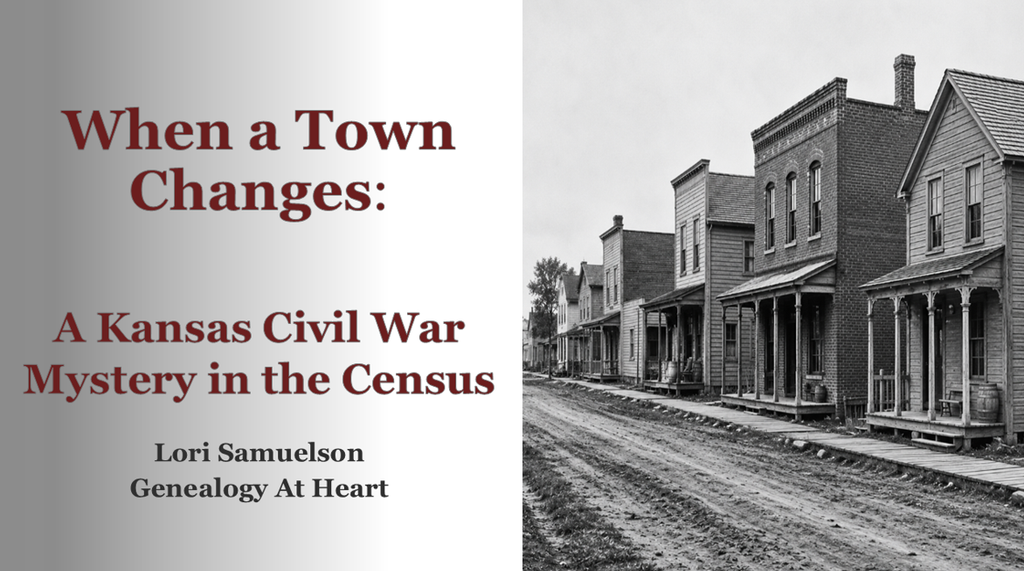
My presentation is titled “When a Town Changes.”
Genealogists naturally spend a great deal of time looking for people. But sometimes the place itself is part of the evidence.
Towns change names. Boundaries shift. Communities disappear. Streets are renamed. Industries arrive and vanish. Populations move. The place we find on an ancestor’s record may look very different today and occasionally understanding what happened to the place is exactly what we need to understand what happened to the people who lived there.
That is the idea behind my 10-minute presentation.
My talk is part of the “Changing Places” theme of All About That Place, and I hope it encourages researchers to look beyond the names and dates in their family trees and ask another question:
What was happening to the place where my ancestor lived?
WATCH PARTY — 13 OCTOBER 2026
I’ll also be holding a Watch Party at noon Eastern Time on 13 October. If you’d like to watch “When a Town Changes” with me, mark your calendar! I’d love to have some familiar faces joining genealogists from around the world.
AND THERE’S A PRIZE! I’ve donated a short private genealogy consultation as one of the prizes for All About That Place.
That means one participant will have an opportunity to Zoom with me and talk through a genealogy problem, research question, brick wall, or next step. I’m looking forward to meeting the winner and seeing what mystery they bring me!
I’M ALSO ON THE FAMILY HISTORIES PODCAST. There’s one more part of this adventure that I’m especially excited about. I recently sat down with the host of The Family Histories Podcast to record a special All About That Place episode. We talked about my research and some of the stories and challenges that come with trying to reconstruct the lives of people who can no longer tell us what happened themselves.
The episode is being released worldwide through Apple Podcasts, Spotify, YouTube, Audible and other podcast platforms, and it will also be available directly from The Family Histories Podcast website.
One of the things I love about All About That Place is its format. These aren’t hour-long lectures. The presentations are just 10 minutes each, which means you can explore a subject, discover a new researcher or technique, and then move on to something completely different.
Best of all, the main All About That Place program is FREE.
You can learn more about the event, see the speakers and explore the program through the Society of Genealogists:
I hope you’ll join me on 13 October for “When a Town Changes.” And while you’re there, take a look through the rest of the program. With nearly 200 talks, I suspect most of us will discover more than a few we simply have to watch.
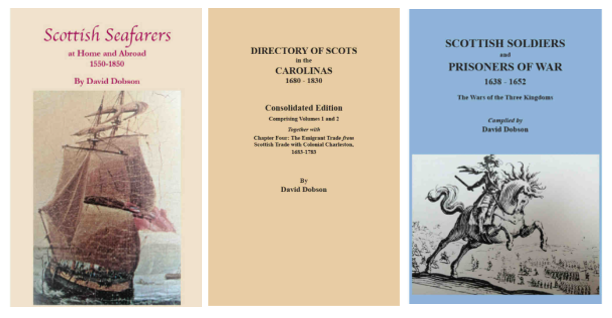
David Dobson has built a well-earned reputation over many years for locating and compiling records relating to Scottish families, migration, military service, and settlement throughout the Atlantic world. Three of his latest publications continue that tradition, each serving as a specialized reference tool for genealogists researching Scottish ancestors.
The first volume, Scottish Seafarers at Home and Abroad, 1550–1850, is exactly what its title suggests. Rather than a narrative history, it is an alphabetical compilation of individuals connected with Scotland’s maritime community over a three-century period. Entries are intentionally brief, typically providing a name, occupation or relationship to a vessel, a date, and a citation directing researchers to the original source. A concise introduction explains the scope of the work, while a bibliography and key to the source abbreviations assist the researcher in locating the original material.
Scottish Soldiers and Prisoners of War, 1638–1652 follows the same format. Researchers interested in Scotland during the turbulent years of the Wars of the Three Kingdoms will find an alphabetically arranged listing of individuals identified in military and related records. As with the seafarers volume, the real strength of the book lies in bringing together names from numerous historical sources into a single, easy-to-use reference.
The largest of the three books is Directory of Scots in the Carolinas, 1670–1830. Spanning over 600 pages, this volume consolidates material from several of Dobson’s earlier publications into one comprehensive reference. In addition to combining previously published directories, it incorporates material from his work on Scottish trade with colonial South Carolina, making this an especially convenient resource for anyone researching Scottish migration and settlement in the Carolinas.
These are not books intended to be read from cover to cover. Instead, they function as finding aids, reference works designed to help researchers quickly determine whether an individual appears in a particular historical record before consulting the original source. For genealogists with Scottish ancestry, that can translate into a considerable savings of research time.
I particularly appreciate having specialized reference works such as these gathered in one place. Many of the original records cited are scattered among numerous repositories and publications in the U.S. and abroad. By compiling them into searchable surname directories, Dobson has made it much easier for researchers to identify promising leads that might otherwise remain undiscovered.
If your Scottish research involves maritime occupations, seventeenth-century military service, or early settlement in the Carolinas, these volumes deserve consideration. While experienced genealogists will still want to examine the original records cited for complete context and analysis, these compilations provide an excellent starting point for identifying those records.
As always, no single reference work contains every answer. However, resources like these can often provide the clue that points us toward the next record and in genealogy, that next record is often where the real story begins.
Every genealogist has encountered it, that moment when you’re handed a family line from a place you know little about and wonder, “Where do I even begin?” Judy Nimer Muhn’s Acadian Genealogical Research attempts to answer that question in just four pages. And it succeeds.
This isn’t a book. It isn’t intended to be a scholarly treatment of Acadian history or an exhaustive research guide. Instead, it belongs to what I would call the “orientation guide” category. Think of it as a roadmap handed to someone before they begin a journey rather than the journey itself.
That distinction matters.
The publication opens with a concise historical overview beginning with the first French settlement attempts in 1604, explains the growth of Acadia, and introduces readers to the Mi’kmaq relationship, Acadian settlement patterns, and the political instability that ultimately led to the Grand Dérangement. None of these sections is lengthy, but each provides enough historical context that a beginning researcher understands why records exist where they do.
One of the strongest features is its organization.
Rather than overwhelming readers with dozens of repositories, the guide follows the chronology of Acadian research. It first explains the history, then discusses records before deportation, then records created during and after deportation, followed by Quebec resources, provincial archives, online compilations, organizations, and additional repositories. That progression mirrors how experienced genealogists naturally approach an unfamiliar locality.
The author also deserves credit for avoiding one of the most common mistakes found in beginner guides, simply producing a list of websites. Here, nearly every repository is accompanied by a sentence or two explaining why it matters. That context helps researchers decide where to spend their time instead of blindly clicking links.
I especially appreciated the emphasis on records that many researchers overlook, including parish registers, provincial archives, historical maps, and family organizations. For someone beginning Acadian research, this is considerably more useful than another generic discussion about online family trees.
Visually, the publication is attractive and easy to follow. The use of colored headings breaks the material into logical sections, making it simple to scan for a particular topic. For educators, librarians, or genealogy societies, it would make an excellent handout for an introductory Acadian workshop.
Overall, Acadian Genealogical Research accomplishes exactly what it sets out to do. It is concise, organized, historically grounded, and filled with practical starting points. In an era when many beginners are tempted to rely solely on online trees or AI-generated summaries, a well-curated roadmap like this reminds us that successful genealogy still begins with understanding the records and where to find them.
It’s Genealogy At Heart book review time and this one is unlike any I’ve written before.
I’m about to make a few bold claims. And I stand by every one of them:
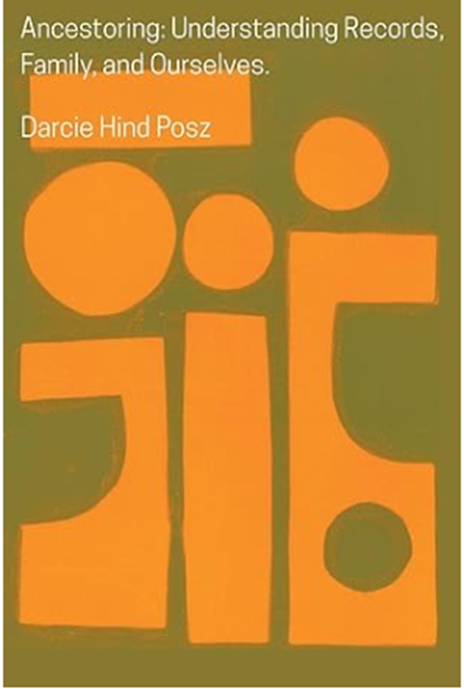
If you read only one book this year, Ancestoring: Understanding Records, Family, and Ourselves by Darcie Hind Posz should be that book.
If I had to part with my entire genealogy library and keep just one volume, Ancestoring would stay.
This book belongs in every high school curriculum.
That get your attention? It should.
Last month, I received two donated books to review. As always, I don’t accept payment, and there are no agreements, spoken or unspoken, that guarantee a favorable review. My long-time readers know I share my honest thoughts, whether glowing or critical.
Frankly, if I had judged this book by its cover or title alone, I might have passed it by and that would have been a mistake.
From the bottom of my heart, Ancestoring is the only book that has ever had this kind of positive impact on me.
Of the two books to review, I chose this one first simply because of the title. Ancestoring, what did that even mean? The preface answers that question, but more importantly, the book embodies it.
Before diving in, I read the back cover endorsement by Henry Z. “Hank” Jones, FASG. I’ve reviewed his work before, and if Hank was this enthusiastic, I was all in. (See those reviews here and here).
The book is divided into three sections, which Posz notes can be read in any order. I chose to move from the broad to the personal: understanding records, then families, and finally ourselves. Perhaps that reflects my own leanings toward a Gestalt approach; the idea that the whole is greater than the sum of its parts. To fully grasp the interplay between these sections, I recommend working through all of them.
Take your time with this book. Do the exercises. If you’re pressed for time, read it through once, then return to it and savor each chapter. Don’t skip the footnotes! Even if you’re not typically a footnote reader, this book may convert you. The sourcing spans multiple disciplines, and that depth is precisely why I make my second and third claims, it’s not just a book, it’s a roadmap for continued intellectual growth.
As a former educator and counselor, I spent years helping students move from concrete to abstract thinking. Though Posz doesn’t frame it this way, I would go a step further: this book fosters lateral thinking, the kind of creative, non-linear problem-solving that genealogists desperately need. That alone justifies my belief that it belongs in every high school.
And for adults? The exercises are even more critical. Think about your daily news feed and your social media. How much of it is accurate? How do you know? This book gives you the tools to evaluate, question, and ultimately uncover truth.
The exercises themselves are refreshingly unconventional. Yes, you’ll learn to analyze photographs, vital records, and obituaries but through a much wider lens. Posz incorporates film, music, and even conspiracy theory narratives as training tools. At first glance, these seem unrelated to genealogy. They’re not. They sharpen how we observe, interpret, and question, skills at the heart of our work.
One of the most intriguing elements is the encouragement to record dreams related to your research. I’ve written about this before (here and here). When deeply immersed in a project, the mind doesn’t simply shut off. Whether it’s subconscious processing, inherited memory, or something we don’t yet understand, those impressions can sometimes point us in new directions. Other times, they signal it’s time to step away. Both are valuable.
The chapter on trauma deserves special attention. All though others have tried, Posz is the first genealogist to address, so directly and personally, how trauma can be researched and interpreted. Memory is not fixed. Two individuals can experience the same event and remember it in entirely different ways. That reminder is essential for anyone working with historical narratives.
I admit, I found myself wondering whether one vivid childhood memory Posz recounts, watching a film while hospitalized, might have been influenced by a dream while medicated. That, in a way, reinforces her point: our recollections are not infallible.
Finally, I applaud Posz for her transparency regarding her earlier work. Too often, we treat a completed project as final. It isn’t. New records surface. DNA reshapes conclusions. Even our most carefully constructed research can shift. Her discussion of ethnicity estimates is a timely reminder that patience and humility are essential in this field.
If genealogy is about understanding where we come from, Ancestoring pushes us further. It asks us to examine how we think, why we believe in what we do, and what it really means to know the past.
That’s why Ancestoring is not just a good book; it’s an essential one.
In the past two weeks, I’ve received four emails from individuals new to genealogy either questioning my public tree on Ancestry.com or inquiring about my professional services.
Each one carried the same message: “The information you have is wrong.”
Let me start with something I say often: no genealogical tree is 100% accurate. Until every individual in every line has been DNA tested and even then, interpreted correctly, there will always be some uncertainty. That’s simply the nature of this work.
But these interactions weren’t thoughtful challenges or collaborative inquiries. They were something else entirely.
They were confrontational, dismissive, and, frankly, uninformed.
The first individual demanded proof of a family adoption story. I recommended DNA testing. They had already tested but refused to share the results and insisted I find documentary proof.
Here’s the problem: no records exist for that place and time. None. The best available evidence is a census record placing the child in the same household at three months old and still there decades later. That wasn’t enough. I was told I didn’t know what I was doing.
DNA would likely resolve the question but there’s a reason it wasn’t being shared. DNA doesn’t lie. And when people avoid it, that usually tells you something.
The second email was even more puzzling. I was instructed to delete an individual from my tree because it was “messing up [her] DNA matches.”
We didn’t match. The individual in question is on my husband’s line. She didn’t match him either.
Her conclusion? A child who died young actually moved to Illinois, changed his name completely, married, and died in the 1940s.
Her evidence?An Ancestry hint from ten years ago that only matched a birthdate. No sources showed a name change. No documentation. No records connecting the identities. Just confidence that in the entirety of Sweden, only 1 male was born on the same day. I’m not making this up!
When I asked basic genealogical questions such as death certificate? marriage record? naturalization? she didn’t understand what I meant. She had been researching for a few months and was certain her conclusion was correct because a now deceased relative had believed it 10 years ago. I declined to alter a fully sourced line.
The third interaction was more familiar but still frustrating.
A man insisted I had the wrong parents for his great-grandfather. His proof was a death certificate, with information provided by the son.
I explained what experienced genealogists know: informants can be wrong. Memory fails. Grief clouds details.
In contrast, I had a letter written by the man himself shortly before his death, naming his parents and explaining his childhood circumstances. I even provided the citation so he could verify it.
His response? “You’re still wrong. Remove it.” He also admitted he didn’t know how to locate the record I referred to online. Sigh.
That was the point where I made a decision: I removed the entire line from my public tree. Not because I was wrong but because the interaction wasn’t worth the time it would take to defend it.
The final exchange involved a demand to remove a death record because “everyone has it wrong.”
No documentation was provided. Instead, the argument rested on a theory built from DNA matches and a guess involving a child being banished to another colony 300+ years ago.
Could there be a connection? Possibly.
Was there proof? No.
When I tried to guide her toward alternative explanations, such as descent from a sibling, she wasn’t interested. She didn’t want to explore the truth. She wanted confirmation.
So I’ll ask the question plainly: Are you experiencing this shift, too?
For over 25 years, I’ve found most genealogists to be curious, collaborative, and open to learning. But recently, something feels different.
More certainty. Less evidence. And a growing resistance to being wrong.
I had a conversation about this with my husband, who pointed me to research from the National Literacy Institute suggesting that a significant portion of U.S. adults read below a sixth-grade level.
As a former reading teacher, that stopped me.
Because genealogy requires more than reading, it requires interpretation, analysis, and the ability to weigh conflicting evidence.
Without those skills, it becomes easy to mistake a hint for proof… or a belief for a conclusion.
And that brings me to where I am now.
I’ve always believed in keeping my tree public. I don’t “own” my ancestors. I’ve invested time and money into my research because I wanted to know the truth, not because I expected anything in return.
But I’ll be honest: I’m reconsidering. Not because of disagreement. Disagreement is part of good research. But because of something else entirely:
A refusal to learn. A rejection of standards. And an insistence that confidence equals correctness.
In every one of these cases, I recommended learning about the Genealogical Proof Standard.
Not one person was interested. That’s the real concern. Because if we lose the standard…we don’t just lose accuracy, we lose genealogy itself.
If you’re thinking this is an AI problem, it isn’t. Genealogists have always worked with flawed records, mistaken informants, and misleading clues. What is new is the speed at which conclusions are formed and the confidence with which they’re defended without the work required to support them.
If you’re new to genealogy, welcome. Truly. But confidence is not evidence. And belief is not proof. Start there and you’ll go far.
I’ll be heading to Salt Lake City for RootsTech, and if you’re attending in person, I’d truly love to connect. I’ll be presenting Voices That Vanish: Capturing Stories That Matteron 5 March at 9:30 AM in Room 155 EF, and you’re warmly invited to join me.
I also have a second session, What They Didn’t Write Down, available as a pre-recorded presentation available on 3/4 at 9:00 AM Mountain Time; please be sure to check that out as well.
Looking ahead, I’m becoming more intentional about meeting readers and fellow genealogists face-to-face, whether I’m presenting or simply attending. Conferences are as much about conversation as they are about lectures, and I hope this is the beginning of more informal, meaningful connections. If you see me at RootsTech, please say hello, I’d love that.
Registration opened for the 2026 Palatines to America National Conference, to be held in Lancaster, Pennsylvania, June 19, 2026. Early registration discount is available until April 15. The conference has activities and tours planned in addition to many presentations by genealogy experts on subjects related to German migration, military service, occupations, Revolutionary War experience, Amish and Mennonite research, and more. I’ll be presenting two talks – Palatinate Pathways: From One Homeland to Many American Homes and From Soldiering to Civil Life. See full details at https://www.pennpalam.org/cpage.php?pt=19
I’m pleased to share that I’ll be presenting a workshop at the National Genealogical Society Conference: WS01 Starting Smart with AI: Hands-On Tools for Family Historians, and I’d love for you to join me.
This session is designed to be practical and immediately useful, focusing on real examples, hands-on tools, and strategies that help family historians integrate AI thoughtfully into their research and workflow. Whether you’re just getting started or looking to refine how you use these tools, you’ll leave with ideas you can put into practice right away.
If you’re interested in attending, you can register using my personal referral link and code below:
I hope to see some familiar faces in Fort Wayne, Indiana on 26 May, 9:00 AM–12:00 PM. Feel free to share this with colleagues or anyone interested in genealogy, research methodology, or practical AI applications.
In November–December 2026, I wrote a series of blog posts about my experience obtaining records for dual citizenship. Since then, I’ve received weekly messages from people interested in pursuing dual citizenship themselves.
Let me be clear: I didn’t write those posts to discourage anyone. I wrote them to be transparent.
If I were hiring someone to help me with a complex, expensive, emotionally charged process, I would want honesty about the cost, the delays, the bureaucracy, and the unexpected hurdles. That’s what I aim to provide my clients in every aspect of my work.
One important disclosure: I contract with citizenship.eu and do not take private clients for dual citizenship applications. My role here is to share my experience, not to sell services.
By early December, I had finally received every record I requested, starting back in July. The last document to arrive was from NARA–DC: my grandmother’s ship manifest, which came on December 3. I didn’t blog about that particular request because it was made online but it came with its own challenges. The NARA website doesn’t always cooperate, the government shutdown delayed retrieval, and I couldn’t find a genealogist available to physically retrieve the record in Washington, D.C.
So yes, even the “easy” requests weren’t always easy. I then had to send it off to be apostilled. The record was returned to me 3 days ago.
If you’re considering dual citizenship, here’s what I wish someone had told me before I started.
Contact the consulate before you do anything else. Not after. Not halfway through. Before. This ensures you understand exactly what they require and it puts you on their radar. In my case, I was emailed detailed instructions which were clear and helpful.
Begin acquiring records and brace yourself. This phase is both expensive and time-consuming. I ordered two certified copies of every record and obtained several documents I didn’t initially plan to submit, simply to have a complete, redundant set in case anything was lost or damaged.
My total cost for records was $1317.80. That included my immigrant grandmother’s birth, marriage, death, ship manifest, and naturalization records; my mother’s birth and baptismal records (because no civil birth record existed), marriage, and death certificates; my own birth and marriage records (both church and civil, because my given name differed); my husband’s birth certificate; and the birth certificates of my adult children and their partners. Some of us all also needed to update our passports which were due for renewal.
I also obtained records I didn’t expect to submit, death certificates for my great-grandparents, my grandfather, and my father, along with his birth certificate, just in case questions arose about lineage. I may not need them, but I sleep better knowing they exist. Those costs are not included in the above total.
Every document must be apostilled. This is a separate authentication process that verifies the legitimacy of public documents for international use. Apostilles add both time and cost, and the process varies depending on whether the document is state or federally issued.
All of the records I plan to submit require apostilles, including birth, marriage, death, naturalization, ship manifests, and FBI clearance. Each record must be sent to the appropriate authority; the state records to the Secretary of State, federal records to the U.S. Department of State, along with forms and fees.
So far, my apostille costs total $305.00, with one state still remaining. I plan to handle Illinois in person because mail processing there is painfully slow. My mailing costs alone reached $92.45 and that amount increased when Florida rejected my apostille request because I included a church marriage record they would not certify. That error added a month-long delay and another trip to the post office.
Here’s my strongest advice: always include a prepaid return envelope with tracking. It costs more, but if documents are sent back by regular mail, they can disappear forever.
FBI clearance was surprisingly the easiest step. You complete the application online and should not include your Social Security number, since the document will be sent overseas. After submitting the form, you’re directed to a local post office for fingerprinting. We opted for electronic fingerprints and received results almost immediately, before we even paid the fee while waiting in line at the site.
If electronic fingerprinting fails, you’ll need to use a paper card and mail it in, which adds time and cost. Ironically, the FBI clearance often considered the slowest part, was the fastest, aside from the three months it took for the apostille.
You will need a certified translator. Ask the consulate if they have preferred translators, or research carefully through reliable sources (yes, Reddit threads can be useful here). Certified translators are approved by the courts of the country where you’re applying, and they are expensive.
I haven’t completed all translations yet, but the estimated cost will be around $5,000. Some translators will assist with applications, biographies, and statements of intent; others will not. I chose to work with a genealogist who obtained my grandmother’s baptismal record, a trusted colleague who kindly offered a discounted rate.
This is where patience goes to die, acquiring records from the country of origin is not easier than obtaining them in the U.S.
In my case, it took two months to obtain a single certified record. The office closed for two weeks for vacation. When the genealogist arrived at the scheduled appointment, she was told, incorrectly, that the church had to issue the record. A week later, the church sent her back to the civil office. Then the church had to write a letter instructing the civil office to release the document. Two more weeks passed before the record was issued. Then it took three weeks for international mail to deliver it.
No one was rude. No one was helpful. Bureaucracy is bureaucracy everywhere.
Understand that dual citizenship is a process of hurry up and wait. Once our records are translated, my family will wait until late October for our consulate appointment in Chicago. There, a consular employee will review our documents to ensure we are submitting the correct ones. Copies will be retained by the consulate, the certified apostilled originals with transcription and that apostilled sent overseas (and yes, I ordered extras because I’m paranoid). There is a fee for submission that is reasonable, considering how much was already spent.
After submission, the waiting begins, sometimes two to five years or more.
I also incurred costs for hotel/gas/parking/meals while we tried to obtain records in person. ($703.47).
So far, I’ve spent less than average as typically dual citizenship can cost between $10,000-20,000.00. My cost was less because I sought out the records on my own in all but one case. I also did not hire a lawyer which is sometimes needed, depending on the country and the situation.
So why would anyone willingly endure this?
Everyone’s reasons are different. For my family, it’s about global mobility and connection. We still practice the customs of my grandmother’s culture, and when we are in Croatia, it feels like home. There should be a language barrier because our Croatian stinks but somehow we razumjeti (understand). I’ll be working on improving while we wait for the decision.
Others pursue dual citizenship for healthcare, education, lower living costs, or expanded career opportunities. Business owners may relocate to continue serving existing clients while building new markets. And many younger applicants, especially those in their twenties, simply want options. I hear that sentiment often.
Dual citizenship is not a weekend project, a budget-friendly endeavor, or a fast-track solution to anything. It is expensive, slow, frustrating, and emotionally taxing. It requires organization, patience, and a tolerance for bureaucracy that most people don’t realize they lack until they’re knee-deep in certified copies and apostille forms.
But for those who value connection, opportunity, and the ability to move through the world with greater freedom, it can be worth every delay and every dollar.
My goal in sharing this update isn’t to persuade you one way or the other. It’s to help you make an informed decision. If you choose to pursue dual citizenship, go in with open eyes, realistic expectations, and a very good filing system. And if you decide it’s not for you, that’s not failure, that’s wisdom.
If this process has taught me anything, it’s that knowing what you’re walking into makes all the difference.