The Summer of My Genealogical Discontent Lesson 6 – Failing to join an organization

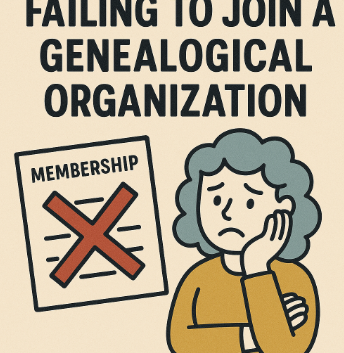
AI Image

I’ve had a passion for genealogy for as long as I can remember—I just didn’t know it had a name.

As a child, I was drawn to the family stories my grandmother told and captivated by her scrapbooks and photo albums filled with long-ago faces and forgotten events. The mystery of my paternal side, which no one ever discussed, only deepened my curiosity. As a teenager, I started searching for answers—but not knowing what I was doing, I didn’t get far. College and life pulled me away for a while.

When my first child was born, I eagerly opened the baby book—only to find I couldn’t complete the family tree. I knew my paternal grandparents, but beyond that? Nothing. My dad told me he’d give me a family book I hadn’t known existed—someday. But when that day came, and he passed, the book never made its way to me. My stepmother found it too much trouble to mail.

So I turned to the internet, which was just beginning to bloom, and took a beginner class at a local Church of Jesus Christ of Latter-day Saints. In hindsight, what I really needed back then was a mentor—someone to show me the ropes, answer my endless questions, and guide me along the path. I should have joined a local or national organization. But with a full-time job, kids to raise, elders to care for, a house to run—and no extra money to spare—I didn’t.

Instead, I used every scrap of free time to work on my tree. I shared my excitement with colleagues, though most didn’t understand why I’d spend vacation time at the Family History Library in Salt Lake. Still, when they had family mysteries, they came to me. I happily helped, and they were amazed at what I uncovered.

More requests came in. I never charged a cent—it never occurred to me to think of myself as a professional.

Then one day, a former boss told me, “You know, people would probably pay you to do this.” I was stunned—and, honestly, panicked. I thought he was letting me go and hinting I should start a business in the middle of a recession. He laughed and clarified: “You’re very good at this. You could turn it into something real.”

I set that thought aside. Life was already complicated.

But as the kids grew up and moved out, I finally had more time—and a little more money. I joined a local society and two national organizations. I attended conferences, subscribed to journals, and slowly built my confidence. I chose a name for my business: Genealogy At Heart, because I wanted to focus on what I loved—helping people uncover those sensitive family secrets. With my background in education and counseling, it was a natural fit.

What I didn’t know? That there were resources out there to help me from the start. I hadn’t heard of SCORE, a free business mentoring service. I didn’t know about the Association of Professional Genealogists, which offers tools, advice, and a sense of community. Had I joined an organization earlier—whether a local society or a national group—I would have had a much smoother beginning as a business owner.

Genealogy can feel like a solitary pursuit. We stay up late combing through records, take solo road trips to distant archives, and keep quiet at family gatherings to avoid the eye rolls. But it doesn’t have to be lonely. And it shouldn’t be.

Today, I’m actively involved in several genealogical organizations. They’ve helped me refine my research, consult with experts, and become a better genealogist—not just for clients, but for my own family, too. I no longer rely solely on myself, and I’ve learned that collaboration isn’t a luxury—it’s a strength.

Looking back, I can only imagine how much further I’d be if I’d learned this lesson sooner. But I’m glad I did.
Genealogy Pronunciation Trick

Courtesy of Wikipedia.org

My blog is late today as I had unexpected tech issues, the bane of my existence!  This past week, first my husband and then I, noticed an “enter code” button that appeared on any Microsoft product we were using on our desktops.  It finally dawned on us that the educator license we had with Microsoft was being removed since we both retired from our academic careers this month.  This was a totally unexpected situation as we had paid for a license for our computers that didn’t expire.  Microsoft only allows military veterans to continue and not educators.  Who knew?!  Took the time this morning to buy two new licenses – one for my business and the other for home use.  The Microsoft site was not working well and wouldn’t allow me to save my domain info so I’m going to have to go back on later.  After the slow download I freaked out when I opened Word and only documents from 2019 showed up.  I was able to open two docs from my desktop I just created in the last two weeks and once they opened, they showed in the list when I reopened Word. I then went to Dropbox and opened a pdf from January and a doc from last August.  Once opened, they show in the Word list.  I don’t understand this at all but as long as I can open older documents as I need them, I’m good.  

Here’s an update on my Bible blog from last week – got a heartwarming thank you from my distant cousin who will be receiving the Landfair Bible.  I’m so glad it found a good home, away from hurricanes, humidity and mold.  Remember this story this week when you run into a rude person – there are a lot of good people out there, just not everyone!

Now, for today….

I had a wonderful 2 day Professional Management Conference hosted by APG.  It was just awesome reconnecting with other professional genealogists in the break out sessions and the lectures were informative.  I plan to be adding a page to Genealogyatheart.com with my lectures soon.  Unfortunately, the terms of my retirement do not allow me to “teach” in any format for the next 6 months so that’s all on hold for awhile.  The conference did nudge me into making proposals to my state genealogy group with ideas for journal articles.  I’ll be writing 3 for upcoming issues.  Working on the first, along with the Bible interaction last week, gave me the idea for today’s blog.

Let’s think of the Louis Armstrong song, You Say Tomato.  Genealogy is fraught with pronunciation problems.  When I spoke to the lady from Ohio about the Bible, I told her I did not live close to either Lima (lee mah) or Celina (Seh lee nah).  She replied she didn’t either and then laughed.  In Ohio, those places are known as (lie mah) and (sel lie nah).  

This got me thinking about why it’s sometimes so difficult for us to find an ancestor’s former residence.  We aren’t seeing it in print – we’re hearing it.  Same issue with census enumerators hearing our ancestors and misunderstanding their English as a second language pronunciation. This week, I’ve been researching a local family from Greece.  Their name evolved from the original spelling from the first generation to how the name is pronounced in English for the second generation.  Loved the Find-A-Grave note that was added by the memorial creator explaining why the names were different!

To complicate the situation, the same word can be pronounced differently depending on the location.  One of my children spent time in both Grenada’s.  That would be Gre nae dah, West Indies and Gre nah dah, Spain.  

Next time you are stuck on a location or surname, try thinking about it in a variety of ways.  Type the word in Google and add “pronunciation.”  Try this for “Lima Ohio pronunciation” and Lima Peru pronunciation.” Pretty neat trick!

Improving Your Genealogy Skills Semester II

Now that the holidays are behind us it’s time to look ahead and schedule some genealogy training. What would you like to learn more about this year? Maybe it’s finally understanding DNA or getting serious about writing that family history you keep putting off. Perhaps you’re stuck on a few lines and need some fresh ideas. Whatever you hope to learn, there are wonderful webinars that you can view in the comfort of your own home. Let’s start with the free ones first!

Legacy Family Trees 2017 offerings are now available and you can register for multiple webinars at once. It pays to register so you can get the syllabus. If something comes up and you can’t attend, no worries! The tape is available for the first week for free. The Board for Certification of Genealogists offers monthly webinars on the Legacy site, too, so don’t miss those offerings

Like to participate as you learn? Then become a member of the Association of Professional Genealogists and take part in their upcoming discussions held via Go To Meeting. You are expected to be engaged either through your microphone or via chat. You can use your computer, tablet or phone to attend. Two sessions are available for each topic – one in the afternoon and one in the evening. In January, “Writing as You Go with Elissa Scalise Powell and Running a Successful APG Chapter with Lois Mackin” will be offered. February brings “Creating Genealogy Classes and Workshops with Lois Mackin.” The meetings are free but you must be a member of APG to attend. Visit APG for more details.

The National Genealogical Society Conference will be held in Raleigh, North Carolina May 10-13. Early Bird registration is now open via the NGS site. Don’t delay – the price to attend rises closer to the event.

Don’t want to travel far but love in person camaraderie and collaboration with other passionate genealogists? Then check out your local societies, libraries and archives for their offerings. In the Tampa Bay, Florida area, Thomas MacEntree recently held an interactive webinar through the Tampa public library and Lisa Marie Cook will be offering workshops at the Largo library in February.

Rather work on your own? Then purchase a workbook and pace yourself. Mastering Genealogical Proofs by Tom Jones is available via Kindle or Paperback on Amazon. Also on Amazon is Blaine Bettinger’s Genetic Genealogy in Practice. If you’re an NGS member, check out the site for a discount on both.

It never ceases to amaze me that I learn something new from every class I take. Additionally, I learn a bunch from reading and writing blogs. A few days ago, I was the guest blogger for AncestorCloud so check out Using S.M.A.R.T.’s to Crystallize Your Genealogy Goals. Happy Hunting!