Oh, technology. You love it when it works and you despise it when it fails.
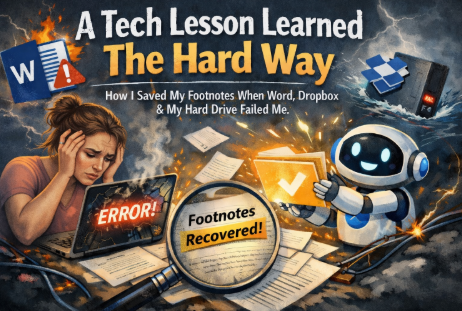
I recently had a failure that stopped me cold, even though I was absolutely certain I had done everything right. I’m sharing what happened so you can avoid making the same mistake.
My number one rule has always been to back up. And I do. Religiously. But sometimes, even that isn’t enough.
I was working on Volume 5 of Echoes of Britannia when I realized it had grown too large and really needed to be split. I saved Volume 5, made a copy on my desktop, and renamed that copy Volume 6. Then I opened Volume 5, deleted the material that would live in Volume 6, saved, and closed it. Next, I opened Volume 6, deleted the material that belonged in Volume 5, saved, and closed that file as well.
That evening, I saved both files to Dropbox and to a standalone external hard drive.
All seemed right with the world. Sure.
Three weeks later, while working on Volume 8, I became confused about a pedigree and reopened Volume 6 to double-check a spouse. That’s when I noticed something was wrong. The footnote I was looking for was gone. In fact, nearly three-quarters of the footnotes in Volume 6 were missing.
I refused to panic. Surely it was just the way Word had loaded the document. I closed it without saving and reopened it.
Nope. Still gone.
No worries, I told myself. I’ll just open the Dropbox version.
The footnotes were gone there, too.
That actually made sense, every night I saved over the same files. But Dropbox keeps deleted versions for thirty days, right? Except…there was nothing to restore. Why? Because I hadn’t deleted the file. I had saved over it using the same filename. The old version was overwritten, not archived.
At this point, panic started to creep in but I reminded myself I also saved everything to a standalone hard drive. Surely that would save me.
It didn’t.
About a week and a half earlier, I had uploaded the entire folder to the drive, overwriting those files as well.
Now I was panicking and I knew I wasn’t thinking clearly. So I did the sensible thing: I turned to Geni, my trusty ChatGPT research assistant.
After I explained the situation, he calmly told me the truth: there was no way to recover what was lost.
Then, cheerfully, he added that it wasn’t so bad. I’d written it once, so I could write it again.
OMG. No. That was the last thing I wanted to hear.
Let’s just say you were lucky you weren’t at my house at that moment. I railed against the universe. How dare this happen when I had been so careful, so diligent, so responsible?
And then, right in the middle of that fury, it hit me.
Geni might have the footnotes.
Here’s something I didn’t fully appreciate until that moment: he did. Almost all of them.
As I wrote these volumes, I frequently turned to Geni with a skeleton narrative and uploaded my research finds. My prompt was always the same: “Write a short, tight, engaging narrative with Chicago-style footnotes from the information I provide, with no subheadings or conclusions.”
Using the chat search feature, I was able to locate most of those narratives. Rebuilding the footnotes wasn’t instant but it was possible. It took three full days to reattach everything, but that was infinitely better than starting from scratch.
Eight narratives were missing footnotes. Geni explained that saved chats can sometimes be lost during system upgrades, which may account for those gaps. He also gently pointed out something else I shouldn’t be doing: I tend to write very long chats. The longer the chat, the more likely parts of it may become difficult to retrieve later.
Lesson learned.
I now know that when I save files to Dropbox or to an external drive, I must rename them every time so they don’t overwrite earlier versions. Backups only work if the history survives.
AI has been a wonderful partner in my genealogy work over the past two years, but it never occurred to me that it might become the one place where my work still existed when everything else failed.
Add this to the list of reasons why I love AI.