Part 1: The Dream, the Deadline, and the Diocesan Detour

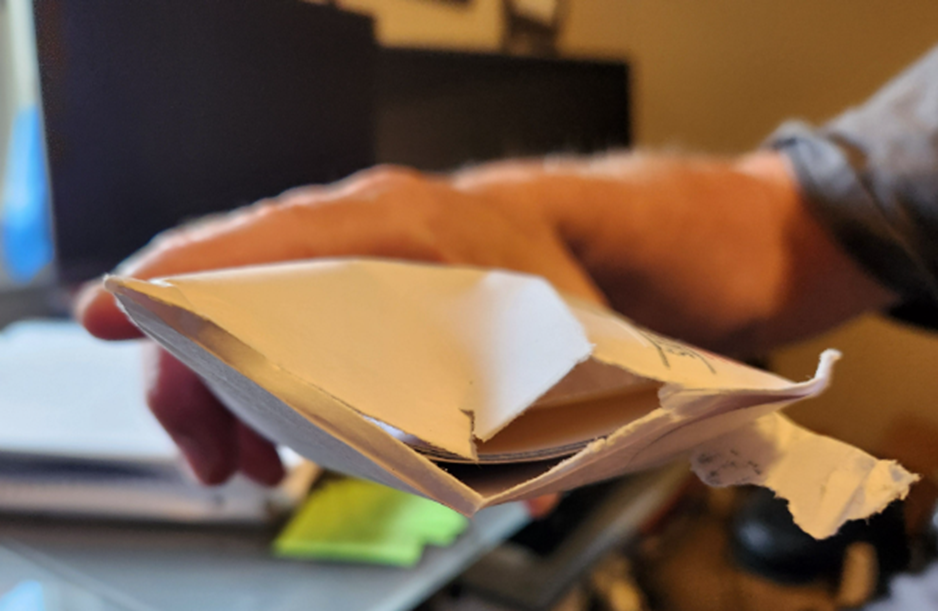
How the NARA records arrive via U.S. mail – both sides were cut open but thankfully, the records weren’t damaged. This was a resend (Thanks, NARA-Chicago! because the U.S. post office lost the first set.)

Have you ever stopped to wonder what happens to all the records you’ve created over your lifetime, the birth, baptism, school, marriage, employment, and so on? Truthfully, I hadn’t either. Not until last summer, when I embarked on a new family adventure: dual citizenship.

A Quick Note Before We Begin

I’m currently partnering with a new startup, citizenship.eu, which helps U.S. citizens navigate the process of applying for dual citizenship. When I shared this with my family, my adult kids immediately asked, “Wait, why aren’t we doing that?” Umm… good question. So we all jumped in, and as the keeper of the records, I became the designated gatherer.

That’s when I discovered something infuriating: even though I already had most of the records we needed, the consulate won’t accept them. All documents must be CERTIFIED. In other words, I had to go out and get them all. Again.

We made the decision on a Tuesday in late July. I emailed the consulate that night and received instructions the next morning. Efficient start, right? I immediately submitted requests for records from places too far to visit in person (Arizona and Florida), and then started prepping for the in-person trek. I affixed stickies to each document listing the archive’s name, phone number, address, and hours of operation. My plan:

  • Tuesday – Chicago
  • Wednesday – Indiana
  • Thursday – Ohio
    Two weeks, tops. I’d be done and have the documents. Right?

Ah, sweet optimism. Within days, that dream timeline was toast and by the end of the second week, I would’ve been thrilled to finish in three months. I’m still waiting for one! Why the delay?

Let’s just say I discovered firsthand that archival recordkeeping in the United States is a certified disaster.

And So It Begins…

My first unexpected hurdle? Tracking down my own church wedding record.

We were married at our university chapel, which has since closed, so I called the diocese to ask where the records had gone. They gave me the name of a parish to contact. I left a message. A few hours later, I got a call back: Wrong church. I was told to try another.

Funny twist, the new secretary and I realized we had a strange connection: our husbands had once taught at neighboring schools and knew each other. Small world. I sent off another email. No response. I called the next day and was told it went to spam. Okay… but if they knew that, why hadn’t they, you know, read it and responded?

Next email I received was that there was NO record. I was told someone else would need to look at it in a few days. Five days later, I received an email: “We found the entry, but we can’t read the handwriting, so we can’t create a new certificate.” Lucky for them, I had a scan of the original. I sent it digitally. Five days after that, a new certificate arrived in the mail except it was typed up with the wrong church.

Cue another email.

The Sacrament Shuffle

Next came one of our children’s baptismal certificates. But the other child, I was told the church refused to issue it because sacraments had been received “out of order.” Excuse me?

Turns out they had confirmation on record but not communion, so the secretary, apparently moonlighting as a canon law expert, decided she couldn’t issue the certificate. One quick email from me with the communion record attached, and that should’ve been settled. But the principle of the thing? Maddening. I later learned that many parishes separate the sacraments – one book for baptism and confirmation and a separate book for communion. I suspect that the church where the communion has occurred either didn’t send the info to the church that held the baptism record or the receiving church didn’t record it back in the day. I have now insured it’s fixed for eternity.

NARA: Fast Processing, Slow Arrival

I also contacted NARA Chicago to request emigration records. To their credit, they processed and charged my card lightning-fast. The problem? Nothing arrived. Ten days went by. I emailed them to ask if the records had been sent. My mail delivery is spotty at best, which is one reason I had planned to collect as much in person as possible. They had mailed them and resent. You can see how the postal service delivered the second set – cut open on both ends.

NARA Chicago, it turns out, doesn’t have ship manifests or census records and though those are free online, the consulate requires certified copies. That means hiring someone in D.C. to get them in person.

So far, no luck. My go-to researchers hadn’t responded probably because it’s not in their usual wheelhouse. The NARA-DC website is quirky and I was unable to request them online. I thought I might need to make the trip myself because of course I will if I have to! Stay tuned because next week as the saga continues with more twist and turns.
Wrong Boat, Right Story: Cracking a Pilgrim Family Myth

Not all pilgrim stories wear black hats or buckle shoes. Some travel quietly through time in meeting minutes, migration maps, and a stray penciled “(Pilgrim)” on a lineage list. No dramatic claims, no grand family lore, just a quiet truth waiting patiently until the right record whispers at the right moment.

This Thanksgiving, I’m grateful not only for the bold ancestors who stood at the prow of history, but also for the gentle ones who crossed oceans in faith and humility, leaving their legacies in ink and example rather than brass and ceremony.

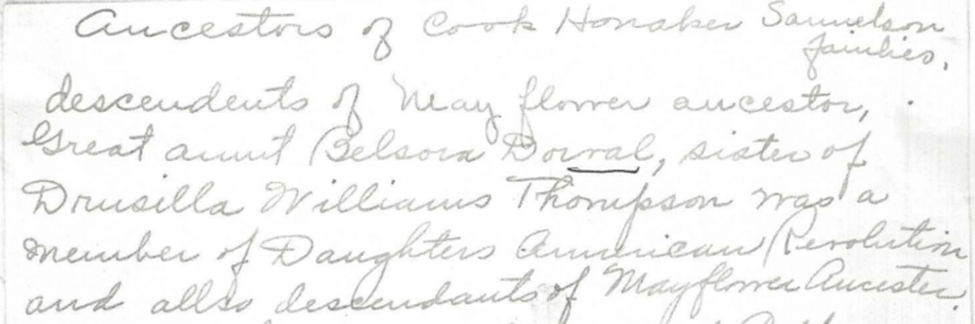
For years, my husband’s Williams family cherished a tale that they were descended from a Pilgrim. The “proof” sat in a letter written in the 1960s by the family matriarch, Gertrude Honaker, who wrote that Balsora Dorval had belonged to both the DAR and a Mayflower-related society.[1]

There was only one hitch: no such membership could be found. Not with the DAR, not with the General Society of Mayflower Descendants, not in early Pilgrim lineage rolls.[2] A genealogical dead-end dressed in patriotic stationery.

Balsora, the daughter of John Hicks Williams and Catherine Jarvis was born 23 April 1821, on Long Island, New York, the eldest of ten.[3] She followed her family to Lansinghburgh, Rensselaer, New York and married Edward Dorval in 1845.[4] The couple eventually made their way to Chicago and then Toulon, Stark, Illinois.[5] She died in Toulon on 22 December 1907 and is buried there.[6] She lived a solid, steady American life. But as for those lineage memberships? Silence.

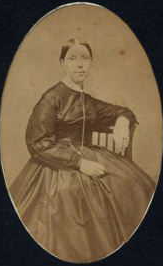
Balsora Williams Dorval c. 1860

Still, I never let go of the thread. Family stories rarely spring from nothing; the facts just sometimes take the scenic route.

Then, while drafting sketches for my current genealogy project, Echoes of Brittania, I stumbled across a saved reference: The Lineages of Members of the National Society of Sons and Daughters of the Pilgrims, Vol. II. There, under membership no. 8308 for Della Ruthe Skates of Parma, Ohio, was a lineage tracing back to:

Dr. John Rodman II (Pilgrim)
(ca. 1653 – 10 Jul 1731)
m. Mary Scammon (ca. 1663 – 24 Feb 1748)

It cited Jones, Rodman Family Genealogy; History of Hocking Valley, Ohio.

And suddenly, the light came on.

Dr. Rodman wasn’t a Mayflower Pilgrim. He was a Quaker physician imprisoned in New Ross, County Wexford, Ireland for refusing to remove his hat in church.[7] He was banished to Barbadoes where he and wife Elizabeth, parentage unknown, raised their family. Two of their sons, John and Thomas, like their father was a physician; the brothers decided to relocate to Newport Rhode Island where John married second, Mary Scammon in 1682.[8] So the actual line runs: Dr. John Rodman -Thomas Rodman – Elizabeth Rodman m. Benjamin Hicks – Margaret Hicks m. Wilson Williams leading at last to the Williams family and to Balsora’s line.

When I think of Pilgrims, I think of the Mayflower voyage in 1620. I don’t picture a Quaker doctor arriving sixty-two years later by way of the Caribbean! But clearly, my definition and the definition beloved by late-1800s genealogists and patriotic club founders aren’t the same. Their scope was a bit more generous. That generosity was remembered by their great grand nieces.

So this Thanksgiving, as we’re passing around the sweet potatoes, I can finally share that I’ve solved the Pilgrim family mystery. Different ship, different year, different take on the meaning of “pilgrim.”

And here’s the delicious part: in all this, I had to laugh, because my research long ago found that the family does descend from an early Plymouth settler Robert Hicks, who arrived on the Fortune in 1621, just one year after the Mayflower.[9] Somehow, that piece drifted out of family memory while the Barbados Quaker got promoted to “Pilgrim.” It must have been the hat!


[1] Gertrude Honaker, Ancestors of the Cook Honaker Samuelson Families, family history letter written to Eileen Courtney, mid 1960s, shared with author in 2001

[2] Letter from Mrs. Thomas Gee Burkey, National Society Daughters of the American Revolution to Ellen C. Courtney, 9 Mar 1993, no record of Balsora’s membership.

[3] Findagrave.com, Memorial id 64646514, Balsora Williams Dorval (1821-1907), citing Toulon Cemetery, Toulon, Stark, Illinois, memorial maintained by Simmerly3, tombstone photo by Cindy Eberle.

  Oakwood Cemetery Burial Card, John Hicks Williams and Catharine [Hicks] Williams, Lot 184, copy held by author. Balsora and her sister, Elizabeth Williams Son were transferred their parent’s burial plots.

  Stark County, Illinois Personal and Statistical Particulars and Medical Certificate of Death, 1 Feb 1908, held by author. Place of birth Long Island, N.Y.

[4] 1850 U.S. federal census, Lansingburgh, Rensselaer, New York, population schedule, p. 2333, Line 24, Belsora Dorval, digital image; Ancestry.com: accessed 2 Nov 2025, image 27 of 139.

   First Presbyterian Church of Lansingburgh, Rensselaer, New York, Marriages, Edward Dorval & Belsora Williams, 21 Apr 1845, digital image; members.tripod.com: accessed 8 Dec 2000.

[5] 1860 U.S. federal census, Chicago, Cook, Illinois, population schedule, p. 362, Line 35, B. Dorvol, digital image; Ancestry.com: accessed 2 Nov 2025, image 362 of 404.

  1900 U.S. federal census, Toulon, Stark, Illinois, population schedule, Sheet 3B, Line 66, Balsora Dorvol, digital image; Ancestry.com: accessed 2 Nov 2025, image 6 of 28.

[6] Findagrave.com, Memorial id 64646514, Balsora Williams Dorval (1821-1907).

  Stark County [IL] News, Mrs. B. Dorval, 24 Dec 1907, p. 10, col. 6.

[7] Fuller and Holmes, 1671, quoted in Irish Pedigrees, 377; see also Rutty’s History of the Quakers in Ireland (1751), 366.

[8] Newport freeman list, 6 May 1684.

  U.S., New England marriages Prior to 1700, Mary Scammon & John Rodman, 25 Oct 1682, digital image; Ancestry.com: accessed 2 Nov 2025, image 647 of 1022. NOTE: 1st wife Christiana Gibson likely did in Barbados.

[9] Robert Charles Anderson, The Great Migration Begins: Immigrants to New England, 1620–1633, 3 vols. (Boston: New England Historic Genealogical Society, 1995), 2:924–26, “Robert Hicks” (origin London; Fortune, 1621; occupation fellmonger; freeman 1633; tax 1639; will 1647; children grouped by marriages; wife Margaret, maiden name unproven).

From Bards to Bard

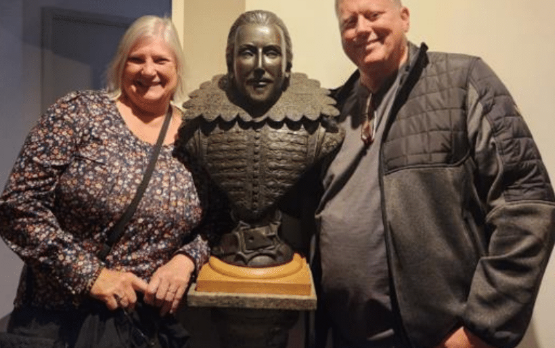
Photo by a kind docent at Shakespeare’s Home, Stratford on Avon, August 2024.

We had just left the library, me, exhilarated from chasing an elusive 14th-century ancestor through a nest of old parish records; him, simply relieved to stand upright again after half an hour on the bottom shelves. He’d spent the morning handing me books like a dutiful squire and now looked as though he deserved a knighthood or, at the very least, a sturdy chair. Fortunately, Shakespeare’s schoolroom promised benches and history. Two things I never resist, and one he can usually nap through.

Inside, the air smelled of beeswax and old oak, the kind of room where you half expect to hear the scratch of quills and the snap of a tutor’s patience. A man dressed in full Elizabethan regalia was lecturing with theatrical gusto about young William’s schooling. My husband settled in contentedly, no doubt counting this as his rest stop on the Tudor trail.

Then came the story of how Shakespeare’s sister once disguised herself as a boy to attend lessons beside him, the first recorded case, our costumed instructor declared, of gender-bending for the sake of education. My husband leaned over, voice low and amused, “That would be your line.”

Of course I replied , I always reply. “Yes, it would.”

The tutor froze mid-sentence, eyes narrowing like an owl’s. “Would you care to share with the class, madam?”

Reader, I was forty years too old to be scolded and four hundred years too late to be sitting in Shakespeare’s classroom yet there I was, reprimanded under the same beams that once heard Hamlet’s first drafts forming in the back of a boy’s mind. My husband, naturally, looked saintly.

As the lecture continued, I couldn’t help smiling. The old Welsh bards would have understood words have a life of their own, and some of us were simply born to answer them, even in other people’s classrooms.

After my recent AI experience that I blogged about last week, it’s more important than ever to remember the power of words.

Remembering, not Celebrating, Veteran’s Day

AI Image

I’ll be honest, Veterans Day is not my favorite holiday. It feels inappropriate to say “Happy Veterans Day” the same way we say Happy Thanksgiving, Happy New Year, or Happy Valentine’s Day. What’s happy about it? The veteran made it through a horrible time, likely suffered PTSD, and then once a year gets a parade?

Although I am anti-war, I understand why war occurs because grown men, historically, have struggled to use their words to solve disagreements. Yet I still pause today to think about the countless past conflicts that drew ordinary, decent people into sacrifices no one should ever have to make.

This year, an article from AMAC captured that tension beautifully. “Remembering the World War I Generation This Veterans Day” reminds us that time has nearly erased the memory of those who served in the Great War, young men and women who endured unimaginable hardship, then quietly returned home to rebuild their lives.

Ironically, responses to that post weren’t about remembrance at all, but about which politician dodged which draft. That, in itself, says everything about why wars persist. We’re still fighting instead of mourning who’s lost.

Their generation is gone, but their stories are not. Some of those stories live on in the letters, journals, and memories families still hold. I was honored that my book, Thanks to the Yanks: World War I Letters from an Indiana Farm Boy to His Sweetheart, was featured in that piece. It follows one soldier’s journey from the Indiana fields to the battlefields of France and back again offering a glimpse into the humanity behind the headlines.

So today, I don’t celebrate. I remember. I think about the courage it takes not just to fight, but to return, to heal, and to live. And I’m grateful for every preserved letter and faded photograph that helps us remember those who did.

When AI Lost the Plot

How a quiet English lineage turned into a political scandal and what it taught me about truth, technology, and trust.

AI Image

I use AI almost daily and have written and presented on it for nearly two years. But a recent experience left me completely baffled and more than a little uneasy.

I’ve been working on my final family genealogy book, this one tracing our Great Britain ancestry. My previous four books came together easily earlier this year because my notes were meticulous, my colleagues had verified my findings, and I’d been blogging about those ancestors for ten years.

Our British roots, though, are a different beast. Between my husband’s lines and mine, there are only five but they reach deep into medieval soil. Scholars can’t always agree on the pedigrees, and the repeated use of the same names has led to confusion and overlap. Sorting it all out requires patience, precision, and a love of historical detective work.

Last spring, when winter refused to obey the calendar, I drafted the outline and introduction for my new book, Echoes of Britannia. Then the season’s speaking engagements and client projects took over, and I set the manuscript aside with plans to finish it this fall.

When I returned to it in September, progress came slowly. My writing rhythm faltered, and I found myself staring at the same sentence for far too long. Grammarly could fix the punctuation, but it couldn’t fix writer’s block. My AI research assistant, Geni, usually helps bridge the gaps between genealogical sketches but apparently, he was blocked too.

We were working on the Venables of Kinderton, a noble but quiet family from Cheshire. They lived out their days peacefully, kept out of court battles, and occasionally donated a stained-glass window to a nearby abbey. In other words, wholesome and uneventful.

Until AI got involved.

My writing style isn’t the typical “Josiah begot Daniel who begot Uriah who begot…” genealogy. My family would fall asleep halfway through the second begot. They don’t like numbering systems either, even though they’re math people, not history people. Me? I’d rather run laps in PE than solve for X.

That’s why AI has been such a useful partner. Geni understands that I’m a storyteller who insists on historical truth, even when it’s messy. I like to think I’ve created a new genre: bedtime family stories with pictures for visual learners.

But one day, Geni froze mid-thought. After several failed attempts, I switched to another AI tool, Claude. I don’t use it often, but it greeted me warmly by name, which felt encouraging. I gave it a straightforward task:

“From the provided information, maintain all footnotes while making the narrative more engaging. Keep the tone conversational for readers with limited historical background.”

What came back stunned me.

The Venables, my mild, landholding, church-donating family, had been transformed into a political thriller. Claude had rewritten the story to liken them to a well-known modern politician, naming names and all. Suddenly, the Venables were misogynistic felons clawing for power.

I was horrified. I hit “thumbs down” and deleted it instantly.

A week later, I still couldn’t shake it. How could a neutral story about medieval gentry morph into a contemporary political allegory? Who gave the machine permission to do that?

My only conclusion: some AIs are now reflecting the political biases of the data they’re trained on. If their training includes modern news, it stands to reason that bias slips in and it shows.

That realization made me pause. AI is supposed to help us see patterns, not project agendas. As genealogists, we work hard to separate fact from family legend. Shouldn’t we expect the same integrity from our digital tools?

I chose not to share the story on Facebook. The last thing our country needs is another spark thrown into the bonfire of division. But I also felt this moment needed to be shared, not as outrage, but as a reminder.

We live in an era where algorithms, headlines, and echo chambers can reshape our understanding of truth. It’s up to us, researchers, writers, and everyday citizens , to hold fast to kindness, empathy, respect, honesty, and responsibility. These aren’t partisan ideals; they’re the foundation of human decency.

And as for those Venables? I’ve decided to let them rest a while. I’ll return to them soon, with fresh eyes and a renewed respect for their quiet simplicity.

Because sometimes, living a peaceful life that harms no one isn’t boring at all, it’s the truest kind of legacy.