If genealogy is a study in patience, dual citizenship is a graduate-level course in patience, frustration, and occasional disbelief.
Back in April, I reached out to a court-approved translator recommended by the consulate to translate and certify the records I had painstakingly collected. I waited. Nothing. I wrote again. Still nothing. Hoping for another recommendation, I contacted the consulate only to learn they no longer provide them.
Well then.
Fortunately, a former client came to the rescue and recommended a translator named Paula. We connected quickly, and I emailed the documents needing translation and certification. Somehow, and I checked twice, my own birth record performed a disappearing act and failed to attach.
Of course it did.
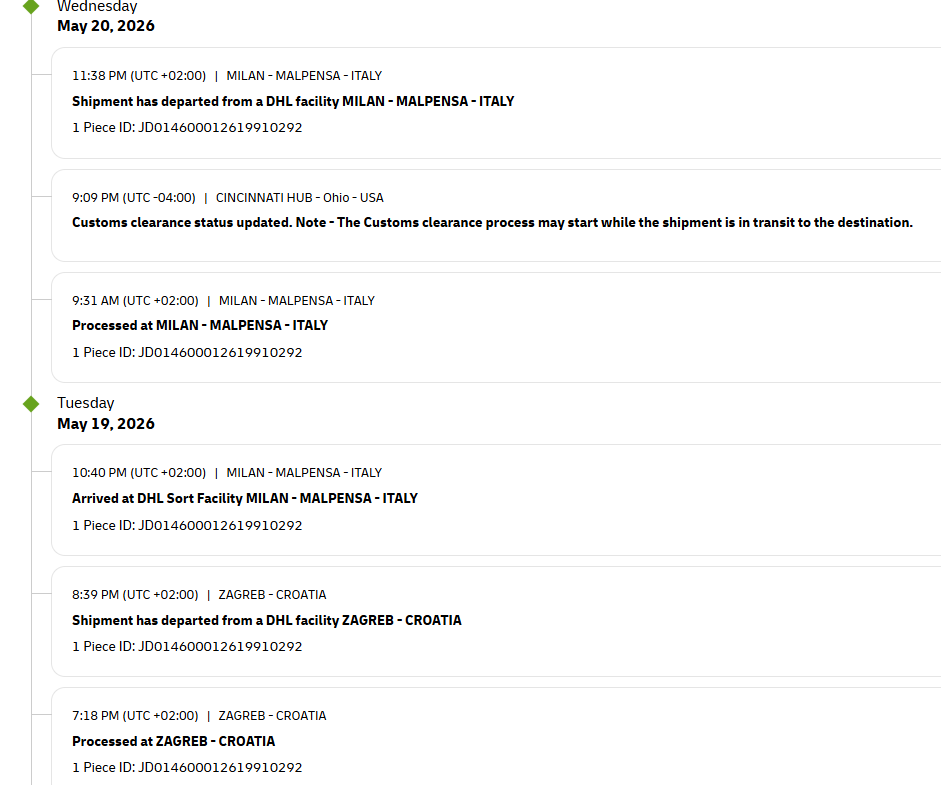
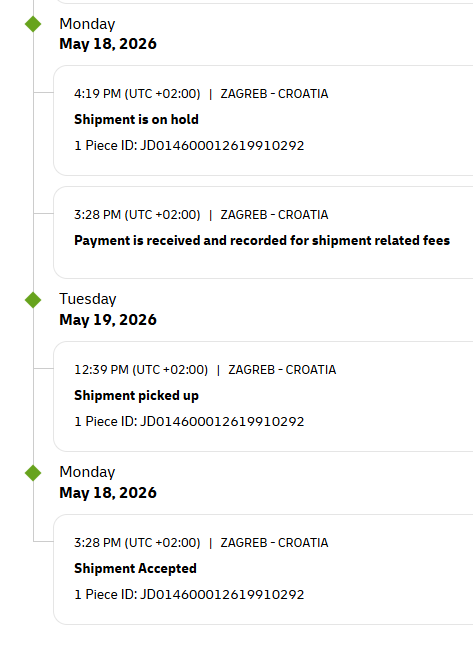
Paula mailed the completed records via DHL on 18 May, with an anticipated arrival date of 21 May. Someday, likely in October, I will share the strange saga involving an email with the wrong address and entirely wrong city. Suffice it to say, the moment I spotted the problem, I contacted both Paula and DHL. The error was not on Paula’s end.
My adventure with DHL, however, was just beginning.
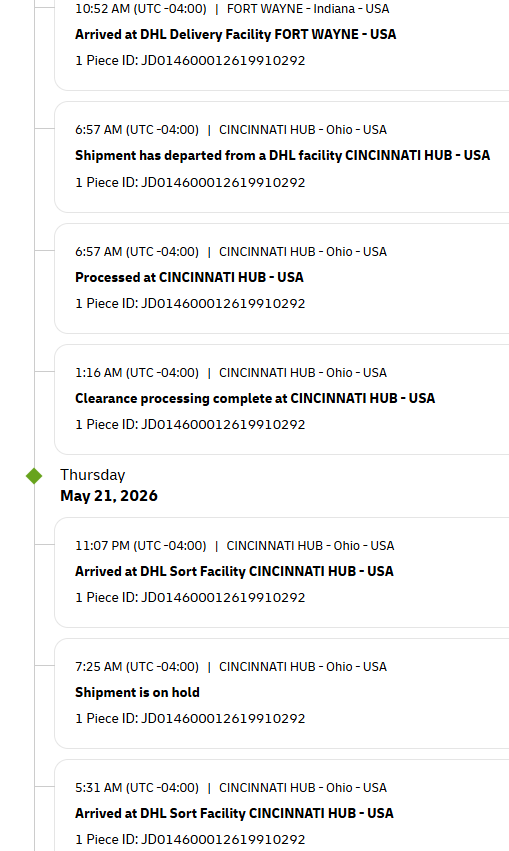
When Thursday came and went with no delivery, I remained optimistic. The package had reached Cincinnati. Surely it would arrive Friday. How long could it take to travel from Cincinnati to northern Indiana?
As it turns out: considerably longer than one might expect.
The package cleared Cincinnati at 6:57 AM Friday and headed to Fort Wayne, a short distance from my home and, in my increasingly hopeful imagination, the final stop. Instead of delivering it, DHL sent it to Dayton.
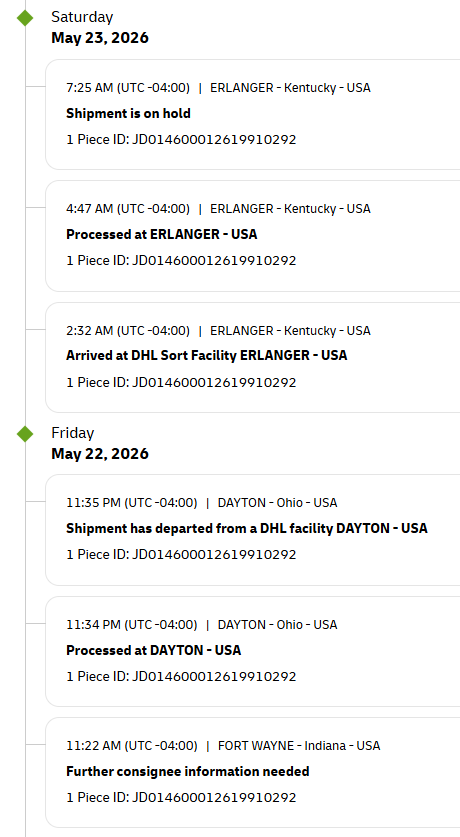
Dayton politely emailed me requesting that I verify my address again. I complied and selected Tuesday as my delivery date because, apparently, choice is an illusion and Tuesday was the only option available.
Then things became truly creative.
On Saturday, Dayton sent the package to Erlanger, Kentucky.
Why?
An excellent question. Customer Service did not know either.
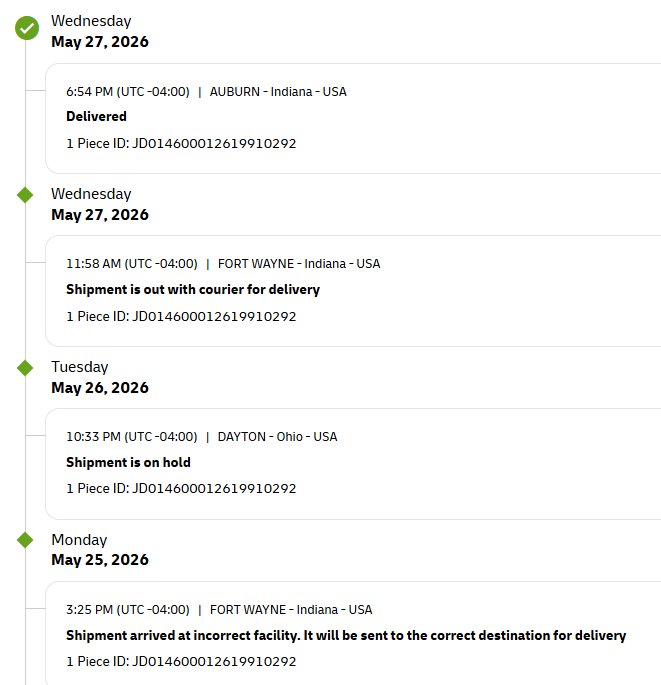
Erlanger held the package hostage for two days before returning it to Fort Wayne on Monday, now a full week after it had left Croatia.
Fort Wayne then declared it had arrived at the wrong destination.
No, Fort Wayne. I live near you. We were so close to success. Had someone simply called me, I would have cheerfully driven over and rescued the wandering documents myself.
Instead, Fort Wayne sent the package back to Dayton.
Dayton placed it on hold Tuesday.
By Wednesday it had returned to Fort Wayne, which once again announced it would be delivered.
Hope springs eternal.
Unfortunately, experience had by then replaced hope with strategy. Before Fort Wayne could develop another urge to send the package sightseeing, I called Customer Service.
The shipment was finally received Wednesday at 6:54 PM.
Customer Service had promised delivery by 7:00 PM, and to their credit, they met that deadline by a remarkable six minutes, albeit nearly seven days late.
As genealogists, we love timelines. Postal timelines? Not so much.
At this point, I am fairly certain the Pony Express could have delivered the records faster and with fewer state lines involved.
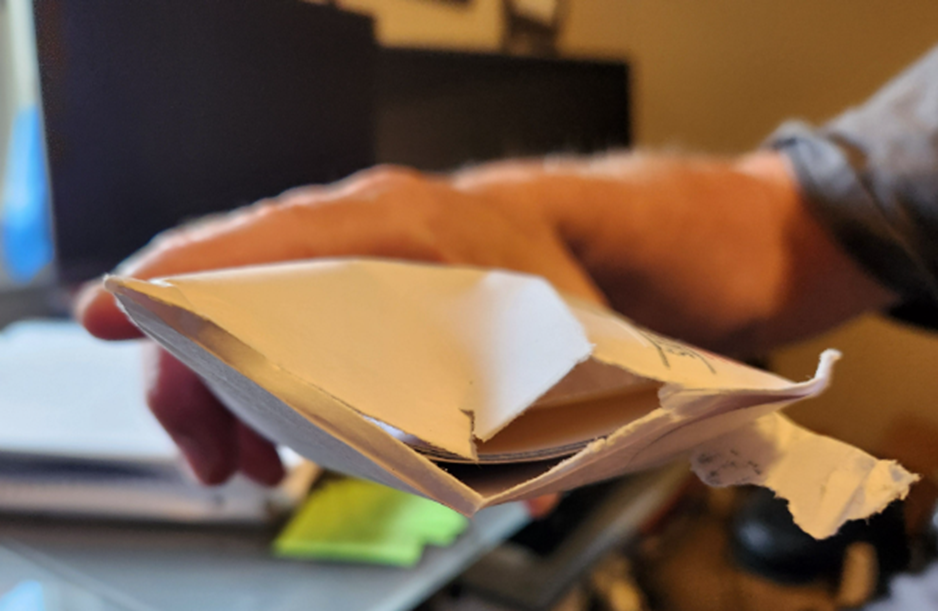
The package was torn open but thankfully, the documents were intact.
And now for the painful epilogue.
This postal adventure cost over 150 euros for the original shipment. Thanks to my own missing attachment mishap, I must now spend another 150 euros to have the overlooked birth record translated and shipped.
Which means I will soon be playing the DHL Waiting Game once again.
In November–December 2026, I wrote a series of blog posts about my experience obtaining records for dual citizenship. Since then, I’ve received weekly messages from people interested in pursuing dual citizenship themselves.
Let me be clear: I didn’t write those posts to discourage anyone. I wrote them to be transparent.
If I were hiring someone to help me with a complex, expensive, emotionally charged process, I would want honesty about the cost, the delays, the bureaucracy, and the unexpected hurdles. That’s what I aim to provide my clients in every aspect of my work.
One important disclosure: I contract with citizenship.eu and do not take private clients for dual citizenship applications. My role here is to share my experience, not to sell services.
By early December, I had finally received every record I requested, starting back in July. The last document to arrive was from NARA–DC: my grandmother’s ship manifest, which came on December 3. I didn’t blog about that particular request because it was made online but it came with its own challenges. The NARA website doesn’t always cooperate, the government shutdown delayed retrieval, and I couldn’t find a genealogist available to physically retrieve the record in Washington, D.C.
So yes, even the “easy” requests weren’t always easy. I then had to send it off to be apostilled. The record was returned to me 3 days ago.
If you’re considering dual citizenship, here’s what I wish someone had told me before I started.
Contact the consulate before you do anything else. Not after. Not halfway through. Before. This ensures you understand exactly what they require and it puts you on their radar. In my case, I was emailed detailed instructions which were clear and helpful.
Begin acquiring records and brace yourself. This phase is both expensive and time-consuming. I ordered two certified copies of every record and obtained several documents I didn’t initially plan to submit, simply to have a complete, redundant set in case anything was lost or damaged.
My total cost for records was $1317.80. That included my immigrant grandmother’s birth, marriage, death, ship manifest, and naturalization records; my mother’s birth and baptismal records (because no civil birth record existed), marriage, and death certificates; my own birth and marriage records (both church and civil, because my given name differed); my husband’s birth certificate; and the birth certificates of my adult children and their partners. Some of us all also needed to update our passports which were due for renewal.
I also obtained records I didn’t expect to submit, death certificates for my great-grandparents, my grandfather, and my father, along with his birth certificate, just in case questions arose about lineage. I may not need them, but I sleep better knowing they exist. Those costs are not included in the above total.
Every document must be apostilled. This is a separate authentication process that verifies the legitimacy of public documents for international use. Apostilles add both time and cost, and the process varies depending on whether the document is state or federally issued.
All of the records I plan to submit require apostilles, including birth, marriage, death, naturalization, ship manifests, and FBI clearance. Each record must be sent to the appropriate authority; the state records to the Secretary of State, federal records to the U.S. Department of State, along with forms and fees.
So far, my apostille costs total $305.00, with one state still remaining. I plan to handle Illinois in person because mail processing there is painfully slow. My mailing costs alone reached $92.45 and that amount increased when Florida rejected my apostille request because I included a church marriage record they would not certify. That error added a month-long delay and another trip to the post office.
Here’s my strongest advice: always include a prepaid return envelope with tracking. It costs more, but if documents are sent back by regular mail, they can disappear forever.
FBI clearance was surprisingly the easiest step. You complete the application online and should not include your Social Security number, since the document will be sent overseas. After submitting the form, you’re directed to a local post office for fingerprinting. We opted for electronic fingerprints and received results almost immediately, before we even paid the fee while waiting in line at the site.
If electronic fingerprinting fails, you’ll need to use a paper card and mail it in, which adds time and cost. Ironically, the FBI clearance often considered the slowest part, was the fastest, aside from the three months it took for the apostille.
You will need a certified translator. Ask the consulate if they have preferred translators, or research carefully through reliable sources (yes, Reddit threads can be useful here). Certified translators are approved by the courts of the country where you’re applying, and they are expensive.
I haven’t completed all translations yet, but the estimated cost will be around $5,000. Some translators will assist with applications, biographies, and statements of intent; others will not. I chose to work with a genealogist who obtained my grandmother’s baptismal record, a trusted colleague who kindly offered a discounted rate.
This is where patience goes to die, acquiring records from the country of origin is not easier than obtaining them in the U.S.
In my case, it took two months to obtain a single certified record. The office closed for two weeks for vacation. When the genealogist arrived at the scheduled appointment, she was told, incorrectly, that the church had to issue the record. A week later, the church sent her back to the civil office. Then the church had to write a letter instructing the civil office to release the document. Two more weeks passed before the record was issued. Then it took three weeks for international mail to deliver it.
No one was rude. No one was helpful. Bureaucracy is bureaucracy everywhere.
Understand that dual citizenship is a process of hurry up and wait. Once our records are translated, my family will wait until late October for our consulate appointment in Chicago. There, a consular employee will review our documents to ensure we are submitting the correct ones. Copies will be retained by the consulate, the certified apostilled originals with transcription and that apostilled sent overseas (and yes, I ordered extras because I’m paranoid). There is a fee for submission that is reasonable, considering how much was already spent.
After submission, the waiting begins, sometimes two to five years or more.
I also incurred costs for hotel/gas/parking/meals while we tried to obtain records in person. ($703.47).
So far, I’ve spent less than average as typically dual citizenship can cost between $10,000-20,000.00. My cost was less because I sought out the records on my own in all but one case. I also did not hire a lawyer which is sometimes needed, depending on the country and the situation.
So why would anyone willingly endure this?
Everyone’s reasons are different. For my family, it’s about global mobility and connection. We still practice the customs of my grandmother’s culture, and when we are in Croatia, it feels like home. There should be a language barrier because our Croatian stinks but somehow we razumjeti (understand). I’ll be working on improving while we wait for the decision.
Others pursue dual citizenship for healthcare, education, lower living costs, or expanded career opportunities. Business owners may relocate to continue serving existing clients while building new markets. And many younger applicants, especially those in their twenties, simply want options. I hear that sentiment often.
Dual citizenship is not a weekend project, a budget-friendly endeavor, or a fast-track solution to anything. It is expensive, slow, frustrating, and emotionally taxing. It requires organization, patience, and a tolerance for bureaucracy that most people don’t realize they lack until they’re knee-deep in certified copies and apostille forms.
But for those who value connection, opportunity, and the ability to move through the world with greater freedom, it can be worth every delay and every dollar.
My goal in sharing this update isn’t to persuade you one way or the other. It’s to help you make an informed decision. If you choose to pursue dual citizenship, go in with open eyes, realistic expectations, and a very good filing system. And if you decide it’s not for you, that’s not failure, that’s wisdom.
If this process has taught me anything, it’s that knowing what you’re walking into makes all the difference.
Cook County, Illinois Marriage Indexes, 1912-1942, Koss, Mary, digital image; Ancestry.com: accessed 30 July 2025, image 145 of 304.
After all the issues I’d already encountered (you can read about here), I foolishly believed things could only get better. So off to Chicago I went.
Stop 1: Cook County Clerk’s Office
I started at the County Clerk’s office, bracing myself, several colleagues had warned me about unhelpful staff. To my surprise, the clerk I got was wonderfully professional. One small mercy. Unfortunately, I didn’t walk away with any of the three records I was hoping for.
I had a certificate number for my grandparents’ marriage record, but it wasn’t in the system. You can see it exists from the picture above. I was also looking for a birth certificate that was possibly never filed; after all, I had a church-issued “Birth and Baptism” certificate. Back then, churches often issued those in lieu of civil records, and that document had even been used by a family member to enroll in Social Security. Still, no luck.
I was also searching for a death certificate I’d requested by mail on 31 March, four months prior to my visit, with no response. After about an hour of searching, the clerk informed me that a specialist would need to take over the research and contact me once they found something.
Correction: if they find something.
Stop 2: The Elusive Archives
Tip for Cook County researchers:
Ask security where to scan your parking garage ticket to get a discount.
When you first arrive, skip the main office, go down the first hallway with a large sign and a barcode. Scan it to get an electronic number. My wait? Only 25 minutes.
While I waited for a maybe, I moved on to Plan B: the Archdiocese of Chicago.
From there, I drove several blocks to the address listed on the Archdiocese’s website. Found a garage, $27 for 15 minutes (ouch), and entered the building.
Inside, I was informed (drumroll…) the archives are no longer located there. They knew the website was wrong. No apology, no signage, no indication they planned to correct it. Clearly, they don’t want people to use the archives.
The receptionist suggested I call the real archives before heading over I suppose they don’t like visitors. I did and was told to mail my request instead of dropping it off. I explained I was already in town for one day and just wanted to drop off the application to ensure my information was correct.
Back to the car. $27 parking bill for 15 minutes. No discount from the diocese, either. So much for grace.
Stop 3: A Parking Lot Blessing?
I spotted another lot across from what I hoped was the correct archives this time only $11 for 15 minutes. Progress! As I crossed the street, I realized the building was none other than Old St. Pat’s, where my husband’s great-great-grandmother, Mary “Molly” O’Brien Cook, had secretly brought her sons to be baptized. (Read my blog about dear Molly)
That felt like a good sign. (Also made for a great photo op.)
Inside, however, I was told the archivist wasn’t available, was going on a two-week vacation, and I shouldn’t check back until late August. The secretary reviewed my paperwork, made a few copies, took my check, and that was that.
The wrinkle? I wasn’t 100% sure which church my grandparents had married in, either St. Salomea, which is now closed, or St. Benedict’s, the family’s parish at the time of my great grandparents’ last child’s birth. Here’s a fun fact: if you don’t know the exact church, the Archdiocese will not help you. No guessing allowed.
I gambled on St. Salomea and asked how to access St. Benedict’s records. “They’re still open,” the secretary told me, handing me their address. I asked if she’d mind calling ahead to make sure someone would be there. She wouldn’t. Just handed me the address and not even a good-bye. Wouldn’t give me the phone number, either.
So, onward to Blue Island.
Stop 4: St. Benedict’s—Sort Of
About 30 minutes later, I arrived to find the church closed and the office now located somewhere else entirely. Apparently, the Archdiocese archives hadn’t gotten the memo.
My GPS couldn’t find the new location, so we tried another app and eventually found the building, locked. After ringing the bell twice, a woman finally came to the door. Without opening it, she told us everyone was in a meeting and to come back later.
I explained that I’d been sent by the Archdiocese and simply wanted to leave a message. After a pause, she let us in and asked for the couple’s names and marriage date. I handed her a copy of the Cook County index listing with the certificate number.
She disappeared into a back room, reemerged a few minutes later, and informed me: “No one by that name was married on that date.”
How the NARA records arrive via U.S. mail – both sides were cut open but thankfully, the records weren’t damaged. This was a resend (Thanks, NARA-Chicago! because the U.S. post office lost the first set.)
Have you ever stopped to wonder what happens to all the records you’ve created over your lifetime, the birth, baptism, school, marriage, employment, and so on? Truthfully, I hadn’t either. Not until last summer, when I embarked on a new family adventure: dual citizenship.
A Quick Note Before We Begin
I’m currently partnering with a new startup, citizenship.eu, which helps U.S. citizens navigate the process of applying for dual citizenship. When I shared this with my family, my adult kids immediately asked, “Wait, why aren’t we doing that?” Umm… good question. So we all jumped in, and as the keeper of the records, I became the designated gatherer.
That’s when I discovered something infuriating: even though I already had most of the records we needed, the consulate won’t accept them.All documents must be CERTIFIED. In other words, I had to go out and get them all. Again.
We made the decision on a Tuesday in late July. I emailed the consulate that night and received instructions the next morning. Efficient start, right? I immediately submitted requests for records from places too far to visit in person (Arizona and Florida), and then started prepping for the in-person trek. I affixed stickies to each document listing the archive’s name, phone number, address, and hours of operation. My plan:
Tuesday – Chicago
Wednesday – Indiana
Thursday – Ohio Two weeks, tops. I’d be done and have the documents. Right?
Ah, sweet optimism. Within days, that dream timeline was toast and by the end of the second week, I would’ve been thrilled to finish in three months. I’m still waiting for one! Why the delay?
Let’s just say I discovered firsthand that archival recordkeeping in the United States is a certified disaster.
And So It Begins…
My first unexpected hurdle? Tracking down my own church wedding record.
We were married at our university chapel, which has since closed, so I called the diocese to ask where the records had gone. They gave me the name of a parish to contact. I left a message. A few hours later, I got a call back: Wrong church. I was told to try another.
Funny twist, the new secretary and I realized we had a strange connection: our husbands had once taught at neighboring schools and knew each other. Small world. I sent off another email. No response. I called the next day and was told it went to spam. Okay… but if they knew that, why hadn’t they, you know, read it and responded?
Next email I received was that there was NO record. I was told someone else would need to look at it in a few days. Five days later, I received an email: “We found the entry, but we can’t read the handwriting, so we can’t create a new certificate.” Lucky for them, I had a scan of the original. I sent it digitally. Five days after that, a new certificate arrived in the mail except it was typed up with the wrong church.
Cue another email.
The Sacrament Shuffle
Next came one of our children’s baptismal certificates. But the other child, I was told the church refused to issue it because sacraments had been received “out of order.” Excuse me?
Turns out they had confirmation on record but not communion, so the secretary, apparently moonlighting as a canon law expert, decided she couldn’t issue the certificate. One quick email from me with the communion record attached, and that should’ve been settled. But the principle of the thing? Maddening. I later learned that many parishes separate the sacraments – one book for baptism and confirmation and a separate book for communion. I suspect that the church where the communion has occurred either didn’t send the info to the church that held the baptism record or the receiving church didn’t record it back in the day. I have now insured it’s fixed for eternity.
NARA: Fast Processing, Slow Arrival
I also contacted NARA Chicago to request emigration records. To their credit, they processed and charged my card lightning-fast. The problem? Nothing arrived. Ten days went by. I emailed them to ask if the records had been sent. My mail delivery is spotty at best, which is one reason I had planned to collect as much in person as possible. They had mailed them and resent. You can see how the postal service delivered the second set – cut open on both ends.
NARA Chicago, it turns out, doesn’t have ship manifests or census records and though those are free online, the consulate requires certified copies. That means hiring someone in D.C. to get them in person.
So far, no luck. My go-to researchers hadn’t responded probably because it’s not in their usual wheelhouse. The NARA-DC website is quirky and I was unable to request them online. I thought I might need to make the trip myself because of course I will if I have to! Stay tuned because next week as the saga continues with more twist and turns.