
Dual Citizenship Part 2: Chicago Chaos

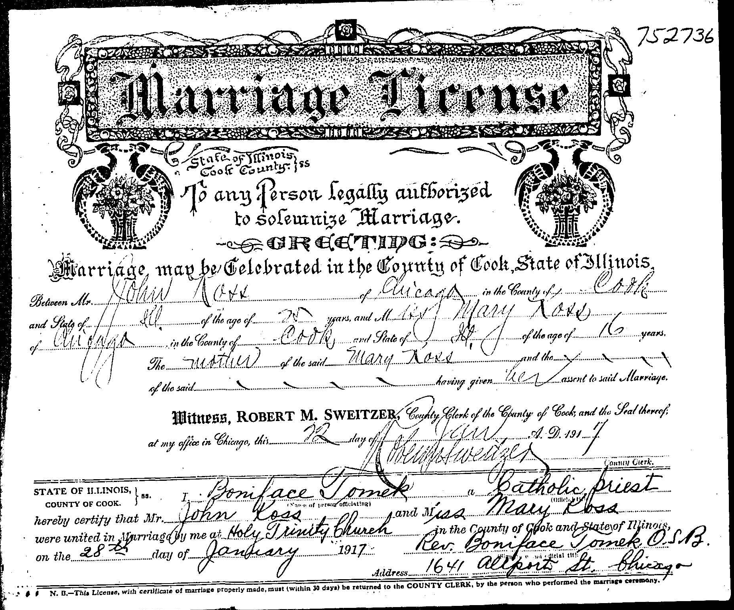
Cook County, Illinois Marriage Indexes, 1912-1942, Koss, Mary, digital image; Ancestry.com: accessed 30 July 2025, image 145 of 304.

After all the issues I’d already encountered (you can read about here), I foolishly believed things could only get better. So off to Chicago I went.

Stop 1: Cook County Clerk’s Office

I started at the County Clerk’s office, bracing myself, several colleagues had warned me about unhelpful staff. To my surprise, the clerk I got was wonderfully professional. One small mercy. Unfortunately, I didn’t walk away with any of the three records I was hoping for.

I had a certificate number for my grandparents’ marriage record, but it wasn’t in the system. You can see it exists from the picture above. I was also looking for a birth certificate that was possibly never filed; after all, I had a church-issued “Birth and Baptism” certificate. Back then, churches often issued those in lieu of civil records, and that document had even been used by a family member to enroll in Social Security. Still, no luck.

I was also searching for a death certificate I’d requested by mail on 31 March, four months prior to my visit, with no response. After about an hour of searching, the clerk informed me that a specialist would need to take over the research and contact me once they found something.

Correction: if they find something.

Stop 2: The Elusive Archives

Tip for Cook County researchers:

  • Ask security where to scan your parking garage ticket to get a discount.
  • When you first arrive, skip the main office, go down the first hallway with a large sign and a barcode. Scan it to get an electronic number. My wait? Only 25 minutes.

While I waited for a maybe, I moved on to Plan B: the Archdiocese of Chicago.

From there, I drove several blocks to the address listed on the Archdiocese’s website. Found a garage, $27 for 15 minutes (ouch), and entered the building.

Inside, I was informed (drumroll…) the archives are no longer located there. They knew the website was wrong. No apology, no signage, no indication they planned to correct it. Clearly, they don’t want people to use the archives.

The receptionist suggested I call the real archives before heading over I suppose they don’t like visitors. I did and was told to mail my request instead of dropping it off. I explained I was already in town for one day and just wanted to drop off the application to ensure my information was correct.

Back to the car. $27 parking bill for 15 minutes. No discount from the diocese, either. So much for grace.

Stop 3: A Parking Lot Blessing?

I spotted another lot across from what I hoped was the correct archives this time only $11 for 15 minutes. Progress! As I crossed the street, I realized the building was none other than Old St. Pat’s, where my husband’s great-great-grandmother, Mary “Molly” O’Brien Cook, had secretly brought her sons to be baptized. (Read my blog about dear Molly)

That felt like a good sign. (Also made for a great photo op.)

Inside, however, I was told the archivist wasn’t available, was going on a two-week vacation, and I shouldn’t check back until late August. The secretary reviewed my paperwork, made a few copies, took my check, and that was that.

The wrinkle? I wasn’t 100% sure which church my grandparents had married in, either St. Salomea, which is now closed, or St. Benedict’s, the family’s parish at the time of my great grandparents’ last child’s birth. Here’s a fun fact: if you don’t know the exact church, the Archdiocese will not help you. No guessing allowed.

I gambled on St. Salomea and asked how to access St. Benedict’s records. “They’re still open,” the secretary told me, handing me their address. I asked if she’d mind calling ahead to make sure someone would be there. She wouldn’t. Just handed me the address and not even a good-bye. Wouldn’t give me the phone number, either.

So, onward to Blue Island.

Stop 4: St. Benedict’s—Sort Of

About 30 minutes later, I arrived to find the church closed and the office now located somewhere else entirely. Apparently, the Archdiocese archives hadn’t gotten the memo.

My GPS couldn’t find the new location, so we tried another app and eventually found the building, locked. After ringing the bell twice, a woman finally came to the door. Without opening it, she told us everyone was in a meeting and to come back later.

I explained that I’d been sent by the Archdiocese and simply wanted to leave a message. After a pause, she let us in and asked for the couple’s names and marriage date. I handed her a copy of the Cook County index listing with the certificate number.

She disappeared into a back room, reemerged a few minutes later, and informed me: “No one by that name was married on that date.”

Sigh. The saga continues next week…
When the Universe Writes Back: A Halloween Follow-Up

As promised, my synchronicity streak isn’t done with me yet.

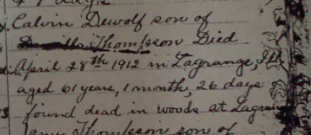
Bible Entry for Calvin DeWolf in Thompson Family Bible

Back in March, I mailed a request to the Cook County, Illinois Vital Records office seeking the death certificate of my husband’s second great-uncle, John Calvin DeWolf. He’s an intriguing figure. A cryptic entry in his mother’s Bible notes simply that he was “found dead in the woods in LaGrange.” That line alone opens a dozen genealogical rabbit holes:

Dead how?
Accident?
Sudden illness?
Suicide?
Foul play?

Why was he in the woods at all?
Where was he buried afterward?
Why has no obituary surfaced?

Online databases are silent. Newspaper searches cough politely and excuse themselves.

So I sent in my request… and then, nothing. Months passed. My check went uncashed. My mailman and I eyed each other suspiciously. I eventually chalked it up to a postal mishap.

Fast-forward to late July, when I traveled to Chicago to obtain several vital records in person for my family’s dual-citizenship pursuit. While there, I re-requested John Calvin’s death certificate. I handed over the form. I paid the fee. The clerk assured me they’d be in touch.

Every other record from that day has since dutifully arrived in my mailbox.

Except John’s.

And then last Tuesday, while writing the chapter on John Calvin’s parents for my upcoming book Echoes of Britannia, I footnoted the matter:

“Death certificate requested; not yet received. Someday, perhaps, the record will surface.”

I sighed, closed the my Word doc, and moved on.

Two days later, yes, exactly two, an envelope from the Cook County Vital Records office appeared in my mailbox. My heart did a little leap. Could this be it?

Not quite.

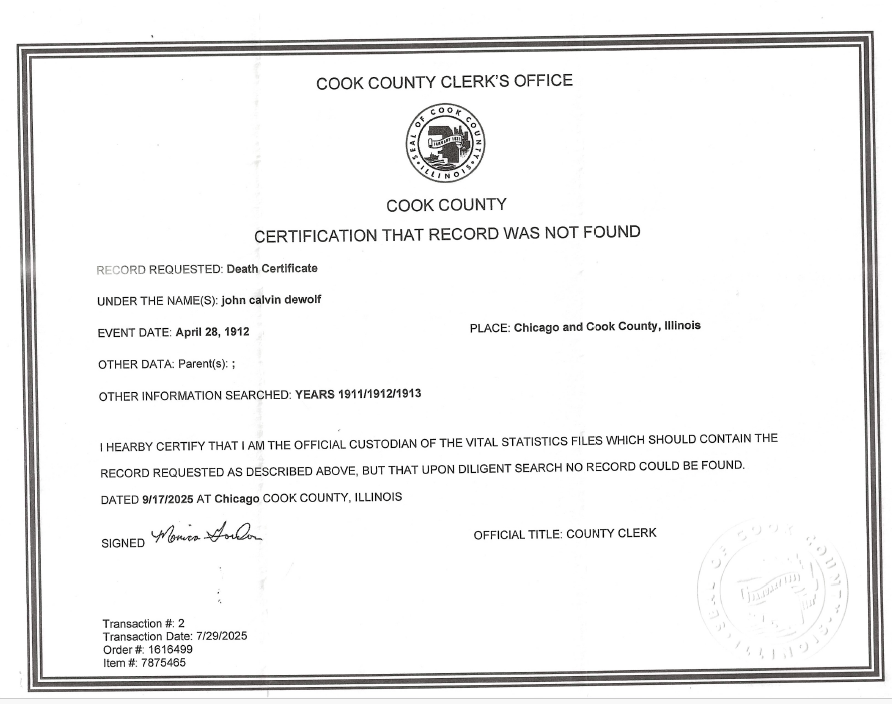
Inside was a Certificate of No Finding.

According to Cook County, they have no death record at all for John Calvin DeWolf.

So where did he die?
Was it reported?
Was it covered up?
Was it recorded elsewhere?

His half sister who owned the Bible at the time of his death and likely made the entry clearly believed he was found in LaGrange. The Bible entry says so. But the county has nothing.

The mystery deepens.

And the timing? After seven silent months, the response was generated on the very day I finally wrote about him.

Coincidence? Maybe. But these synchronicities love to show up when I start telling a story.

Of course, I’m not done with John. Next stop: IRAD, for coroner’s records, inquests, and investigations. Somebody, somewhere, documented what happened.

Because records hide.
But they rarely disappear forever.

Earlier this month, the same thing happened with my mom’s Cook County, Illinois birth record. I had requested it in person in Chicago in late July. They couldn’t find it which was no surprise to me as my mom and grandmom had both said the birth was only registered with the Roman Catholic Church, an accepted practice in 1918. On the anniversary of my mom’s death earlier this month, I finally received a response from Cook County. It was a record of no record. Thanks, mom! Sometimes are family tell us the truth and we can confirm it over 100 years later.

At times, family history feels less like research and more like a conversation across time. We chase records, but every now and then, the records seem to chase us back. These little moments remind me that discoveries don’t always happen in archives. Sometimes they appear in unexpected envelopes or on memorial pages when we least expect them.

They’re often hidden in plain sight, waiting for the right moment to surface.

If you enjoy reflections like this, I’ve begun sending a short once-a-month note to curious-minded family historians. You can join me by messaging me at genealogyatheart.com. It’s a quiet circle, and you’re welcome there. I’ve also begun a FaceBook and LinkedIN page so we can interact frequently. Hope you’ll join me there as well!

Happy Halloween, dear readers.
May the ancestors keep whispering and may you always listen.

Happy Halloween: The Synchronicity That Saved My Blog

My readers tell me, year after year, that my Halloween synchronicity series is their favorite tradition. Which is why, by August, I was in a quiet panic. The kids were back in school, stores were already pushing candy corn, and for the first time in my genealogical career… nothing weird had happened to me.

Nada. Zilch.

I considered scrapping the whole thing and writing a single line, “Sorry, folks, nothing to report this year” and calling it good. But that felt wrong. These uncanny little moments can’t be summoned on command, but I still held out hope that one would arrive just in time.

It did. On August 14th.

I was volunteering at the Association of Professional Genealogists table during the Jewish Genealogical Conference in Fort Wayne. Since I’d signed up for the whole week, I was allowed to attend a few sessions during breaks. I’m not Jewish, though occasionally my DNA results tease me with a percentage or two that disappears the next time I test, but I found every talk fascinating.

Meanwhile, in my own research life, I was deep in the throes of acquiring certified vital records for my family’s dual citizenship application. Two notarized forms were already on their way to Croatia to obtain my grandmother’s birth record. That left one gaping hole: my grandparents’ 1917 marriage record from Cook County, Illinois.

I had the index entry from Ancestry.com, names, date, location, marriage license number, but when I visited the Cook County Clerk’s office two weeks earlier, they couldn’t find the record. I paid for the search anyway, but they gave me no timeline of when they could do deep research.

At the conference, I mentioned my predicament to a fellow genealogist, who knew someone with database access. The news came back: my grandparents’ marriage record hadn’t been digitized. Neither had the record for the couple immediately after them.

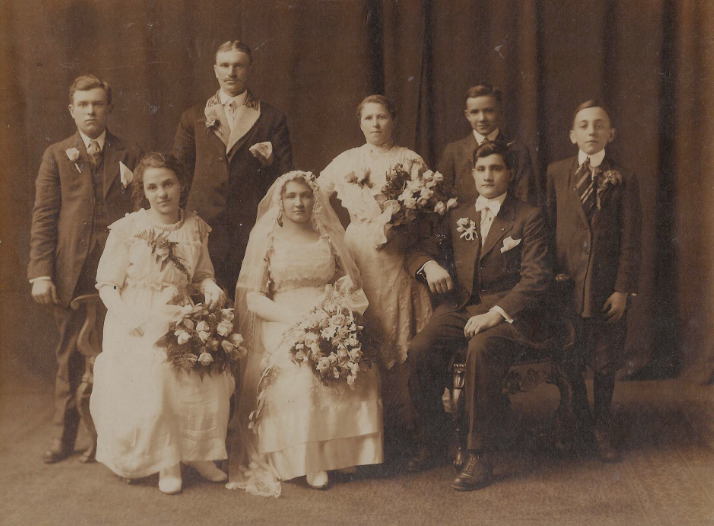
Lost? Misfiled? Never returned? Theories abounded. One person even suggested they’d never married. (“It was staged,” she said of their wedding photo. To which I thought: Really? That would be an awfully elaborate prank for this couple.)

No one had a solid lead. And I needed that record, not just to prove the marriage, but to identify the church where it took place. Chicago city directories for the period were scarce. The Chicago History Museum couldn’t help. The Archdiocese would search closed-church records for $50 a pop, but that was a quick road to the poorhouse.

Then came my first odd nudge of the week. While exercising, I heard my grandmother’s voice in my head: Look at the back of the pictures. Sure enough, on the reverse of what looked like an engagement photo, there it was “Chicago Heights.”

I brought the photo to Sherlock Kohn, a fellow conference-goer and photo expert, who confirmed the clothing was period-correct. She suggested the Chicago History Museum for studio leads. I kept chasing, but the record stayed stubbornly hidden.

A second genealogist offered another tip: years ago, FamilySearch had donated pallets of old microfilm to the Allen County Public Library (ACPL). Maybe, just maybe, my record was buried there. I tracked down Adam, one of ACPL’s librarians, and he gamely searched the microfilm. Blank images.

At this point, you’re probably thinking, Lori, just search FamilySearch online. Oh, I had using the index with every permutation of the last name and around the date the marriage occurred, and nothing.

So I decided: I’d comb through every 1917 marriage image by hand. First, though, I made a side trip to birth records for my mom, two hours later, I had confirmed my mother’s birth was indeed only recorded by the church, just as she and my grandmother had said. (Cook County, Illinois later confirmed this – I got the “certificate” of no registered birth on the date my mom had died 24 years ago. Weird, huh?!

By then it was late. I was tired, discouraged, and dreading the thought of cold-calling every Catholic church in South Chicago. Still, before leaving, I opened the 1917 marriage film on FamilySearch, locked to home users, but accessible at ACPL. I scrolled to the end of one reel. No luck.

Then my computer glitched. As a non-resident, my ACPL guest account was on a timer. It flashed “10 minutes remaining” and kicked me out of FamilySearch. When I logged back in, I had 7 minutes left.

The next reel contained 1,278 images. No way I could check them all. So I did the only thing left, I scrolled, stopped, and clicked at random.

And there it was.

My eyes fell immediately on “Mary Koss.” Without even scanning the rest, I gasped loud enough to turn heads in the reading room. “Sounds like you found something,” a man seated across from me said. A woman down the row called, “We aren’t finding anything, do tell!”

I was near tears.

Adam hurried over. I showed him the record, and he smartly told me to write down the film and image number. Then he handled the printing as the machine wouldn’t cooperate (with help from a kind patron who wanted to donate her library account to me) while another researcher kept my computer from timing out so I could email it to myself.

Out of 1,278 possible images, I had landed on the one I needed, completely blind. Missed in indexing, out of sync in databases, invisible to every search I’d tried. And yet, here it was.

Thank you, Grandma!

And here’s a link of another uncanny find I didn’t have – ENJOY!

And to you, dear readers: Happy Halloween. May the coming year bring you your own uncanny genealogical coincidences – just when you need them most.