
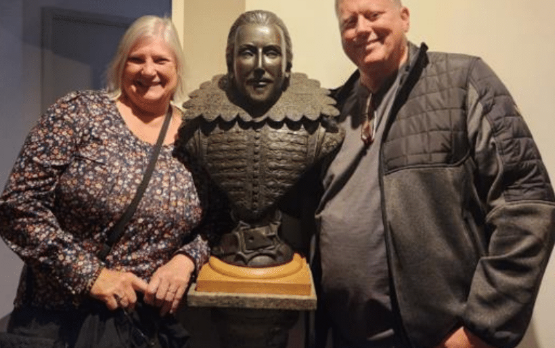
We had just left the library, me, exhilarated from chasing an elusive 14th-century ancestor through a nest of old parish records; him, simply relieved to stand upright again after half an hour on the bottom shelves. He’d spent the morning handing me books like a dutiful squire and now looked as though he deserved a knighthood or, at the very least, a sturdy chair. Fortunately, Shakespeare’s schoolroom promised benches and history. Two things I never resist, and one he can usually nap through.
Inside, the air smelled of beeswax and old oak, the kind of room where you half expect to hear the scratch of quills and the snap of a tutor’s patience. A man dressed in full Elizabethan regalia was lecturing with theatrical gusto about young William’s schooling. My husband settled in contentedly, no doubt counting this as his rest stop on the Tudor trail.
Then came the story of how Shakespeare’s sister once disguised herself as a boy to attend lessons beside him, the first recorded case, our costumed instructor declared, of gender-bending for the sake of education. My husband leaned over, voice low and amused, “That would be your line.”
Of course I replied , I always reply. “Yes, it would.”
The tutor froze mid-sentence, eyes narrowing like an owl’s. “Would you care to share with the class, madam?”
Reader, I was forty years too old to be scolded and four hundred years too late to be sitting in Shakespeare’s classroom yet there I was, reprimanded under the same beams that once heard Hamlet’s first drafts forming in the back of a boy’s mind. My husband, naturally, looked saintly.
As the lecture continued, I couldn’t help smiling. The old Welsh bards would have understood words have a life of their own, and some of us were simply born to answer them, even in other people’s classrooms.
After my recent AI experience that I blogged about last week, it’s more important than ever to remember the power of words.