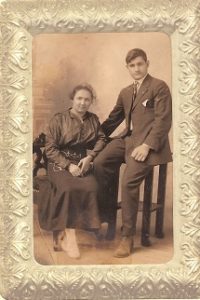
Circular Migration Patterns-How History Repeats Itself


Originally published on genealogyatheart.blogspot.com on 30 May 2015.

My family does not stay in one place for long which makes tracing them a challenge.  As I mentioned in my last blog, my husband and my family also tends to migrate in circles.  -I’m still in Harbaugh Country but I’m thinking about the odd way I discovered this phenomena with my Duer family.

I had traced my paternal grandmother’s line back to a Maria Dure with the help of some distant cousins in the late 1990’s but I hit a brick wall with Maria and was unable to discover who her parents were.  My cousins said she was German which made sense as Maria married Henry John Kuhn Jr. who was born in Germany 3 Dec 1831.1  I tried to obtain a death certificate, probate records, cemetery records, and obituary for Maria hoping that a clue would be uncovered as to her parentage but nothing was available electronically.  Then, online trees started showing Maria as the daughter of a John Duer and Mary Cook in Mahoning, Ohio.  I wasn’t sure if my Maria was John and Mary’s daughter so in April 2010 I emailed a “cousin,” Edward Duer Whitley, about a posting I had found on Genforum.  Ed informed me that I had spelled Maria’s last name wrong – reversing the last two letters (Dure should be Duer).  He mentioned that he had been searching for Maria’s line for years as he had updated all of her siblings but had been unable to trace her. That was because Maria and her spouse had relocated to Mercer County, Ohio.  Ed gave me his electronic tree going back to Robert Dure (1563-1617) who spelled his name the way I had spelled Maria’s.  I don’t know why I had the original and not the most recent spelling. Perhaps Maria’s children had remembered the original name and that was what was passed down my line.  Some mysteries we will never solve!  Ed and I had only corresponded for a few weeks when I lost contact with him.  I never discovered what happened and assumed he died as he was 93 years old.  I know in genealogy we shouldn’t assume anything but he was up there in years, and then just disappeared.  Since Ed had not made his tree public, it was fortunate that I had contacted him when I did or his years of work may have been lost. (My next blog will be about disappearing data!)  I have entered all the information Ed shared with me on my public Main Tree on Ancestry.  What was truly odd, though, was the timing of this find.

Maria’s great great grandfather, Thomas Stone Duer, was christened 29 Sep 1663 in Charleton, Devonshire, England.2 He emigrated with his maternal Uncle George Stone to Philadelphia in 1683.3  Thank goodness he was a Quaker so there’s wonderful records of Thomas and his wife, Elinor “Ellen” Beans (Bayne/ Bane) but I will save Ellen’s story for another day.

Thomas and Ellen had a son, Thomas, born 7 Mar 1702 in Falls, Buck, Pennsylvania.4 From the Duer Bible, Thomas married in 1729 but the Bible does not list his wife’s name.5 Ed discovered she was Mary Ann Hollinshead, born 11 May 1712 in St. Michaels, Bridgetown, Barbados, West Indies, the daughter of Daniel and Ann Alexander Hollingshead.  Ann died in Feb 1715 in Barbados.6 Why was the family in the West Indies?  Daniel was in Barbados as an indentured servant.7  After Ann’s death, he remarried, completed the terms of his servitude, and moved with his family to New Jersey where he died in 1730.8

Why move to New Jersey?  That I haven’t yet proven but I do know that while in New Jersey a strange family event occurred.  “Daniel Hollinshead was born in Leicestershire, England in 1683. He was one of several brothers, one of whom was Captain under the Duke of Marlborough and was killed at the Battle of Blenheim. One of his brothers was a merchant in Boston, of him, he used to relate the following incident: While riding along the road at a distance from home, he overtook a person traveling the same way: They entered into conversation and after some time discovered that to their great joy, they were brothers. They had not seen each other since childhood. This brother had been shipwrecked on his passage from London to Boston and had lost the whole of his fortune. He went with his brother to his home in New Jersey where he then lived, obtained a public office, and died in Sussex County in 17–.”9

To sum up, Daniel Hollin(g)shead moved from his birthplace of Leicestershire, England to Barbados, West Indies as an indentured servant and then to Sussex, New Jersey where he died.  He met his long lost brother who traveled from England to Boston, after being shipwrecked somewhere, and then on to Sussex, New Jersey.  

Yes, this is a weird chance meeting but what I find odder is my own child’s migration route 300 years later.  

My oldest left Florida to attend the Massachusetts Institute of Technology in Boston.  During a January term, she visited friends in England who were attending Cambridge University and there she finalized her decision of where she wanted to attend medical school.  Upon her graduation from MIT, our daughter moved to Grenada, West Indies.  Why?  As an International Baccalaureate graduate she insisted she wanted an international medical school experience.  The medical school, St. Georges, is based on Long Island, New York.  As I’ve noted in my previous posts, the early founding families of Long Island were my husband’s lines, along with his family connections with the Caribbean and the Dutch West Indies Company (see Motherhood and the Brain blog 10 May 2015).  Our daughter did not choose the school based on previous family connections to the area, rather her decision was based on its strong international curriculum.  St. George’s students spend the first two years in Grenada, West Indies and the last two years either in the US or England. She selected her last two years to be in Morristown, New Jersey. We have no relatives in New Jersey so why pick Morristown?  At the time of her decision we didn’t even know where Morristown was located in New Jersey.  She said she was drawn to it after speaking with fellow students who knew the area.    

Even stranger, at the time of her decision I made the comment to a coworker in Florida that our daughter was relocating to New Jersey.  Turns out, he happened to have been the former principal of Morristown High School.  Truly, it’s a small world after all!

But before continuing on, let’s review my family’s migration patterns:  We know our daughter was not the first in the family to move from Boston and the West Indies to New Jersey.  If you take into consideration her student loans, she’s not even the first indentured servant in the family.  But moving to Sussex, New Jersey is not the same as moving to Morristown, New Jersey.  Well, the family travels will take another twist!

Thomas and Mary Ann Hollingshead Duer had a son, John, who married Susannah Miller in Sussex, New Jersey in 1773.10  After Thomas served in the New Jersey Militia during the American Revolution, he and Susannah relocated to, you guessed it, Hanover Township, Morris County, New Jersey.11 Thomas and Susannah are my daughter’s 5 great grandparents.  We did not know this relationship until a year after she was residing in an apartment that was built on the former site of the military encampment where her 5th great grandfather was housed during the American Revolution.  Our daughter is a DAR but not through this line which we had not


1United States of America, Bureau of the Census. Twelfth Census of the United States, 1900. Washington, D.C.: National Archives and Records Administration, 1900. T623, 1854 rolls.

2Edmund West, comp.. Family Data Collection – Births [database on-line]. Provo, UT, USA: Ancestry.com Operations Inc, 2001

3Filby, P. William, ed. Passenger and Immigration Lists Index, 1500s-1900s. Farmington Hills, MI, USA: Gale Research, 2012.

4Hinshaw, William Wade. Marshall, Thomas Worth, comp. Encyclopedia of American Quaker Genealogy. Supplement to Volume 1. Washington, D.C.: n.p. 1948.

5Editor. Literary Era, Vol. III, 1896, Philadelphia, Pennsylvania Repository:  486-7, Print.

6Sanders, Joanne McRee. English Settlers in Barbados, 1637-1800. S.l.: Brøderbund, 1999. Print.

7England, Terri. Indentured Servants on Barbados Bristol Servants: A-F. N.p.: n.p., 2002. Print.

8Edmund West, comp.. Family Data Collection – Deaths [database on-line]. Provo, UT, USA: Ancestry.com Operations Inc, 2001.

9“The Hollinsheads.” Our Ancestors, A Genealogical & Biographical Magazine, 2.2 (1882): n. pag. Print.

10The Henry B. Baldwin Genealogical Records.” Publication: File OR919.3B193r, (26 Jun 2010): Public Library of Youngstown and Mahoning County, Ohio.

11Jackson, Ronald V., Accelerated Indexing Systems, comp.. New Jersey Census, 1643-1890. Compiled and digitized by Mr. Jackson and AIS from microfilmed schedules of the U.S. Federal Decennial Census, territorial/state censuses, and/or census substitutes.

Memorial Day Memories

Originally published on genealogyatheart.blogspot.com on 24 May 2015.

Most holidays start with Happy – Think Easter, Thanksgiving, and New Year. So every year, when I hear about the upcoming “holiday” sales in honor of Memorial Day, I cringe.  I don’t consider Memorial Day a holiday.  Yes, it’s a 3 day weekend.  Yes, school is almost over for the year.  Yes, it’s even a time to spend with family and friends but it is not a holiday.  On Memorial Day I believe we should all honor those that came before us allowing us the freedom we have today.

I will not be visiting graves this weekend as all of my family is buried far away from where I reside.  That doesn’t mean I won’t be thinking of the sacrifices of my forefathers and my memories of past Memorial Days.

As a child, my grandmother, Non, always took me with her to tend to the graves of her father and uncle.  As a first generation American, she had no fallen soldier graves to care for in this country but I remember the cemetery filled with small flags to honor American veterans.  Non was lucky her Sonny, my Uncle George, had made it home safely after serving in the Coast Guard during World War II.  

George and Betty Mione Kos

As Non and my mother pulled weeds and clipped grass growing around the stones, I would read the inscriptions if I could, because my multicultural neighborhood had many markers engraved in languages other than English.  Although I could not read the Polish, Lithuanian, Greek, Italian and like my Great Grandfather’s memorial, Croatian, I knew that the men buried there had shared a common experience in a war.  The back of the cemetery held the graves of World War I veterans, the middle section seemed to be for those killed in World War II and in the front, Korean and Vietnam veterans.  Too many lives cut short too soon. 

I am also fortunate to have my father’s diary from World War II while he was stationed in Alaska.  

Orlo Guy Leininger

His war time experiences were very different from my husband’s uncle.  With a German surname, my father was not sent to Europe but to the Pacific theatre instead.  My dad’s sister, Mary Ellen Leininger Tronolone, enlisted as a Yeoman, First Class, in the Navy.  Most of her service was in Washington, DC.

Mary Ellen Leininger Tronolone

Having known most of these family members I am proud of their bravery and thankful for their service.  You can read more memories of soldiers by visiting a Crestleaf blog, Real Letters of Love, Hope & Inspiration Written by Soldiers – A Memorial Day Tribute 

Motherhood and the Brain

Originally published on genealogyatheart.blogspot.com on 10 May 2015.

A extra special welcome to my readers from across the pond – Australia, Finland, Great Britain, Ireland, Netherlands, Slovakia, Taiwan, Turkey, Ukraine and closer to home – Canada and of course, the good ole U.S.A.  Happy Mother’s Day to All!

My day will be spent being spoiled by my family, recuperating from my recent conference in New York City, processing what I learned, and planning how I can incorporate it in my work – both in counseling and genealogically. The conference, Learning & the Brain, Educating World-Class Minds: Using Cognitive Science to Create 21st Century Schools, was phenomenal  So many passionate educators, psychologists, and physicians from around the world united to discuss research findings on how to prepare students for being global citizens.  I kept thinking about my family tree.  I call my husband and me Mutts – as in belonging to no special breed.  Our people have migrated across several continents for lots of reasons and I bet your family tree is very similar to ours.

Every time I visit the Big Apple I am reminded of a family paradox.  My husband’s family was early Dutch settlers who operated a farm on the East River in what is now the Wall Street district.  A large bank currently sits on the farm property and that particular bank owns the mortgage on our home.  I don’t think that’s right. It’s downright absurd.  My husband agrees that his family has never done well with real estate ventures and selling that farm on what is currently such expensive property validates our opinion.

While walking around Manhattan this past week my thoughts turned to Ghislain1 and Adrienne Cuvellier de la Vigne, Walloons who emigrated from Leiden to New Netherlands with their children in 1624.2

Born about 1586 in Valenciennes, France, Adrienne’s maiden name most likely refers to her father’s occupation, which in English would be a cooper.  Coopers made barrels and utensils, primarily out of wood.  Ghislain’s last name could also give us a hint as to his family’s profession, Vigne means vineyard in French.  I’d rather like to think of this as a match made in heaven instead of a marriage to consolidate business – the vineyard owner’s son and the barrel maker’s daughter but I will never know.  I do know the family stayed intact and together through much adversity to create a new life in a new world.

Although a truce between Holland, France and Spain began in 1609, about the time of Adrienne & Ghislain’s marriage, there was no telling if it would be continued after its 1621 expiration.  Complications further arose in the region between the Roman Catholic and Protestants.  Valciennes was part of the Netherlands but ruled by Catholic Spain. Adrienne& Ghislain were Protestant.  We know from Baptism records of their children that by 1618, the family had relocated to Leiden, Holland, an area that was known to be safe and tolerant.3  There the family adapted by changing their names; Adrienne became Ariantje and Ghislain became Willem Vienje. (I’ll continue to use their birth names.)

How the family was selected by the Dutch West India Company to settle in New Netherlands is not known.  Hart (1959) mentions that a wealthy merchant and founder of a Lutheran congregation in Amsterdam, Herman Pelgrom, was living in Nuremberg where he married a Susanna Cuvelier in 1578.  Pelgrom’s four sons from his first marriage were involved with the New Netherland’s Company in Amsterdam by 1609.4 Some researchers believe Susanna Cuvelier Pelgrom was related to Adrienne and tipped her off about the opportunity but I can find no connection.  Perhaps the Vignes’ heard town gossip and volunteered to go.  However they were selected, the family must have been eager to start a new life as land was scare in Holland and the promise of religious freedom must have been enticing.

In the Spring of 1624, two ships, the Eendracht (Unity) and the Nieuw Nederland (New Netherland), sailed into the North (Hudson) River, bringing the first colonists to New Netherlands.  “Although we do not have a Netherlands record regarding the departure of Ghislain and Adrienne (Cuvellier) Vigne and their children Marie, Christine, and Rachel, they certainly were on one of these vessels, as their son Jan would be the first male child born in the new colony, or at least the first male child who survived and remained there (Sara Rapalje was the first female child born in New Netherland).”5

Have you ever sailed on New York’s Harbor?  Each time, I marvel at the breathtaking view of the Manhattan skyline and reflect on the past hopes and dreams of immigrants as they approached Ellis Island and the promise of what Lady Liberty stands for.  That is not what greeted the Vignes’.  Instead, they were met by a French ship blockading the Dutch for the purpose of claiming the land for the French king.  “The Dutch vessel, ‘rendered imposing by two cannons’ forced the French to leave rather than fight.  The way clear, Captain May brought some of the immigrants 144 miles up the Hudson River and docked at Fort Nassau” (what is now Albany, New York).6

The following year, the Vignes’ began farming in Manhattan. The family grew with the addition of son, Jan.  Happiness was brief; by 1632 Ghislain had died leaving Adrienne with 2 minor children as the eldest daughters, Marie and Christine (from whom my husband is descended), had married. Marie married Jan Roos and shortly after his death, Abraham Ver Planck.  Christine married Dirck Volgersen.

Eleventh Great Grandma Adrienne did not remain a widow for long.  Jan Jansen “Old Jan” Damen, emigrated to New Netherlands about 1634.  Old Jan was a warden of the Dutch Reformed Church and owned a large piece of land just west of the Vigne farm.  Combined together, the land tract ranged from Pine Street north to Maiden Lane and from the East River to the Hudson River.  We’re talking prime Manhattan real estate today!  Before the marriage, a prenuptial agreement was signed.  In part, it reads “Dirck Volgersen Noorman and Ariaentje Cevelyn, his wife’s mother, came before us in order to enter into an agreement with her children whom she has borne by her lawful husband Willem Vienje, settling on Maria Vienje and Christina Vienje, both married persons, on each the sum of two hundred guilders … and on Resel Vienje and Jan Vienje, both minor children, also as their portion of their father’s estate, on each the sum of three hundred guilders; with this provision that she and her future lawful husband, Jan Jansen Damen, shall be bound to bring up the above named two children until they attain their majority, and be bound to clothe and rear the aforesaid children, to keep them at school and to give them a good trade, as parents ought to do. This agreement was dated the last of April 1632.”7

The prenuptial did not insure tranquility in the family.  On June 21, 1638, Damen sued to have Abraham Ver Planck and Dirck Volckertszen “quit his house and leave him the master thereof.”8  Dirck countered with a charge of assault and had witnesses testify that Jan tried to “throw his step-daughter Christine, Dirck’s wife, out of doors.”Records show that Adrienne remained married to Old Jan but continued a positive relationship with her adult children. This must have placed her in a difficult position.

Old Jan’s character is further shown in 1641 when, as a member of the 12 Man Council he was one of only three on the committee who wanted to exterminate local Native American tribes.10 Although out voted, Damen persisted.  In February 1643 he “entertained the governor (Kieft) with conversation and wine and reminded him that the Indians had not compiled with his demands to make reparations for recent attacks. ‘God having now delivered the enemy evidently into our hands, we beseech you to permit us to attack them,’ they wrote in Dutch on a document that survives today.”11 The Governor agreed thus Kieft’s War, a three year conflict between the Algonquin tribes and the Dutch resulted. It was the begining of the end for Damen.  His neighbors horrified by the bloodshed nicknamed him “the church warden with blood on his hands” and expelled him from the local governing board.”12  I wonder how Adrienne felt.  Was she ostracized by the townsfolk along with her husband?

Leaving politics, Old Jan began to amass considerable wealth in a new way – as one of the owners of La Garce, a privateering venture run between 1643-1646.13  (If you don’t know French, you really must do a google translate of La Garce.  This is what makes genealogy so wickedly interesting!)  You also read correctly that Old Jan financed a privateering venture, aka piracy.  When you think of La Garce, think Pirates of the Caribbean.  Records show that in April 1645 the vessel returned to New Netherlands with goods of tobacco, wine, sugar, and ebony seized from two Spanish ships in the West Indies.  In 1646, it returned from the area off the Bay of Campeche, Mexico with a load of sugar and tobacco.14

In 1649 Old Jan returned to Holland due to a court case in which he was defending Peter Stuyvesant, the last Dutch Director General of New Netherlands, leaving Adrienne behind on the farm.  He died before returning to her, in 1651.

I wonder how the neighbors treated Adrienne after Old Jan was gone –  did they shun or embrace her? There are no records to tell us.  I speculate that Great Grandma lived quietly until her death in 1655.

And what happened to the farm?  Damen’s “heirs sold his property to two men: Oloff Stevensen Van Cortlandt, a brewer and one-time soldier in the Dutch West India militia, and Dirck Dey, a farmer and cattle brander. Their names were ultimately assigned to the streets at the trade center site. Damen’s was lost to history.”15

Unfortunately, so was the whereabouts of Adrienne’s burial.  Christina Vigne’s husband, Dirck, and her sister, Maria Ver Planck, were sued by Dutch Reformed Church Elder Claes Van Elstandt on March 8, 1658, for nonpayment of Adrienne’s grave.  The pair claimed to have given money to Rachel Vigne’s husband, Cornelius Van Tienhoven, who had absconded with it 16 months prior. The court ordered all heirs to pay for the grave.16  The debt was paid but there is no mention in the records of where the grave was located.

On this Mother’s Day, I wanted to remember Adrienne.  Although she died 360 years ago there are mother’s today still seeking safety from brutal spouses, war, and religious conflict. My Mother’s Day wish is that they can persevere and be as strong as Adrienne.


1Ancestry.com. New York, Genealogical Records, 1675-1920 [database on-line]. Provo, UT, USA: Ancestry.com Operations Inc, 2004.

2Dorothy Koenig and Pim Nieuwenhuis, “The Pedigree of Cornelia Roos, an Ancestor of Franklin D. Roosevelt,” New Netherland Connections [NNC] 2(1997):85-93, 3(1998):1:1-5, correction 3:2:34-35 corrected Ghislain’s originally recorded name as Guillaume.

3Parry, William. New Netherland Connections Quarterly, Vol 3 No. 1, Jan-Feb-Mar 1998.

4 Hart, Simon. The Prehistory of the New Netherland Company: Amsterdam Notarial Records of the First Dutch Voyages to the Hudson. Amsterdam: City of Amsterdam Press, 1959. 22.

Macy, Harry Jr. The NYG&B Newsletter, Winter 1999, The New York Genealogical and Biographical Society at http://www.newyorkfamilyhistory.org (search for the pdf – you don’t have to be a member to view this)

6 McNeese, Tim. New Amsterdam. New York: Chelsea House Publishers, 2007.56.

7 New York Historical Manuscripts: Dutch, Volume 1, ed. and trans. by Arnold J. F. Van Laer. Baltimore, 1974

8 McVicar, Hugh D. McVicar Post Ancestry: The Ancestry of George Wesley McVicar (1884-1936) and Naomi Theresa Post (1881-1951) : 16 Generations of Family from Toronto to Scotland, New England, New York & Overseas. Madison, Wisconsin: E. J. Burch, 2003. 38.

9 Ibid

10 “Blackmail as a Heritage: Or New York’s Legacy from an Earlier Time.” In The Century Illustrated Monthly Magazine, 771. New York: Century, 1887.

11Lupton, Eric.  “Ground Zero:  Before the Fall.” In The New York Times, June 27, 2004.

12Ibid.

13Jameson, J. Franklin. Privateering and Piracy in the Colonial Period:. New York: A.M. Kelley, 1970. 9.

14New York State Secretary’s Office. Dutch Manuscripts, 1630-1634. Vol. II. New York: Weed Parsons, 1865. 36.

15Lupton, Eric.  “Ground Zero:  Before the Fall.” In The New York Times, June 27, 2004.

16 Rollins, Sarah Finch Maiden. The Maiden Family of Virginia and Allied Families, 1623-1991: Aker, Alburtis, Butt, Carter, Fadely, Fulkerson, Grubb, Hagy, King, Landis, Lee, Scudder, Stewart, Underwood, Williamson, and Others. Wolfe City, Tex.: Henington Pub. ;, 1991. 20.