A Phenomenal Photo Find – A Picnic in a Chicago Cemetery

Originally published on genealogyatheart.blogspot.com on 25 Oct 2015.

Hope you enjoyed the genealogical synchronicity links in my last blog.  For some reason, many of my strange experiences tend to revolve around photos and I’m going to share 2 odd occurrences that happened in the same week which completed a prediction made 18 years earlier.

The Christmas before my first child was born, my in-laws gave me a book to record family history. My mother-in-law asked me 3 months after my child was born if I had the book completed as she knew I was extremely interested in genealogy.  Overwhelmed with motherhood, I told her no. She said she expected that I would have it completed back to the American Revolution by the time my child graduated from high school.  Little did I know how right she would be and the odd timing of an important discovery in that line that made her prediction accurate.

I was always intrigued with my husband’s 2nd great grandmother, Drusilla Williams DeWolf Thompson.  No one else in the family was named Drusilla so where the name came from we don’t know.  I liked to call her Grandma Dru because Drusilla makes me think of one of Cinderella’s mean stepsisters.

Hubby’s parents didn’t know much about Grandma Dru; their knowledge was that she was a seamstress in Chicago and that she had arrived there via Conestoga wagon from upstate New York with her husband.  She was supposedly the youngest of 21 and her father, John Hicks Williams, a sea captain, died from a bad shave in the Orient.   Turns out much of that story isn’t fact.  Some of the wrong information came from an undated letter written by a family member who though Drusilla’s sister was a member of the Daughters of the American Revolution (DAR) and the Mayflower Society. No one in the family questioned the accuracy of the information until the early 2000’s when a second cousin decided to join the DAR and found their was no link in the line.

I came into contact with the cousin’s daughter via an internet posting on Rootsweb Gen Forum seeking info on Dru and I agreed that I would help research the family.  Separately, the cousin, her daughter and I made several trips to Long Island and Troy, New York seeking records as back in those days, internet searching was difficult.  We were able to prove descent from Dru’s paternal grandfather, Wilson Williams, and that Wilson was a member of the Hempstead Harbor, Long Island Militia during the American Revolution.  Along the way we discovered another cousin via the internet who filled us in on her line.

We had documentation from the family, census, military, church and civil authorities but what we longed for was a picture of Drusilla.  Dru died in Chicago, Cook County, Illinois in 1898 so it was probable that she had been photographed in her lifetime.  I have all of the pictures of my husband’s family and none were of Dru.  The cousins had no picture, either.  We decided to search collateral lines.  Dru had one son, John Calvin, with her first husband, Calvin DeWolf, who had died in 1852.  John Calvin had 4 children, Sadie, who died in 1953 had no children. Caroline died as an infant in 1883. Nellie died in 1908 during childbirth and Henry, who died in 1924, was unmarried.  The cousins and I would joke that the best chance of finding a picture would be for me to search antique shops locally as Sadie had died not far from where I live.  Instead, we decided to search other collateral lines.

Dru had 3 birth children and 1 adopted child with her second husband, Thomas Coke Thompson.  The adopted child, Nellie, seems to have vanished after age 11 so we assumed she had died.  Dru’s oldest child, Lewis Warren, died in 1883.  He married twice and had one child, Louisa, with his second wife.  Louisa also married twice but her only child died at age 3 in 1910 so this was another dead end.

Dru and Thomas’ second child, James, had 2 children.  Daughter Rose died as an infant in 1883.  Jeannette, their other child, died in 1944.  She married but had no children.  No picture would be found here, either!

If a picture existed it would be in the possession of a descendant of Dru’s youngest child, Mary, who both my husband and his internet found cousins’ descend.  Mary and Andrew Cook had 7 children but we could quickly eliminate 6 of the children’s descendants from having a photo.   Lulu May, who is my husband’s grandmother, can be eliminated since I have all of the family pictures.  To be sure, I double checked with all of his living relatives and no one could recall ever seeing a picture of Dru.

Oldest son, John Thompson, who one of the cousins is descended from, and second oldest son, William DeWolf Cook, who the other 2 cousins descend from, can be eliminated as none of those families had a photo.  Three of Mary’s children died without marrying – Drucilla in 1897, James Andrew in 1906 and Whitney Calvin in 1924.

This left one of Mary and Thomas’ children to find – Grace Gertrude Cook, the author of the undated family letter.  This was our last hope!  We knew that Grace had married John Honaker and they had 2 children.  I had met one of their children, John Sheridan Honaker, who had retired not far from where my husband and I lived when we first married and my in-laws would visit John when they came to see us.  He had 2 children we had never met.  Grace’s second child, Anne Virginia, married and also had 2 children we had never met.  My sister-in-law thought the family lived somewhere in the midwest.

Finding an obituary for John Sheridan Honaker, the cousins were able to get a phone number for one of his children.  This newly found cousin hadn’t ever seen a photo of Dru, either.  She doubted anything was left as a tornado in 1974 had blown the roof off her family’s home and there were only a few pages of the Family Bible that had survived.  She promised to check with her uncle who had been the one to clean up after the tornado.

It took several months for the cousin to be able to convince her uncle’s son to look in the attic.  The son insisted that everything had been lost and he really didn’t want to climb around his dad’s attic as the uncle was too old to look himself.  She volunteered to look but was politely told no.

I had moved on to other lines and really wasn’t thinking about Dru when I dropped off at Walgreens a baggie filled with undeveloped film and disposable cameras I had found while spring cleaning in a spare closet.  It was a Sunday afternoon and I knew I had too much for the harried clerk to develop in an hour so I told her to call me whenever she got the film developed.  As I turned from the counter I ran smack into another customer who I hadn’t known was standing close behind me.  I apologized and asked if she was okay since she clearly looked rattled.  She said she was fine but she certainly didn’t look it; she was scowling and tense.  I told her that I hoped the rest of her day would be calm and beautiful.  As I walked past her she asked if she could have a word with me.  I turned and she sputtered that she was psychic and did I know that I had a lot of dead people surrounding me.  The store clerk was taken aback but I just laughed and told the customer that I was a genealogist and that they were most likely all my relatives.  The woman told me she had never seen anyone surrounded by so many dead people.  I laughed again and told her I had a big family and that I hoped they were all listening because I really needed their help in finding their records, especially their pictures.  I shared what happened when I got home with my husband who shook his head and remarked that the strangest things happen to me. Every time I see this cartoon I think of that experience:
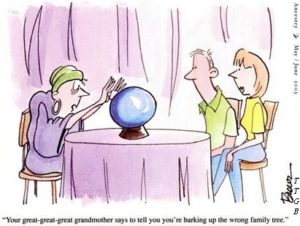
90c28bcfbe8cc5ef61e05a0b6e3c0b42

I got a call several days later from Walgreens to pick up my photos.  While I was gone my husband was checking email.  When I returned from the store hubby was excited and told me there was an email I just had to read right away – it was from the Midwest cousin.  Here’s a transcription of the email dated 5 April 2001 but  I have used initials only as I don’t have permission to use their names:

“Found it!!!!! Actually J. found it.  It is very faint and has some water damage.  I will send you all copies (I’ll take it in tomorrow).  I have never been to Graceland [Cemetery] but there is a tall white stone with what looks like an urn on top.  On the left side of the picture is a young girl with a fancy dress.  Seated next to her is a bearded man with a top hat.  To the right of him is a girl with her head resting on her hand.  Two boys are seated on either side of the monument.  On the back in a flowery script it says:  Graceland  Cemetery 1870 Thomas Thompson Drusilla Thompson Lewis Thompson James Thompson Mary Thompson.

I will have the back photocopied so that I can send that along with the prints.  Hope this does it for you.  I actually jumped up and down when Uncle B. handed it to me.  He did not want me to take it from the house, but I insisted… Congratulations! S.”

I shouted and jumped up and down, too and thanked all the dead people who supposedly were following me.  Later that evening I received the following email from the Midwest cousin:

“I had a long talk on the phone with Uncle B tonight about Aunt V. and we were rejoicing over the good news from the doctor.  Then he says, “S., did you pray about this picture?” (He is a religious man.  I don’t pray about pictures.)  I said, “No, but it means a lot to I. and her daughter, and to Lori.  Why?”  And he says, “J. didn’t go up to find the picture.  He was just going through some old things cleaning up.  Then he came upon a box that he had never seen that had been up there before the tornado because it had water damage.  He went through it and found old clothes and things, and there in the bottom of the box was this picture.  The only picture in the box.  Somebody’s prayers must have been answered.”

“Well, I’ll leave that last part for you to decide.  But this is very weird because J. has been through those attics time and time again and he said this box was just sort of sitting there.  This makes the tape thing* of mine even spookier.  Anyway, J. brought the picture down not eve (sic) knowing what it was because it was so faint, and wouldn’t you know.  It’s the picture.

Just thought I would share that part of the story with you.  You can make of it what you will. S.”

And you, dear readers, can make what you will of this odd story that happened to me.  Here’s the picture:
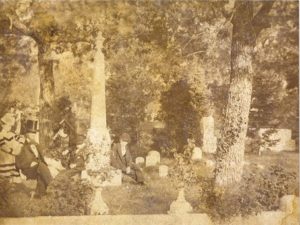
dru

From a later email, here’s further information about the photo:

“…I asked what they [the photography shop] could do to make it clearer and they said that I would be pleasantly surprised because it was made before there was film so there is no grain and should enlarge perfectly.  I had them make a 5 x 7 with some cropping of tree tops from the top; a  5 x 7 that focuses on the family and the monument and an 8 x 10 that includes as much of the picture as possible in the original, which is about 7×6…”

The miracle of this picture is that it survived not only the 1974 tornado but also 131 years of no heating or air conditioning, the Chicago fire (1871), and several moves across three states.

But the story doesn’t end there….

Six months after the photo was discovered my eldest child was inducted into the DAR; it was her senior year in high school as my mother-in-law, long dead, had predicted would happen.

As I was writing this blog I decided to take a break and look at some of the hints that had popped up on ancestry. I have disabled most of the hint feature so when I get some, I tend to take a look.  I can’t explain how there was a hint for Find-a-Grave for Uncle B, the man who had the picture in his attic.  I didn’t even know he had died 3 years ago.  Someone had posted his and his wife’s gravestone photos just 2 months ago.  I have no idea who made the memorial or the relationship of the person who posted the photos.  Why that hint showed up a few hours after I had written most of this blog I can’t explain, either.

So just maybe all those dead people behind me in Walgreens are still around helping me keep my tree updated.  I don’t understand how it all works but I certainly appreciate the help!

*I’ll save that strange story of the tape for another day!

Creepy Creepy October

Originally published on genealogyatheart.blogspot.com on 22 Oct 2015.

As we approach Halloween, I’m thinking about the weird and unexplained that happens in the world of genealogy.  I’ve had several strange situations occur which I’ll be sharing over the next few posts.

Since I know I’m not alone I wanted to share with you some coincidences I’ve discovered in the past few weeks written by other genealogists.

The first was from Crestleaf.com – if you don’t subscribe to their free email newsletter you really need to as it’s filled with useful posts.  In their September recap there’s a link to their interesting finds for the month and one written by Vicki Noels-Cornish, The Ginger Genie, who shares a serendipitous find.  Click on Crestleaf to read about it.

Don’t know if you saw the History Channel show last year about the violin that was discovered to belong to one of those who perished on the Titanic.  I’m not a big Titanic fan but I loved how the show followed the trail to discover that the violin was in fact one used on the ship.  I was astounded to read the rest of the story – recently posted by the Daily Mail in the UK.  This you’ve got to read if you’re not aware of the update.  Warning – there’s a spoiler in the headline so scroll down before you begin reading!  View it here.

My Mother was quite superstitious and one of her favorite saying was “It always comes in 3’s.”  So here’s the 3rd coincidental story – I’ve discovered recently that Genealogy Today has short stories submitted by users about Serendipity.  I really enjoyed “Marriage Arranged By Ancestors” as my husband and I met accidentally through friends.  Over the years we’ve discovered that we are “cousins” several times, the most recent in the 1500’s.  Before researching my ancestors I would have said I was Croatian and German and he would have said he was Swedish.  Little did we know we are also Irish, English, Welsh, Scottish, and French. Enjoy!

The Apple Doesn’t Fall Far From the Tree – The Real Life of Johnny Appleseed

Originally published on genealogyatheart.blogspot.com on 16 Oct 2015.

When I think of fall I don’t think about pumpkins and leaves like most.  Instead, I think of apples.  I loved apple picking as a child and I knew what would come soon after, my grandma’s apple strudel. We bobbed them, tried to bite chunks out that were dangling from the ceiling and dunked them in caramel.  My neighbor, Carol, and I would twist the core while reciting the alphabet to determine the initials of who we would marry someday. Sweet or tart, there’s an apple for every one’s taste.

When my in-laws moved to a rural part of northeastern Indiana in the 1980’s, hubby and I always knew where to turn on the unmarked road – just look for the old abandoned apple orchard on the corner.  The trees were gnarly and the fruit small and withered.  It always looked creepy to me, even on a bright sunny summertime day.  I remarked to my father-in-law that it was a shame the trees were neglected.  He said that he had heard that they were once owned by Johnny Appleseed.  Little did I know how right he was.

I knew Johnny Appleseed was a real person named John Chapman.  With a romantic notion of him traveling the west to plant apple seedlings so that pioneers could benefit from the delicious fruit on their journey, I knew little else about him.

I passed on the story of Johnny Appleseed to my children every fall when I made my mother’s apple salad. They wanted us to plant an apple tree but in our part of Florida, that wouldn’t work.

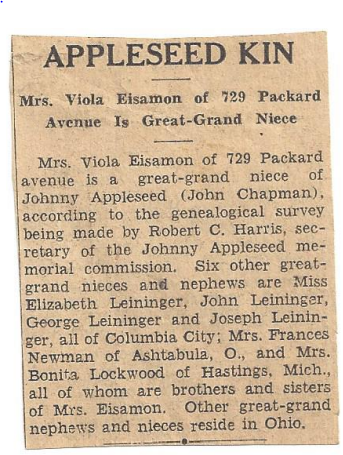
Imagine my surprise when I discovered this newspaper clipping with my father’s papers after his death in the late 1990’s:

Like most everything my family has left me, I have no idea of the source.  Grrr-no newspaper name or date. Did Dad save it because the name Leininger was mentioned or was he, too, related somehow to Johnny Appleseed?  Dad and I weren’t close but there was an apple tree on my grandparent’s farm in Hobart, Indiana that I used to climb.  Wouldn’t someone have told me if Johnny Appleseed was a relation?

John and George Leininger are common names in the family – I’ve got 19 John’s and 18 George’s. In addition, I’ve got combined John George and George John.  I knew John Chapman never married and I had no Chapman’s in my tree so I assumed the clipping was because of seeing the Leininger name. Yet, there was some other oddities that made me wonder.  My step-grandmother was from Michigan, close to Hastings, and the Leininger family first settled in Ohio, though it was not Ashtabula.  My aunt’s name was Bonita and she once lived near Columbia City, Indiana.  Hmmm.

It wasn’t until a distant cousin emailed me his Leininger records that I learned that John Chapman was involved with the Leininger family and that spooky old orchard did in fact once belong to him.

“According to a deed signed by President Martin Van Buren, John Chapman owned 74.04 acres in the South 1/2 of the N.W. 1/4 Sec. 3 Twp 24 Range 15.  The deed was dated March 11, 1836. This land is located in the far northeast corner of Jay County, on the Wabash River.  It was on this land that he planted a nursery of appletree seedlings…. John Leininger purchased through a deed, entered July 1, 1839, 128.60 acres of the S.E. fraction of Sec. 15 of the same township. This land was located about two miles south of Chapman’s land.  John Leininger also purchased eight acres of land in Mercer Co., Ohio, on the other side of the State Line from his larger purchase.  He built his house and buildings on the eight acres, so that he could send his children to Ohio schools, which were better at the time than Indiana’s.  Please realize that this area was practically wilderness at this time.”1  My dear readers know I’ve written earlier about my family’s interesting ways to get their children into the best school districts – see blog of 20 August 2015 Education Across State Lines.

Map of Johnny Appleseed's farm (John Chapman) and John George Leininger's farm
The John Chapman and John Leininger Farms – Map courtesy of Robert LeRoy Leininger in his book, Leininger Family History and Genealogy (1970) p. 7F

So here’s how John Chapman is connected to the Leininger Family.  John’s step-sister, Percis Chapman (15 Nov 1793-28 Jun 1859), married William Broom (1792-1 Mar 1848).  Percis was known as John’s favorite sibling so he remained close to her, even after her marriage to William. Percis and William had 4 daughters, Mary, Lucy, Elizabeth and Harriet.  Elizabeth (10 Sep 1829-2 Jun 1863) married John George Leininger (7 Feb 1826-31 Mar 1917).

Elizabeth Broom
Elizabeth Broom Leininger Photo courtesy of Jill on Find-a-Grave

John George and Elizabeth had 6 children before her death.  He remarried to Sarah Hough in 1864

Sarah Hough and John George Leininger Photo courtesy of  Robert LeRoy Leininger

and had 5 more children.  John George is my 2nd great uncle, sibling to my 2nd great grandfather Jacob Leininger.

Henry Leininger and Jacob Leininger
John George’s brothers Henry (left) and Jacob (my 2nd Great Grandfather-right)  Photo courtesy of Robert LeRoy Leininger

I’ve written about John George in a previous blog (see 26 June 2015 Planes, Trains, Automobiles & Barges, Oh My!) and how difficult it must have been for my 3rd great grandmother, Marie Gasse Leininger, to have to journey to America with young children.

Marie Margaretha Gasse Leininger Photo courtesy of Robert LeRoy Leininger

According to family recollections, Johnny Appleseed lived with Percis and William when he came back to Indiana.  William tended Johnny’s land in his absence and when Johnny died in 1845, Percis inherited Johnny’s 1200 acre nursery.2  Johnny was a wealthy man at the time of his death.

I don’t know what religion Percis and William followed but their daughter, Elizabeth, married into a Lutheran family.  Johnny, however, followed the tenets of theologian Emmanuel Swedenborg.  At the end of his days, Johnny was a barefoot vegetarian who preferred to treat everyone and everything with respect.  Since that included Native Americans, animals and insects, Johnny was viewed as eccentric.

Here’s some things I bet you didn’t know about Johnny:

  • Johnny’s dad was one of the Minute Men in Boston during the American Revolution.  When Johnny’s mom and brother Nathaniel died in 1776, his dad returned home from the war.  Johnny was raised by his step-mom.
  • If you were a Girl Scout and sang the Johnny Appleseed blessing you really were singing Johnny’s favorite traveling song. (Ohh, the Lord is good to me, and so I thank the Lord, for giving me, the things I need, the sun, the moon and the apple seed, the Lord is good to me.)
  • The trees he planted weren’t designed for eating – they were designed for drinking.  Yep, Johnny was helping the settlers produce hard apple cider.  No wonder they loved him! Johnny didn’t believe in grafting which is the only way you can get an edible apple.  Planting apple seeds produces a fruit that may be just plain awful (but not if you’re going to use it for an alcoholic drink).  Apple liquor was easier to make than corn liquor and cured quicker.
  • He didn’t just sell apple trees – he also had a business selling herbs.  Native Americans purchased their herbs from Johnny.
  • Johnny was the “Paul Revere of the Western Frontier.”  During the War of 1812 he warned settlers in Mount Vernon, Ohio that the Native Americans were planning an attack by racing 30 miles through dense forest.  His actions saved the entire town.
  • His pet was a wolf that he once freed from a trap.
  • The west that Johnny ventured to was what we consider the midwest.  He planted in Pennsylvania, Ohio and Indiana.  There is some who think he went as far south as northwestern West Virginia, then known as Virginia, but that hasn’t be authenticated.
  • Johnny was the first person to travel between nursery sites.  He’d plant, stay a bit, then travel back to nurture a site he previously planted, move to a new site to plant and then move on to visit one he already planted.  This enabled him to have supplies in various places and not lose a crop due to poor weather conditions.
  • He’d rip out pages of his Bible to give to settlers and the remains of the last one he wore stuck in his belt was last known in 1970 to be in the possession of Waldo Dock, a descendant, in Celina, Ohio.

So the real Johnny would have fit right in the 1960’s as a hippie type that would have approved of Boone’s Farm Apple Wine with his special herb mixture.

Oh, and that newspaper article – seems that it was from the Ft. Wayne, Indiana newspaper around 1931 when Robert Harris was interested in finding descendants.  So it wasn’t cut out by my dad after all.  Most likely either my grandmother or grandfather clipped the article as that is where they were living at the time. Robert Harris published a book in 1946 about Johnny.

One more mystery remains – that apple tree I used to climb on the family farm.  I wonder if it was one of Johnny’s.  We couldn’t eat the fruit as my mom said it was “bad” and my grandparents were from the Ft. Wayne area so it just might have been one of Johnny’s.  Too bad we’ll never know.  The farm is now a subdivision and the apple tree was cut down in the


1 Leininger, Robert LeRoy Leininger Family History and Genealogy Two Centuries of Leiningers Manchester, IN:  Self Published, 1971, Appendix F.

2 The Straight Dope:  “What’s the story with Johnny Appleseed?” Straightdope.com.  Retrieved. 11 Oct 2015.

A New Genealogy Society – What Fun!

Originally published on genealogyatheart.blogspot.com on 11 Oct 2015.

My sister-in-law called me last week and wanted to know if she was Scotch-Irish. I laughed and told her she was of Scottish and Irish heritage.  I then explained that the term Scotch-Irish is derogatory and only used in the U.S.

She was happy to find out that she was indeed Scottish as a new genealogy society is being established in the city where she lives and she wants to join with her friends.  The first organizational meeting is today so she doesn’t have a membership application to complete or much information on the requirements.

I looked at a similar organization and, knowing that I’m going to be extremely busy with my day job and trying to get my genealogy certification portfolio put together, I told her I’d pull the records for her as an early Christmas present.

Oh what fun it was to review my older research notes on one of my favorite couples on my husband’s side!  I really wish I could have met these folks as they are just endearing to me with their spunk, love and acceptance of each other’s differences.

John Cooke was born in  Whees, Stirlingshire Scotland about 1827.  I have him with his family in the 1841 and 1851 census in Scotland.  I’ve never been able to locate an emigration record but he must have come to New York City shortly after 1851 as he married Mary “Mollie” O’Brien in 1854 in Newark, New Jersey.  Mary was born in 1835 in Limerick, Ireland and thanks to the Irish records now available online, I have her Roman Catholic Baptism record.  Of course, it is on the right side towards the bottom of the page that is most difficult to read!  Mollie and her step-sister, Ellen, emigrated in February 1853 as domestic servants with another girl from her parish.  This was during the potato famine and there is no records of land ownership by Mollie’s parents so times must have been tough.  Coming to a new country at 18 years of age with nothing takes spunk!

Newark, New Jersey, being just across the river from New York City, was the perfect place to elope and take the train to Chicago.  I don’t know for fact that Mollie and John eloped but it’s awfully odd that there were no traditional wedding banns posted, which was a common Roman Catholic tradition. Also strange is that step-sis Ellen wasn’t the witness.  It appears that two unrelated parishioners did that job.  The birth information that was given at the church doesn’t quite match reality, either.  With no relatives around to question, John shaved off a few years, making him the same age as Mollie.

The couple remained together until John’s death in 1889.  Mollie lived until 1903 and never remarried. I believe they truly loved one another and their respect goes way beyond what a lot of folks can’t do even today.  The couple made an arrangement prior to their marriage – all female children would be raised Roman Catholic and all male children would be raised Protestant.  I’m not sure how Mollie got the Roman Catholic Church to agree to this since the rule was if you were married in the church you were agreeing to raise ALL of your children in the faith.  I also have to give John credit for marrying Mollie in her church and giving 50-50 in regards to the children.  I’m really impressed this agreement was made 160 years ago and both parties kept their word.  With integrity, they didn’t need a written pre-nuptial

The couple had 3 children – 2 Protestant boys and 1 Catholic girl.  I’ve been in contact with the girls descendants and they are all Catholic to this day.  All of the boys descendants I’ve been in contact with continue to be Protestant except for one and that was due to marrying a Catholic girl (me).

Interestingly, when John died he was buried in the Protestant cemetery, Calvary, in Cook County, Illinois.  Mary’s death certificate noted that she was going to be interred in Calvary, too, but she wasn’t.  She was buried in Queen of Peace Roman Catholic Cemetery instead.  After 15 years of being apart the children decided the couple needed to be together so John was re-interred next to Mollie. Unfortunately, there was no stone.  I assume because the cost of re-interment was considerable at the time.  I wish I could afford to put a stone there cause this is a true love story that needs to be long remembered.

Family Pets

Originally published on genealogyatheart.blogspot.com on 7 Aug 2015.

My daughter wants to get a dog in the next few months.  Growing up, our kids have had lots of pets as my husband and I believe that the benefits far outweigh the work.  Gaining responsibility and compassion, instilling nurture and playful fun are worth the cost and effort, IMHO.

Lab Mariah, Son holding cat Tinker and daughter holding rabbit Fluffy.  They also had a parakeet, fish and turtles.

Daughter will most likely find an older mutt at the local shelter.  Son thought she ought to get a cat, instead, since she likes to travel.  Hubby is just excited to finally be a “grandparent.”

We’ve been having a large amount of rain lately that limits outside activity so I decided last weekend to look through photo albums of our family’s pets.  I was amazed to discover how far back the interaction of animals in my ancestors’ lives are recorded.

The oldest seems to be this pic of my mom and aunt from around 1923:

I wish I knew the pony’s name!  Living on a farm, we had 12 ponies and a horse but my favorite was Dapple Brownie – I’m about the same age as my mom on her pony:

The oldest dog photo we have is of my husband’s grandmother, Elsie Johnson Harbaugh, from around 1942. The dog’s name has also been lost to history:

Funny how families tend to like similar breeds.  Hubby’s family really liked small dogs; his

parents also had a poodle named Schatze when he was growing up and after he left home, Nano:

Hubby liked larger dogs but his parents drew the line and only allowed him to have a mid size mutt, Henry:

I miss Henry.  He used to sit between my husband and I in the car on dates and hold my hand.  Hubby said he knew I was the one as Henry was very particular about who he liked.

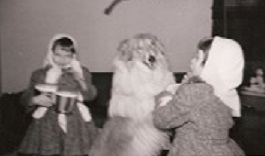
My side of the family liked big dogs.  My dad always had collies:

Friend Debbie, Me and Lassie (not the famous one!)

as did my twin cousins, with Twinks:

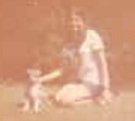
Since my parents were divorced, and my mom and I lived with my grandparents, I had Australian sheepdogs there.  Here I am with Toto, as a puppy, who was hit by a car.

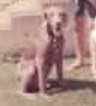
After his death, I cared for Toto’s sister, Snowball, until we moved to Florida and Snowball retired to a farm in Indiana.  I also took care of my uncle’s weimaraner, Lucky, for a bit.  Someone stole him from my uncle’s backyard and it broke my uncle’s heart:

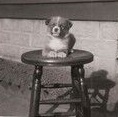
Our next door neighbor, Mr. Bauer, had a small dog I played with, too:

Clearly, we aren’t just dog people as many cats have imprinted love on our hearts:

My cat, Blackie, at the farm
Boots and kittens at my grandparents
Thomasina and I at my grandparent’s house

My husband had a kitten for a short time but it was a wild child so his parents had to return it:

Kiitie looks so innocent here but it scratched anyone who came near.  When hubby and I were first on our own we got a cat, Midnight, at the pound:

Mid got into a cat fight when he was about 8 years old and died from an infection.  We were so upset that it took us a year before we could get another pet.  Eventually we got Tinker (the cat) and Misty (the dog).

who were the best of friends as we got them within 2 weeks of each other.  Tinker lived 19 plus years and Misty, 12.  These were the first pets our kids had.

Over the years we also adopted a stray, Cipher, who turned out wasn’t a stray.  When we couldn’t find the owner we took Cipher to the vet – no chip so we got him shots and adopted him.  Cipher slept at our house at night and we later learned was spending his days a few blocks away at a neighbor’s house. When the neighbor decided to get Cipher chipped (she was calling him Ben) she discovered we were his people.  Cipher decided to move in with her permanently after I brought home two kittens who had been abandoned at the school where I worked.

Last but not least are 2 birds that I will never forget.  The first is a wild bird that wasn’t very wild. Every time I went out to play the bird below would join me.

This went on for at least 3 years and as an adult, I realize how strange that is but as a child, I didn’t know that wild birds aren’t supposed to play with you.

When I was three, an elderly neighbor was moving and couldn’t take her parakeet with her so my mother said we’d look after the bird.  The neighbor had had Chipper for about 20 years so my mom figured it wouldn’t live much longer.  Surprise, surprise, Chipper happily chirped for the next 13 years.  He didn’t like to leave his cage; he’d fly from one end of the room to the other and than land on the open door and go back inside.  Chipper’s favorite show was same as that of my grandparents, Lawrence Welk, and later, The FBI.  I don’t know why he liked the latter but he would sing so loudly you couldn’t hear the show.

I can’t wait to see how our two cats, Charlie and Parker, are going to behave when daughter’s dog visits. I’m expecting it will make for some more memorable family stories!

Picnics

Originally published on genealogyatheart.blogspot.com on 26 Jul 2015.

I have fond memories of picnics – beginning in childhood all the way to last weekend! Picnics today are a relaxed affair, it’s a wear something comfortable, de-stress and enjoy family, friends and nature.  I don’t know about you but I definitely don’t try to make a fashion statement when going on a picnic.  That wasn’t the case, however, back in the day.  I love the picture below showing my grandmother, Non, with the family’s first car in 1923. Nice touch with the American flag on the front since it was Independence Day.  They were on their way to the Croatian Picnic Grounds located between Glen Park and Hobart, Indiana.  A dress, heals and Sunday’s best hat for spending the day in the sticks.

July 4, 1923-on the way to a picnic, L-R Boarder, Mary Koss, Joseph Koss Jr.

Non wasn’t alone in her wearing apparel.  You’d think the family was going to church instead of spending the day in the woods.

Croatian Picnic Grounds 1923 L-R George Kos, Anne Marie Koss, Anna Grdenic Kos, Ivan “John” Koss, Dorothy Koss, Mary Koss and Barbara Kos
Must have been a chore to get the kids’ clothes clean!  The area was heavily wooded with a small clearing that was mostly dirt.  No wonder Non loved her Fels Naptha laundry soap. We had an old Maytag ringer washer in the basement that had to be filled up by hand with hot water.  I can still picture my Gramps hooking up the laundry line around our backyard and adding poles with slits to insure that the line didn’t sag.  Monday was wash day and the picnic sure must have been a distant memory the following day spent cleaning all those dirty garments.

The Croatian picnic grounds were used for at least 50 years.  The picnic grounds were open on Sundays from Memorial Day through Labor Day.  Every Sunday, one of the men would rise early to attend 6 AM Mass and then set off for the grounds to prepare the spit that would roast the lamb.  Families took turns selling plates of food and drinks.  Our shift was usually 1-2 PM once a month.  I wish I had a picture of the building which was just a wooden shack.  The north end was enclosed to hold supplies.  That was attached to a covered bar area.  Since the bar rail was too high for kids, a child who was helping would stand on an overturned wooden “pop” or soda carton or two.  Customers would order plates of roasted lamb, Vienna style bread, Croatian style potato salad or a lettuce salad with oil and vinegar dressing.  Drinks were always Budweiser beer in a bottle or whatever pop was on sale that week – Coke, Pepsi, Fanta, Sprite.  Funny we never had water though there was a spigot that we all used to wash our hands after eating.  Someone would put a bar of soap in a mesh bag on a string around the spigot.  Nature dried our hands. I have no memory of the bathroom facilities, if they even existed.

Some of the ladies brought desserts to sell – pita which is like a fruit filled bar cookie and not the bread sold today, apple or cheese strudel, and cookies.

Both lunch and dinner was served.  Sometimes the menu changed and pork was included, along with hamburgers and hot dogs.  We always got lamb, though, which was heavenly. My father-in-law disliked lamb as he believed it was tough and tasteless.  My last visit to the Croatian picnic grounds was in 1985 when my husband and I returned to visit his family. We brought a takeout container to my in-laws and after one bite, my father-in-law groaned that he had spent his entire life in the area and never knew what he had been missing. The following Sunday he went back for more.

After lunch, as kids, we’d cut through the woods on a well worn trail or crossed the street to visit our school friends and neighbors of other nationalities.  My next door neighbor, Carol Leon, would be at the Spanish picnic grounds right across the street.  There was also Polish, Serbian, Greek, and Italian grounds.  Possibly there was more but I wasn’t allowed to walk that far!  Sometimes we’d play baseball or badminton with our friends but our favorite was cigarette tag – Someone was “it” and “it” chased everyone around.  If you were tagged you had to sing a cigarette jingle (like, Winston, tastes good like a cigarette should or I’d walk a mile for a Camel) or you became “it.”  Funny but none of us grew up to be smokers.  The adults spent the afternoon playing horseshoes or cards.  The women loved to gossip.  There was also singing and dancing (after a couple of beers) as the musically inclined always brought their native instruments.

By the mid 1960’s female children began wearing shorts.  The ladies continued to dress up through the early 1970’s.

pradevic
Prerodevic Picnic L-R Barbara Kos Milosevich, Family Friend Violet Harminsic, Anna Kos, Unknown Friend, Mary Koss Circa 1950

I wish I had the secret lamb recipe, I know it was infused with garlic, probably patted down with salt and pepper but what else I have no idea.  I do make the Croatian potato salad often which is similar to German potato salad. Besides lamb, it’s wonderful with ham, too. Try it and let me know what you think:

Croatian Style Potato Salad

Peel and cube potatoes to bite size (I use red but any kind will do) about 2 potatoes per person.

Add water and cook on stove til tender.

Meanwhile, cut a small sweet onion coarsely.

When potatoes are done, drain and place into a large serving bowl.  Liberally sprinkle with coarse salt and pepper.  With a serving spoon, mix then salt and pepper some more.  Add the onions.  Using a ratio of 1 tablespoon red wine vinegar (or regular vinegar) to 2 tablespoons oil (vegetable or light olive) drizzle over the potatoes/onions until the potatoes are well saturated.  Gently stir to make sure that all of the liquid is absorbed.  If you have fresh dill or parsley you can add either.  Put a dinner plate over the serving bowl to maintain the heat and allow the dish to marinate, about 5 minutes.  When ready to serve, stir and enjoy!

The Bank Heist

Originally published on genealogyatheart.blogspot.com on 22 Jul 2015.

It was the Great Depression and times were tough as my grandfather, Gramps, had his work hours reduced at the steel mill.  The family took in boarders but as their hours were also cut, money was extremely tight.  One of our family legends takes place in the midst of this difficult period.

Gramps always turned his paycheck over to my grandmother, Non, to cash.  The family had an account at Gary National Bank on Broadway in Gary, Indiana.  The typical routine was Non would cash the check, put a small amount in savings and then on her way home, shop for groceries at a small family run store.  One never knows when a typical day will turn into a major event but that was what was about to happen.

Non stood in line at the bank awaiting her turn with the teller.  Hearing noise, she turned and saw a group of men exiting a car parked at the curb.  What made the scene different was they were waving guns and had their hats pulled down low over their eyes.  Bursting into the bank, the ring leader ordered everyone to get down on the floor.  Non stood still, in shock, clutching Gramps’ check.  Shots were fired at the ceiling. Non continued to stand still.  As one gunman approached the tellers directing them to place money in the bag he carried, another stood guard at the door.  A third man approached Non and again ordered her to get down on the floor.  Non pleaded, “Please, sir, my husband is a cripple and I have 3 small children.  My widowed mother and my sister also live with me.  I need this money. Please don’t take it.”  The gunman replied, “Get down now or I’ll shoot.”  Non got down on the floor. “Put your hands out to the side.” he ordered.  Non complied.

Minutes later the gunman was back and he dropped a stack of bills in Non’s outstretched hand.  She turned her head and saw him wink at her.  The gunmen told the customers to remain on the ground until they counted to 100 aloud. Departing, the robbery was over.

When they got to 75 Non shoved the bills down the top of her dress. Amply endowed, no one would notice.  Non not only could use the money, she feared that the police would think she was an accomplice if she reported what had happened so she said nothing.

After Non got home she hid the money, which amounted to several hundred dollars, fearful that if she used it she would be in trouble.  Years later, after the robbers were convicted, the money was used to partly pay for the  family home being bricked. Non swore that the gunman who gave her the money was John Dillinger, the Indiana farm boy turned bank robber.

Problem is, Dillinger didn’t rob a Gary National Bank.  He robbed a 1st National Bank in East Chicago, Indiana1 but Non would not have gone that far as she would have had to rely on street cars to get there nor was that bank located on Broadway.

Historians dispute some of the bank robberies at the time that were thought to be committed by Dillinger.  A friend of Dillinger’s, John “Red” Hamilton and Baby Face Nelson’s gang has now been credited with some of the robberies initially attributed to Dillinger. Today, 14 robberies are thought to have been the work of Dillinger between 1933-1934.2

Non insisted that Dillinger was the man who gave her the money.  There are many reports of Dillinger’s compassion.    “Dillinger was generous with his ill-gotten gains, leaving $100 bills behind for each member of the family whenever he visited and one time offering to finance Gallagher’s (his niece’s) dream of opening a beauty shop by giving her $5,000. After discussion by the family, it was decided not to accept the money.”3  Another “story told of a farmer who had come to a bank to make a deposit while the gang was robbing the place. Standing at the teller window with his money in front of him, Dillinger asked the farmer if the money was his or the bank’s. The farmer answered it was his and Dillinger told him, “Keep it. We only want the banks’.”4

Was Dillinger involved in the robbery Non remembered or not?  Possibly his role was that of an accomplice and not the leader.  Perhaps Non was mistaken and the robber was not Dillinger.

There were several bank robberies so I can’t pinpoint which robbery Non experienced.  I can understand as an immigrant with a previous arrest (see The KKK Strikes post of  18 July 2015) she would fear further police involvement.  Although I can understand why Non didn’t tell authorities about the money she received it clearly was wrong.  In genealogy, separating our family’s past choices from our present lives can be difficult.  Keeping in mind that we’re all imperfect humans helps.

Mary & Daughter Mary Lou Before Bricking 1943


After Bricking. Photo taken Dec 2001

“John Dillinger – List of His Bank Robberies.” AwesomeStories.com. N.p., n.d. Web. 08 July 2015.

2 Ibid

3 “Dillinger Relatives to Attend New Museum Opening.” Nwitimes.com. N.p., 28 Feb. 2015. Web. 08 July 2015.

4 “John Dillinger.” History.com. A&E Television Networks, n.d. Web. 08 July 2015.


The KKK Strikes – Reasons Behind the Cross Burning in Gary, Indiana

Originally published on genealogyatheart.blogspot.com on 18 Jul 2015.

One of my mother’s most frightening memories occurred when she was 6 years old.  It was late autumn and the family had just finished dinner.  Hearing the sounds of cars and voices my grandfather, Gramps, went out to investigate as typically, there was not much traffic at that time of night. Peaking out the window, my mother saw men in white and many cars lining the street.  Gramps soon reappeared and ordered everyone to turn off the lights and to quickly go down into the basement.  My grandmother, Non, asked him what was happening but he just shook his head and grabbed his young son, my Uncle George. The outside noises grew louder – car doors slammed, men spoke loudly and then it became quiet.  The children were told to remain still.  My mother recalled how cold and damp it was in the fruit cellar as the family had not had time to grab a sweater and this part of the house was unheated. My mother didn’t understand what was going on but she knew her parents and grandmother were frightened. Then the sounds of cheering and what sounded like singing, though muffled, was heard. In the dark, mom’s siblings fell asleep but she felt, as the oldest, she needed to remain alert so she pinched herself to stay awake.  After several hours of quiet my grandfather decided to investigate.  He soon returned  and said the Klan had left, the charred cross was not glowing so the fire must be cold. The family could return to their beds for the night.  My mother had a fitful sleep for many nights after as she was sure those bad men were going to return and cause harm.

Why did the Ku Klux Klan choose to burn a cross in front of her home?  Why did they hate her when they didn’t even know her?  Why did they wear hoods and capes?  Where were the police?

My mother went to her grave never knowing for sure why her family was targeted.

I thought I knew the reasons but in researching this family story I discovered I was very, very wrong.

Some background information is necessary to see how my initial reasoning was flawed. I’ll highlight some of the key parts of the saga:

After my grandmother, Non, emigrated to the US in July 1913 with her mother, Granny, and brother, my Great Uncle Joe, the family resided in Glen Park, a suburb of Gary, Indiana, while her father lived in nearby Chicago, Illinois working for the Pullman Company as a laborer.  My great grandfather thought it best if the family lived in a more bucolic setting than the nitty gritty urban environment they weren’t used to.  Non’s first residence was an upstairs apartment on West Ridge Road between Adams and Jefferson Streets.  The building below the apartments held a church and a paint store.  Non and her brother briefly attended school in the neighborhood to perfect their English and she fell in love with the community.  Looking for ways to increase the family income, however, my great grandmother, Granny, decided to apartment hunt in Chicago, locate a larger apartment and then sublease to other immigrants, providing them with room and board.  So off to Chicago the family moved.

In January 1917, my grandparents wed at St. Salomea’s Roman Catholic Church in Chicago and they remained there until after my mom’s birth in April 1918.  The family seriously discussed moving to Bethlehem or Alquippa, Pennsylvania as there was rumors of steady income with the steel mills but they decided to remain in the Chicago area.

Family outside Granny’s Pullman area apartment Left-Right, A neighbor, Great Uncle Joseph Koss, Non, my Mother Dorothy and her Godmother, a friend of Non’s.

My great grandpa did not live long, dying as a result of the Great Flu Epidemic in January 1919. The family unit consisted of widowed Granny, her 3 children – Joseph (who is missing from the 1920 census), Barbara (born in the U.S.) and my Non, Non’s husband, Gramps, and their 2 children, Dorothy, my mom, and Anne Marie with a third, George, on the way.  The only breadwinner became Gramps.  By late 1918, Gramps and my great grandfather were hired as laborers in the steel mill in Gary.  The family rented a house at 2626 Harrison Street, not quite in Glen Park but close.  My mother recalled that the house often flooded from the nearby Calumet River, there was a grape arbor in the back but lots of snakes so the children played on a hill across the street.

Times were tough so Non learned a lot from her neighbors who had moved to Gary from Mexico and Louisiana.  Being a young mother with 3 small children, her Black neighbors, the Gilkeys, taught her the value of Vicks Vaporub and shared a secret family recipe to help the children recover from scarlet fever, sore throats and earaches.  Even though the city had placed the family under quarantine for the scarlet fever, the neighbor woman would sneak in the back door to bring food and the homemade medicine.  Non learned to cook in new ways and corn meal mush, fried chicken, hot sauce and greens became commonplace. The family had a garden with chickens and rabbits.  In the fall, the children would stomp the grapes to a pulp so the family could make vino, a family tradition, which they began to sell locally.

1920-census
1920 Census – Note that one of the “Black” families were of Mexican Hispanic descent

The only problem was that the home was considered so far out from the city limits of Gary that there was no streetcar so my one legged Gramps re-learned how to ride a bike to get to the last stop of the streetcar line on Broadway, about a mile away, to get to work in the mill.Around 1923 another tragedy struck the family.  Breadwinner Gramps had to have his right leg amputated due to a steel mill accident.  With the settlement money they received the family decided to buy a home in Glen Park, 1 block west of the apartment that the family first lived in when they emigrated.  Non wanted her children to attend Glen Park Elementary School that was known for providing a good education and St. Marks, the brand new Roman Catholic Church, was only 1 block away.

The farmhouse was large enough to once again take in boarders for extra cash.  The family continued to raise chickens and rabbits, a vegetable garden and of course, grapes so that they could produce more vino to sell.  My mother recalled that in the fall, her feet were often purple due to the stomping of the grapes.  The fruit cellar where the wine was stored was in the basement, directly under where my mom (Dorothy) was standing:

1926
L-R Anne Marie, Dorothy, Non, Boarder, Friend of Non’s with her son

Shortly before the cross burning, my mother experienced another frightening event.  On Saturday nights, Gramps would play cards with his friends while Non went to the movies with her girlfriends.  Granny remained at home watching the children.  One Saturday night the Gary police arrived at the door inquiring about sales of alcohol.  Granny, with her limited English, had my mother translate.  The officers searched the house, found the vats in the fruit cellar and with backup, removed the wine.  When my grandparents returned home they were questioned and then arrested.  The next morning they appeared before a judge who told them they would be contacted about an upcoming court date.

My grandparents were arrested because of the laws of Prohibition.  “While the manufacture, importation, sale, and transport of alcohol was illegal in the United States, Section 29 of the Volstead Act allowed wine and cider to be made from fruit at home, but not beer. Up to 200 gallons of wine and cider per year could be made, and some vineyards grew grapes for home use.”1  The problem was my grandparents had sold wine.

The court date never occurred as the evidence seemed to have disappeared.  Perhaps the officers lost it, sold it or drank it.  According to the Gary Police Department, there are no records of arrests from that far back.  Searching court records, none could be found since there never was a court date.

Who turned the family in to police?  My mother always thought it was a teacher who had repeatedly questioned her about the purple stains on her hands and feet.  Perhaps it was a card player associate of my Gramps who was disgruntled after a losing game.  Maybe it was a neighbor who witnessed cars coming and going.  Most likely I will never know how the police were tipped off.

In researching this story I also contacted the Gary Health Department for records on the quarantine.  I was informed that there were no records from that time period, however, I did find online that there was a smallpox epidemic in Gary in 1920 but no record of a scarlet fever outbreak.

I also investigated newspapers for records of quarantine, my grandparents’ arrest and cross burning in Glen Park.  Nothing appeared.

For years, I thought the cross burning was because my relatives were the perfect poster family for Klan hatred – as immigrants, these Roman Catholic foreigners who had friends of people of all colors had taken jobs away from the good ole boys and now were living the American Dream by owning a house in the country.  I now believe it is most likely that the cross burning occurred because of the wine arrests.

Recently I learned that “After Prohibition took effect in 1920 until its demise in 1933, it opened up a financial bonanza for criminal activity, especially underground bootlegging and the smuggling of liquor into Chicago, Gary, South Bend, Fort Wayne, Indianapolis, Evansville and other thirsty cities. Enforcement was haphazard; the Anti-Saloon League was more of a lobbying agency and never rallied community support for enforcement.”2  “The KKK called for punishment of bootleggers and set up the ‘Horse Thief Detective Association’ (HTDA) to make extra-legal raids on speakeasies and gambling joints. It seldom cooperated with law enforcement or the state or federal courts. Instead (it) gave enforcement a bad name. Arthur Gillom, a Republican elected state attorney general over Klan opposition in 1924, did not tolerate its extra-legal operations. Instead, ‘He stressed the dangers of citizens relinquishing their constitutional rights and personal freedoms, and emphasized the importance of representative government (at all levels), states’ rights, and the concept of separation of church and state.’ When Rev. Shumaker proposed that ‘personal liberty had to be sacrificed in order to save people,’ Gilliom replied that surrendering power and individual freedoms was a slippery slope to centralized government and tyranny.”3

The arrest may have been the straw that broke the camel’s back with the Klan – we put up with you and now you’re making wine.  Enough already!  Perhaps because the police didn’t press charges, the Klan used the event to make a point to law enforcement – we know you didn’t pursue the case because you “lost” the evidence.  Who knows what the real reason was.  Unless a diary of an officer or Klansman involved miraculously appears mentioning these occurrences I probably will never know for sure.

This is one reason that I love genealogy, the unexpected discoveries!  I attended 12 years of schooling in Gary and never once did I hear about the Klan going after bootleggers and gamblers in the area. Although as vigilantes they were wrong to take the law into their hands, ironically, they were right in making a point that a crime had been committed and the enforcers of the law ignored it.

I realize my grandparents were the guilty ones in this story – they broke the law by selling wine and should have paid the price for their actions.  They got lucky in getting off – no evidence, no proof of sales, no case.

Unfortunately, it was an innocent victim, my mother, that was most affected.  I do know that the cross burning left an indelible mark on her


  1.  Prohibition in the United States Wikipedia. Wikimedia Foundation, n.d. Web. 05 July 2015.
  2. Thomas R. Pegram, “Hoodwinked: The Anti-Saloon League and the Ku Klux Klan in 1920s Prohibition Enforcement,” Journal of the Gilded Age and Progressive Era(2008) 7#1 pp 89-119
  3. Ann Gilliom Verbeek, “The League and the Law: Arthur L. Gillom and the Problem of Due Process in Prohibition-Era Indiana,” Indiana Magazine of History(2011) 107#4 pp 289-326, quotes at p 297 online

The Truth About Ellis Island

Originally published on genealogyatheart.blogspot.com on 16 Jul 2015.

Like so many immigrant families, I heard the story that our family name was changed at Ellis Island. Our story, however, did not blame the officials.  Supposedly, upon emigrating, my Great Grandfather, Joseph Kos, was told that his last name was awfully short for an American name. No one suggested that a short name was wrong or bad.  It was just a benign comment.  I figure the Ellis Island clerk was probably glad to finally get a short name he could clearly understand to record but it did not sit well with my Great Grandfather.  He wanted to be an American and if the name was too short then he would make it bigger, just like America!  He could do that by simply adding an “s.”  The pronunciation would then change from the long o sound, that rhymed with dose, to the short o sound, that rhymed with Ross. The seed was planted to grow from Kos to Koss.

Last year, a 2nd cousin emailed me to discuss his belief that the Ellis Island story was not correct and that my grandmother, Non, was really the one behind the name change.  His reasoning was that Non’s sister, his mother, Barbara, who was born in the U.S. on the 19 September 1914 has Kos as her name on her birth certificate and the parents’ names are both listed as Kos.  Barbara was born 4 years AFTER our Great Grandfather emigrated so there is no reason why he would have recorded his daughter’s name with the original spelling if he had changed his name upon his arrival in the U.S.  Non assimilated into the American culture the quickest and was the family matriarch so those factors supported my cousin’s reasoning.

Birth Certificate of  Non’s sister, Barbara Kos, born in Chicago.

I looked at the ship manifest for Joseph Kos who arrived in New York City on La Lorraine on 17 Jan 1910:

Ship Manifest from La Lorraine 1

I then looked at the 1910 Census where his name now appears more Americanized as Joseph but his last name remains Kos:On the manifest he is listed as Josip Kos.  An error was made in recording his wife’s name – it was duplicated from the entry above him instead of listing his wife, Anna’s name.

1910 Census for Joseph Kos 2

Joseph was working for the railroad, and at the time of the census, was in Chardon, Ohio. Next I decided to investigate the manifest for Joseph’s wife, daughter and son who did not emigrate until 3 1/2 years after Joseph.  Below is the manifest for Non, listed as Mara, her mother, Jana (Anna), and her brother, Joseph Jr. (Josip), from the President Lincoln that arrived in New York City on the 16 July 1913.  The last name is clearly Kos.

Ship Manifest from the President Lincoln 3

I know that when Non and Gramps were married on the 28 January 1917 in Chicago, Illinois both of their names appeared on the records with the added “s” as “Koss.”  As distant cousins from the old country, both had the last name Kos(s) so Non’s maiden name was the same as her married name.

See the 10th from bottom – John and Mary Koss 4

There are 3 possibilities as to why Kos became Koss between 1914 and 1917:

1) the marriage license was an error, There are 3 possibilities as to why Kos became Koss between 1914 and 1917:

2) my great grandfather or another family member added the “s” after 1914 or

3) maybe the Ellis Island story was told about my Gramps and not my Non’s side.

I checked the ship manifest for Gramps, Ivan “John” Kos who arrived in New York City on the 6 April 1909 with his brother, Janko (Stephen) Kos:

Ship Manifest from La Gascogne 5

The manifest shows Kos.  Next record to check is the 1910 Census.  Gramps is shown as a boarder living in Bethlehem, Pennsylvania.  His brother, who had left a wife behind in Croatia, had returned to her.  Gramps is still shown as Kos.

1910 Census 6

So the Ellis Island story wasn’t about Gramps, either.  I have no family documentation between my Great Aunt Barbara’s birth in September 1914 and my Grandparents’ wedding in January 1917 so I can’t pinpoint when the last name changed or who changed it.

The family continued to use Koss after the wedding.  My mother and her siblings were born at home so I do not have a birth certificate for them; a delayed certificate was never issued, either.  I do have a Baptism Certificate, however, it was a copy of the lost original made when she was an adult.  Born and baptized in 1918, my mother and her parents’ names are recorded as Koss.

My Mother’s Baptism Certificate – Copy of the Original

The death index for my Great Grandfather in January 1919 has his last name as Koss but since he was dead, he didn’t provide his own name. The informant on the death certificate was Non since she was the eldest of his three children, the most educated, and with a distraught mother, Non would have been the most rational at the time.  Did she use Koss because that was the name she and her husband were using or was it because her father was also using Koss?

Indiana Death Record Index 7

Yet his tombstone in Oak Hill Cemetery in Gary, Indiana is etched as Kos and according to cemetery records, Non and Gramps were the ones who purchased the stone.

See stone on right – 2nd from bottom

Photo by Lori Samuelson December 2001

The inscription is in Croatian so possibly the decision to engrave the original spelling was in keeping with that is how the name was first spelled in his birth language.

In 1920, the family reverts to using the original spelling of Kos:

1920 Census 8

The 1920 census is the last paper record with the original spelling.  I have no idea why they returned to using it in 1920.  Perhaps they never spelled it for the census taker but instead pronounced it in the original way, with a long o sound.  If that was the case, though, I would think the census taker would have spelled it Kose and not Kos.

The record below is a scan of a textbook the family purchased for school use in the 1920’s. It was passed from child to child and they each wrote their own name inside the cover.  All were spelled Koss.

Textbook from 1922

By 1930, the name is Koss:

1930 Census 9

In 1940, the name is Koss but is misspelled as Kolls:

1940 Census 10

You’d think that was the end of the story but the saga continued…Both of my Grandparent’s used Koss when they became naturalized citizens in the 1940’s and that is what was on their Social Security Cards and death certificates.

Note in the textbook above that the top name on the left is George Koss.  When Uncle George served in the Marines during World War II he told his Sargent about the name change at Ellis Island (that we now know didn’t happen).  The Sargent told George that happened in his family, too, but the Sargent had decided it wasn’t right so he went back to using whatever the original family spelling was.  He told George he would have dog tags reissued with the original name if he was interested.  George decided that was the right thing to to do so George Koss became George Kos til his dying day.

WW II Muster Rolls 11

Since George was the only son the original family name was restored and continued down the line.  My Grandparents’ and my Non’s brother are the only ones to use Koss through the rest of their lives. Check out my Grandparents’ gravestone at Oak Hill Cemetery in Gary, Indiana:

Photo by Lori Samuelson December 2001

When my Great Grandmother was to be buried, 3 plots were purchased. Going back to their roots, the original name was engraved.  So much for


1 Year: 1910; Arrival: New York, New York; Microfilm Serial: T715, 1897-1957; Microfilm Roll: Roll 1400; Line:17; Page Number: 105

2 Year: 1910; Census Place: Chardon, Geauga, Ohio; Roll: T624_1185; Page: 16B; Enumeration District: 0056; FHL microfilm: 1375198

3 Year: 1913; Arrival: New York, New York; Microfilm Serial: T715, 1897-1957; Microfilm Roll: Roll 2130; Line:24; Page Number: 149

Ancestry.com. Cook County, Illinois Marriage Indexes, 1912-1942 [database on-line]. Provo, UT, USA: Ancestry.com Operations, Inc., 2011. Original data: Private donor.

5 Year: 1909; Arrival: New York, New York; Microfilm Serial: T715, 1897-1957; Microfilm Roll: Roll 1234; Line:2; Page Number: 178Ancestry.com. Cook County, Illinois Marriage Indexes, 1912-1942 [database on-line]. Provo, UT, USA: Ancestry.com Operations, Inc., 2011. Original data: Private donor.

Year: 1910; Census Place: Pittsburgh Ward 21, Allegheny, Pennsylvania; Roll: T624_1307; Page: 3B; Enumeration District: 0573; FHL microfilm: 1375320

7 Indiana Death Index

8 Year: 1920; Census Place: Gary Ward 5, Lake, Indiana; Roll: T625_446; Page: 24A; Enumeration District:111; Image: 889

Year: 1930; Census Place: Gary, Lake, Indiana; Roll: 600; Page: 4B; Enumeration District: 0058; Image:242.0; FHL microfilm: 2340335

10 Year: 1940; Census Place: Gary, Lake, Indiana; Roll: T627_1121; Page: 8A; Enumeration District: 95-83

11 Ancestry.com. U.S. Marine Corps Muster Rolls, 1798-1958 [database on-line]. Provo, UT, USA: Ancestry.com Operations Inc, 2007.

Our Lady of the Snows – A Maybe Miracle

Originally published on genealogyatheart.blogspot.com on 12 Jul 2015.

As I continue exploring family legends, I recall the story my Grandparents told me about the miracle of their village church, Our Lady of the Snow.  The tale goes like this:  The local chapel had grown too small so the villagers decided to build a larger church.  A debate over the location ensued for months and with no agreement reached, no church was built.  After a long time period consensus as to where to build was made.  It took many days to clear the land because the weather had turned unseasonably cold and rainy.  When the site was finally ready, stakes were placed in the ground outlining what would be the church.  The next morning, the stakes were gone.  Baffled at the disappearance, the villagers replaced the stakes.  Again, the next day, the stakes had disappeared.   Bafflement turned to anger and accusation as to who was responsible for the removal.  It was decided to wait until the bricks arrived and then, the stakes would once again be placed so that the bricklayers could quickly lay a foundation which would deter the unknown perpetrator.  Soon the bricks were delivered and the whole village arrived at the site.  After the local priest’s blessing there was food and dancing as the villagers were sure that they were now united in where the needed church would be built.  The stakes were replaced and the bricks added before the townspeople went home for the evening.  When the masons returned to the site the next morning, they were shocked to discover that the bricks had disappeared!  The village decided that the only way to deter any further damage and to move forward with construction was to have local men serve as guards at night.  The work was once again begun and a few men built a fire in preparation for their long night of guard duty that lay ahead.  When the sun rose the next morning the guards discovered that the previous days’ work had vanished again and the pile of supply bricks was now scattered and broken.  They had heard nothing all night. Hurriedly fleeing back to the village, the guards reported their find.  The townspeople were angry and accused the men of sleeping but the guards pointed out that the noise of the destruction would have aroused them from sleep so that proved they had been awake.  The villagers accused the guards of being in a drunken stupor; the guards insisted they had not been inebriated.  The guards could not explain how they had not seen or heard the damage occurring.  A new group of men was selected to watch the site the following evening.  The plan was to a include more men of varying age groups and to have the men walk the perimeter of the site all night long in shifts to insure that no one fell asleep.  When dawn arrived the bricks were found to be destroyed again.  The men were shaken by the discovery as they did not hear or see anyone or anything that could have done such damage so quickly and quietly.  After reporting the find back to the rest of the village the decision was made to halt construction.  Clearly, these events were unexplainable and until an explanation could be found, the church would not be built.   The next day was Sunday so the townspeople crowded into the existing chapel to pray for understanding of what was happening and for a new church to be built.  Although it was summer, that Sunday night it snowed.  The next morning, as the villagers opened the doors of their homes they could see an outline of what appeared to be a church in a cleared field.  The entire field was snow covered except for the area that resembled a church building.  Inside the cleared area, flowers bloomed.  The villagers took this event as a sign that the church should be built at this site and the decision to name the church after Jesus’ mother, Mary, because the flowers must be her work.  Due to the snow falling in August and outlining the church, the church would be named Our Lady of the Snows.  Construction was immediately begun and with no further delays, the church was quickly finished.

I thought this would be an easy story to confirm as miracle sites are usually well documented and typically easy to find.  I wanted to know when the event occurred and I wanted a picture of the church.  I spoke with a 2nd cousin who said, although he had never heard the story, he had heard the name of our ancestor’s church and it was Our Lady of the Snow.  I then confirmed online that the parish church in Dubranec, Croatia is still named Our Lady of the Snow.

I first went to a Roman Catholic site and determined that Our Lady of the Snows, or the Ice Lady, is a feast day celebrated on August 5th.  The “miracle” happened in Rome and the tale goes like this:  “During the pontificate of Liberius, the Roman patrician John and his wife, who were without heirs, made a vow to donate their possessions to Our Lady. They prayed to her that she might make known to them in what manner they were to dispose of their property in her honour. On 5 August, during the night, snow fell on the summit of the Esquiline Hill and, in obedience to a vision which they had the same night, they built a basilica, in honour of Our Lady, on the spot which was covered with snow.”1  The problem with the story is that no mention was made of the miracle until a few hundred years after the event, in the 13th Century.  By 1471, every church in Rome was celebrating the feast day but by 1741, the church renounced the miracle.  There is no mention of a miracle with snow occurring in Dubranac.

250px-masolino_fondazione_di_santa_maria_maggiore
The Blessed Virgin Mary overlooking Pope Liberius as the Pontiff scraped the foundation of the basilica into the snow. By Italian artist Masolino de Panicale circa 15th-century.  Museo de Capdodimonte.

Online I found the parish history but unfortunately, the google translation from Croatian to English is not clear and the records are confusing.2 “The first written mention of the parish of the Annunciation is in the list of parishes of the Zagreb diocese by Archdeacon Ivana Goričko in 1334.  Probably the parish existed before, but it is impossible to confirm.  The recorded parish in Velika Gorica is called “ecclesia beate Virginis de campo Turouo” (The Church of the Blessed Virgin in the field of Mozyr).”3 There is conflict, however, with another source that mentions the church located on “the highest hill between Bukovčak and Dubranac” as the “parish church of St. Catherine.” 4 “This is the church in its original form was made of wood, and it eventually demanded restoration. Its maintenance was not the best, which is confirmed by the fact that the liturgy occasionally (was) held in private homes. The church did not have a permanent parish priest.”5

I’m thinking that the 1334 list of parishes included 2 churches in the area – the older St. Catherine’s, located on the hill between Bukovack and Duranac, and The Church of the Blessed Virgin, built in the field in Velika Gorica.  Notice that the church in the field is not called Our Lady of the Snows.  There is no mention of the miraculous events that my grandparents described which I would think would have been recorded as the Roman Catholic Church investigates reported miracles.  So I dug deeper…

“Archdeacon Benko Vinković, in the canonical visitation in 1622, says that the church is built of old, and that for the time, pretty well covered and clean.  He added that the church was destroyed in 1592 for burglary Hasan – fits in Turopolje, but the parishioners very quickly restored (it).  The church had three stones of the altar, of which only the main was dedicated and equipped with all necessary (items).  In front of the church was a wooden porch where he (sic) was an altar of Our Lady.” 6

I don’t understand the “…in 1592 for burglary Hasan – fits in Turopolje,…” I believe the “fits in Turopolje” means that the style of the church was in the Turopolje custom but I can find no information on a burglary in 1592 occurring.  I’m also not clear on which church– St. Catherine’s or the Blessed Virgins, the record refers.  Perhaps this “burglary” was a part of the family legend of the stolen stakes and bricks.

Regarding the Church of the Blessed Virgin, “A church visitation was again made in 1642 and it was noted that the bell tower, containing a bell, was made of wood and the cemetery was around the church.”7    As the population increased the church became too small, so they began preparations for the construction of a new church, which is what my family legend reported.  “The chapel of Saint Mary in Dubranec was built in 1650, and liturgy was served during winter when access to church (I believe this means to St. Catherine’s) was very difficult.”8  Another source confirms that the “Chapel of the Mother of God, which is at first probably served for worship in the winter when the snow, because of the distance and access to the parish church of St. Catherine, was more difficult.”9  Still no miracle mentioned but the reason for enlargement was due to population increase AND snow is brought into the story.

“In 1686, an agreement was signed to build a new church and construction was started.  All the stone needed for building was brought by parishioners from Okić.  Thus, in 1688, the sanctuary, the sacristy and the part of the boat (sic) was completed.  In large part, the church was completed in 1692, in addition to the ceiling of the nave and the windows.  The church used the old altars.  The title of the church, The Birth of the Blessed Virgin Mary, as the new altar was supposed to be dedicated to the Nativity of Mary.
The new church was completed in 1704, and blessed in 1702 or 1703. A memorial blessing celebrated the Sunday before the Nativity of Mary in 1746. The Turret tower was covered with a sheet and a new organ was added.”10  In my family legend, the land was blessed before the church was built.  This part of the story could be from the blessing in 1702/1703 that occurred before the church was completed.  This church was built of stone that the parishioners brought, however, my story is that the construction material was brick.

“Since 1714 the seat of that same parish was relocated to Dubranec and the patron saint ever since is Majka Bozja Snjezna (Our Lady of Snow).”11  “In 1714, the first chapel in Dubranec was consecrated to Our Lady and was mentioned as a parish church, instead of the previous Church of St. Catharine that was situated further from the town.”12  So it wasn’t until 1714 that name became Our Lady of the Snow. I believe the original buildings were considered chapels and it wasn’t until 1714 that the building was large enough to become known as a church.  There is no mention, though, of why the name change to Our Lady of Snow occurred.

“Early in 1726 the extension of the church was finally completed. There are new altars and a statue of the Virgin Mary dressed in silk and richly adorned with ribbons and braids. In it comes more and more pilgrims not only from Dubranac, but also from surrounding parishes.”13  There is no explanation as to why pilgrims were coming – was it because it was the newest church in the area or because of the story of the miracle was circulating?

“The church was again too small and the 1757, church expansion began.  The side chapels were added to the south and north sides.  The wooden hall was destroyed and burials in the church were forbidden.  The church was consecrated on the Feast of the Assumption, 1781, and dedicated to the bishop of Zagreb, Josip Galjuf.  The title became Church of the Annunciation of the Virgin Mary.”14  There’s mention that that parish priest and the “Noble Commune of Turopolje“ were behind the change but there is no mention as to why the name change occurred.  There is no further mention of pilgrims coming so my theory is that the townspeople were warned by the bishop to stop using the legend per the Vatican directive of 1741.  To appease him, the new church name was dedicated to the bishop.

In 1881, some type of new regulations were enacted by the church authorities.  “Opinions were divided as to what to leave” and “the then Culture Minister, Isidore Krsnjavi, led major controversy with Herman Bolle, (architect) warning him of the value of the domestic construction, particularly the valuable painted ceiling in the church.”15  “It owes its present appearance to Herman Bollé, who in 1881 removed the majority of the decorations belonging to the Turopolje style, not recognizing the value and originality of the local architecture and artwork. He designed the present day brick church with the wooden ceiling, and designed the main altar of Our Lady and the two side altars dedicated to St. Joseph and St. Catharine.”16  At this time, the name, Our Lady of the Snows, was restored and the stone church was bricked.  There is still no mention of the legend of the stolen bricks but there is a notation of divided opinions and controversy.  Why the church regained its old name is also not discussed.

In 1889, the church received great damage after an earthquake and major renovation was needed.  In 1892, reconstruction of the church and the tower began, in keeping with the design by Herman Bolle.  The formerly baroque tower was replaced by a slender octagonal pyramidal tower.  The restoration was completed in 1896. The most recent renovations occurred in 1995 to 1997.

st-mary

So my family legend appears to be a mixture of facts and fiction that occurred over hundreds of years, then rearranged into one tale.  The truths are that the church is named Our Lady of the Snow, was built in a field, and it is currently made of brick.  There is some basis in the story for the villagers’ disagreeing but it appears to be about style and not due to site location and perhaps a burglary of some sort occurred, which may have been the stakes and bricks.  There is no basis for the snow in August outlining the site.

One more family mystery remains.  My Aunt Anne Marie and my Great Aunt Barbara went to Croatia in June 1974.  They sent my Non the postcard below:

pilgrimage

The back of the card is written “Where Anna used to walk when she went on pilgrimage.” I didn’t even know Anna, my great grandmother, went on pilgrimages.  I would love to discover the name of the church pictured above and where it is located. If Anna walked there it couldn’t be to far from Dubranac or Velika Gorica.  Hopefully, dear reader, one of you will


  1. “Our Lady of the Snow – Catholic Encyclopedia – Catholic Online.” Our Lady of the Snow – Catholic Encyclopedia – Catholic Online. N.p., n.d. Web. 08 July 2015.
  2. “Google Translate.” Google Translate. N.p., n.d. Web. 08 July 2015.
  3. Ibid
  4. Google Translate.” Google Translate. N.p., n.d. Web. 08 July 2015.
  5. IBID
  6. “Google Translate.” Google Translate. N.p., n.d. Web. 08 July 2015.
  7. “The Church of Saint Mary of Snow.” The Church of Saint Mary of Snow. N.p., n.d. Web. 08 July 2015.
  8. “Google Translate.” Google Translate. N.p., n.d. Web. 08 July 2015.
  9. IBID

10.”Message Boards.” Localities Europe Croatia General. Ancestry.com. N.p., n.d. Web. 08 July 2015

  1. Ibid
  2. Google Translate.” Google Translate. N.p., n.d. Web. 08 July 2015.
  3. IBID
  4. Google Translate.” Google Translate. N.p., n.d. Web. 08 July 2015.
  5. “Message Boards.” Localities Europe Croatia General. Ancestry.com. N.p., n.d. Web. 08 July 2015

16 “Velika Gorica – Neovisni Forum.” Tradicija I Baština. N.p., n.d. Web. 08 July 2015.