I have not tried this AI tip noted on Facebook by Michael Cassara but it is something I’ve placed on my to-do list.
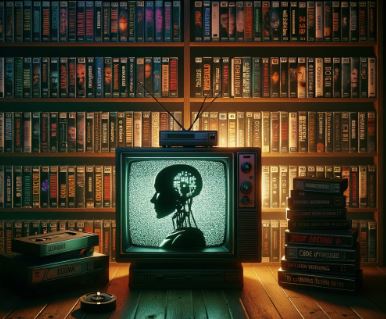
Do you have lots of old VHS tapes? I do and I’ve had them digitized as they do fade away with time.
Michael uploaded his digital file to ParrotAI and had the former VHS tape transcribed. It can then be summarized and you can even ask questions, such as “Where was immigration mentioned?” of “What did Aunt Dot say about her first job?” This would be a real time saver if you can’t watch the entire video and need to refer to a certain part.
Last week I blogged about solving an AI creepy result and this is a continuation of how you can get the most out of AI. You can read last week’s blog here.
First, a disclaimer. AI will not immediately be looking at your blog posts as the various companies “train” their technology at set times. This means you aren’t going to see immediate results but you will over time.
You will likely see positive results fairly quickly by connecting with far flung family members who are researching the very same lines you are. I’ve obtained photos and lots of helpful documents I wouldn’t have known existed if I had not blogged about my family.
I love blogging for so many reasons! I began it as I pursued certification through the Board of Certified Genealogists as I thought the journey would be of interest to others. I did not obtain certification but I got hooked on blogging!
Several folks I know had tried to blog but just didn’t follow through with it. The reason was they claimed they didn’t have time. It doesn’t take long to write a short blog post. Schedule an hour once a week at a time where you will have minimal distractions. With practice, you’ll cut down on the time you spend writing.
Another reason I’ve heard that people don’t blog is because they can’t think of what to write about. I write about what I’ve been doing or plan to do. If I find a great webinar, hint, or an a-ha moment, I figure it will be of use to others so I share it. It’s that simple!
I think one of the reasons I was successful in continuing to blog was because I initially wrote four blog posts before I ever published one. That way, I had back up posts in case life got crazy. At the time, I was working two jobs, still had kids at home, and was involved in a lot of community organizations. Developing the habit of sitting down to write when there was a quiet moment and writing several pieces helped me develop a habit. Scientists claim (according to Google, hmm!) that it takes 66 days to develop a positive habit. So, definitely schedule time during that initial period. After that, you can wing it.
I began blogging through Google’s Blogger. It is simple, just follow the directions provided on the website. Why I chose Google over other blog sites is because you will have that search engine behind you to get the word out of what you are writing about.
As my business, Genealogy At Heart, grew I added a website through WordPress. I selected WordPress because other professional genealogists said it was easy and inexpensive. Now I post my weekly blog in both places. If Google ever decides to stop supporting Blogger than my blogs are safe on my own website. If I decide to retire and cease my website, then I can easily backup my blog posts so that future family will still have access to my ancestral discoveries. That’s a win-win outcome!
There are many other blog sites so do a simple search if you’d like alternatives.
So, there you have it! I’ve published over 500 posts since I began in 2015. In 2023 my Genealogy At Heart blog was recognized as one of the top 100 by Genea-Blogs and for 2024, FeedSpot has named it in the Top 100 Bloggers. Getting recognition is nice and appreciated. Getting connections with other who have the same passion I do is even better. Got a question on how to get started? Email me at genealogyatheart@gmail.com.
In December, I blogged about a creepy AI discovery I had made when testing ChatGPT’s ability to extract and summarize from newspaper articles. Information in the summary was provided by AI that was no where in the articles uploaded. Although errors like this, called hallucinations, are known to happen with this budding tool, the information that AI proved was 100% correct. That’s what made this feel creepy. How did it know more about my family than the articles I entered?!
I’m now enrolled in my second AI for Genealogy class through the National Genealogical Society and my instructor, Steve Little, noted in class this past week that AI was trained by, among other information, through blog posts.
Bingo! That explains how ChatGPT got my correct ancestors to include in the summary as I have blogged extensively about my Leininger and Landfair families.
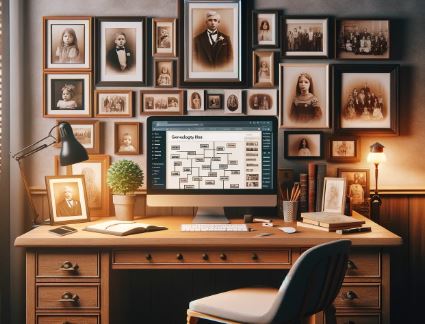
Since I’ve blogged about my families for years much of my research is available online. I’ve spoken with other family historians who haven’t had as good a result as I have with using AI. Perhaps this is why I’m getting the results that I am.
When the world wide web was in its infancy, I had difficulty with understanding the concept that once something is place there you can’t get rid of it. Sure, websites come and go but the information is still out there if you look hard enough with tools like the Wayback Machine. Personally, I was involved with an educator only web in the early 1990s and on the world wide web since 1995 so my digital footprint is a large size. Who knew that it would be a help to me with the latest technology?!
If AI is not giving you the results you’d like, I’d suggest that you upload the info you’re working with as a pdf when you prompt it. This might also be a good time for you to start blogging about your family. I will be providing more info on how to do that next week. Happy Hunting!
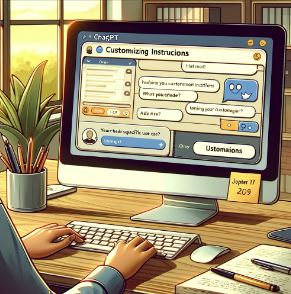
If you have a Chatgpt account ($20.00/month) you have the ability to customize how you want AI to respond to you. It’s simple to set up:
Setting Up Customized Instructions:
On the left side bottom of the screen, click on your name.
Click on “Customize Instructions”
Make sure the button is enabled on the new screen!
Type in the box your instructions to AI. Mine were that I wanted it to be creative. I’m interested in responses that would be given to a professional genealogist. When I type “Geni” I want the response addressed to “Lori”. I also requested a limerick every so often as they make me laugh.
Why Customize? If you want answers tailored to your role, then customized instructions are a must. If you have more than one person sharing an account, you definitely want to add customized instructions. My husband does not use Chatgpt often but when he does he does not want a response that would be given to a genealogist. So, we added into the customized instructions when his name for AI is typed, AI is to respond with my husband’s name and the information he would want from an expert by adding what the his interest and preferred responses would be. He didn’t want a limerick. He wants a response that is engaging to a reader.
I then created a new chat, addressing Chatgpt by the name my husband has given it and asked it to generate reasons why people shop on eBay. He received a response directed to his name with 10 sound reasons. I then replied and used the name I have given AI and asked why would a genealogist use eBay. I got 10 more sound reasons directed to me (using my name).
In case you’re wondering, here’s reasons it came up with why a genealogist would use eBay:
Variety and Rarity: eBay offers a wide range of products, including rare and hard-to-find items. Collectors or those seeking unique items often turn to eBay.
Competitive Pricing: Many users shop on eBay to find better deals or lower prices than in traditional stores or other online platforms.
Auction Format: The excitement of bidding in auctions can be a draw. It gives shoppers the chance to snag items at potentially lower prices.
Second-hand and Vintage Items: eBay is a go-to place for second-hand goods, vintage clothing, and antique items, appealing to those who prefer pre-owned or retro products.
Seller Diversity: From individual sellers to small businesses, eBay hosts a range of vendors, offering shoppers unique buying experiences and a broad diversity of goods.
Global Marketplace: eBay connects buyers with sellers worldwide, providing access to products not available in one’s own country.
Convenience: The convenience of shopping from home and having items delivered to the doorstep is a significant advantage.
User Reviews and Feedback System: eBay’s review system helps buyers make informed decisions based on seller ratings and feedback.
Protection Policies: eBay’s buyer protection policies can make consumers feel more secure in their online purchases.
Niche Markets: eBay caters to niche markets and specific interests, making it easier for buyers to find exactly what they’re looking for.
To sum up, ChatGPT will allow you to customize how you want your responses and for what audience (a child, a teen, a college student, adult, etc.), and by your role (author, editor, marketer, teacher, etc.). It will respond with the request immediately after you enter it following the directions above. You can switch your roles within a chat. Enjoy!
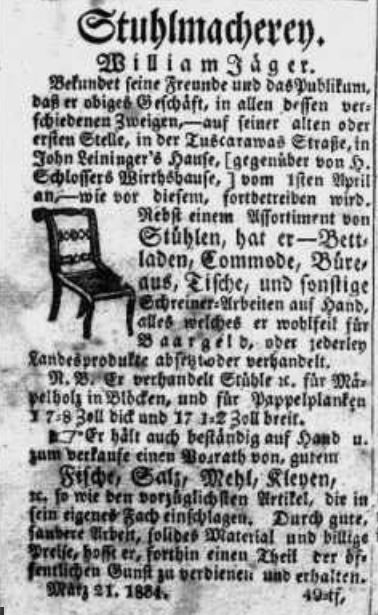
Perhaps you are like me and you have ancestors who spoke a variety of languages. This can become problematic if you don’t read the language where they left records. Sure, there has been Google Translate, an AI program, but Google Translate was unable to translate fully the article shown above in December 2022 when I needed it for a lineage society application I was submitting.
I tried to type in what I saw from the article but it is written in old German style and my guesses of what the letters were was not accurate. I had family members who can read German take a look at it but they couldn’t decipher the entire article either. I placed the article on two list servs I use and there was disagreement among German speakers of what the translation was because some of the words used were archaic. I eventually got a translation but it took a lot of time, effort, and connections to get it done.
Enter Chatgpt.
I uploaded the article and in seconds got a translation. Wow, it was extremely close to the one that I eventually submitted after the German “experts” looked at it.
I then decided to try translations from French and Latin. I had needed that for the very same lineage society application. The ancestors lived in what is now Germany so they read the German newspaper, however, Napoleon had taken over their area by the time they were married so the record was in French. Their birth record was in Latin. Sigh, that’s alot of language translations needed!
I used records from geneanet.org for birth and marriage that had been transcribed into French. Again, in seconds, I had a very good English translation.
Now, for the final test – I had a letter written in pencil from 1950 that was faded from someone who had written to my grandparents from Croatia, then called Yugoslavia. I could never translate it because I couldn’t even see it clearly. I had once tried uploading it to MyHeritage.com’s photo enhancer but it still wasn’t readable.
Since I had such luck with German, French, and Latin I decided to let ChatGPT attempt a translation. My goodness, it was wonderful! I only wish that I had the envelope or an address of the sender. I now know that the letter was written by one of my maternal grandfather’s relatives. This solves a mystery for me as I know my grandparents sent care packages for years to a relative but I didn’t know who. I never thought to ask as a kid and my grandmother’s address book disappeared when she made several moves as she got older.
ChatGPT’s translation allowed me to get a better understanding of this family question mark. Try it – so far ChatGPT is able to translate into about 50 languages. If it doesn’t know exactly it will give you a hint. For example, I did another query asking for information on plementi ljudi – people of nobility. It wasn’t familiar with the term which would equate with a Von or Van status of a German. What ChatGPT did recognize was that it was a Slavic language and it asked me to be more specific. I then stated it was Croatian and if AI knew what p.l. status meant. It correctly gave me a brief history of the honor awarded going back to Hungary. It acknowledged it didn’t know specifically about the meaning in Croatia but that in other Slavic countries, it came with privileges dependent on the time period. When I gave it a time period I got more specific info. This is important as language based AI’s are not the same as search engines. You cannot ask them to tell you when your local library is open or what the library address is. But they can tell you ideas of what you should research in a library or other archive to get the answer you are seeking.
I have enrolled in the National Genealogical Society’s second AI class so I’m hoping to learn lots more of this new genealogy tool. As always, I’ll be sharing it with you.
The DeKalb County Indiana Genealogy Society (DKIGS) regrets to have to reschedule the Ask A Genealogist event that was to be held on Saturday, January 13 from 9:30-11:30 am at Willennar Genealogy Center due to inclement weather.
If you are not a member of DCIGS and would like to receive information on when the event will be rescheduled, please email genealogyatheart@gmail.com and we’ll let you know.
A New Year is always time to make plans and set goals. I’ve just completed a series on Artificial Intelligence (AI) so it has hopefully given you some ideas to boost your family history output.
Two years ago I blogged about my one month deadline to write my personal memoir. You can read about it here. I strongly believe we genealogists often neglect the importance of documenting our own lives. Sure, we know what happened but just like our ancestors who didn’t leave many records, someday, someone will not be happy with you for doing the same.
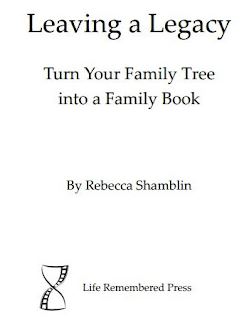
Recently I was given the opportunity by author, photographer, and genealogist Rebecca Shamblin to review her new book, Leaving a Legacy: Turn Your Family Tree Into A Family Book (Life Remembered Press, 2023).
My long time readers know I’m not one to gush over the latest and greatest. I take a more middle of the road approach, looking for the pros and cons.
Seriously, I cannot find one con in this book. I can’t even come up with a suggestion for improvement.
This is a must read book if you are considering publishing a family history or genealogy book. I’m an eBook author but I understand the reasons that a hard cover book would sometimes be preferred.
If you thought that the task to write your family’s story was too time consuming or expensive to publish, think again! Rebecca has, through trial and tribulation, worked through the process several times and the reader can benefit from her experiences.
I strongly recommend that you purchase this book even if you aren’t ready to embark on creating a book. There are so many helpful technology tips – short cuts, how to, and step by step directions that it will benefit you in other computerized tasks you need to accomplish.
I’ll only give away one of the tips and it was such an Ah Ha moment for me. I don’t want to get into the debate of whether footnotes or endnotes are the way to go but suffice it to say, in my opinion, there is time for one and a time for another. Recently I submitted an article for publication that required endnotes. The endnotes in Word were formatted as Roman Numerals. My goodness, did that look clunky. Rebecca provides directions on how you can turn the Roman numerals into Arabic numbers effortlessly. Wish I had known that trick before I submitted the article! Definitely read the Word Processor Settings chapter.
Rebecca uses Family Tree Maker (FTM) software. Read the chapter even if you don’t use FTM as both RootsMagic and Legacy Family Tree can be used similarly to what the book describes. When in doubt, send your software company a message for help. Competition is fierce these days so it’s in their best interest to help you out and keep your patronage.
My favorite part of Rebecca’s book is how she handles sensitive genealogical discoveries. We all have them. One of my most sought out lectures is Skeletons in the Closet. Not sure how to write about that illegitimate child? Definitely follow Rebecca’s suggestions. She even provides excerpts from her own family history books to serve as examples.
I also loved the Distribution chapter as you want your book to be available long after you’re gone. Please do give a free book to your local library and if possible, to a larger library like Allen County Public Library in Ft. Wayne, Indiana – they have an entire large room that contains family genealogies. I’m not an accountant but check with yours to see if you can get a tax deduction for your donation.
To purchase a copy of Leaving a Legacy, click this link on Amazon. Let me know when you’ve finished your family book and where I can read a copy.
Happy New Year! Hard to believe this is my last blog of 2023. I’ve been writing about using Artificial Intelligence in family history research for the past few weeks. I hope it has been helpful and taken the fear out of the tech. Whenever I’ve talked about it with my personal FAN Club, I get the same reaction which is either a sign of the cross and the question, Haven’t you seen the terminator movie? to Oh, I want to learn how to do that. Absolutely no reactions in between!
Which I think is quite interesting because I’m a middle of the roader. I love the time saving aspect and the assistance in handling large amounts of data to analyze but I also am very cognizant that this tech is still in it’s infancy, makes mistakes (like people do), and due to lack of transparency from the companies involved, we have no idea what training information was used. So, it could have been an item that was under copywrite, it could have been biased information, or it could have been false information.
That said, I still think it can be useful. I really miss an early Google AI attempt called Picasa. I had saved all of my family photos there and it could identify family members that were infants I could not. I have two sets of twin cousins and in some of the photos I can’t tell them apart. Picasa was able to separate them out individually.
Today, AI can also create pictures. I haven’t tried to input photos from say, 1890, and ask it to take the person in the photo and create a new picture in 1820 period clothes but I suspect that can be done. Sounds interesting and want to get started?
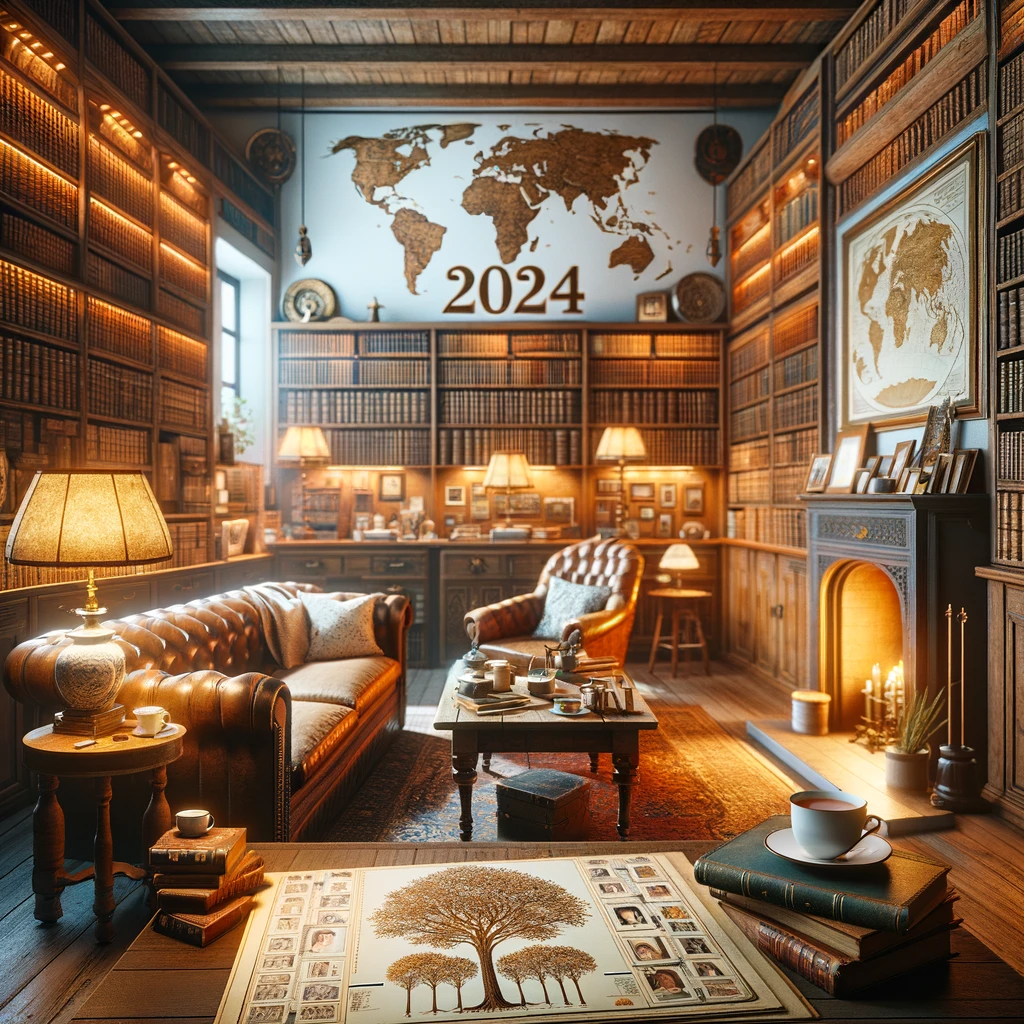
Through ChatGPT I use Dall-E. It has become one in the same since November. Before that, Dall-E was Beta but now they are joined. Here’s how to use AI to get a picture.
In the chat box, ask to “Create a picture or photo of” whatever. You can be specific or not.
When you get a response you might want to edit the picture. You can have the AI do that by specifically stating what you want altered. In the photo above, I asked to update the first image with the word “2024” added. I never told it where to add but perhaps you wanted it front and center. You can then tell it to add a calendar showing the month of January and the year 2024 displayed.
I will be one of seven professional genealogists giving a lecture at an upcoming genealogical conference later in 2024. I will be using AI to create some of the slide pics. For some slides, I had an idea but for others, I let AI create for me with only the slide title as the instruction.
Ethically, I believe that I need to credit AI for the pictures, just as I would source any photo that I use.
I hope you are enjoying the holidays with family and friends. I look forward to 2024 and providing you with more heartfelt and informative blogs. All the best to you and yours!
As the year closes, I’d like to reflect on some luck I had this past year. I was able to find the school enumeration records for my husband’s grandmother by getting a tip after writing a journal article. I hired a genealogist in Croatia who knew someone I could hire as a driver who just happened to have had a Ph.D. in archaeology and just happened to have done her dissertation on the area my ancestors once lived. Another lucky strike was writing to a small library in Ohio to ask if they had a list of Masons from the 1820s and getting a response they did not but they had in their vertical drawer notes from an unknown researcher that provided the source for a lost deed that hadn’t been filed until years after it was made and hadn’t been included in the index.
Those were all wonderful unexpected finds but I think the best luck came when I went cemetery hunting.
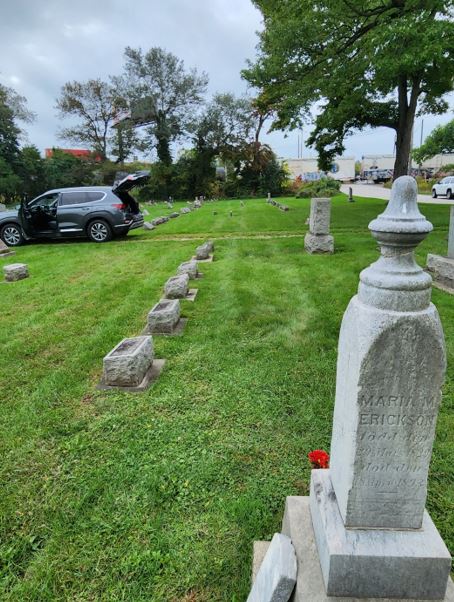
The photo above is just one of many that I took this past summer as I traveled across Ohio and Indiana searching for ancestor’s graves, then cleaning and photographing them. The one showing in the right corner is for my husband’s second great grandfather and his second wife, Maria Erickson.
Notice where the car is parked? I had no idea where in the cemetery the stone we were looking for was located. I only had a map for one cemetery, Graceland in Valparaiso, Indiana, but the sections weren’t marked in the cemetery so the map was useless. Somehow, my ancestor GPS was fully on as except for Graceland, hubbie and I found every grave in record time. I just drove in and something told me to STOP!!!! So we did.
Usually cemetery hunting is a spring-summer-early fall activity but two weeks ago one of my adult kids and I went to Chicago. The weather was frightful – sleeting, windy, and bitterly cold. We had wanted to go to the Field Museum but they had closed the parking lot close by, there was no street parking left and I didn’t want to pay for the parking garage down the street so we decided to go to the cemetery.
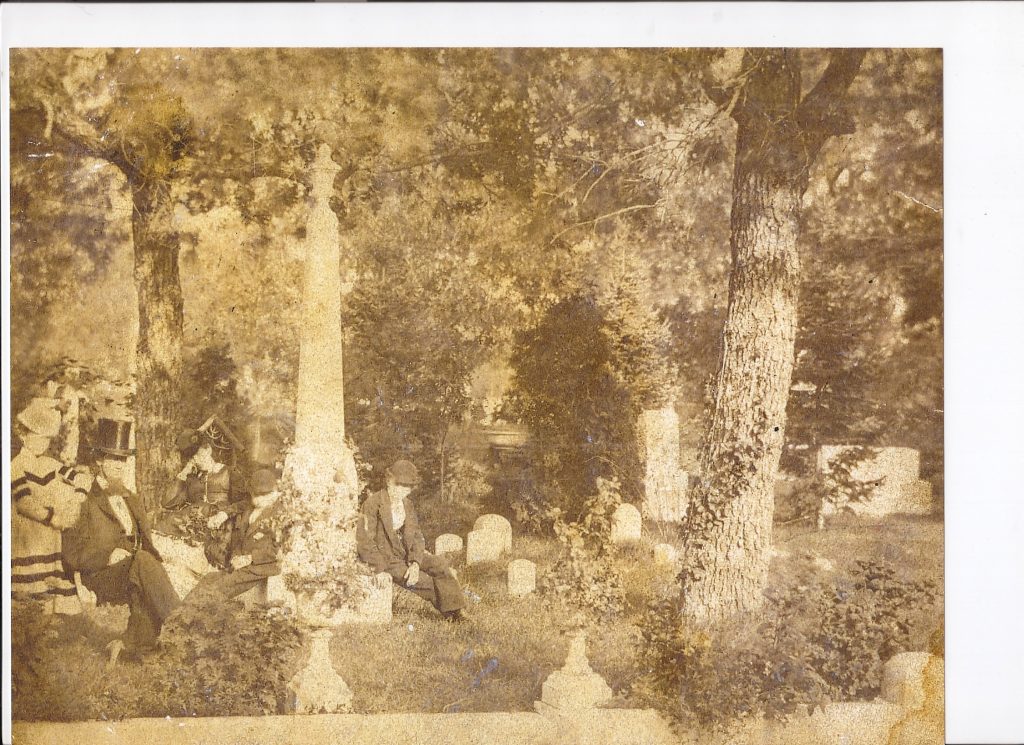
I realize that is a tad weird to those who aren’t interested in family history but this worked for us. I’ve written about Drusilla Williams DeWolf Thompson before and I’ve shared the also lucky find of the picture below in an attic in Dayton, Ohio where Dru never once set foot:
Dru is the woman with her head on her hand under the tree. Husband Thomas is impersonating Abe Lincoln. Daughter Mary is to his right, that’s my husband’s great grandmother.
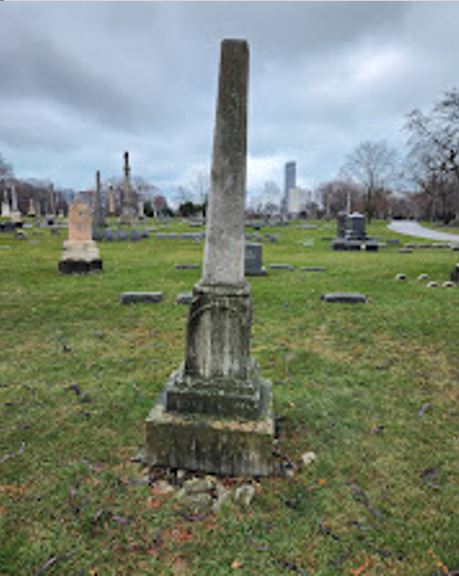
You would think this stone on a bleak December day would be easy to find but it wasn’t. We had a map, too. We could see it was close to the cemetery office so we decided to just park there and inquire where to find it. The sweet office clerk donned his jacket and said it wasn’t far and he was right. It was just a few yards from the office. I wouldn’t have discovered it, though, without his help as the limestone is now barely readable. The trees are gone, as is the fence. The stone is off kilter as the base has eroded. It’s missing the top. It’s also filthy:
Photo by Lori Samuelson Dec 2023
You can see that other stones surrounding it are also gone.
The cemetery does not allow families to clean stones so I’ve consulted with a company who will go out next spring and take a look.
I had always wanted to visit these folks as their story fascinates me – arriving in Chicago by wagon in the 1840s, surviving the fire, and watching Chicago grow into a metropolis. If only they had left their memoirs!
As a new year peaks around the corner I can’t wait for more exciting finds. Hope your holidays are delightful and that you continue to follow my fabulous genealogical adventures next year. I’m planning to take another AI course through the National Genealogical Society and two more heritage trips. Lady Luck is who I’m hoping to accompany me. Keep your fingers crossed for me!