I typically don’t blog twice in a week but I received a reply to an email I had sent with the concern I raised about the quiet disappearance of historical records from several U.S. government websites. These weren’t obscure documents—these were public records I had accessed online before, copied, and cited. I even included the original URL and step-by-step directions. But today? “No such record exists,” I was told—unless, of course, I want to pay a fee and maybe someone at the agency will “research” it for me.
My library contact passed along to colleagues my email.
The reply? “She’s just being political.”
No. I’m being factual.
Here’s what’s happening, and it deserves attention:
Government agencies are quietly removing access to records once available online.
Researchers are being told those records never existed—even when we have the receipts.
In some cases, agencies are offering to retrieve them for a price. Same record different paywall.
When we raise concerns, we’re dismissed as overreacting or “politicizing” the issue.
This is not a partisan problem. It’s a public trust problem. If you don’t think this affects you, try sourcing a vital record for a family history project or accessing a land claim file for historical research. You might find a broken link—or worse, a dead end with a price tag.
If you think I’m exaggerating, feel free to test it yourself. If you’d like to email me, I’ll be happy to furnish the documents I accessed in the past—along with the original URLs. Try retrieving them now. See what you find.
Spoiler: It won’t be what it used to be.
This isn’t about politics. And if researchers stay silent, it’s only going to get worse. It’s about the deliberate erosion of public access, the rewriting of digital history, and the arrogance of institutions that think no one will notice.
House Bill 1148 has passed in Indiana raising from 75 years to 99 years the ability to obtain a birth certificate.
I am embarrassed to live in a state that votes by fake “fears” than by real truths.
I am sharing the ignorant letter I received from one of the state senators:
Office of Senator Greg Walker
Dear L S, Thank you for your email regarding your opposition to House Bill 1148. At this time, I am in support of the bill’s proposal to expand accessibility to birth records for 99 years instead of the current 75 years.With the increasing longevity of individuals and the rise in identity theft, this bill is a necessary step in protecting against fraud. The expanded access will help ensure the safety and security of living persons’ identities.Again, I appreciate you reaching out. If you have any other questions or concerns in the future please feel free to reach out again. Sincerely, Senator Greg Walker District 41 Indiana Senate
Here was my response: Dear Senator Walker, Thank you for your response. However, I was disheartened to read your justification for supporting HB 1148. The claim that expanding the restriction on birth records from 75 to 99 years is necessary due to “increasing longevity” and “identity theft” is not only unsupported—it’s misleading. There is no documented evidence that public access to 75-year-old birth certificates has contributed in any meaningful way to identity theft. In fact, neither the Federal Trade Commission nor the Identity Theft Resource Center lists genealogical or archival access as a source of modern identity theft. Further, life expectancy in the U.S. is currently decreasing, not increasing (CDC, 2023), and even at its highest levels, the 75-year threshold was still sufficient to protect living individuals. Your claim does not hold up to scrutiny. Restricting access to these vital records undermines legitimate genealogical, historical, and medical research. Many state archives and national organizations—including the National Genealogical Society and the Records Preservation and Access Coalition—oppose measures like this for good reason: they cut off access to essential public records without any demonstrable benefit. I respectfully ask you to share the data or studies you are using to support your position. If your stance is truly rooted in protecting citizens, transparency and evidence should be the foundation.
Of course, he didn’t respond because he has no proof. As my grandmother used to say, you can’t fix stupid!
And this country is being run by STUPIDS!
Want to know what else has been taken away from us in the past month?! I tried to go online to NARA for a Civil War document they had posted previously, a land patent at the Bureau of Land Management, and an old tax record from the 1700s – All removed. BLM wants you to pay for the record it now claims it doesn’t have.
Jokes on them as I hope, like me, you were smart enough TO HAVE SAVED A COPY of your government documents and remembered to source it.
I am strongly urging my fellow Americans to do the following: 1. If you haven’t saved the records you found by all means do so ASAP. 2. This is especially urgent if you have birth records in Indiana. I have noticed that some marriage records have also disappeared from Ancestry.com. Take action now. 3. Remain vigilant of bills that are floating through state and federal bodies. 4. SPEAK UP! 5. VOTE these fools out of office. EVERY.LAST.ONE!
My pioneer ancestors would have been appalled by these clowns. They founded Indiana to be less government. Don’t believe me? Read the history before they take that away, too.
There are now TWO bills in Indiana to severely cut funding to libraries. Why? Keep the peeps from knowing the truth.
I may be old, and a token female (Yep, been told that by politicians in my own town “We believe in diversity and we need to replace a woman with a woman.” So an old white woman is considered diversity in Indiana. Think about that for a moment. Keep just ONE woman on a board and the rest the big boys.) but I will not go away quietly. I will continue to RESIST and I look forward to you joining me.
Perhaps it’s just me but I’m having some issues with several situations that have arisen this month that makes me feel the need to share with all of you genealogy enthusiasts.
The weather has been cold, though the snow minimal (not complaining!). Since I’ve been house bound a good deal of the time (I don’t do cold!) I’ve been spending my days researching, writing, consulting, and watching online presentations.
Here is some nonsense that I’ve heard in just the past two weeks:
Regarding an indexed set of school enumeration records, the presenter emphasized there was no need to see the original because the presenter was certain the person who had indexed didn’t make mistake.
No – just NO! Everyone makes mistakes, whether intentional or not. We need to see the original. Indexing is nice and can be a short cut but it’s not the end all be all. Thorough research requires that we search for originals that exist.
2. I suggested to a presenter via the chat box that the organization might want to try to obtain club and society records to add to their list to digitize. The answer took my breath away – the response was, “We don’t THINK those records exist.”
Whoa – you don’t THINK?! I don’t want a THINK I want to KNOW. Do you KNOW if those records exist? If so, how do you KNOW? Who did you ask? Where did you look? When did you look?
Friends, this really hit a nerve with me as I’ve blogged before about trying to find school records for my husband’s grandmother only to be sent from Hobart Township to the city of Gary to the city of Crown Point to the city of Merrillville to Indiana University and then back to Hobart Township. Each person I spoke with in those locations suggested I contact somebody else. Turned out, the records I needed were at IU but in the Calumet Township archive. Why? I have no idea why someone would have filed Hobart Township in Calumet Township but they were there. So, if you are in need of records do not accept I THINK they are blah-blah-blah. Look there but keep looking and one day you will be successful. If you accept that the records don’t exist with no reason given for why they were destroyed you aren’t done looking.
3. I received a pedigree chart from someone that was beautifully done but when I inquired as to SOURCES, and questioned an odd name change, received the response, “I’ve been researching for 40 years and know it to be correct.”
Really? I’ve been researching for years, too, but that doesn’t provide me with some sort of privilege to say that my work is flawless and I should not be questioned. Readers – keep me on my toes, please. If you see something I write you disagree with let me know. We never stop learning and should be able to handle a difference in opinion and to explain our findings.
4. In discussion with a colleague, I mentioned I thought the relationship of a son to his father wasn’t sound. The colleague had asked me to review the information and that was my conclusion. I listed the reasons why I believed more research was needed. The response I got was, “You just don’t want to believe it.”
Umm, no I don’t because of the reasons I gave. If you want to believe it then why did you ask in the first place?
5. If you post on Facebook seeking help and you get a response, thank the person and not kill the messenger. Really, it’s not hard.
A distant family member posted about their frustration with a cell phone and how they got no help at the phone store. I suggested seeking out a tech savy kid as it worked for me. Here was the response – edited to not identify the person (because I’m writing from the heart and they don’t): “My kid is a tech genius… I was not looking for advice (as I have stated previously in this thread).”
Honey, please re-read your initial post because YOU DID NOT state you weren’t looking for advice. Two other posters gave you sound advice as well but you didn’t respond as you did to me.
Reminder to all – treat your family with respect like hopefully, you would your friends and associates.
The best thing about genealogy is that you are constantly learning and growing. No one can know about every record set, historical period, or nuances of language over the years. Today I’m reflecting on some of the A-Ha moments I had this year:
AI has been the biggest game changer in my life. I use ChatGPT almost daily now and occasionally with Claude and others. It saves time and helps me think outside the box to solve problems.
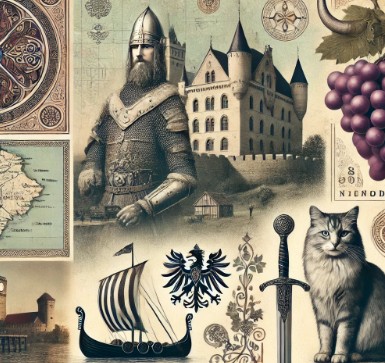
Realizing that the Viking Pagans held on to their symbolism after converting to Roman Catholicism was amazing to me. Who would have thought the church would have allowed it? Even more surprising is that the pagan baptismal fonts are still used today by the Lutherans.
I also didn’t know that grapes don’t grow in Sweden so the Vikings traveled in the summer to the Mediterranean to buy wine. My family had vineyards there so maybe they bought Zinfadel from them. Always been a small world, right?!
Had no idea when the potato famine hit Ireland it also affected crops in Europe, hence many from the French German Palatine area migrated to the U.S. at that time.
While researching Ohio River pirates for an upcoming presentation, I learned that one of the most notorious, James Mason, got a Spanish passport because President Benjamin Harrison had given him a recommendation. Dear Ben’s sister had married the honorable brother of James Mason. Just goes to show you how different siblings can be even back in the day.
Did you know that identity theft occurred in the 1890s? It did and I’m still working on solving that one!
My husband is constantly kidding me about being a princess (which I’m not) because I’ve now seen the family castles in Croatia, Germany, and Great Britain. People are so worried about being safe today but it’s no different than in the past– we just don’t have a moat around our houses anymore.
I didn’t realize that there were jobs for lawyers regarding keeping a person’s coat of arms protected. Who would have thought that would still be needed today?!
Every time I look at my cats I just can’t get over their ethnicity and I wonder which ancestor in my husband and my past was adopted by my cat’s ancestors. Yeah, it’s weird, I know!
A good reminder that there is someone out there who knows the answer to whatever question you might ask and you just have to be persistent and patient to get the answer. I finally found a knowledgeable person who knew how to read old German script AND understood the cultural heritage. I needed to find someone who had both these skills to understand one little ole word in a 1834 newspaper article written in German in Cincinnati, Ohio. He learned that the custom had been brought over to the US which was also news to him. Collaborating with others helps us get the info we need and in turn, we help them gain insights.
Loved the easy peesy way to do genealogy in French villages – take a walk and look above the doors of the houses. Back then they engraved the date the house was built and who the owners were. I was able to quickly find my ancestral homes.
I am reminded almost weekly of how much our life has changed since the pandemic. Zoom seems to have been around forever but I didn’t use it before 2019. Makes me wonder what’s next on the horizon.
That’s one new thought for each month of 2024. Can’t wait to discover more new and exciting ideas next year.
As usual, I’ll be taking off next week and will be back in January with my top ten blog list from 2024. Have a wonderful holiday and I’ll blog with you soon!
I honestly never thought I’d be blogging about my pet’s DNA. I laughed when Ancestry.com came out with their DNA test kits for dogs. At the time, I thought it was just a dumb idea.
If you’ve ever attended my lectures you might have heard me say that I’m a mutt. That’s a dog with no definable breed or heritage. Um, that would be me. I’m often dog-tired after spending too much time doing genealogy research and no matter what the ethnicity estimates report about my ancestry, they often get updated as my people were everywhere!
I am leery of people who boast that their heritage is purely from one location. Brings to my mind Nazism, the Ku Klux Klan, and Harry Potter. To be clear, I like Harry Potter; I just don’t like people who think they are superior because of their pure blood lineage.
While my husband and I were in Great Britain one of my adult kids decided to perform DNA swabs of my two elderly cats as a pre-Christmas gift.
Upon my return, when I was informed about the testing, I had a hard time not rolling my eyes. I would not have spent money on that. Both of my cats were found at schools my husband and I used to work at. The oldest, Charlie, was born to feral parents and I only have him because a cold hearted employee ordered one of the clerical staff to snatch him and his two siblings from their mother so her two kids could play with them over summer break. This mean individual was told that they were too young, not yet weaned, and that their mother would reject them if she changed her mind of keeping the cats. She didn’t care and at the end of the day when her husband came to pick up the kids he said he wasn’t taking the flea infested kittens home. Well, duh! They had flea because they were born and reared outside. She told the clerical staff to call the county animal shelter. The shelter employee arrived and announced that all three would be euthanized unless we could also provide the mother since they were not weaned. That was impossible since she was feral and he only gave us an hour. The psychologist and I took the kittens home, I took two and she took one. We always thought Charlie was part Maine coon because like his daddy who used to terrorize the children walking to after care through he woods, he was a big boy. We also thought he might have come from Puerto Rico because he only quieted when we played that type of music and he loved hot sauce. In hindsight, I should have realized he was born in a Hispanic neighborhood and his mom must have eaten a lot of Mr. Empanada’s food during her pregnancy. Unfortunately, Charlie’s sister, Ginger, disappeared when we went to one of our children’s college graduations; a neighbor was supposed to be watching them. Ginger slipped out and was never seen again. She was small and orange, like her mom.
Parker was found in the second floor hallway of the school my husband where my husband worked. Likely a middle school kid had brought him in a backpack and he somehow escaped during the day. As a counselor, my husband was called to do something about the cat. That something was get him milk from the cafeteria since he was emaciated and bring him home. He looks a little like a Siamese but we had no idea of where he had originated.
I was good with what we suspected about their heritage. I love them for who they are and not where their ancestors came from.
I really didn’t expect any big surprises when we got their DNA results but my family and I had the biggest laugh as the cat’s DNA matched regions of the world where our ancestors had once lived. Go figure!
Charlie is mostly Siberian with a touch of Norwegian and Persian. The Siberians are big and poor Charlie was always on a diet as our vets thought he was just too heavy. Nope, he was always in the normal range for his ancestry. (Going to use this during my next annual physical.) Charlie became diabetic earlier this year; that also goes with his majority breed. I was happy to share these results with our current vet.
Parker was primarily Norwegian but also of a California breed and some Egyptian Mau. No Siamese! The Egyptian explains why he had spots in his younger years. The Norwegian explains his quirky personality. If you hold him he drops to dead weight. He also loves to pretend he’s afraid of his shadow and runs from it, then looks at you with sad eyes wanting you to pick him up. Yes, he has us humans trained.
The Californian part, though, really made sense. Parker was probably born in Florida where there was an air force base in close proximity to where he was found. I suspect a military family brought one of his parents with them when they relocated to Florida.
My husband is 75% Swedish, I wouldn’t doubt that his ancestors once had Norwegian cats in their household. My mtDNA does cross through Persia and I have half that is eastern European. Charlie has always been closest to me. I wouldn’t be surprised to learn that those cats we saw in my family’s villages in Croatia were very distant cousins of Charlie. Likewise, those Swedish cats we saw in April could also be related distantly to Parker. Very weird in a fun way!
The season is just about upon us and now is the time to think of a special gift to give to your genealogist-enthused loved one or for yourself:
The Flower Letters is an interesting gift I received for Mother’s Day – it’s a gift that lasts all year. Every two weeks the recipient will receive a snail mail letter about a historical fictional mystery. The letter is written in cursive, quite decorative, and includes additional items about the info contained in the letter, such as postcards, calling cards, maps, etc. For further education, some words are written in red, and for more information, the reader can go to the online website to learn about the topic. Currently, the company is having a fall sale so take advantage of this unique opportunity. This is a wonderful gift, especially if you are tying it in with an ancestral region.
2. Is travel in your loved one’s future plans? If so, it might be a surprise to learn that travel isn’t quite what it used to be. Lost luggage is happening more frequently so here is a way to find it quick – GPS Trackers. There are many out there so identify first if your loved one has an Android or Apple. I use one of my kid’s Apple trackers when we travel and it is peace of mind knowing that my bags can be found anywhere in the world.
3. If you want to avoid lost luggage entirely, do what we do for trips of less than two weeks – simply get a duffel bag to carry on. I highly recommend a duffel bag instead of a rolling smaller bag as lately, airlines are making you check in those roller bags at the gate. Never thought to put a tracker into a bag I was carrying but it was needed. I have since switched to a duffel. They never take those, they can be crammed under the front seat of even the tiniest planes, and your belongings stay with you.
4. BOOKS, BOOKS, BOOKS! Here’s a list of my top 6 must haves:
Griffeth, Bill. Strangers No More – This is a sequel to his memoir, A Stranger in My Genes.
Hanson, Anne. Buried Secrets: Looking for Frank and Ida – This family’s brick wall was eventually gotten over and could help if you are stumped, too.
Jones, jr. Henry Z. Psychic Roots and More Psychic Roots – These are two books by the same author – You Can read my review here and here. If your genealogist is having strange and unusual finds this might be just what they need to understand them.
Mills, Elizabeth Shown. Evidence Explained. 4th Edition – Revised must have
Shamblin, Rebecca. Building a Legacy – You can read my review here. For those interested in preserving and sharing their researched and sourced family tree.
Shamblin, Rebecca. Leaving a Legacy – You can read my review here. This is a must if you are planning on writing a family history book in the upcoming year.
5. Here’s a gift to give to yourself if you are age 65+ – a FREE membership to the National Genealogical Society. See if you qualify for membership through Grouper.
6. Had to laugh at a recent drawing that was held in Indy for the Indiana State Library’s Fall Genealogical Conference. The giveaway that got the most Ooohs and Ahhs was a lighted magnifying glass. Older eyes can all use this and not just for genealogy. I absolutely hate the writing on food labels that keep shrinking (or maybe it is my eyes?). More than one is nice – one to keep at home and one for the road trips to archives.
7. You’ll probably think this is dumb but it’s so important – pencils. Yep, those number twos are still used by especially beginner genealogists who are keeping records as hard copies. A big eraser also goes a long way. Personally, I prefer to digitize but I understand not everyone does that. I also like engineering pencils as I don’t have the mess of a pencil sharpener and I can take them into archives that don’t allow pens with no issues of trying to find a sharpener.
9. If your genealogist is into cemetery visits, create a cemetery to-go kit. Walmart even has an incomplete (IMHO) kit for $35.95. Add a bucket, a spray bottle, and some gardening shears to cut the grass/weeds around the stone. Include garden gloves and bug spray as well. If you want to go all out then also add a kneeler pad.
10. Your Time – seriously, just listen to what your family genealogist has discovered. Who knows, you might even get interested?!
It’s October when I typically blog about the creepy coincidences that happen to me over the past year when I am doing genealogy.
I started a bit early, mentioning how I met some Irish and Scotts relatives through my recent travels to Great Britain.
I have another story to share but there’s a back story to it so this will be a two part blog.
I’ve blogged and researched extensively on my Hollingshead family originally from Saxelby, England. Some of the findings were just down right strange! You can read about past blogs I’ve written about Daniel here, here, and here.
I’ve never before shared a personal story about why I am so interested in the Hollingshead family but I think it’s time to do so.
In 2006, after spending time with a college friend who had transferred from the U.S. to Cambridge University in England, one of my adult kids informed my husband and I that they were going to apply to medical school out of the U.S. We questioned the decision but they were adamant with no reasons other than they felt they had to do that. After several acceptances, the decision was to accept the offer to St. George’s Medical School in Grenada, West Indies. To be honest, I wasn’t wild about this decision but once I visited I felt at home. After two years of study there, students transfer to either Great Britain, Canada, or various locations in the U.S. Our adult child decided to move to New Jersey.
I am not trying to be rude New Jerseyans but I just couldn’t understand why someone would relocate from a beautiful tropical island to a snowy cold location. Really, I told my kid, no one does that. Child was insistent that this was the right place but couldn’t explain why.
The adult child finished up their degree by living in Morristown, New Jersey. We visited several times and enjoyed the small town atmosphere. On one of our visits I happened to park next to a church cemetery. I looked up and was faced with a stone for the Byrd family. I had a brick wall Byrd family from somewhere in New Jersey. I decided I would contact the church but I always found it closed and got no response to emails. If you had asked me then, I would have told you we had no connection to Morristown; I thought the Byrd family was from Trenton.
Our last trip to Morristown was in the spring as our child was graduating and would soon leave for internship in another state. We drove one of our vehicles from Florida to New Jersey so that we could have two vehicles (ours and theirs) packed with belonging while my husband drove a small U-Haul to the new location.
On the way, we experienced a major traffic jam in Tampa which delayed us. Bored, I checked my email. There was a new email from someone I didn’t know, Edgar Duer Whitley. The gentleman had found my online public tree on Ancestry.com and was excited that I was providing him info on my Duer line that he had been unable to research. I was spelling Duer as Dure – the original family spelling, so had not connected to his research. He attached his genealogical research which connected to Daniel Hollingshead. I had never heard of Daniel.
I responded I would look at the information when we returned from our trip and would get back with. It was three weeks later when I downloaded the information and I was astounded.
Our child had been residing on land that had once been owned by their 8th great grandfather. Even more astounding was that Daniel Hollingshead had relocated to New Jersey from the West Indies. So I stood corrected, others in our family beside my kid have relocated from the West Indies to New Jersey.
But there’s more…when I shared this with my child I got a laugh. Our kid had traveled around the area of Cambridge and had visited Saxelby, where Daniel Hollingshead migrated from. It was there that they got the idea to go to a medical school that was international. Was this a channeling of a long dead ancestor?
One of Daniel’s sons had become a noted physician in New Jersey. The location where our child had attended undergrad, Boston, was the same area where one of Daniel’s grandson had migrated to, Boston. My line went on to Ohio via a stop in the wilds of Virginia, now known as West Virginia. Our adult child was leaving New Jersey for West Virginia. Creepy!
We joked with our child that they would probably end up in Ohio one day since they seemed to keep following that family line’s migration route. That hasn’t happened yet, however, they live about 10 miles from the Ohio border and work as a physician in Ohio. It’s just two counties away from where the Duers, who married the Hollingshead, settled.
As for Edgar, as soon as I reviewed the information he had sent and realized the migration path I wrote to him. I never got a response. Evidently, Edgar had died in the few short weeks after he sent me his life’s work. I can’t explain how this all happened. It’s wonderfully weird and unbelievable. I may have eventually broke through my brick wall without Edgar’s research but the timing was perfect as we had a family member in the areas that I could stay with while confirming the information. I guess a side moral of this story is contact those folks you find online and share your research widely.
Next time, I’ll tell you another strange connection regarding Daniel and I that occurred while I was in Great Britain.
Are books disappearing from your local library or archive? I’ve heard concerns locally from several patrons and I do share their concerns. The books are showing up at library book sales and even Goodwill.
I asked a local librarian why this was occurring and was told that the books weren’t being used. I asked how would they know if the books were being used or not since they were all reference books not available for check out. Didn’t get an answer.
Last month I spent the day at the Indiana Historical Society. I asked Suzanne Hahn, VP of Archives and Library and Bethany Hrachovec, Director, Education and Engagement if there was a trend towards purging genealogical tomes. There is for the following reasons:
They are a duplicate copy
They have been digitized (though not necessarily by the library who is purging it)
There is a copy at a larger library. In northeastern Indiana that would be Allen County Public Library, Indiana State Library, Indiana Historical Society, or a university library.
Many libraries are now moving to a theme – only railroad books, for example, or only books for their particular county. Could be but I’m seeing books meeting the purported theme also removed. I’m also not seeing communication between libraries so one removes a book that would be a great addition for another library’s theme. Instead of contacting the library it goes to the resale bin.
Which gets me to the current situation I see in my local library. Too many books for resale and not enough storage so they are giving the books to Goodwill. If they don’t sell they are then disposed of. So very sad!!!
There are people who cannot read digitized books. Perhaps they don’t have the tech or their eyes will not handle it. I see no sense in removing a book that has been digitized, especially not by the entity that was purging it. How do they know that book will stay available to the public? Think about the recent law suit with Internet Archives! The case is back in court again but that doesn’t mean that Internet Archive will survive their appeal. What a loss that will be for all of us.
Maintaining only one regional copy is also problematic. When it starts snowing here people stop driving, especially older folks. Having to travel up to two and a half hours to look at a book that used to be available five minutes from your home is a ridiculous waste of time and money.
If shelf space was at a premium I could understand thinning the ranks but in most cases, it’s not. If the library had funds to purchase new materials I could understand it but that’s not happening, either.
If this situation is occurring in your region speak up. Complete library surveys to voice your concerns. If you have the funds and space, purchase the volumes. Perhaps a genealogy club or society can scoop up the works and create their own check out system. Genealogy books need to be treasured and available to future generations. Help make that happen.
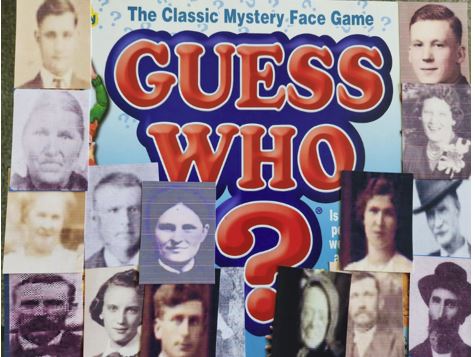
I received the most unusual genealogy Mother’s Day gifts from one of my kids that I just have to share. The first is the game you see above – Guess Who? We had the game when my kids were young but my adult child bought a new game and switched out the faces to include the faces of ancestors. I’ve taken the cards that were made to replace the ones that come in the box and placed it on the box top so you can see the variety of family photos included.
This is an awesome idea if you are having a family reunion or want to get a head start now for a holiday gift in December. What a wonderful way to get the younger generation involved in identifying their ancestors!
The second gift I received was also unique. One of the parts of genealogy I love is uncovering mysteries. Who were these people? Why did they do what they did? How did the meet? Where are they buried? Well, the second gift is using old time snail mail to send a letter written in cursive to my home every two weeks for a year. The company, TheFlowerLetters, has several themes. The one I’m receiving is the Adelaide Magnolia Collection which takes place in England in 1817. Since I’ll be trekking to Great Britain later this summer it’s a perfect way to get me in the mood. For the genealogist in your life, the letters feature mystery, history, adventure, and romance – what more could a genealogist want?!
The National Genealogical Society conference continues today. Thank you, dear readers, for all of you who attended my presentation with six other genealogists last evening. If you missed Rapid Roots or would like to review it since it was rapid and had lots of helpful tips, please do so. Don’t forget to complete a review through Whova. You can still leave questions on Whova for the next three months or you can email me anytime at genealogyatheart@gmail.com.