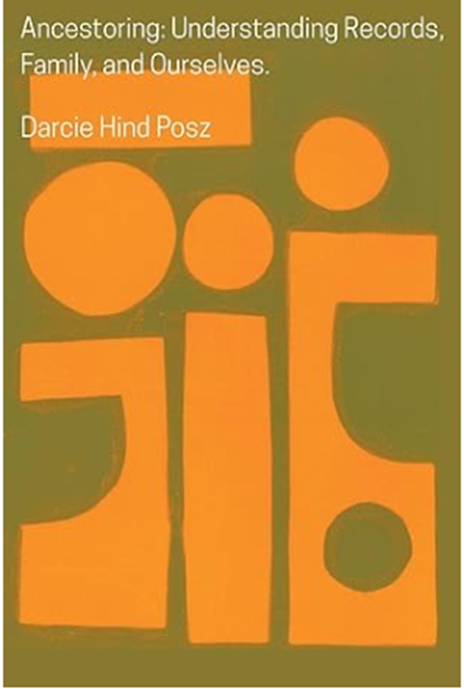
Book Review: Ancestoring: Understanding Records, Family, and Ourselves by Darcie Hind Posz

Published as a paperback by Genealogical Publishing Company

It’s Genealogy At Heart book review time and this one is unlike any I’ve written before.

I’m about to make a few bold claims. And I stand by every one of them:

  1. If you read only one book this year, Ancestoring: Understanding Records, Family, and Ourselves by Darcie Hind Posz should be that book.
  2. If I had to part with my entire genealogy library and keep just one volume, Ancestoring would stay.
  3. This book belongs in every high school curriculum.

That get your attention? It should.

Last month, I received two donated books to review. As always, I don’t accept payment, and there are no agreements, spoken or unspoken, that guarantee a favorable review. My long-time readers know I share my honest thoughts, whether glowing or critical.

Frankly, if I had judged this book by its cover or title alone, I might have passed it by and that would have been a mistake.

From the bottom of my heart, Ancestoring is the only book that has ever had this kind of positive impact on me.

Of the two books to review, I chose this one first simply because of the title. Ancestoring, what did that even mean? The preface answers that question, but more importantly, the book embodies it.

Before diving in, I read the back cover endorsement by Henry Z. “Hank” Jones, FASG. I’ve reviewed his work before, and if Hank was this enthusiastic, I was all in. (See those reviews here and here).

The book is divided into three sections, which Posz notes can be read in any order. I chose to move from the broad to the personal: understanding records, then families, and finally ourselves. Perhaps that reflects my own leanings toward a Gestalt approach; the idea that the whole is greater than the sum of its parts. To fully grasp the interplay between these sections, I recommend working through all of them.

Take your time with this book. Do the exercises. If you’re pressed for time, read it through once, then return to it and savor each chapter. Don’t skip the footnotes! Even if you’re not typically a footnote reader, this book may convert you. The sourcing spans multiple disciplines, and that depth is precisely why I make my second and third claims, it’s not just a book, it’s a roadmap for continued intellectual growth.

As a former educator and counselor, I spent years helping students move from concrete to abstract thinking. Though Posz doesn’t frame it this way, I would go a step further: this book fosters lateral thinking, the kind of creative, non-linear problem-solving that genealogists desperately need. That alone justifies my belief that it belongs in every high school.

And for adults? The exercises are even more critical. Think about your daily news feed and your social media. How much of it is accurate? How do you know? This book gives you the tools to evaluate, question, and ultimately uncover truth.

The exercises themselves are refreshingly unconventional. Yes, you’ll learn to analyze photographs, vital records, and obituaries but through a much wider lens. Posz incorporates film, music, and even conspiracy theory narratives as training tools. At first glance, these seem unrelated to genealogy. They’re not. They sharpen how we observe, interpret, and question, skills at the heart of our work.

One of the most intriguing elements is the encouragement to record dreams related to your research. I’ve written about this before (here and here). When deeply immersed in a project, the mind doesn’t simply shut off. Whether it’s subconscious processing, inherited memory, or something we don’t yet understand, those impressions can sometimes point us in new directions. Other times, they signal it’s time to step away. Both are valuable.

The chapter on trauma deserves special attention. All though others have tried, Posz is the first genealogist to address, so directly and personally, how trauma can be researched and interpreted. Memory is not fixed. Two individuals can experience the same event and remember it in entirely different ways. That reminder is essential for anyone working with historical narratives.

I admit, I found myself wondering whether one vivid childhood memory Posz recounts, watching a film while hospitalized, might have been influenced by a dream while medicated. That, in a way, reinforces her point: our recollections are not infallible.

Finally, I applaud Posz for her transparency regarding her earlier work. Too often, we treat a completed project as final. It isn’t. New records surface. DNA reshapes conclusions. Even our most carefully constructed research can shift. Her discussion of ethnicity estimates is a timely reminder that patience and humility are essential in this field.

If genealogy is about understanding where we come from, Ancestoring pushes us further. It asks us to examine how we think, why we believe in what we do, and what it really means to know the past.

That’s why Ancestoring is not just a good book; it’s an essential one.

When “I Know I’m Right” Replaces Research: A Troubling Trend in Genealogy

AI Generated

In the past two weeks, I’ve received four emails from individuals new to genealogy either questioning my public tree on Ancestry.com or inquiring about my professional services.

Each one carried the same message: “The information you have is wrong.”

Let me start with something I say often: no genealogical tree is 100% accurate. Until every individual in every line has been DNA tested and even then, interpreted correctly, there will always be some uncertainty. That’s simply the nature of this work.

But these interactions weren’t thoughtful challenges or collaborative inquiries. They were something else entirely.

They were confrontational, dismissive, and, frankly, uninformed.

The first individual demanded proof of a family adoption story. I recommended DNA testing. They had already tested but refused to share the results and insisted I find documentary proof.

Here’s the problem: no records exist for that place and time. None. The best available evidence is a census record placing the child in the same household at three months old and still there decades later. That wasn’t enough. I was told I didn’t know what I was doing.

DNA would likely resolve the question but there’s a reason it wasn’t being shared. DNA doesn’t lie. And when people avoid it, that usually tells you something.

The second email was even more puzzling. I was instructed to delete an individual from my tree because it was “messing up [her] DNA matches.”

We didn’t match.
The individual in question is on my husband’s line.
She didn’t match him either.

Her conclusion? A child who died young actually moved to Illinois, changed his name completely, married, and died in the 1940s.

Her evidence?An Ancestry hint from ten years ago that only matched a birthdate. No sources showed a name change. No documentation. No records connecting the identities. Just confidence that in the entirety of Sweden, only 1 male was born on the same day. I’m not making this up!

When I asked basic genealogical questions such as death certificate? marriage record? naturalization? she didn’t understand what I meant. She had been researching for a few months and was certain her conclusion was correct because a now deceased relative had believed it 10 years ago. I declined to alter a fully sourced line.

The third interaction was more familiar but still frustrating.

A man insisted I had the wrong parents for his great-grandfather. His proof was a death certificate, with information provided by the son.

I explained what experienced genealogists know: informants can be wrong. Memory fails. Grief clouds details.

In contrast, I had a letter written by the man himself shortly before his death, naming his parents and explaining his childhood circumstances. I even provided the citation so he could verify it.

His response? “You’re still wrong. Remove it.” He also admitted he didn’t know how to locate the record I referred to online. Sigh.

That was the point where I made a decision: I removed the entire line from my public tree. Not because I was wrong but because the interaction wasn’t worth the time it would take to defend it.

The final exchange involved a demand to remove a death record because “everyone has it wrong.”

No documentation was provided. Instead, the argument rested on a theory built from DNA matches and a guess involving a child being banished to another colony 300+ years ago.

Could there be a connection? Possibly.

Was there proof? No.

When I tried to guide her toward alternative explanations, such as descent from a sibling, she wasn’t interested. She didn’t want to explore the truth. She wanted confirmation.

So I’ll ask the question plainly: Are you experiencing this shift, too?

For over 25 years, I’ve found most genealogists to be curious, collaborative, and open to learning. But recently, something feels different.

More certainty.
Less evidence.
And a growing resistance to being wrong.

I had a conversation about this with my husband, who pointed me to research from the National Literacy Institute suggesting that a significant portion of U.S. adults read below a sixth-grade level.

As a former reading teacher, that stopped me.

Because genealogy requires more than reading, it requires interpretation, analysis, and the ability to weigh conflicting evidence.

Without those skills, it becomes easy to mistake a hint for proof… or a belief for a conclusion.

And that brings me to where I am now.

I’ve always believed in keeping my tree public. I don’t “own” my ancestors. I’ve invested time and money into my research because I wanted to know the truth, not because I expected anything in return.

But I’ll be honest: I’m reconsidering. Not because of disagreement. Disagreement is part of good research. But because of something else entirely:

A refusal to learn.
A rejection of standards.
And an insistence that confidence equals correctness.

In every one of these cases, I recommended learning about the Genealogical Proof Standard.

Not one person was interested. That’s the real concern. Because if we lose the standard…we don’t just lose accuracy, we lose genealogy itself.

If you’re thinking this is an AI problem, it isn’t. Genealogists have always worked with flawed records, mistaken informants, and misleading clues.
What is new is the speed at which conclusions are formed and the confidence with which they’re defended without the work required to support them.

If you’re new to genealogy, welcome. Truly. But confidence is not evidence. And belief is not proof. Start there and you’ll go far.