
Lost in Translation: When Names Refuse to Behave

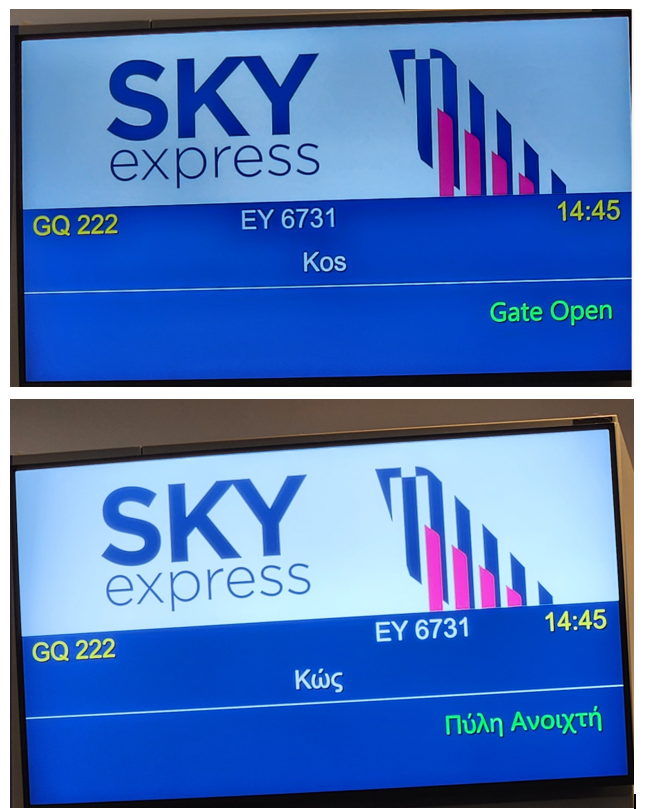
Photo by Lori Samuelson, Athens Airport, 3 April 2026.

I wasn’t expecting to be tripped up by my own name.

Not in an airport. Not in 2026. Not after years of working with records, languages, and historical documents.

And yet, there I stood, staring at a screen, absolutely certain something was wrong… because my name wasn’t spelled correctly.

Except, it was.

Travel has a way of reminding us that names are not as fixed as we think they are.

As genealogists, we’re trained to look for variation:

  • Smith / Smyth
  • Miller / Müller
  • Johnson / Johansson

We nod along, we teach it, we write about it.

And then suddenly, there it is, happening to us in real time.

In the airport, my name appeared in a way I didn’t immediately recognize. The letters were familiar, but not quite right. Some were substituted. Others seemed to shift in ways that made my brain hesitate. For a brief moment, I did what we’ve all done at some point in research: I assumed it was wrong.

But it wasn’t wrong. It was simply… written differently.

Names don’t just change over time, they change across languages, alphabets, and systems.

What we often call “Anglicization” is only one small part of a much bigger reality.

Because sometimes names aren’t Anglicized at all.

They are:

  • Transliterated (converted between alphabets)
  • Phonetically interpreted by someone unfamiliar with the language
  • Standardized by a government or institution
  • Digitally altered by systems that don’t support certain characters

Think about it:

A name written in:

  • Greek
  • Cyrillic
  • German with umlauts
  • Croatian with diacritics

…doesn’t always have a one-to-one match in English.

So what happens? The system makes a choice and that choice isn’t always the one you expect.

At that airport, I realized something important.

I was reacting the same way many researchers do when they encounter a record that doesn’t match their expectation:

“That can’t be right.”

But it can be right. It just isn’t familiar.

This is where genealogical research either stall or moves forward.

Because if we insist on one spelling, one version, one “correct” form of a name we will miss records.

Names shift in predictable and unpredictable ways:

  • Letters are substituted based on sound
  • Endings are adapted to fit grammar rules
  • Characters are dropped when they don’t exist in another language
  • Entire spellings are reshaped to fit a new cultural context

And sometimes? They’re just recorded however someone heard them.

The lesson isn’t new but experiencing it firsthand changes how you approach it. From that moment on, I wasn’t just telling people:

“Look for variant spellings.”

I was thinking:

“How would this system have interpreted this name?” Because that’s the real question.

Not:

  • What is the correct spelling?

But:

What versions of this name could exist in this context?

Whether you’re working in:

  • immigration records
  • church registers
  • court documents
  • or modern travel systems

…the principle is the same.

Names are not static. They adapt. They shift. They survive. Sometimes, they surprise you, right there in an airport, when you least expect it.

If there’s one takeaway from that moment, it’s this:

Don’t search for your ancestor’s name.

Search for the ways it could have been written.

Because somewhere, just slightly altered, slightly unfamiliar, your answer is waiting.

A New Way to Identify Name Variations

Originally published on genealogyatheart.blogspot.com on 18 Sep 2016.

I was reading the article Guild of One-Name Studies Is Now Available at FamilySearch.org  in The Genealogy News recently and thought I’d  check out the database on Familysearch.  On a few lines, I trace everyone who has that name in the US in an attempt to make a connection across the pond.  Stop and read the article and then come back to my blog.

If you followed the articles link to Familysearch, (added here in case you didn’t), and you enter a surname in the search field, you probably were disappointed.  I know I was!  I first added HARBAUGH and got links to everything but Guild Of One-Name Studies.  I know family historians, some quite renown, have traced the name back to a HARBO who was a court scribe in the 1200’s in Denmark.  I expected to find that and more but all I got were records of Harbaughs.

I then typed in LEININGER and got lots of IGI records but nothing for the Guild of One-Name Studies.

Then it hit me!  On the left hand side, I should have scrolled down and filtered out everything but Guild of One-Name Studies.

I still got nothing for Harbaugh and Leininger but when I entered KOS I got Cass and Coss,

Next I tried KABLE and that’s when it occurred to me – duh – this could be an innovative way to come up with surname variations!  My Kables were listed as Cable, Cabel, Kabel, Cobbold and Cabot.  I would have never come up with Cobbold and Cabot.

Next I tried DUER and got Dewhurst.  Now that was very interesting to me as I’ve been heavy into deeds and wills of my John Duer in Trumbull/Mahoning Counties, Ohio who died in 1831 after his son, Thomas, and I keep seeing Dewhurst in the records.  I pronounce Dewhurst as doo’ herst but I guess it could be pronounced doo’ ers.  Hmm.

We’ve all seen creatively spelled names, likely recorded from pronunciations, in records but I’ve never been really good at coming up with more than obvious variations.  I’m adding this tool to my genealogy tool box!

Playing With Names – Wildcard Searching and Other Methods to Discover Your Family

Originally published on genealogyatheart.blogspot.com on 13 Dec 2015

Just read a helpful blog about how to use wildcards when researching online.  You can read it here. I have to admit that I’m not very good at using wildcards or identifying the many, varied and unusual ways my ancestors spelled their names.  I think that many of my brick walls could could tumbling down if I took the time to use the wildcard search approach.

Another method I’ve used was just plain dumb luck but it taught me a very simple way that I’ve used since. I once had a dead end on my paternal grandmother’s line.  A distant family member thought my 2nd great grandmother’s name was Maria Dure.  I searched and searched for years and found nada!  It never dawned on me that I had two of the letters reversed in the last name. Duh, DURE should have been DUER.  I would love to take credit for that discovery but alas, wasn’t me who figured this out. I’m not sure how the gentleman found me but I received an email asking me about by DUER connection. I responded I didn’t see any Duer’s in my tree.  The writer than let me know he suspected my Maria Dure was a long lost line he was pursuing.  He knew his missing Maria had married an immigrant named Kuhn and sure enough, once I began looking for Maria under Duer the whole line fell into place!  He was kind enough to send me his years of Duer research and they are just a fun family to learn about.  (Well, probably getting kicked out of England wasn’t exactly fun, nor later being shunned or having to payoff an indenture in the Caribbean but you understand what I mean)

Last technique I’ve used is adding or removing an ending.  My Koss’ are really Kos.  Have found documents with both names so it pays to play with the last name.

Sorry this is so short but I’m recuperating from jet lag! Once my head clears I’m going to take my own advice and play with my Bird or is it Byrd?! or Berd or Burd line.  Happy Hunting!