
Artifacts on eBay – A Must Read


I recently read a fascinating story in The Weekly Genealogist, the online edition published by AmericanAncestors.org about stolen artifacts being sold on eBay. The blog, Rare Colonial Documents Found on eBay, originally published by the Smithsonian, is a must read if you search for documents on eBay as I do.

Although I knew that each state has laws regarding record retention, it never occurred to me to search them when I discovered something that just wasn’t quite right. I assumed (ahem, wrongly!) that the document must not be an original or had been disposed by the government and some nice person saved it from a dumpster.

I discovered my several times great grandfather’s indenture records on eBay a few years ago. There were other individuals listed on what appeared to be a court ledger page. The price was steep and I didn’t buy it. I did cite where and when I found it and using the snipping tool, saved a picture of it. The seller was overseas and it never dawned on me to report him/her. Now I know better.

Preserving Old Furniture


Besides family stories, photos and documents, my husband and I are fortunate to have several furniture pieces that have been passed down to us by ancestors. Unfortunately, a bedroom set that once belonged to my mother began to show its age – it looked dull and small scratches appeared on the top of the dresser. My kids insist the house ghost decided to leave us an undecipherable message, however, it looks to me like someone, once upon a time, wrote a note on top which left a minor imprint on the finish that became visible with age. We can’t read most of the letters but a H, A and L are visible.
I didn’t want the furniture refinished but I did want to prevent it from further fading and minimize the scratches. Last December, we visited a local antique store that carried a product that the owner swore would do the job for us. With less than a $10.00 investment we thought, why not?!
Hubby tried it on the dresser as soon as we returned home and we were disappointed that there was no visible change to the piece. The product, along with the steel wool that was needed to apply the liquid, was all but forgotten as we moved ahead with house renovations.
Saturday evening, with our hardwood floors installed (but not completely as the transitions still haven’t come in) we were moving furniture back into the living and dining room. I mentioned to my husband how much I missed the old Formby’s kits that he used to use to restore our older pieces. Hubby said we ought to try the product we had purchased at the antique store. I was thinking that would be a waste of time since the last time we used it the results were not what I was hoping it would be but I kept my mouth shut.
Hubby retrieved the can, shook it and applied a thin layer to one of my grandmother’s chests that I use to store linens. The result was breathtaking! As he went to get a rag to wipe off the excess, I grabbed the steel wool and went to work on an old secretary I used to house china. Pleased with the results, I went on to give a quick touch up to the dining room table and chairs.
We’re thinking the reason the product didn’t work the first time was because the stain didn’t match exactly. Although the bedroom set is cherry, it is a light stain compared to the dining room furniture. We plan on purchasing another can with a lighter stain this weekend and try again on the bedroom set.
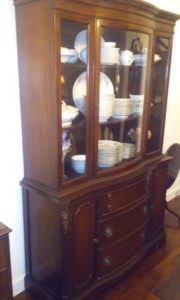
After celebrating Easter with the family, I decided I really needed a larger china cabinet to safely display my husband’s maternal grandmother’s china so I surfed Craigslist and found a piece that would match what we had and best of all, it was in my price range and only a few miles from our home. The bowed front china cabinet, circa 1940, was inherited by the original owner’s grandson who had no room for it. Bought in Oklahoma, the piece was moved 4 times by the Army over the past few years.
On Tuesday, we finalized the purchase and its travels; thankfully, it fit in hubby’s vehicle. Our teenaged neighbors helped get it into the garage where I went at it with my new wonder product. You can see the results above.
Hubby told me he was reluctant to make the purchase as there were dog scratches on the right side, some spots on the bottom were completely missing veneer and there were watermark rings on shelves. He was also concerned about the wood swelling as it was housed in an unairconditioned high humidity drafty building that was about 100 years old, though we don’t know how long it had been stored in those conditions. In just two days of being in a climate controlled environment, the difficulty in opening the doors are no longer an issue.
I’m glad to give our china and the cabinet a new home and I’m absolutely in love with Howard’s Restor-A-Finish. The big box stores locally don’t carry it so check around if you’d like to give your furniture a facelift. I’m thrilled with the results.

Our Ancestor’s First Names


I recently read an interesting article about trending baby names. Supposedly, 36 baby names are endangered, meaning that they haven’t been registered since January 1st of this year on a website for pregnant women. Not that it means they are going extinct, mind you, but it does mean that families who frequent that particular website aren’t planning on using names that many of us are familiar with.
Here’s the list of names:
Angela
Bertram
Beverley
Cecil
Carol
Clarence
Clive
Cyril
Debra
Diane
Donna
Dean
Doris
Dennis
Derek
Duncan
Elaine
Ernest
Geoffrey
Horace
Joanne
Leonard
Maureen
Malcolm
Nigel
Neville
Paula
Roy
Sally
Sandra
Sharon
Sheila
Tracey
Wendy
Yvonne
Wayne
As a baby boomer, I went to school with lots of Carols, Debras, Dianes, Maureens, Paulas, Sallys, and Sandras. I have relatives named Joanne and Sharon. I work with Angelas, Traceys and Wendys. Dated a Wayne once – we won’t go there. Lived next door to a Beverly and Doris.

From this data I have a hunch that millenials may not be using family names as was the custom of previous generations. My mother is Dorothy because my grandmother’s sister was Dorothy. My aunt was Anne because that was her grandmother’s name.

I would be interesting to check the site for middle names. In our family, often the father’s first name becomes the son’s middle name. Maybe the names on the list above are being used that way.

You can read the article here.

Identifying a Possible Ancestor Via Art?!


Here’s something different to try! First, take a selfie of yourself not smiling. Next, click on the link for the Musée de la Civilisation and upload your selfie. Complete the short form and click “Find Your Double.” The database compares your selfie to statues down through history.
The museum in Quebec is preparing for an upcoming exhibit and is looking for people today who most closely match the statues of yesterday.
I didn’t expect a match so I was pleasantly surprised when a sculpture of an unidentified woman, thought to be the Empress Faustina the Younger, matched me. An unidentified woman in my family tree, of course, it would be a match! I can see somewhat of a resemblance, especially if I were younger.
Do I have Faustina in my family tree? No, my tree doesn’t go back to Abt 125-175 AD when she was alive. Roman heritage wouldn’t surprise me, though, as my maternal side is Croatian and half of my paternal side is from the Alsace-Lorraine region. Both areas have a historical connection to Rome.
Although this definitely isn’t remotely proof of ancestry, it sure is fun and unique! Plus, you may just add to your history knowledge. I had no idea who Faustina was and well, after reading about her, wasn’t really wild about the possibility of being a relative. Maybe I should reread my blog for AncestorCloud, Dealing With Genealogical Disappointment. Faustina was known as a two timing schemer who may have poisoned a few who got in her way. She definitely was a helicopter mom, long before helicopters were invented. I was pleased that in grief, her husband, Emperor Marcus Aurelius, founded charity schools for orphan girls in her honor.
My hubby tried it, too, and matched to Ahata, a woman who lived in Palmyra in the 2nd century. There was barely a resemblance which makes sense as he’s Nordic on all sides and the database is mostly collections from the Mediterranean and Middle East.
Say cheese and give it a try.

Diversity in the Family Tree and Its Importance Today


Last month I took part in an activity at a workshop in New York City on Cultural Competence that’s been haunting me ever since. The presenter, Vivian V. Lee, Ed.D. from Johns Hopkins University provided an adapted handout from M. Loden & J. Rosner’s book, Workforce America (McGraw-Hill, 1991) that opened my eyes to my family’s core values in ways that I had never experienced before.
The worksheet consisted of a Diversity Wheel – a circle within a circle that listed 12 category descriptions of an individual, such as your level of education, geographic location and gender. Participants were asked to identify and record a word that described their personal category descriptions. For myself, it would be master’s degrees, USA, female.

Next, participants were asked to record the complete opposite of their personal description. So mine would be no degrees earned, anywhere but North America, male, etc. A few minutes was provided to reflect on the recorded responses by thinking about:

how would the opposite from yourself identity be perceived and treated by society and by the individual
how different would your present life be compared to that of the opposite individual
how would you adapt in society as the opposite individual
I was shocked to discover that my polar opposite in most categories would be my maternal grandfather, Ivan “John” Kos[s] and great grandfather, Josef Kos[s]. Although they both had the same surname, these men were distant relatives. Josef was my grandmother’s father and John was her husband of an arranged marriage. So, my grandmother’s maiden name was the same as her married name (now that’s convenient!). But back to the exercise…

Both John and Josef emigrated separately from then Austria-Hungary, now Croatia, to the U.S. for reasons that so many emigrants continue to come – economic opportunity, freedom, a new start. Manual laborers with little to no education, limited English and no citizenship rights, these men, along with others like them, were the backbone of the United States’ economy for generations as continue to be so today. I never met Josef who died young; he caught the flu and passed away in 1919. Of John, I never heard one complaint from him about his status in society. Even after residing here for over 60 years, though, he knew he continued to be identified by a slur – I heard a shopkeeper once call him a D.P., aka a displaced person. Although he took a citizenship oath, would never be fully accepted and remained subject to distrust by those who fate allowed to be born here. Although I’ve become the opposite of my grandparents, I know they would have been very proud of my children and my role in society. They would not begrudge that I am not treated as they had been.

I reaped the fruits of Josef and John’s difficult lives. If you take a moment to think about your own roots, you most likely have an immigrant story in your family. It may have been as long ago as 1600 or just in the last decade. Your ancestors may have come of their own volition or not. It matters not when or how they arrived. What matters is that the hardship they endured afforded you comfort and security that was lacking from their point of origin. Perhaps it’s due to my childhood interactions with and knowledge of my grandparents’ life experiences that make me thankful for their risk in immigrating and I will always have a place in my heart for those who are so courageous that they would begin again in a new land.

DNA and National Geographic, I Remember When…


Yesterday I received the March issue of National Geographic and as I unwrapped the cellophane, out fell an insert about their Geno 2.0 program. This got me thinking about how far DNA has come over the past few years.

Back in the day, I’m thinking circa 2006, a co-worker had used the Society’s DNA service. I don’t remember what the cost was but I remember thinking it was pricey for what she received, a slick brochure that gave her general information about her ethnicity. It told her she was of Greek heritage; since she lived in Tarpon Springs, Florida that was not an Ancestry.com trade in your lederhosen for a kilt revelation. I decided I’d wait until the results became more specific.

After reading the insert in the magazine, I figured the price still must be high as it was not provided, though a special $50.00 off discount was mentioned. Checking the Geno 2.0 Next Generation site, I found that the $199.95 regular price was on sale for $149.95. With the subscriber discount noted on the insert, the price would be $99.95. Guess they’re trying to be competitive with the rest of the market.

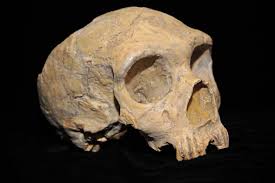
The results brochure looks quite similar to what my co-worker received over a decade ago. The biggest change appears to be identification of Neanderthal ancestry which my mother would have just relished. She always swore she had Neanderthal DNA long before science proved remnants remain. If she were alive today, this would have been an awesome birthday gift.

The other updates are vague; “improved ancestral results” and “ancestral calls” but it doesn’t say how the are improved and “more accurate regional ancestry” to include 60 reference populations.

What does make this offer unique is that you can also purchase a ball cap or t-shirt that provides further advertising for the project. Not that it would influence you to test with them, just sayin’.

Access to Preserved Records is Being Threatened!


There’s been a lot of discussion on several genealogical lists that I follow regarding proposed cutbacks that would greatly impact accessing records that are vital to anyone looking into their ancestor’s past.

I am advocating that records remain open and accessible. If you agree, than please read the following and take action:

A New U.S. Budget Blueprint May Affect Genealogists by Diane Haddad

Help Us Nip Efforts to Defund NEH in the Bud

I use newspapers found in Chronicles of America at least weekly. I have found so many genealogical gems in those old papers I couldn’t even begin to count! The NEH does a whole lot more – go to their home page and type in your state name in the search box on the top right. You’d be amazed at how many grants they’ve awarded for record preservation in your area.

Thank you, readers!

Privacy and the Genealogist – Part 2

My last blog was about ways to find the living who might have the genealogical information you need without making them feel threatened that their privacy had been invaded. Today, I’m thinking about how much more private our lives are then in the past. Thomas MacEntee mentioned this, too, in an interactive webinar he recently did. If you don’t believe that, check out an old newspaper and you just might find something like this:

1

2

3

4

5

These are just a few of the times that George Harbaugh was noted in three local papers between 1900-1909. From the first notice we know that there were two individuals who were professors who traveled together to Missouri. Today, a notice like this would alert burglars and the professors might return home to find a break in had occurred.
The second item confirms that George was an educator. Did they send junk mail back in the day? He’s fortunate that there were no big box office supply stores sending him ads based on his job description.
Next item lets us know not only his residence but that he has a son with the same name and that they visited Plymouth, Indiana. Great information from a genealogical standpoint; we’ve got relationship confirmation! The fourth notice lets us know that George visited nearby Walkerton, Indiana on a Saturday. Together, both notices are kind of creepy. Can you imagine every time you leave your town that it would be published in your local newspaper?! Sure with public figures, every movement is tracked and reported today but George wasn’t famous. Looking at the other statements surrounding George’s show that this was common practice; we know that G.S. St. John of Tipecanoe also visited Plymouth and Ed Cook purchased from William Burger a “fine carriage.” Seriously, when you buy a new vehicle or a major appliance, we certainly wouldn’t expect it to be published in the newspaper.
Today, we continue the practice of placing family relationship information and residence locations in obituaries as item 5 did. We can connect George to his father and two of his brothers. Another clue to finding George’s whereabouts on a Sunday might be the Dunkard church as that’s where his father, grandpa Harbaugh, attended. Since grandpa lived with George more information about George might be found there. Again, nice for a genealogist and even nicer for a crook who knew the family wouldn’t have been home during church service. Don’t think they had robberies in those days? George’s aunt, Mary Ann Eyster Johnson, wrote in her diary on 10 April 1898 that “Today we found that the Meeting House had been robbed. Tablecloths, aprons, dishes, knives, and forks and baskets all gone. No clue to the robbery.”6 Interestingly, I never found the story of the church robbery in the newspaper.
Clearly, it was not just a slow news day but a standard practice to record the comings and goings of residents a century plus ago. Your personal whereabouts is fairly safe these days, although it can be gleaned from public records courtesy of your property appraiser. Don’t despair, so is your neighbors! The only difference between property records now and in the past is we can look the information up quickly using the internet instead of having to drive to the assessor’s office.
Although our privacy is more assured, future genealogists will not find the gems that we do in newspaper archives. All the more reason for you to start writing about yourself!

1 “Lapaz Items,” Marshall County [Indiana] Independent, 27 April 1900, p. 5, col. 5.
2 “Lapaz Items,” The Plymouth [Indiana] Tribune, 2 July 1903, p. 4, col. 4.
3 “Saturday,” The Plymouth [Indiana] Tribune, 1 September 1910, p. 5, col 2.
4 “Saturday,” The Weekly [Walkerton, Indiana] Republican, 14 March 1912, p. 2, col 3.
5 “Lapaz Items,” The Plymouth [Indiana] Tribune, 28 January 1909, p. 5, col. 6.
6 Mary Ann (Eyster) Johnson, “Diary,” 10 April 1898, n.p.; privately held by the Pine Creek Church of the Brethren, North Liberty, St. Joseph County, Indiana.

Privacy and the Genealogist Part 1


Have you ever Googled yourself? If not, take a moment and do so. If you have, then you know how much information about you is readily available at the click of a few keystrokes.
I understand why many people are greatly concerned that their personal information is “out there.” In the uncertainty of today’s world, we’ve all heard horror stories of identify theft and Craig’s list murders. It makes us more cautious and fearful.
Recently, I took an interactive webinar by Thomas MacEntee about finding living persons. Why would you want to find the living? It’s the best way to make contact with folks you are related to that may just have the information you are seeking. I though it very interesting and I totally agree with Thomas that using snail mail is the most effective way to make initial contact. People are more apt to respond to you if they have the time to process the contents. Additionally, the distance between you and them provides a sense of security. Think about it! If you telephone the individual you have caught them off guard and no one likes to feel that way. Emailing can work but may go to spam. I never tried texting someone I don’t know but if I received a text from a stranger I certainly wouldn’t respond.
When I write a letter to an individual I do not type it. I typically print as cursive can be difficult for older eyes (and though I haven’t written to anyone under 20, if I did they most likely wouldn’t be able to read it since it isn’t taught in school any longer.) Printing also sends the message that you took the time to be personal. I keep it short which is often difficult for me to do! In the first paragraph I introduce myself and explain my connection. The second paragraph explains what I’m seeking – a Bible record or a photograph, for example. The third paragraph gives ways to contact me that are more expedient than mail, such as my phone and email address. I also offer to pay for the cost of copying and mailing. I always end with “looking forward to hearing from you soon.”
Does this always work? No, but it might and has so give it a try! I’ve been successful in many cases. I can only think of once where I didn’t get a response and possibly, the individual did not have the information and being in his 90’s, was not able to let me know that. In two other situations I did make contact but the individuals were “too busy” to get the information to me. Both emailed me that they would but after a few reminders over the course of a year it didn’t occur. I haven’t given up hope yet as last fall, I connected with the son of one of my deceased’s mother’s friends. The friend had recently died and the son, while cleaning, found my name and contact information as I had sent a Christmas card 15 years ago right before she moved from our area. The son had newspaper clippings of my wedding and events my mom had attended with his mother. So you never know who has your personal information! In my next blog I’ll continue discussing privacy and share some examples of why I believe, like Thomas, that we have more privacy today than in the past.