
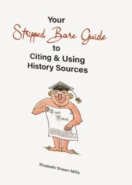
They say you can’t judge a book by its cover but in the case of Elizabeth Shown Mills’s latest, Your Stripped Bare Guide to Citing & Using History Sources (2025), the cover is so charming it almost makes me want to sit down and write a source citation. And that’s saying something, coming from someone who usually dreads the task and full disclosure, often cheats by letting AI do it for her.
You might wonder, after decades of writing about citations, what more could ESM possibly have to say? I own all four editions of her past works, Evidence Explained, along with two editions of Professional Genealogy. Those texts are monumental, hefty, encyclopedic guides designed to help family historians create (and yes, crafting a citation is an art) a source reference for every conceivable research situation. But therein lies the problem; they are so thorough they can overwhelm beginners. Too often, they end up gathering dust and making the bookshelf sag, which is a shame because they hold the keys to accurate, credible, and most importantly, findable research.
I’ll admit, I’ve grown a bit lazy since AI became part of my workflow. For my personal research, I often settle for a quick and dirty Chicago-style citation generated by a chatbot. I’ve noticed some of my editors have relaxed their standards, too. Why? Because tracking down the exact template in Evidence Explained can be a time consuming hunt.
Enter Your Stripped Bare Guide. This is the book I didn’t know I’d been waiting for, clear, concise, and portable. At just 138 pages, it’s a featherweight compared to its predecessors, but it’s packed with practical, ready-to-use information. I liken it to The Elements of Style, a distilled, timeless resource that belongs within arm’s reach of every researcher’s desk.
And timeless it is. Consider how much genealogy has changed since 2007, when the first Evidence Explained was published. Back then, FamilySearch was still shipping microfilm via snail mail to local Family History Centers. AI existed only in movie scripts. Blogging was in its infancy. The very first iPhone had just been released. Now, so much is online (though not everything) and our research methods continue to evolve. I had wondered, when ESM retired, who would carry the citation torch into this ever changing landscape. No worries now! Stripped Bare teaches the core principles so we can confidently adapt to whatever new technology comes next.
Pro tip: read the foreword first, it’s a soothing antidote to any citation anxiety. The opening chapter lays out universal guidelines for any source, followed by “Fundamentals of Documentation,” filled with tips and practical recommendations.
One passage made me laugh out loud; ESM notes that the purpose of citations isn’t to help others find our sources. Gasp! I could picture one of my high school English teachers having an apoplexy. After all, isn’t that what we were always taught? Even now, I carry that belief with me. Stripped Bare challenges that notion, and while some “old school” researchers may bristle, I found it refreshing.
I also appreciated the section on citing derivatives. About a decade ago, I found myself in a spirited (and unresolved) debate with another professional genealogist who insisted I was wrong to cite both the original and the derivative. ESM explains my position far more elegantly than I did, which may be why we never reached agreement.
Here’s what I love most, Stripped Bare offers just 14 templates. Yes, that’s the same number found in Evidence Explained, and many of the examples are familiar, but what’s gone is the 555 page sprawl of trying to illustrate every possible source on earth. That level of detail served its purpose once, but it’s no longer necessary for most researchers.
Some might think this is simply a repackaged version of the first three chapters of Evidence Explained. It isn’t. While there’s necessary overlap, after all, the fundamentals don’t change, the material is rewritten in a fresh, approachable way. Most importantly, it keeps evidence analysis front and center, reminding us that citation is not just about formatting, but about thinking critically about our sources.
For intermediate researchers and beyond, I highly recommend Your Stripped Bare Guide to Citing & Using History Sources. It’s available in paperback and eBook from Genealogical.com—and it just might make you want to write your next citation.
