I abhor spending time on tech issues but that has been on my to-do list for awhile so I decided to spend this week taking care of needed updates. First on the agenda was to update my blog settings. Typically, I just have to click a button and the settings are updated. Last May, I got a popup that said I must update my PHP settings first. I ignored it because I was spending 12 hours a day online and didn’t want to have to spend more time researching how to do that. On Sunday, I decided I really had to figure it out.
Trying to update PHP is a little like trying to find a genealogical document. To put it simply, you just need to know where to look. In actuality, it’s a whole lot more complicated. I started by Googling and was directed to go to the cPanel. Nowhere does it tell you where the cPanel resides. One of my family members said it was on my hard drive, mistakenly thinking I was looking for the C Drive. Another said I probably downloaded it somewhere on my hard drive from my Hosting company. More Googling took me to YouTube but again, the videos do not tell you how to find the cDrive but do show you what to do when you find it.
This reminds me of desperately trying to locate an obit but you can’t find the newspaper. You know the time frame it should have been published but that particular issue is missing. I decided to reach out to those in the know – I posted on a genealogical list serv. Three folks quickly came to the rescue – they told me to go to my cPanel. Umm, right, but where is the cPanel? I was directed to contact my Hosting company.
The Hosting company was experiencing heavy contact volume so they recommended placing a ticket with my concern. About 4 hours later I got a response and ta da, it directed me to the same YouTube video that didn’t answer my question in the first place.
On Monday, I tried to chat with the company who was still experiencing high volume. After a short wait I got a techie who sent me to the same YouTube video. I was trying not to be rude but this was ridiculous. I asked to be directed to the cPanel from the home page. Instead, she took a pic of the page I should be on. I told her my page did not look like her page and how did she get to her page. Light bulb moment on her part – “Oh,” she responds – “you don’t know where to find the cPanel. Click on Hosting and there it is.” Two clicks later and I had the update done.
Next I decided to tackle updating my Legacy Family Tree and RootsMagic tree to Ancestry. I am embarrassed to admit it has been 2 years since I last did that. The Legacy update took just a few minutes since there is no media. I was dreading the RootsMagic as its been synching but the program makes you go into each person changed and update individually. I toyed with the idea of just dumping what I had and starting fresh but I was worried that it would take up too much of my desk computer’s time and I wouldn’t be able to use it for anything else. I also was concerned with power outages that might disrupt the synch and then, well, I’d be worse off than I was currently. Years ago, I synched Ancestry to Family Tree Maker and then it just stopped working. Each company blamed the other. I never got it resolved and so I became a beta tester for RootsMagic when they were developing their synch.
For those reason, I decided to just go for it – painstakingly checking every individual change. Took me a few minutes to realize I needed to ADD all the new people first. Wish there was a way to filter what the discrepancy is – new to RootsMagic? New to Ancestry? In RootsMagic but not Ancestry? In Ancestry but not RootsMagic? You can get in the zen by doing the same monotonous task over and over and it would really speed the process up. Alas, that wasn’t the case so I spent all day Monday just adding new people from Ancestry to RootsMagic. Tuesday I got throught the A surnames, I’m now up to G. Every few minutes I have I update. At this rate, it’ll be another week before I get everything where it needs to be.
I have colleagues who have completely given up on the synching saying it is a waste of time. I understand their time issue but I’m more worried about losing important info I saved to just Ancestry.
Problem could be solved if I just saved everything in the first place to my hard drive but as I’ve mentioned, I’m awful with back ups and I’d hate to lose everything. We’re supposed to be getting 3 full days of rain and I’m hoping so that not only will our drought end but that I have nothing else pressing to do but update RootsMagic. Hope you’re upcoming week will be much more exciting!
Do you have DAMAGED PHOTOS that break your heart because you can’t appreciate the picture while fixating on the ugly part? I do and I was never able to use the photos in family projects because I couldn’t restore them to their former glory.
Thanks to MyHeritage.com, it is now simple, quick, easy and free (some limitations apply) to return the photos to better than new. Here’s how:
First, upload your photo to be repaired by logging into MyHeritage.com and click on Photos in the ribbon, then click the Upload box on the right.
Once uploaded, the photo appears with your media items. Now, click the photo needing to be repaired.
Above the photo on the right hand side, the following options are shown: Repair, Enhance, Colorize, Animate. To correct the photo it’s recommended you select options from left to right.
Once I click Repair and MyHeritage.com does it’s magic, the photo will be shown as follows:
Much improved but still not perfect. Sure, I can clip out the damage to the upper portions of the photo but I want to restore the picture to as close as new as possible so here’s what I’m going to do – On the upper left hand side of the photo, click on the gear icon which is the settings option. The photos are first repaired Gently – that’s the default setting. I’m going to click the box Extensive Repair Option and Preview. Now look at what it does:
Isn’t that AMAZING?! You can stop there but I wanted to make the photo even more defined so I next clicked on Enhance. Here’s what the result was:
Due to the size limitation on my blog, the subtle improvements are not as apparent as on my larger computer screen but when you try it you’ll notice the difference. Next I decided to go ahead and colorize it. I’ll be honest, I’m not a big fan of colorizing because I like to know FOR SURE if what I’m presenting in my research is accurate. It is fun, however, to imagine what the original outfits looked like so I decided to click the Colorize button to see what the program would select:
I again used the Settings (gear icon) to tweak the saturation manually as the first colorization picture showed a pink hue on right side of the dress. Knowing the individuals as I did, that wouldn’t have been the color choice. The brown/silver grey was more in keeping with the time period (1917) fashion and the wearer’s preference. In my excitement to get the photo corrected I neglected to tell you who the people are! This is a photo of my paternal grandparents, Edwin and Lola Landfair Leininger, and their oldest child, my dad, Orlo Guy Leininger. He was born June 4, 1917 so I guess this must be a photo that commemorated his first Christmas. Nothing was written on the photo back (of course). I received the photo 5 years after my father’s death in a box that was kept in a damp unheated northern Indiana basement for probably at least 10 years. I’m fortunate that the photo survived, albeit damaged. I’m thrilled that it has been restored. Thanks, MyHeritage.com for your new feature! For the ethic minded, I also appreciate that MyHeritage.com acknowledges that the photo was altered. You can see the After written in the upper left hand corner of the photo and on the bottom left, icons appear showing exactly what features were used to change the original picture. I’ve blogged before about the animation feature but it has since added many new features, too. I couldn’t resist animating my Dad, I’m sure he would approve:
Set your alarm and check out MyHeritage.com for a wonderful new feature that will be rolled out tomorrow. I promised Daniel Horowitz I wouldn’t tell you WHAT it is but I don’t want you to miss it as I think you’ll be as excited as I am to give it a try.
If you have a gmail account you may have been getting notices from Google over the past few months that their terms are changing June 1st regarding storage. You may have also gotten information that they would like to “offer” you, for a fee, extra storage space for your photos and emails through Google One.
I have a Dropbox account that I use so I don’t need to be paying for another storage space. I haven’t successfully been able to transfer photos and emails from the gmail account I share with my husband to my desktop to then transfer to my Dropbox account, though I’ve followed online directions. When the emails are on my desktop they appear as an Outlook file but I’m unable to open them, even though I do have an Outlook account.
If you are having the same problem, here’s a temporary work around I discovered.
I like to keep my genealogy business separate from my personal research so my family related genealogy goes to my shared account and my second gmail account was set up to be business only. However, these are difficult times and I’m now combining all of my genealogy in one place. Since I so often blog about my personal research anyway, it only makes sense to keep all my genealogy related correspondence together.
By doing that, I’m freeing up valuable space in my shared gmail account without having to pay for extra storage.
Here’s what you need to do:
1. Create a second email address if you don’t already have one. It’s simple – here’s the directions. https://support.google.com/mail/answer/56256?hl=en
2. Next, go to the email address where you have too many saved messages. In the search bar, type a term that will bring up messages that are similar. Here’s an example; I typed in genealogy Williams because I want every genealogy related item for the Williams surname in my gmail inbox.
1. If you created labels, as I have, then click to open one of them (they are visible on the left side:
When I click into the Genealogy label, I will use that search box which appears under the header as it does on the main inbox page. To keep emails from the same sender or for the same surname, type in a surname, such as Williams or a person’s email address. All of them will appear:
Now click the check box next to the down arrow and checkmarks will appear in all the emails listed below:
On the line where the checkmark next to the down arrow is, click the last icon, 3 dots:
The last option is Forward with Attachments. Click it and all of the check marked emails will be placed in the body of a new email. This can take a few minutes if you are sending many at one time.
In the subject, list the surname and/or who the emails are from. In my picture above, I’ve given an example as I typed Williams from Courtneys. That’s referring to all my Williams surname correspondence that I received from the Courtney family. Then, in the recipient box, type the email address where you will send the message. In my case, I’m sending it to my second gmail account.
It will arrive in your new email inbox as a unit. Just open the email and all the others are attached.
I created a label I called Personal-followed by the surname. This way, I can quickly find all emails sent to me over the years for a particular surname.
Someday, ahh hum, I will go through these as I’m sure there are some gems in there that will spark a new clue to an existing research problem but for now, they are safe and I’m not out any money.
We were at 99% used and by just removing my 12 pages of saved genealogy emails and a few pages of photos has allowed me to be at 90% capacity.
My clip – look at the 3rd image from the left side to see the red dot
Are you noticing some subtle changes on your Ancestry.com home page? I’m referring to the red dots on the right side of header above the leaf and sometimes the envelope.
What’s up with that? Clicking on the leaf I see that I have some Hints. Scrolling down the drop down Hint menu and clicking on “See all recent hints in” I still have the red dot. I also have a counter that is still not working:
All Hints= 1 & Photos=1 but I’m on the photo page and there are no hints!
Sometimes the red dot is showing above the envelope but it seems to clear away when I get a legitimate message from another member. I had a “1” showing for three weeks, even though I had read the message. I discovered that you must click in the “respond” box, even if you aren’t really responding, to make the counter reduce. That doesn’t work for Hints, however.
The dot seemed to appear about the same time that Ancestry changed the viewing of Hints but I’m not sure they are related. Seeing the information on the right screen side will take getting used to. I’m not complaining about it, just don’t see the need for that change when there are others that could be addressed.
I realize I am perseverating on a dot which is a picayune detail but as it’s time for me to renew, I am looking at the program with the price of an annual subscription in the back of my mind. How they can’t get it right after all these years is beyond me.
I blogged about the Newspaper.com free access a few weeks ago. I have Ancestry All Access Membership, however, over the last year, I’ve often clicked on Newspapers.com and received the message that the image isn’t accessible because I don’t have their premium subscription.
Here’s a little math since I love saving money! The Ancestry.com All Access membership for a year is $389.00 which includes Ancestry, Basic Newspapers.com and Fold3. Newspapers.com Access Everything membership is $74.90/6 months or $149.80/year. Their Basic membership is $44.95/6 months ($89.90/year).
If I select Ancesty.com World Explore membership for $149.00/6 months ($298.00/year) and purchase Newspapers.com separately ($149.80) and Fold3.com separately ($79.95/year) the total cost would be $527.75 annually. So, yes, I am saving money by going through Ancestry.com in order to access Newspapers.com and Fold3, however, I’m not getting full access to Newspapers.com which I sometimes need.
My local library has the full Newspaper.com subscription but it is only available at the library so that hasn’t been helpful. Here’s my work around – as I work on my personal genealogy, I’m making a list of any item I can’t readily access and then, will either check it out at the library someday or wait until the site has another free weekend. In a pinch, I’d use the Ask a Librarian option for a look up. For my research areas, Newspapers.com does not have the info that would be worth it for me to buy the Everything access. Your needs, however, might differ.
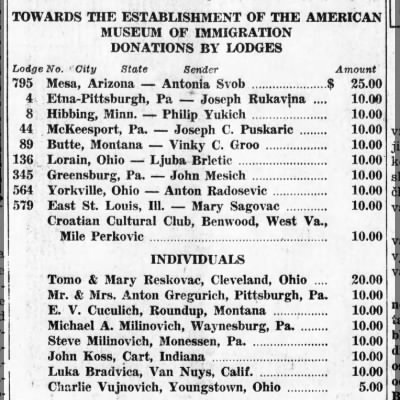
John Koss was my Grandfather, Michael A. Milinovich was my God Father and Steve Milinovich was Mike’s brother. Typo in my Grandfather’s city- should be Gary, not Cart! 26 Dec 1956, c. 3 p. 2.
You may have a Basic membership through Ancestry.com to Newspapers.com but that’s doesn’t permit you to view all of the holdings. I spent a few hours yesterday rechecking my closest to me relatives to see if additional newspapers had been added since the last time I took advantage of a free special offer from the company.
I was delighted to find several articles that I didn’t know existed – such as:
Who knew that my grandmother Mary Koss had an obit in a Hammond, Indiana newspaper? I have the obit from the Gary Post Tribune but didn’t know about the Hammond Times. Likewise, my Uncle George also had an obituary in the Hammond Times. Must have been a deal hrough the funeral home I just wasn’t aware was in place. Funny as they rarely visited Hammond and to my knowledge, had not friends there!
Struck gold in the Zajenicar, a Croatian newspaper that my grandparents used to receive. I had been told that my name had once appeared in it. Evidently, back in the day, the Croatian Fraternal Union sold life insurance policies to the parents/grandparents of newborns and my grandparents had bought a policy for me that expired when I turned 18. I was told that the children’s names were printed in the newspaper so I searched for me but didn’t find myself. I decided to search for my grandparents thinking it might have been placed under them instead. Surprise, Surprise! Discovered that my grandfather, Kum (that’s God Father) and his brother had given $10.00 to the organization before my birth to help fund an Immigrant Museum to be built in Pittsburgh. Don’t think that goal ever materialized but it was a sweet find for me. I think they all would be pleased knowing I have tried to honor all of the family’s immigrants through my blog and family tree.
Interesting to me, I also understood why my Grandparents always paid for a lamb to be raised and slaughtered at Buncich’s Farm in Hobart, Indiana every year. Duh – they were sorta kinda related and I had no idea until I found an obituary that mentioned my aunt through marriage. One of her brothers had married the daughter of the owner of the farm. That would just be like my grandparents to support a family member if they could. I always thought they just liked the taste of the lamb!
Finding that obit was another aha! moment for me. I have one cousin whose name is “off” the naming pattern the family typically uses – we have a zillion John – George – Joseph – Nicholas – Michaels and those names move from first to middle so frequently it’s often hard to keep everyone straight. Since my cuz is still living and I don’t want to hurt feelings if he ever sees this I’m not typing the name but now I realize where he got it from – his mom’s brother’s middle name that had been a grandfather’s name. Who knew? ! I guess most of the family but me.
Since this weekend will be very cold in most parts of the states and we’ve had torrential rains already this morning in my part of the world – stay warm, stay safe and stay focused on your genealogy by taking the weekend to visit newspapers.com. No telling what you might discover!
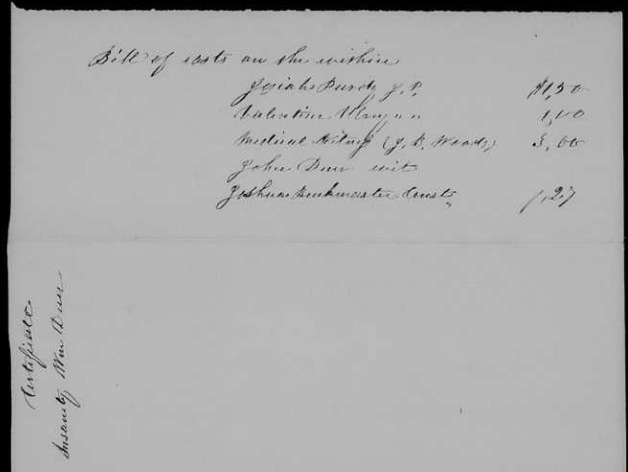
Certificate of Insanity, William Duer, May 1852; digital image, FamilySearch.org: Accessed 27 December 2020, citing Common Pleas Court civil records, 1825-1901 ; civil index, 1825-1900 Miscellaneous, 1846-1873 Miscellaneous (alphabetical), pre-1900 Depositions (chronological), 1886-1901. Film # 008271767, image 921 of 2904.
Usually, I’m happy when I climb over a brick wall but sometimes the find provides harsh reality of what the individual was experiencing. I recently had such a discovery and in all honesty, I put off writing about it for a month.
I’ve made a lot of progress on my John and Jane Duer line lately although several mysteries remain, like where is John buried, why does Jane’s tombstone say “wife of John Duer” when he was married to someone else at the time of Jane’s death and why does Jane’s youngest children, who were adults when she died, not tell their own children about Jane as evidenced by their death certificates stating mother is unknown?
My working theory is, among other reasons, because of the sad discovery I made regarding one of John & Jane’s children.
William Duer (1828-c. 1852) was the oldest son and oldest surviving child of John and Mary “Jane” Duer; he relocated with the couple from Trumbull County, Ohio where he was most likely born to Killbuck, Holmes, Ohio where he is shown residing with his parents and siblings in 1850. That census shows that William and his closest aged sibling, Thomas, was working on the farm with father John.
For years, I had difficulty discovering what became of William as he was not shown with the family in the 1860 census in Mercer County, Ohio where they had relocated, nor was he found in any census anywhere. He seemed to have disappeared in thin air as nothing was found for him anywhere. Until now and thanks to the images on FamilySearch.org.
My search for William took the usual path over the years – checking all the online sites, family trees and connecting with known relatives. I thought he had perhaps died in the Civil War which wouldn’t explain where he was in 1860, but I also had another missing brother from the 1860 census so I figured they may have been together somewhere and missed the enumeration. That brother, John B., eventually ended up in Adams County, Indiana. William was never found again. Until now.
I decided to look through the images for Common Plea Court Civil Records, 1825-1901, for Killbuck Township, Holmes, Ohio where the family lived to see if a record may exist for anyone in the family. That’s where I discovered the Certificate of Insanity for William Duer.
From the medical report, I learned that William was age 23 and free from infection. In March 1852 William complained of “feelings in his head” that lasted 1-2 weeks. He was last reported sane on 12 April 1852.
Apparently, insanity must have been shown for at least 30 days before the courts could be contacted. The physician diagnosed William with melancholy that was not related to hereditary or epilepsy. He was not violent. His past medical history showed bleeding and blisters but it does not clarify the cause.
Interestingly, the physician noted William had received “no education” and “worked hard” and had “no amusement” yet he was not “disappointed” by his life. The education information is verified by Historical Collection of the Mahoning Valley which stated “the public schools were few, with little interest taken in public education until 1840, when a new impulse moved the settlers” (p. 484). William’s early life was in Trumbull County which became Mahoning County.
The Justice of the Peace had also visited William at his home and found him insane. Since he was a resident of Killbuck, he was sent to the Ohio Lunatic Asylum to undergo treatment. His condition had been the case for less than 2 years. The reason cited for committing William was that “his being at large would be dangerous to the safety of the community.” Although this clearly conflicts with the physician report stating that William was not violent, father John Duer attested the same.
I do not believe William every survived the commitment. I suspect he is buried on the asylum grounds where there are numerous unmarked graves. I will be following up with an organization that holds the records which is currently closed due to the pandemic.
I hadn’t expected this would be the reason for the brick wall.
From searching through images, prior to this find, I discovered a letter to the courts regarding another community member’s request for an insanity hearing in the preceding year. The request was denied, not because the woman wasn’t insane, but because the county had already used up all of their bed space in the asylum. I have no idea from the records what the county’s allotted number was but it is telling that there were more community members who needed mental health assistance then there was available treatment for them.
This find leads me to a new working theory about William’s mother, Jane, that I will explore in more details next time.
What do you do when you’ve looked for a deed in all the usual places – county property appraisers office, FamilySearch.org or other online database of deed records, and even probate files but you come up with nothing? I was fortunate to find deed records in an unlikely place and you just might find this useful…
What do you do when you’ve looked for a deed in all the usual places – county property appraisers office, FamilySearch.org or other online databases, and even probate files but you come up with nothing? I was fortunate to find deed records in an unlikely place and you just might find this useful.
I wanted to locate a deed record for my John Duer (1801-1885) because I was trying to discover which wife might be named on it. John married Mary “Jane” Morrison (1804-1866) on 29 July 1827 in Trumbull County, Ohio. The couple would go on to have 11 children together and relocate first to Killbuck, Holmes County, Ohio by 1840 and then to Liberty, Mercer County, Ohio by July 1860 when they are found together living two residences away from one of their married daughters, Maria Duer Kuhn.
The census does not state if the residence was owned or rented. The couple owned property both jointly and separately when in Holmes County. I’m not exactly sure when they relocated but the last deed of sale I find for them in Holmes was 27 April 1854.
I began to look in Mercer County, Ohio for deeds between 1853 (when they sold another piece of land in Holmes-I figured they may have relocated then but couldn’t sell the other lot they owned until the following year) and 1864 when I knew John had remarried. I tried all the usual places but came up with nothing. The property appraiser site found no John Duer. The site doesn’t say how far back the records go but one of the options for age of buildings is 1800. I then looked for old deed books at the various online genealogy sites and found nothing for Mercer County, Ohio. I even tried the Familysearch.org image search that I blogged about two weeks ago but came up with a big zero.
Sometime after July 1860 and before 11 December 1864 John and Jane split up and John remarried widow Margaret Ann Martz Searight. They had a child together, Charles Edward, born in February 1866.
Since emigrating from Germany, Margaret lived first in Hardin County, Ohio but relocated to Adams County, Indiana, perhaps after her husband, George Washington Searight died 8 April 1863. John and Margaret, after their marriage, lived together in Adams County, Indiana.
My next search was for property in Adams County, Indiana as I knew, from John’s will made in August 1884, that he was leaving Margaret the property. That meant she had not been a co-owner. He possibly bought the land prior to their wedding or for some other unknown reason, decided to buy land separately from his second wife as he had done in Hardin County, Ohio with his first wife.
His will states, in the case of Margaret predeceasing him, the property would go to some of his children (why he selected only 3 children in his will I do not understand. He names the two children he had with Margaret and one of his children, Angeline, he had with Jane. Angeline had married and was living in Adams, Indiana. What is odd is two of his sons, John B. and James William, were also living in Adams. Why he excluded them from his will I hypothesized in my last blog, Missing Tombstones.)
The Adams County, Indiana property assessor’s office website is not very user friendly and I got lost in the clicking. I eventually found that “NEW! Electronic Records” were available but there is no link to where. Trying to click on what appears to be a link stating “Adams County is now ready to electronically record all your documents through e-recording.” also didn’t work. In small print, there is a note that the records are from 1990 to present. Oh well!
I continued to click and thought maybe “History” would be helpful but it was just a few facts about the 12 townships in the county. Under “Residents,” I decided to click on “Genealogy.” I was taken to INGenWeb for Adams County. I was so excited to find a search box so I entered “Duer” and found 59 items.
At this point I had to decide, did I want to derail my search for a deed, which I figured wouldn’t be placed here, or just get more info about the Duer’s who had lived in Adams County. I decided to stay focused but to do a new search for “John Duer” hoping that it would eliminate all of the other Duers except for John’s son, John B., known to also be living in Adams. I was pleasantly surprised to discover that the search results were for 53 items.
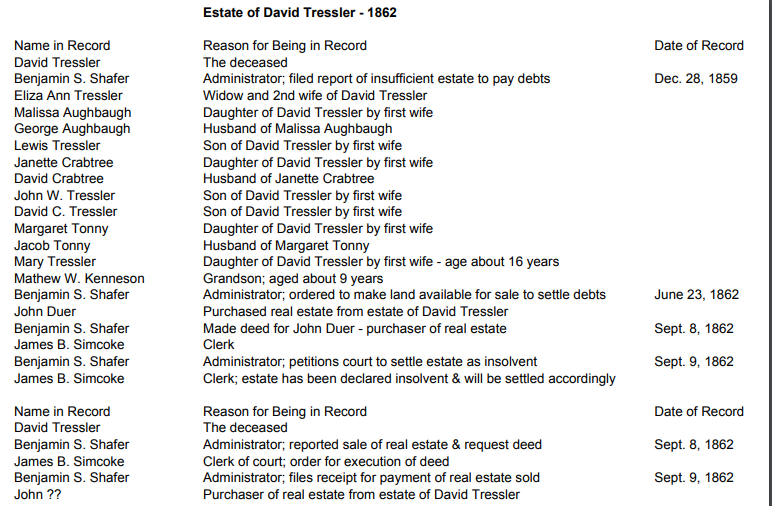
What immediately caught my eye on the first page (10 items show per page) was “Estate of David Tressler2 – 1862.xls.” Who was David Tressler – certainly no one in my tree and how/why was John Duer associated with him? Intriguing!
The image (above) was a timeline followed by scanned documents of David Tressler’s estate from 1862. Using the Find trick (hold down the Ctrl and F keys and type in the box) I quickly found that John made a deed to purchase Tressler’s real estate on 8 September 1862. Yippee! So John had purchased the property IN HIS NAME ONLY prior to his marriage with Margaret which explains why she was not on the deed. This also tells me that either he and Jane were having marital problems/separated/divorced by this time since Jane was also not a co-owner.
After doing my happy dance, I went back to explore the remaining Duer findings on the site. I was surprised to find another deed record – on 28 June 1860 John Duer purchased from Benjamin Shafer, the estate administrator for John Tressler. Interestingly, this purchase was made ONE MONTH BEFORE the 1860 census records showing John in Mercer County, Ohio, which borders Adams, Indiana. Jane’s name was not on that deed, either. It’s likely the couple was already having problems with their marriage at that time. The property description matches the property he left Margaret in his will.
So John Duer planned to relocate to the next county over even before he and Jane divorced. (Yes, it would be wonderful to discover their divorce document but I have been unable to locate it in either county.)
Of course, every find leads to more questions. Now I want to know where and when John met Margaret. Her first husband died supposedly at age 35 but I don’t know where. I checked to see if he had enlisted in the Civil War but did not find him. I can’t verify his date of death; he’s not on Find-a-grave/Billion Graves. The date is unverified and comes from online family trees. He was last known alive in Dunkirk, Cessna, Hardin, Ohio in 1860.
My guess is one of Margaret’s sisters or step-sister was living in Adams and as a widow with a young daughter, Margaret moved to be closer to family. I will have to search them to discover if that theory is correct.
It appears from plat records I also found on INGenWeb that Margaret owned 20 acres of her own land in 1880 in Adams, Indiana. I don’t know when that land was purchased – before her marriage to John or after. More research is definitely needed. It’s now clear where John met Margaret; they were property owners in the same neighborhood.
Moral of the blog….when you can’t find what you are looking for check out the local genealogy sites. Kudos to those at INGenweb.org as they have done a phenomenal job in preserving local records and uploading them for FREE. I also love how they insert a timeline of the scanned original documents. I am deeply appreciative of your efforts.
I wanted to locate a deed record for my John Duer (1801-1885) because I was trying to discover which wife might be named on it. John married Mary “Jane” Morrison (1804-1866) on 29 July 1827 in Trumbull County, Ohio. The couple would go on to have 11 children together and relocate first to Killbuck, Holmes County, Ohio by 1840 and then to Liberty, Mercer County, Ohio by July 1860 when they are found together living two residences away from one of their married daughters, Maria Duer Kuhn per the census.
The census does not state if the residence was owned or rented. The couple owned property both jointly and separately when in Holmes County. I’m not exactly sure when they relocated but the last deed of sale I find for them in Holmes was 27 April 1854.
I began to look in Mercer County, Ohio for deeds between 1853 (when they sold another piece of land in Holmes-I figured they may have relocated then but couldn’t sell the other lot they owned until the following year) and 1864 when I knew John had remarried. I tried all the usual places but came up with nothing. The property appraiser site found no John Duer. The site doesn’t say how far back the records go but one of the options for age of buildings is 1800. I then looked for old deed books at the various online genealogy sites and found nothing for Mercer County, Ohio. I even tried the Familysearch.org image search that I blogged about two weeks ago but came up with a big zero.
Sometime after July 1860 and before 11 December 1864 John and Jane split up and John remarried widow Margaret Ann Martz Searight. They had a child together, Charles Edward, born in February 1866.
Since emigrating from Germany, Margaret lived first in Hardin County, Ohio but relocated to Adams County, Indiana, perhaps after her husband, George Washington Searight died 8 April 1863. John and Margaret, after their marriage, lived together in Adams County, Indiana.
My next search was for property in Adams County, Indiana as I knew, from John’s will made in August 1884, that he was leaving Margaret the property. That meant she had not been a co-owner. He possibly bought the land prior to their wedding or for some other unknown reason, decided to buy land separately from his second wife as he had done in Hardin County, Ohio with his first wife.
His will states, in the case of Margaret predeceasing him, the property would go to some of his children (why he selected only 3 children in his will I do not understand. He names the two children he had with Margaret and one of his children, Angeline, he had with Jane. Angeline had married and was living in Adams, Indiana. What is odd is two of his sons, John B. and James William, were also living in Adams. Why he excluded them from his will I hypothesize in my last blog, Missing Tombstones.)
The Adams County, Indiana property assessor’s office website is not very user friendly and I got lost in the clicking. I eventually found that “NEW! Electronic Records” were available but there is no link to where. Trying to click on what appears to be a link stating “Adams County is now ready to electronically record all your documents through e-recording.” also didn’t work. In small print, there is a note that the records are from 1990 to present. Oh well!
I continued to click and thought maybe “History” would be helpful but it was just a few facts about the 12 townships in the county. Under “Residents,” I decided to click on “Genealogy.” I was taken to INGenWeb for Adams County. I was so excited to find a search box so I entered “Duer” and found 59 items.
At this point I had to decide, did I want to derail my search for a deed, which I figured wouldn’t be placed here, or just get more info about the Duer’s who had lived in Adams County. I decided to stay focused but to do a new search for “John Duer” hoping that it would eliminate all of the other Duers except for John’s son, John B., known to also be living in Adams. I was pleasantly surprised to discover that the search results were for 53 items.
What immediately caught my eye on the first page (10 items show per page) was “Estate of David Tressler2 – 1862.xls.” Who was David Tressler – certainly no one in my tree and how/why was John Duer associated with him? Intriguing!
The image (above) was a timeline followed by scanned documents of David Tressler’s estate from 1862. Using the Find trick (hold down the Ctrl and F keys and type in the box) I quickly found that John made a deed to purchase Tressler’s real estate on 8 September 1862. Yippee! So John had purchased the property IN HIS NAME ONLY prior to his marriage with Margaret which explains why she was not on the deed. This also tells me that either he and Jane were having marital problems/separated/divorced by this time.
After doing my happy dance, I went back to explore the remaining Duer findings on the site. I was surprised to find another deed record – on 28 June 1860, John Duer purchased from Benjamin Shafer, the estate administrator for John Tressler. Interestingly, this purchase was made ONE MONTH BEFORE the 1860 census records showing John in Mercer County, Ohio, which borders Adams, Indiana. Jane’s name was not on that deed. It’s likely the couple was already having problems with their marriage at that time. The property description matches the property he left Margaret in his will.
So John Duer planned to relocate to the next county over even before he and Jane divorced. (Yes, it would be wonderful to discover their divorce document but I have been unable to locate it in either county.)
Of course, every find leads to more questions. Now I want to know where and when John met Margaret. Her first husband died supposedly at age 35 but I don’t know where. I checked to see if he had enlisted in the Civil War but did not find him. I can’t verify his date of death as he’s not on Find-a-grave/Billion Graves. The date is unverified and comes from online family trees. He was last known alive in Dunkirk, Cessna, Hardin, Ohio in 1860.
My guess is one of Margaret’s sisters or step-sister was living in Adams and as a widow with a young daughter, Margaret moved to be closer to family. I will have to search them to discover if that theory is correct.
It appears from plat records I also found on INGenWeb that Margaret owned 20 acres of her own land in 1880 in Adams, Indiana. I don’t know when that land was purchased – before her marriage to John or after. More research is definitely needed.
Moral of the blog….when you can’t find what you are looking for check out the local genealogy sites. Kudos to those at INGenweb.org as you have done a phenomenal job in preserving local records and uploading them for FREE. I also love how you insert a timeline of the scanned original documents. I am deeply appreciative of your efforts.
Last week I wrote about my awesome find locating the deed for one of John and Jane Duer’s children, Mary, in Mercer County, Ohio. I mentioned that no one knows where John Duer was buried and that it is my guess he is buried next to his first wife, Jane.
It is frustrating when we can’t find a burial location so before I get into why I believe that is where his body lies, I want to take a moment to list reasons of why someone may not have a tombstone.
1. Lack of Money – many families, especially if a breadwinner died in his/her prime, would have certainly been impacted by the loss of income. If it is between feeding the children and memorializing the dead, it is understandable that the living become a priority over the tombstone.
2. Family Dissension – unfortunately, as we all know too well, families don’t always get along. In my own, I know of a brother and sister who lived only a few miles from one another but did not speak after the death of their mother due to a disagreement over the mother’s care in a nursing home in her last year of life. The sister had no other living relatives when she unexpectedly passed except her brother and a few step-siblings that lived far away from her. The sister’s friends reached out to the brother when she died, taking up a collection and paying for the cremation. They wanted to know what to do with her ashes but the brother stated he didn’t care. The brother emailed me two months after his sister’s death to inform me she had died. He never told me about the ashes or the disagreement. I sent my condolences via an online memorial site. The friends saw my post and contacted me inquiring what I would like to do since I appeared to be the next closest relative to the brother. I accepted the ashes. I paid for the internment in the cemetery where the mother is buried as the friends stated that was the deceased’s wish. I did not pay for a stone as I believe that would be out of line while the brother is still alive. Perhaps I will have a small stone placed there someday. But what happens if the brother outlives me? Then there will most likely never be a stone. If a researcher ever checked with the cemetery, the records will clearly show that I requested the internment and where the location was. I do not own the rights to the deceased’s Find-a-grave or Billion Graves memorial so no information has been placed there. Perhaps someday I will and then I will add the burial location. Sadly, in the interim, no one seems to have been concerned where the cremains were interred.
3. There is NO Burial Site – Regarding cremains, the family may have scattered the ashes as requested by the deceased. Placing a tombstone in the middle of the Gulf of Mexico just isn’t an option!
4. Deceased Requests No Memorial – The family may be keeping with the wishes of the deceased who wants the “ashes to ashes, dust to dust” to be literal.
5.Religious Preference – My example here is poor because I really don’t know if this was the case with my husband’s 4th great paternal grandfather, Wilson Williams (1754-1831). He is buried next to his wife, Margaret Hicks Williams, in Christ Church Cemetery, Nassau New York. She has a lovely stone. He has zilch. The family could afford a stone and there is no indication that there was family dissension. Although his death location is not noted in the current church’s records, it was recorded in an old work of cemetery transcriptions by Josephine C. Frost in 1913. (Thank you, Josephine!) In what appears to be empty space next to Margaret was once “a common field stone marked W.W.” In a past blog, I wrote that Wilson was a member of the Dutch Reformed Church and a common burial practice was marking a grave with a field stone. Over the years, the stone has been lost and for a time, so, too, was our knowledge of where Wilson was buried since the church cemetery records are no longer in the church at that site. If not for the Frost transcription we would still be wondering.
6. The Missing – for those individuals that are no longer in touch with their family for any number of reasons, a falling out, an abduction, etc., the location of their burial is unknown so family cannot place a stone. Some families do place a memorial to the deceased in a cemetery as evidenced by the many fallen soldiers interred overseas who have a memorial in their hometown.
7. Avoid Remembering – deceased murderers often do not have a stone to ward off those who seek out the grave to disrespect it. Being eternally unnamed and forgotten is a final punishment for heinous crimes committed.
8. The Stone was Lost – tombstones sink, they fall over, they are vandalized or some idiot decides they would make great construction material and steals them. My 4th great paternal grandfather, Thomas Duer’s stone had toppled over in a rural Ohio cemetery that had become abandoned. A local genealogy group righted the stone and moved it to be in line with the other stones but its present location is not exactly where he was buried.
9. The Burial Site Relocated -My husband’s 2nd great maternal grandfather’s child, Lincoln Mordecai Harbaugh’s (1846-1847) was once interred in a cemetery adjacent to the family church in Waynesboro, Franklin, Pennsylvania. The church sold the property long after he died and the family relocated to Indiana. His remains are interred in a group burial site in Green Hill Cemetery after the new owners wanted to expand the building.
10. Chaos Following an Emergency – In some parts of the world today, due to the pandemic, those who have died are being buried in mass graves. This is not a new phenomena. During an ongoing emergency the need to inter takes precedence over individual burials. Whether the site will eventually be marked with a memorial may or may not occur.
Perhaps you can think of more reasons why tombstones might not be found.
In the case of my John Duer (1801-1885), I can only point to examining further family dissension as the reason why he doesn’t seem to have a stone. At the time of John’s death he had a second wife and 8 surviving children, 4 of whom were prosperous and have elaborate tombstones of their own (Maria, John B., Sarah Jane and James William). John died in Jefferson Township, Adams County, Indiana where he was residing with wife Margaret Ann Martz Searight Duer. He knew he was ill as he made a will in August 1884. He did not name his prosperous children in the will or his daughter Mary Ann, possibly because they didn’t need the money or perhaps, because he was not on speaking terms with them. Children Angeline, Charles and Lucinda were all named to receive John’s property, along with his wife. I also know from the will that John requested “that my body be burried (sic) in a manner suitable with my condition in life.” John wasn’t well to do but he did own 80 acres that he farmed and had few debts at the time of his death. A tombstone was not against his religious beliefs; he was raised Presbyterian as a child but there is no church membership found for him as an adult.
Mary “Jane,” his first wife who died after his second marriage and a few months after he had a son with his new wife, is buried in Kessler Cemetery, Chattanooga, Mercer, Ohio. The cemetery records are not complete and do not state who or when her plot was purchased. The family owns a plot next to her that is sunken and may contain the body of John. Family tales state he is buried in Kessler. His second wife is also buried in Kessler but not close to Jane. There are tombstones on both sides of Margaret’s gravesite so he is not buried next to her.
No death certificate has been found for John, nor an obituary or church records that may shed light on where he was interred.
Perhaps John’s older children did not think he needed a marker as his name is on Jane’s stone. It would have been awkward putting a stone next to Jane’s that said “John Duer, husband of Margaret.” Perhaps the children decided to ignore the situation and leave his plot unmarked. Since Jane died AFTER John’s remarriage, her stone’s inscription of “Wife of John Duer” holds a clue. Perhaps she didn’t remarry as she believed that one only marries once. Maybe she had no preference but her surviving children had the stone engraved as a way to voice their unacceptance of the second marriage.
The only way I’ll ever know if someone is buried next to Jane is if ground penetrating radar is used and I’m not planning on doing that. Even if someone was found to be buried there I wouldn’t know for sure it was John unless the body was exhumed. So, I’ll have to leave this Duer mystery unsolved for now. Sigh.
I absolutely adore those unexpected finds, don’t you?! During my two week hiatus I decided I’d try to solve a John Duer (1801-1885) mystery. I wasn’t able to do that yet but I have made some tremendous progress and want to share how I came to put the pieces together to answer my question – Why is it written on Mary Jane Morrison Duer’s 1866 tombstone “Wife of John Duer” when John was married to Margaret Ann Martz Searight Duer at the time of Jane’s death? I have never found a marriage record for the 2nd marriage nor have I found a divorce record for the first wife. Was there more than one John Duer? (Yes, there are many!) Was John polygamous? (Could be but I haven’t found that in the Duer line. They were Quakers, Presbyterians and then Independent Christians.)
John and Jane are my paternal third great grandparents. No one ever mentioned them but in all fairness, I was not close to my father’s side of the family so I never got much family information about anyone. Duer cousins I have connected with have no information, either.
I love researching the Duers for several reasons – 1. They are complex in that they reuse the same names every generation – John, William, Thomas, and they all have large families so separating who is who is a wonderful mind puzzle. 2. Records are scarce – they don’t leave many records and they just disappear in thin air. 3. Somehow, every time I go back to working on those lines a strange event occurs to help me find the information. That kind of happened again Christmas night which I think was the most perfect gift I received.
The week before Christmas I re-analyzed all the information I had on the family and began to sort out some anomalies. I discovered that a Find-A-Grave memorial for a John Fred Duer is in error. I’ve written to my distant cousin to have it corrected. The mistake was in plain site on the page and I’m embarrassed I didn’t catch it years ago. The memorial shows that the man was 102-3 when he died – possible but unlikely. Looking at the individual who requested the tombstone, I realized that two Johns – John Fred and John B. had been merged. The birthdate for John B. was entered with the death date for John Fred. The tombstone does not provide a birth date.
John B. was John and Jane’s son; John Fred[eric] was the son of Charles Edward and Almeda Buckmaster Duer. Charles Edward was the son of John and 2nd wife Margaret Martz Duer. John Fred’s mother had requested the military tombstone for her son who had served in World War 1. John B. was dead before World War 1 and too old to serve.
I can understand how the mistake happened – most of John and Jane’s children are buried in Kessler Cemetery, Mercer, Ohio. John B., however, is not – he is buried in Backestro Cemetery, Adams, Indiana. John and Margaret lived in Adams, Indiana so you would think they would be buried there but Margaret, Charles Edward and John Fred are buried in Kessler. No one knows where John, husband of Jane and Margaret, was buried. My guess is Kessler in an unmarked grave. I’ve checked with those who oversee the cemetery and there is a depression next to Jane’s grave that was possibly an interment. My guess is that the family didn’t pay for a tombstone. More on that in another blog sometime.
My working theory is that some of John and Jane’s children were not wild about his second marriage to Margaret. Hence, they would put the “wife of John” on Jane’s tombstone to validate their mother’s marriage to their father. I wanted to narrow down the time period of when the couple split and try to determine how John met Margaret since she was in the next state. I’ll write more about that another time, too.
My thought was to check out, in detail, all of the players – meaning looking more closely at all of the children of the two couples and their spouses. I used Excel to list all of them, the date and the place where I had a record they could be found. I realized there was a lot I did not know. I’ll be writing in the next few weeks about some of the interesting and sad finds I made but for now, back to the Christmas night find.
I was using FamilySearch.org image feature which I highly recommend. If you haven’t used it you must because almost all of the wonderful information I have compiled lately on this family is from this unindexed, convoluted place. You must try it! Images do not mean pictures as in photos. Images mean they are a picture of a document. They look just like the other microfilmed documents that are indexed on the site. The images are not always orderly, meaning you might find a death record next to a marriage consent. You must take it slow, examine closely and click away.
To use images, sign into Familysearch.org, on the ribbon click “Search” and the “Images.” Under “Place” type whatever area you are researching. In this case, I was looking for a deed record for Mercer County, Ohio because John and Jane were last found together there in July 1860 in the US Federal Census. I entered in Place “United States, Ohio, Mercer” and clicked Search Image Groups. When I try to duplicate that search today, however, it will only let me enter Ohio, United States. Don’t know why it’s been changed but no worries! On the left hand side of the screen “Places Within” is a drop down so I will scroll to Mercer [County]. There are 321 record types to look at – woo hoo, that’s a lot of info that may or may not be relevant.
The 1860 US federal census showed John and Jane living two residences away from their married daughter, Maria Duer Kuhn, in Liberty Township, Mercer, Ohio. Liberty Township should have been where I was looking for a record of the deed for the property but I didn’t find that township specifically. (I first tried the Mercer County, Ohio property appraiser site and did not find the record there). With the options limited, I clicked on FamilySearch.org on Celina, Land Record 1834-2003, etc. I was thinking that Celina was the county seat and that’s where the deed may have been recorded.
Remember, these images are not indexed so I decided I would open the page to as full a view as possible (meaning I clicked the > on the right hand side and was just mindlessly clicking image after image zeroing in on the years 1850 (when I last knew the family was in Killbuck, Holmes, Ohio based on the census and 1866 when John and Margaret had their first child together and Jane died. Sometime in those 16 years perhaps there was a deed in Mercer and I wanted to know which wife was on it.) Turns out that wasn’t correct but that’s another story…
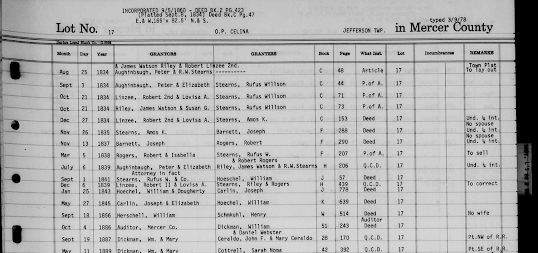
It was a very good practice that I had first become familiar with children and their spouses. After just a few minutes, on image 130 of 1112, I discovered the record at the top of the page. Look at the second from last entry above for Grantees Ceraldo, John F. & Mary Ceraldo.
John and Jane’s daughter, Mary Ann, has been elusive and here I found a deed record for her and her husband in 1887. I about jumped out of my chair!
All I knew of Mary was that she had married twice, to a James Furman in July 1875 and to John L. Ceraldo in April 1879, both in Mercer County, Indiana. I can’t find her in the 1860 or 1900 census. There is a child, Daniel, listed with the couple in 1870 US federal census, however, it must be from a previous relationship of John’s. That is the only record for the child I could find. No marriage record for a possible first wife. No burial records. Nada!
John Ceraldo was a naturalized citizen having been born in Mexico and serving in the cavalry for the Union during the Civil War. He could not read nor write so his name is spelled in multiple ways in the few records found. The couple eventually ended up in Michigan where Mary died in 1909. Sadly, John, the informant, knew John Duer was Mary’s father but did not mention Jane as her mother. The mother space is recorded as Unknown. Jane, having died in 1866, probably never met John but why didn’t Mary ever talk about her? This seemed to be a pattern with the younger children of John and Jane as James William and Angeline’s death certificates list an incorrect first name or record unknown. More Duer mysteries! Why was Jane forgotten by her youngest children?
What was so awesome about this find was that I wasn’t looking for it. I also was able to place the couple in Ohio as they had not yet relocated to Michigan. The gap between 1880 and 1900 is large so any find in that period is just wonderful. I also discovered they continued living in Jefferson Township, since at least 1870, and not Liberty Township where siblings had settled.
I don’t know the relationship of Daniel Webster, also listed as a Grantee, is to the couple. That’s another clue I have to pursue.
I’m looking forward to more Duer finds this year. Since my top 10 blogs from 2020 showed that my readers love the unexpected, I thought you might enjoy the following article in the Washington Post (3 Jan 2021) Near the End of life, my hospice patient had a ghostly visitor who altered his view of the world, by Scott Janssen, originally published in Pulse – Voices From the Heart of Medicine. If only John or Jane would give me a visit!