
Diversity in the Family Tree and Its Importance Today


Last month I took part in an activity at a workshop in New York City on Cultural Competence that’s been haunting me ever since. The presenter, Vivian V. Lee, Ed.D. from Johns Hopkins University provided an adapted handout from M. Loden & J. Rosner’s book, Workforce America (McGraw-Hill, 1991) that opened my eyes to my family’s core values in ways that I had never experienced before.
The worksheet consisted of a Diversity Wheel – a circle within a circle that listed 12 category descriptions of an individual, such as your level of education, geographic location and gender. Participants were asked to identify and record a word that described their personal category descriptions. For myself, it would be master’s degrees, USA, female.

Next, participants were asked to record the complete opposite of their personal description. So mine would be no degrees earned, anywhere but North America, male, etc. A few minutes was provided to reflect on the recorded responses by thinking about:

how would the opposite from yourself identity be perceived and treated by society and by the individual
how different would your present life be compared to that of the opposite individual
how would you adapt in society as the opposite individual
I was shocked to discover that my polar opposite in most categories would be my maternal grandfather, Ivan “John” Kos[s] and great grandfather, Josef Kos[s]. Although they both had the same surname, these men were distant relatives. Josef was my grandmother’s father and John was her husband of an arranged marriage. So, my grandmother’s maiden name was the same as her married name (now that’s convenient!). But back to the exercise…

Both John and Josef emigrated separately from then Austria-Hungary, now Croatia, to the U.S. for reasons that so many emigrants continue to come – economic opportunity, freedom, a new start. Manual laborers with little to no education, limited English and no citizenship rights, these men, along with others like them, were the backbone of the United States’ economy for generations as continue to be so today. I never met Josef who died young; he caught the flu and passed away in 1919. Of John, I never heard one complaint from him about his status in society. Even after residing here for over 60 years, though, he knew he continued to be identified by a slur – I heard a shopkeeper once call him a D.P., aka a displaced person. Although he took a citizenship oath, would never be fully accepted and remained subject to distrust by those who fate allowed to be born here. Although I’ve become the opposite of my grandparents, I know they would have been very proud of my children and my role in society. They would not begrudge that I am not treated as they had been.

I reaped the fruits of Josef and John’s difficult lives. If you take a moment to think about your own roots, you most likely have an immigrant story in your family. It may have been as long ago as 1600 or just in the last decade. Your ancestors may have come of their own volition or not. It matters not when or how they arrived. What matters is that the hardship they endured afforded you comfort and security that was lacking from their point of origin. Perhaps it’s due to my childhood interactions with and knowledge of my grandparents’ life experiences that make me thankful for their risk in immigrating and I will always have a place in my heart for those who are so courageous that they would begin again in a new land.

DNA and National Geographic, I Remember When…


Yesterday I received the March issue of National Geographic and as I unwrapped the cellophane, out fell an insert about their Geno 2.0 program. This got me thinking about how far DNA has come over the past few years.

Back in the day, I’m thinking circa 2006, a co-worker had used the Society’s DNA service. I don’t remember what the cost was but I remember thinking it was pricey for what she received, a slick brochure that gave her general information about her ethnicity. It told her she was of Greek heritage; since she lived in Tarpon Springs, Florida that was not an Ancestry.com trade in your lederhosen for a kilt revelation. I decided I’d wait until the results became more specific.

After reading the insert in the magazine, I figured the price still must be high as it was not provided, though a special $50.00 off discount was mentioned. Checking the Geno 2.0 Next Generation site, I found that the $199.95 regular price was on sale for $149.95. With the subscriber discount noted on the insert, the price would be $99.95. Guess they’re trying to be competitive with the rest of the market.

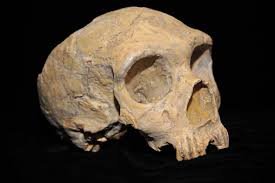
The results brochure looks quite similar to what my co-worker received over a decade ago. The biggest change appears to be identification of Neanderthal ancestry which my mother would have just relished. She always swore she had Neanderthal DNA long before science proved remnants remain. If she were alive today, this would have been an awesome birthday gift.

The other updates are vague; “improved ancestral results” and “ancestral calls” but it doesn’t say how the are improved and “more accurate regional ancestry” to include 60 reference populations.

What does make this offer unique is that you can also purchase a ball cap or t-shirt that provides further advertising for the project. Not that it would influence you to test with them, just sayin’.

Access to Preserved Records is Being Threatened!


There’s been a lot of discussion on several genealogical lists that I follow regarding proposed cutbacks that would greatly impact accessing records that are vital to anyone looking into their ancestor’s past.

I am advocating that records remain open and accessible. If you agree, than please read the following and take action:

A New U.S. Budget Blueprint May Affect Genealogists by Diane Haddad

Help Us Nip Efforts to Defund NEH in the Bud

I use newspapers found in Chronicles of America at least weekly. I have found so many genealogical gems in those old papers I couldn’t even begin to count! The NEH does a whole lot more – go to their home page and type in your state name in the search box on the top right. You’d be amazed at how many grants they’ve awarded for record preservation in your area.

Thank you, readers!

Privacy and the Genealogist – Part 2

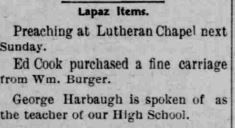
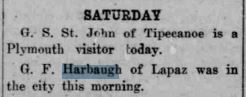
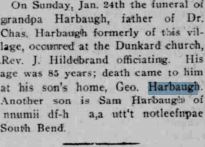
My last blog was about ways to find the living who might have the genealogical information you need without making them feel threatened that their privacy had been invaded. Today, I’m thinking about how much more private our lives are then in the past. Thomas MacEntee mentioned this, too, in an interactive webinar he recently did. If you don’t believe that, check out an old newspaper and you just might find something like this:

1

2

3

4

5

These are just a few of the times that George Harbaugh was noted in three local papers between 1900-1909. From the first notice we know that there were two individuals who were professors who traveled together to Missouri. Today, a notice like this would alert burglars and the professors might return home to find a break in had occurred.
The second item confirms that George was an educator. Did they send junk mail back in the day? He’s fortunate that there were no big box office supply stores sending him ads based on his job description.
Next item lets us know not only his residence but that he has a son with the same name and that they visited Plymouth, Indiana. Great information from a genealogical standpoint; we’ve got relationship confirmation! The fourth notice lets us know that George visited nearby Walkerton, Indiana on a Saturday. Together, both notices are kind of creepy. Can you imagine every time you leave your town that it would be published in your local newspaper?! Sure with public figures, every movement is tracked and reported today but George wasn’t famous. Looking at the other statements surrounding George’s show that this was common practice; we know that G.S. St. John of Tipecanoe also visited Plymouth and Ed Cook purchased from William Burger a “fine carriage.” Seriously, when you buy a new vehicle or a major appliance, we certainly wouldn’t expect it to be published in the newspaper.
Today, we continue the practice of placing family relationship information and residence locations in obituaries as item 5 did. We can connect George to his father and two of his brothers. Another clue to finding George’s whereabouts on a Sunday might be the Dunkard church as that’s where his father, grandpa Harbaugh, attended. Since grandpa lived with George more information about George might be found there. Again, nice for a genealogist and even nicer for a crook who knew the family wouldn’t have been home during church service. Don’t think they had robberies in those days? George’s aunt, Mary Ann Eyster Johnson, wrote in her diary on 10 April 1898 that “Today we found that the Meeting House had been robbed. Tablecloths, aprons, dishes, knives, and forks and baskets all gone. No clue to the robbery.”6 Interestingly, I never found the story of the church robbery in the newspaper.
Clearly, it was not just a slow news day but a standard practice to record the comings and goings of residents a century plus ago. Your personal whereabouts is fairly safe these days, although it can be gleaned from public records courtesy of your property appraiser. Don’t despair, so is your neighbors! The only difference between property records now and in the past is we can look the information up quickly using the internet instead of having to drive to the assessor’s office.
Although our privacy is more assured, future genealogists will not find the gems that we do in newspaper archives. All the more reason for you to start writing about yourself!

1 “Lapaz Items,” Marshall County [Indiana] Independent, 27 April 1900, p. 5, col. 5.
2 “Lapaz Items,” The Plymouth [Indiana] Tribune, 2 July 1903, p. 4, col. 4.
3 “Saturday,” The Plymouth [Indiana] Tribune, 1 September 1910, p. 5, col 2.
4 “Saturday,” The Weekly [Walkerton, Indiana] Republican, 14 March 1912, p. 2, col 3.
5 “Lapaz Items,” The Plymouth [Indiana] Tribune, 28 January 1909, p. 5, col. 6.
6 Mary Ann (Eyster) Johnson, “Diary,” 10 April 1898, n.p.; privately held by the Pine Creek Church of the Brethren, North Liberty, St. Joseph County, Indiana.

Privacy and the Genealogist Part 1


Have you ever Googled yourself? If not, take a moment and do so. If you have, then you know how much information about you is readily available at the click of a few keystrokes.
I understand why many people are greatly concerned that their personal information is “out there.” In the uncertainty of today’s world, we’ve all heard horror stories of identify theft and Craig’s list murders. It makes us more cautious and fearful.
Recently, I took an interactive webinar by Thomas MacEntee about finding living persons. Why would you want to find the living? It’s the best way to make contact with folks you are related to that may just have the information you are seeking. I though it very interesting and I totally agree with Thomas that using snail mail is the most effective way to make initial contact. People are more apt to respond to you if they have the time to process the contents. Additionally, the distance between you and them provides a sense of security. Think about it! If you telephone the individual you have caught them off guard and no one likes to feel that way. Emailing can work but may go to spam. I never tried texting someone I don’t know but if I received a text from a stranger I certainly wouldn’t respond.
When I write a letter to an individual I do not type it. I typically print as cursive can be difficult for older eyes (and though I haven’t written to anyone under 20, if I did they most likely wouldn’t be able to read it since it isn’t taught in school any longer.) Printing also sends the message that you took the time to be personal. I keep it short which is often difficult for me to do! In the first paragraph I introduce myself and explain my connection. The second paragraph explains what I’m seeking – a Bible record or a photograph, for example. The third paragraph gives ways to contact me that are more expedient than mail, such as my phone and email address. I also offer to pay for the cost of copying and mailing. I always end with “looking forward to hearing from you soon.”
Does this always work? No, but it might and has so give it a try! I’ve been successful in many cases. I can only think of once where I didn’t get a response and possibly, the individual did not have the information and being in his 90’s, was not able to let me know that. In two other situations I did make contact but the individuals were “too busy” to get the information to me. Both emailed me that they would but after a few reminders over the course of a year it didn’t occur. I haven’t given up hope yet as last fall, I connected with the son of one of my deceased’s mother’s friends. The friend had recently died and the son, while cleaning, found my name and contact information as I had sent a Christmas card 15 years ago right before she moved from our area. The son had newspaper clippings of my wedding and events my mom had attended with his mother. So you never know who has your personal information! In my next blog I’ll continue discussing privacy and share some examples of why I believe, like Thomas, that we have more privacy today than in the past.

Most Read Genealogy At Heart Blogs of 2016


With the New Year approaching I decided to look back on my blogs written during 2016. When I began blogging in 2015, it was with the intention of documenting my journey to become a Certified Genealogist. Although I submitted my portfolio in August, I won’t receive a response for several more months. Since I’m no longer “On the Clock” but still don’t have a decision regarding certification, I decided to continue my twice a week musings about new discoveries, trends and ideas. Here’s what my dear readers found most interesting – the top 10 most read articles of my 2016 posts:

1. Genealogy Gift Ideas
2. Family Tree Maker’s Fall Newsletter Makes Me Feel Vindicated?
3. Ancestry’s New Connection Ap
4. DNA Lab Analysis-The Accuracy is Questioned
5. Genealogy Catch Up – Using the Extra Hour of Day Light Savingsto Keep Organized
6. Watching the Waistline – Diets from my Family’s Past
7. A New Way to Identify Name Variations
8. TIE- Less Than 6 Degrees of Separation
8. TIE – Every Genealogical Record You Need is Online. I Beg to Differ!
10. Making the Most of Your Research – Part 8 – Last in a Series

Due to Christmas falling on my usual post day of Sunday I won’t be blogging again until the following week. Wishing you and your loved ones a wonderful holiday.

Blaming DNA

naturenurtureI blame my DNA a lot and I know I’m not alone.  Did you ever hear an older individual tell you as you were growing up that you were just like one of your relatives?  I had a teacher tell me I was like my Uncle George and I was perplexed.  How could I be like him?  I was a girl and he was an adult.  When I told my mom she laughed and replied that I liked to play with words like he did.  Uncle George had a nickname for everyone.  Barely five feet tall and needing to sit on a phone book to peer over the steering wheel, Uncle George called my grandmother “Cutlass Mary” as she was quite assertive in her driving.  She also just happened to drive a Cutlass.  Since I loved alliteration, rhyming and play on words I understood what my mom was saying.  I think that was the beginning of my blaming DNA for my personality.

As I began to delve into my family’s history I completely identified with relatives who had gotten into some serious trouble for their views.  Never one to take the path of least resistance, I have questioned authority for as long as I can remember.  In high school, my husband joked that must be my personal motto.  When I discovered I wasn’t the only one in my family with that trait, I also attributed it to my DNA.

I’m rethinking, though, the amount of influence my DNA has on me due to two events that happened within an hour of each other.  The first occurred while visiting a new dentist.  At this initial appointment, the dentist asked me what happened to my front teeth.  Although not very noticeable, I have some fracturing on the bottoms and a small indent on one of my top teeth.  Regarding my bottom teeth, I told the dentist, I had a playground accident as a child as my permanent teeth were erupting.  They just came up that way!  I told him we must have a genetic mutation of some type on my maternal line as every female has the same indent in the same place.  He laughed and asked if I did arts and crafts, sewing in particular.  Well, yes, I had even worked as a subcontractor with a costume design company in my younger years.  He asked if I used scissors or teeth to cut thread.  My goodness!  The realization that every woman in my family used their teeth to cut thread hit and all I could say was, “I’ve got to tell my daughter.”  So, the indent wasn’t due to DNA but to passing on a habit.  My daughter learned to sew from me as I learned from my mom and she from her mom and who knows how far back.  I recall my Great Grandmother had the same chip on the same tooth.  Who knew?!

After I left the dentist I stopped by a store as I was having one of my kid’s certificates framed.  As the clerk displayed the final product another customer asked me who was the recipient.  I told her and she said, “Wow, you must be proud.”  I am a proud Momma but I always strive to be a Momma who recognized both of my children’s accomplishments so I added an achievement recently made by the other child.  Her response surprised me; she said, “You must have good DNA.”

What does that mean – having “good DNA?”  I guess “bad DNA” would be a true mutation that resulted in a life threatening illness.  Yet mutations alone aren’t “bad,” such as adaptions to make one resistant to diseases. These thoughts quickly ran through my mind as I paid for the frame.

As I left, I turned to the customer and replied, “Naw, it’s not my DNA or my husband’s.  It was hard work, tenacity, and self discipline.”

As we delve into our family’s history, we need to be mindful of both nature and nurture.  We can blame or praise our ancestors’ influences on our lives, both genetically and observed, but the choices and decisions we make are our own.  Happy Hunting!

Obtaining US Ancestors Immigration Documentation – What You Need to Know

In May, I requested an index search request for $20.00 from the USCIS website.  I’ve always meant to do so but never got around to it.  I had read a blog on Judy Russell’s Legal Genealogist site that mentioned the price may be going up dramatically so I decided the time was now and quickly followed through with the request.

You must complete and index search request ($20.00) if you don’t know the Case ID number.  A Case ID number is needed to request Alien Registration Forms (AR-2) and Naturalization Certificates (C-File) which are an additional $20.00-35.00. I was requesting two index searches, one for each of my maternal grandparents.

In August, I received a letter in the US mail that provided me with a Case ID number for my grandmother.  The letter referred me to the Department of Homeland Security website so that I could obtain the AR-2 and C-File.  I tried to follow the directions but I was unable to gain access.  Frustrated, I decided to try from different computers as I wasn’t sure if cookie settings were the problem.  After making a number of attempts from my home’s laptop, desktop, Kindle, phone and my work computer I came to the conclusion it wasn’t me.

The only way to contact the agency is via email.  I was livid when I received a response stating they would respond by December.  Seriously?!

A survey popped up and I took the time to complete it;  I mentioned the poor customer service access, the long delay between the letter’s date (July 8) and receiving it (date stamped August 18), lack of a functional website and that my initial request was for two searches and I only had one returned. I also sent an email to the agency on August 22 because their phones don’t work.  Here’s the response:

“It is our goal to complete all requests within 90 days of receipt. 

Nevertheless, due to an increased volume of requests we are now answering:

  • Index Search Requests (Form G-1041) received in MARCH 2016.
  • Record Requests (Form G-1041A) received in FEBRUARY 2016. Please note that pending record requests submitted prior that date are waiting for files or privacy screenings.”

Clearly the response isn’t even accurate as I didn’t even request the documents until May and had half of my request returned in August.

The following day I received this email response:

“Your payment has been submitted to Pay.gov and the details are below. If you have any questions or you wish to cancel this payment, please contact the USCIS Genealogy Program at (866) 259-2349.”

I called the number but never could reach anyone.

I was pleasantly surprised to receive an email from James Igoe on October 3rd that attached my grandmother’s C-File.  I responded with a thank you and then asked for an update on where my grandfather’s file was.  Here’s the response I received on October 3rd:

“It is our goal to complete all requests within 90 days of receipt. 

Nevertheless, due to an increased volume of requests we are now answering:

  • Index Search Requests (Form G-1041) received in MARCH 2016.
  • Record Requests (Form G-1041A) received in FEBRUARY 2016. Please note that pending record requests submitted prior that date are waiting for files or privacy screenings.”

Sound familiar?!  Between August 22nd and October 3rd the agency had made NO progress with their backlog.

My advice, if you need to request records, is to do so with out delay cause it’s going to be a long, long time before you receive them.

The Adoption Trend

Originally published on genealogyatheart.blogspot.com on 25 Sep 2016

In the past six months I’ve been approached by two clients who had adoption inquiries.  I used to be contacted by folks who were adopted and were searching for their birth parents but lately, I’ve noticed a different trend.

The first individual discovered she was adopted while she was at college.  Her assigned roommate swore she knew someone back home that looked identical to her.  This was before Facebook and email so seeing a picture or contacting the “twin” had to wait. In the spring of her freshman year the client visited the roommate’s home and upon entering, roommate’s family remarked about the resemblance.  Unfortunately, the client wasn’t able to meet this “twin” because the “twin” was out of town as it was her spring break, too.  Everywhere the client went that week she encountered people who called her by the “twin’s” name.  Finally, someone showed her a picture and indeed, there was a striking resemblance.  A few weeks after the client returned to college she was contacted by the “twin’s” father.  He had heard of the client’s visit and wondered if perhaps, they were related.  The client called her parents who fessed up – she had been adopted and they knew who her parents were.  Yes, the “twin’s” father was her father, too.  When this client called me I thought she was interested in tracing her birth parents’ lines but she wasn’t.  Her adopted parents were an older couple who had recently died and she wanted to know about their families.  She felt that they had given her their family’s customs and norms and she was more a part of their lineage than her birth parents.  Shortly after working for this client an episode of Genealogy Roadshow aired and an adopted woman was to trying to verify a family story told to by her adopted parents.  As part of their family, she felt the story was a part of her history, too.

Last month,I was contacted by another individual who asked me to complete lineage paperwork for her sister.  I thought this was going to be fairly quick as the client’s mother had been a part of the organization.  When I mentioned I would need the birth certificate the client let me know that her “sister” had been adopted.  The organization that the ladies were interested in joining does not accept applications unless bloodline is proved. After explaining that I thought there might be a way around this dilemma.  Often children are adopted by other family members and if that was the case, proving kinship might still be viable.  Unfortunately, that wasn’t the situation.  The woman, who is in her 50’s, had discovered who her birth parents were and confirmed it through dna testing a few years ago.  I offered to research the birth parents but client and her sister weren’t interested.  They had been raised as siblings and if they couldn’t join as siblings they weren’t interested.

As our society evolves so does the concept of family.  My opinion is we are all related anyway.  If the inquiry is to learn more about customs and norms than I understand why there is an interest.  If the concern is medical, however, it may or may not be valid.  We’re all aware that lifestyle effects health but so does our genetic makeup.  My prediction is that genealogy software is going to  catch up to enable a connection between two sets of parents.