A Title Conferred – The Legend of the PL

Originally published on genealogyatheart.blogspot.com on 8 Jul 2015.

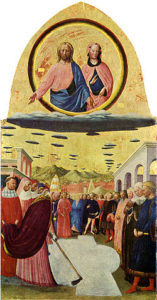
Every little girl wants to be a princess and I was no different.  My grandmother, Mary Violet Koss, loved to tell the story of how the family was awarded a title of PL by royalty back in the day. The details were sketchy of when the event occurred but the story and the privileges that were a result were a well remembered family legend.

Marauding bands of Turks had been seen throughout the land for some time. As peasant farmers, my family and others like them, were often the first to warn the community of the approaching men on horseback.  With a shout in the fields, tools were flung aside and a fast run to the castle for safety ensued. One day, however, not just a few men on horseback appeared but an entire army. Fighting from the castle became intense and many men had perished on both sides. It appeared that the castle would soon be overtaken and in despair, the women, among them my many times great grandmother, decided to take action.  Using the communal cooking pots, when a rolling boil was reached the vats’ contents of oil or water was poured down upon the enemy.  The fight was soon over as the invaders fled in retreat.

For valor, my grandmother’s husband was awarded the title of PL, an abbreviation of the word plemeniti which is Croatian for “noble.”  This permitted the family to have special privileges, such as hunting in the king’s forest, a lessening of the annual taxed amount and a voice in community affairs.

When did this occur?  Who was the King that granted the title?  Where was the castle located? How can I verify that my family really was awarded this honor? Non did not know but she knew that her father, Joseph Kos, was the last of the line to be able to reap the benefits of the title.  Joseph had been a leader in the Austria-Hungary Calvary when Non was a child and his position afforded the family a comfortable life.  Unfortunately, while holding his horse that was being re-shoed, the horse kicked Joseph in the chest which caused him to become an asthmatic.  He was released from his duties and with no prospects for another career, emigrated in 1910 to America.

As an adult, I wanted to dig further into the family lore and discover what event led to the title.  The only additional information I could recall was that as a practicing Roman Catholic, Non had said the Turks not only wanted more land but wanted to put an end to Catholicism.  Using religion as my first clue I began to investigate when the region became Catholic.

Although there is not agreement on when Croatia became Christianized, it most likely was over several centuries beginning in the 7th with the faith becoming firmly established by 925 when the ruler Tomislav aligned himself with Pope John X.1 Most of the titles Tomislav extended were to noncitizens so it is not probable that the PL title was conferred to my relatives by Tomislav.

Next I decided to research when the Ottoman invasion occurred.  After Coloman united Austria and Croatia in 1102 2, the Ottoman’s began to invade the area. History records that the Great Turkish War occurred between 1667-1698.  I suspect, if the PL designation occurred, it would have been between 1102 and 1698.

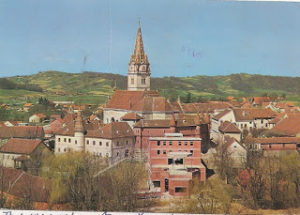
My family resided close to the present city of Zagreb; both of my grandparents being born in the tiny village of Dubranec.  In 1900, they were 2 of the 454 residents.3 Today, Dubranec is part of the city of Velika Gorica so I investigated battles that occurred nearby.  “In 1278 noblemen from Turopolje joined into a union called Plemenita opčina turopoljska (“Noble municipality of Turopolje”). Plemenita opčina turopoljska was granted a rule over Turopolje by Croatian monarchs and exists still today with mainly (a) ceremonial and not political role.  Regarding the Turopolje name, among the most common opinions is that the name, meaning “Tur field”, comes from an old Slavic word “tur” which means Aurochs, an ancient type of cattle with long horns, which was a symbol of fertility and the sun god. These cattle died out in the 16th century. The cattle were closely related to agriculture. Plowing had a symbolic meaning, the fertilization of Mother Earth, so these cattle were often assumed to have “sacred” characteristics. Because of its importance in the life of the plowmen, “tur” became the basis for numerous toponyms. However, as recently as the 16th century, Turopolje was called Campus Zagrebiensis, i.e. “Zagreb field”, or just Campus (field). At that time the name was replaced by “Tur field”, i.e. Turopolje”.4  Knowing my family were farmers this most likely was the event my Non described.

Investigating further, I found it was King Ladislas IV of Hungary and Croatia who confirmed “the ‘nobles of Turopolje’.  (They) originally were (but with no doubt at the time when their charter was issued in 1278, castle-warriors of Zagreb (iobagiones castri Zagra-biensis), i.e. they occupied – because of their military duties – the most honourable rank within the population of the castle, but they were definitely subjugated to the jurisdiction held by the comes of Zagreb.”5  I cannot find reference to an Ottoman invasion of Zagreb during this time, however, Osman I, who was the individual the Ottoman/Turkish empire was named for, did begin to expand settlements into the eastern Mediterranean and Balkans during this time.6

Interestingly, King Ladislas IV was more of a Pagan than a Roman Catholic so he may have more in common with the tur plowmen’s sun god and Mother Earth worship than just military exploits.

The only part of the story left to verify is whether my Kos line was one of the Turopoljes.  I was able to find that in the Armorial Book, Duis Dragon Hung, Kos was a name that was granted nobility status.7 That doesn’t necessarily mean that it was my line, however. Alas, even if I can confirm


1 Vladimir Posavec (March 1998).”Historical Maps and Borders in the Age of Tomislav. Radovi Zavoda za hrvatsku povijest (in Croatian) 30 (1): 281–290. ISSN 0353-295X. Retrieved 28 Jun 2015.

2 Ladislav Heka (October 2008). Croatian-Hungarian relations from the Middle Ages to the Compromise of 1868, with a special survey of the Slavonian issue. Scrinia Slavonica (in Croatian) (Hrvatski institut za povijest – Podružnica za povijest Slavonije, Srijema i Baranje) 8 (1): 152–173.ISSN 1332-4853  Retrieved 28 Jun 2015.

3“Google Translate.” Google Translate. N.p.,Web. 29 June 2015.

4“Velika Gorica.” Velika Gorica. N.p., Web. 29 June 2015.

5“Noble Communities in Spiš and Turopolje in the Thirteenth and Fourteenth Centuries.” Noble Communities in Spiš and Turopolje in the Thirteenth and Fourteenth Centuries. p.224., n.d. Web. 29 June 2015

6 The Sultans: Osman Gazi. The Ottomans.org. Retrieved 13 December 2010.

7“Google Translate.” Google Translate. N.p., Web. 29 June 2015.

Curse of the Dance

Originally published on genealogyatheart.blogspot.com on 5 Jul 2015.

This month I’m fact checking my family legends in honor of my maternal grandmother, Mary Kos Koss’ 115th birthday on July 18th.  Non loved to tell stories but since she was somewhat dramatic, I wanted to discover the truths behind the legends.  Today’s family tale is rather ominous and as children, my cousins and I repeatedly were warned by older family members to guard against the curse that was placed on our family by a scorned woman.

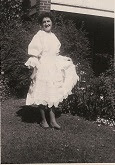
Long ago, one of our several times great grandmothers was young and beautiful.  Being fair of face, with sparkling blue eyes and blonde hair, she was nicknamed Blondie.  Her best feature, however, was her shapely legs that could dance the night away.  It was then the custom to wear long dresses but that didn’t stop Blondie from hiking up her dress as she danced the intricate steps of the kolo, a type of circle dance   A young man who was promised to another woman became smitten by Blondie’s dancing and soon broke off the relationship with his then girlfriend.  The relationship with Blondie intensified and the couple was married.  The entire village was invited to the wedding feast.   At the feast, the ex-girlfriend  announced to the villagers that Blondie had stolen her man and because of it, the exgirlfriend was cursing Blondie and all of her descendants to unbearable suffering of their legs.  Blondie did not believe in curses so she laughed at the woman and continued to celebrate her wedding.  Not long after, however, Blondie did experience pain in her legs and eventually became crippled.  The ex-girlfriend never married and lived to a ripe old age alone on the outskirts of the town.

As a child, I assumed that this story was just used to keep us in line when all 11 of us cousins got together and went running at breakneck speed through grandma’s house.  I figured it was a version of don’t run with a stick in your hand that most parents tell their children.  But as one family member after another sustained leg injuries over the years, myself included, I decided to delve a little deeper.

This is not a story that can be verified as certainly no records would exist that recorded these events.  I can confirm that my family loves dancing and are quite musically inclined.  The kolo is a Croatian folk dance.  “Many young men and women used this as an excuse for courting and teasing one another”1 so there most likely is some basis to the tale of a long ago grandma hiking up her dress at a gathering and gaining the eye of a suitor.

non
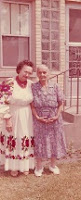
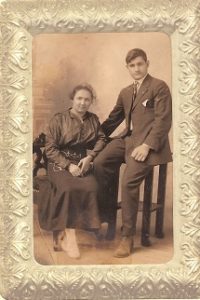
Grandma and Great Grandma Koss
mom
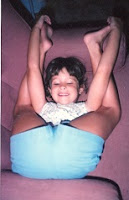
My Mom in a Blondie Pose

Here’s some pics of my own children – I just assumed it was normal to be this agile and flexible.

jon
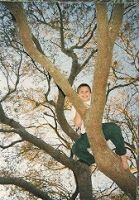
Still LIkes Rock Climbing
h
Has Moved on to Yoga

I can also give a long list of family members – actually everyone from my great grandparents on down to the present generation, that have been affected with serious issues with their legs and feet – including amputations, freak accidents while white water rafting, motorcycling, snowboarding, bicycling and horseback riding, lots of broken ankles, legs and hips from falling down stairs, bunions, arthritis and ingrown toe nails. I suspect Blondie became crippled from arthritis as that seems to effect most of the female family members.

I shared this story with my doctor daughter who laughed and said we should all just get tested for Ehlers-Dandlos Syndrome.  I had never heard of it but after looking up the symptoms, I’d say we all have a genetic predisposition to one of the many types of the syndrome – symptoms include overly flexible joints which do allow us to be good dancers and nimble athletes.  Our skin is rather stretchy and fragile, too.  Although we don’t have all of the symptoms I suspect this is the basis for our leg mishaps, coupled with some recklessness because when we’re young we think we’re invincible and when we’re older we forget our age.

feet
6 Years Old

Yes, my daughter’s feet are backwards – when she was young she could turn them around and stand and it freaked teacher’s out.  In the pic she’s pliaing with her feet backwards because she was into ballet at this time. Daughter thought it was comfortable.

So now I know we aren’t a family of klutzes!  Next time I trip I’ll blame


  1. “Croatian Dances” Wikipedia.Wikimedia Foundation, n.d. Web. 05 July 2015.
  2.     “Ehlers-Danlos Syndrome.” Symptoms. N.p., n.d. Web. 05 July 2015.
Verifying Family Legends – Where did we come from?

A FABULOUS FIND of 3 July 2015.

Originally published on genealogyatheart.blogspot.com on 2 Jul 2015.

Growing up, I would often ask my grandma to tell me stories about the Old Country.*  Immigrating to the US with her mother and brother a week before her 13th birthday, my Non preferred to tell the tales she had heard from her elders and not those that she recalled herself.  I’ve previously mentioned my own faulty memories so I wondered, as an adult, about the family lore and how much truth was contained in those stories.

When I asked Non where she came from she would always smile and say, “I was born in a little village outside of Zagreb in what was then Austria-Hungary but we came there from other places.”  Non would go on to say that our family moved about long ago from a land far away, an island south, and before that, a land far to the east.  She did not know the name or locations of these places nor the time period that the moves were made.  I would push for more; why did the family move to begin with?    Non said the first move was because of violence.  Due to some long ago forgotten period of unrest the family decided to move west.  They were farmers and they were looking for a safe place to raise their crops.  After traveling for a long time the family settled on an island somewhere but Non did not know where.  Why did they move from the island?  Non claimed that due to overpopulation and soil over use, farming was not as prosperous as it once was so the family moved on, searching for another location.  Ultimately, they settled in the Zagreb area with other families that chose to leave when they did.  The destination was almost heaven to them, clear springs, fertile soil, mountains for protection, and there the family remained for years.

I wanted to determine if the stories were true and if so, where the location of the island and the land to the east was might have been.  Several years ago I took an Ancestry DNA test with the results showing my maternal line belonged to Haplogroup H.  “The Colonists are believed to have arrived in Europe from western Asia about the same time as a culture known as Gravettian. For that reason, it’s probable that the Colonists adopted or even originated the Gravettian technology. “1

So Non was correct, the family had moved from the east.  A second cousin shared his maternal results with me that he had done by National Geographic.  The results confirmed that his mother and my Non, who were sisters, both tested as Haplogroup H and the movement is from east to west.  See his “Eve” line below:

But what about the island story?  National Geographic does mention “Haplogroup H is a great example of the effect that population dynamics such as bottleneck events, founder effects, genetic drift, and rapid population growth, have on the genetic diversity of resulting populations.”2  Although I can’t prove it, there is oddly a Kos Island in the Dodecanese chain of the Aegean Sea that perhaps was why my family became known as Kos’.  Kos as a name (Greek: Κῶς, genitive Κῶ)3  has been first documented in Plato’s Illiad.  In Croatian, it is known as a blackbird or crow and is the 45th most  common name in Croatia today.4  The travel route is in line with migration patterns and strangely, these locations are a “as the crow flies” since Kos Island is located in a straight line with Zagreb.

Moreover, the story of farming is further confirmed as historically, the Kos Island was known for its crops of grapes, almonds, figs, olives, wheat, corn and lettuce.5  My family loved grapes (and vino!) of which I still grow today and they continued to grow in their new home in Croatia.

With the premise that there is a basis in Non’s stories, I began to research migration pattern timelines to try to determine where my ancestors resided in the past.  My Aunt Anne Marie had sent my mom an undated clipping from the Zajednicar, a Croatian-American newspaper published by the Croatian Fraternal Union.  Entitled, The History of Croatia, Lodge 793 member Gordon J. Z. Bobesich wrote that “There is a theory that the name “Hrvati, which is what the Croats call themselves is Persian in origin.” Persia is known as Iran today and does show on the maps above as a possible place of origin.  Since the article was undated and I was unable to locate a citation online I decided to further search for more recent research of a Persian-Croatian connection.

I also decided to check out my maternal grandfather’s origin story.  Also surnamed Kos and a distant cousin of my grandmother, Non said Gramps’ people were of gypsy heritage.  Gramps was dark complected with brown hair and eyes.  Non was fair with blue eyes and lighter brown hair.

john-and-mary-kos
Ivan “John” and Mary Kos Engagement 1916

Gramps’ ancestors, “The Gypsies, or Romanies, are an ethnic group that arrived in Europe around the 14th century. Scholars argue about when and how they left India, but it is generally accepted that they did emigrate from northern India some time between the 6th and 11th centuries, then crossed the Middle East and came into Europe.” 6  

SPOLIER ALERT – I was unprepared for what I discovered.

On Non’s side, I first found the following, “Historical studies indicate that the Croats started migrating from the Iranian homeland to Croatia, Serbia and Bosnia about 3,000 years ago. However, a much larger migration took place about 1,700 years ago. Probably the reason behind this migration was the suppression of the followers of Manichean faith during the Sassanid era.”7  This not only supported the DNA evidence but also that the original reason to leave which was due to conflict.  Now I had a time period of about when the original migration occurred.  I then discovered that since the 4th Century BCE, a “presence of Iranian-speaking Iazyges8 resided along side the Greeks throughout the Aegean region.   This further confirmed the Kos Island connection.

Further research uncovered that although the Persia to the Dodecanese to the mainland of Croatia most likely was my maternal grandmother’s families’ route, others have a different take on who are the present day Slavs.

I learned that there are several theories as to how today’s Slavs originated.  Some believe that the Goths, as noble barbarians, were the original settlers to the region.  Others postulate that 5 brothers and 2 sisters of an upper-caste of the Avar-Bulgarians moved into the area.  The Slavic view believes groups belonging to the Illyrians, an Indo-European people who always resided in the Balkans, moved from southern Poland and northern Ukraine to settle.  At this point my research uncovered extremely racist posts which showed that the area’s tensions have not ceased since the last war.  How very sad, after all these years, that people cannot just get along and accept that we are all human.  Did anyone stop to think that all 4 emigration theories might be correct?  My grandmother’s most likely was the Persian theory and my grandfather’s ancestor’s migration as gypsies is not even considered as a theory, I suppose because after their near extermination during World War II, gypsy lineage is not what many Slavs wish to think about today.

I was so disturbed after reading the many racist posts that demonstrated a Superiority Complex disorder that I had difficulty sleeping.

I strongly believe the roots of racism is the need to feel more superior (upper-caste, noble) and to be first (always resided) which somehow relates to best.  I am deeply disappointed that these needs still exist.  I was sickened by the many posts of Croats, Serbs, Bosnians and Iranians who seem to think that they are genetically superior.  With the recent events in the US and throughout the world, that region is clearly not alone in its racist beliefs.  I simple can’t understand this mindset!

I am proud to be a mutt – yep, I am a mix of so many diverse ethnic groups who found love in someone different from themselves but realized that was what was important – not domination, hatred and narrow mindedness.

We all have prejudices, myself included, but we must work towards understanding and acceptance.

Dionne Warwick sang it best:   What the world needs now is love sweet love, / It’s the only thing that there’s just too little of. / What the world needs now is love sweet love, / No not just for some but for everyone.


1Ancestry.com Maternal Lineage Test Result

2National Geographic and IBM Maternal Lineage Test Results, p. 17.

3Liddell et al.A Greek–English Lexicons.v.

4“Croatian Names.” Croatian Genealogy & Family History. N.p., n.d. Web. 27 June 2015.

5 “Kos Island.” Wikipedia. Wikimedia Foundation, n.d. Web. 27 June 2015

 Kenrick, Donald (2007). Historical Dictionary of the Gypsies (Romanies) (2nd ed.). Scarecrow Press. p. xxxvii.

7 “Culture of Iran: Croatians and Cravats Are of Iranian Origin.” Culture of Iran: Croatians and Cravats Are of Iranian Origin. N.p., n.d. Web. 27 June 2015.

8Heršak, Emil; Nikšić, Boris (2007), “Hrvatska etnogeneza: pregled komponentnih etapa i interpretacija (s naglaskom na euroazijske/nomadske sadržaje)” [Croatian Ethnogenesis: A Review of Component Stages and Interpretations (with Emphasis on Eurasian/Nomadic Elements)]Migration and Ethnic Themes (in Croatian) 23 (3)
*Mary Violet Kos Koss, my maternal grandmother, would have been 115 years old on July 18th.  I’ll be spending the next few posts on my Croatian ancestors’ stories trying to confirm their accuracy and to learn more about the events that were remembered.

Faulty Memories

Originally published on genealogyatheart.blogspot.com on 28 Jun 2015.

I think it’s a miracle that there are any truths in family stories that are passed down considering how the passage of time and personal perceptions can lead to faulty memories.  I have just discovered two faulty memories in my own life.

If you are a Baby Boomer or older you may remember where you were the day of John F. Kennedy’s assassination. I would have sworn on a stack of Bibles that I was in Sr. Martina’s first grade classroom at St. Mark’s Catholic School.  It was morning, before our 10:00 AM recess, and my reading group was working away quietly doing our seat work while another group was sitting in a circle doing oral reading in the front of the room.  I recall the principal, Sr. Jerome,  opening the classroom door and sticking her head inside.  She looked distraught with an expression I had never seen her display before. I knew something was wrong and one of my classmates shouted out, “Sister” which caused our teacher to look up from the reading group and notice the principal.  Our teacher went to the door and a whispered exchange occurred.  The principal left and our teacher sat at her desk with her head hanging down.  We looked around at each other but no one dared speak.  Sr Martina then told the students in reading circle to return to their seats.  When they had, she explained that she had terrible news to tell us, someone had just shot the president.  She asked that we say a silent prayer for his recovery.

After a few minutes she called my reading group to the circle.  There were only 3 of us in our group as we had started school already reading – Laura Atzhorn, Dennis Barunica and me.  We had just sat down when the principal came on the overhead speaker telling us that parents would be arriving soon as school was being dismissed for the day.

I remember being very happy that school was being cancelled as I really didn’t like it very much but I was also confused as to why this was happening, I didn’t connect the shooting with school closure. Within minutes my mom arrived to pick me up.  I was so glad to see her I ran to the door to tell her that the president had been hurt.  I didn’t say a word once I saw the look on her face.  I could tell she had been crying.  My mom was not a crier so this startled me.  I got my coat and book bag from the cloak room and was quickly on my way home.  On the way I asked my mom why she had been crying.  She told me the president had been shot and was not expected to live.  When we arrived home my grandparents and great grandma were watching TV, which was unusual during the daytime. No one spoke.  I went to my room to change out of my uniform.

I would swear by this memory but the problem is, I wasn’t in first grade when President Kennedy was shot.  I was in 2nd grade.  My husband thought he was in 2nd grade and his memory would jive with mine since he is a year older than me.  So both of our memories are wrong.

How we discovered our faulty memories is because he remembers the teacher he had and how she had informed the class.  In looking at old photos, I discovered his 2nd grade teacher was really his 3rd grade teacher.  If he was in 3rd, then I had to be in 2nd grade.  Checking the year President Kennedy was shot confirms that I was in 2nd grade.  My 2nd grade teacher, though, was not Sr. Martina, it was Sr. Michelle.  Why would I confuse the two as one was very old and the other, very young?  The only thing I can think of is that Sr. Martina served as a substitute teacher the day the president was killed. Sr. Michelle was absent alot and we had Sr. Martina in her absence as Sr. Martina retired after my first grade year. No way I can confirm my explanation for my memory lapse, though. 

The time I thought the event occurred is also off.  My cousins and I would walk home together at noon for a 30 minute lunch period.  President Kennedy was shot at 12:30 PM in Dallas which would be the same time in northern Indiana, the Central Time Zone.  So this event did not occur before recess as I had thought but after I had returned to school after lunch. Now I’m not even sure that I was in reading group because reading was always in the morning.  Perhaps it was math, instead but I don’t ever recall going to the front of the room to work in math groups. 

It’s understandable that you may not remember an event correctly from when you were 7 years old but my next faulty memory is from my late teen years.  I would swear that my husband, then my boyfriend, barely missed being called up to serve in the Viet Nam War.  Turns out, that’s not right, either.

The last draft lottery was held in February 1972.  The draft ended in July 1973 but no lottery was held for men born after 1953. This means my husband never had a draft lottery number because the lottery was based on your birthdate and he was born after 1953.  Our faulty memories must be based on remembering the number that was assigned to his birthdate in 1972 even though it didn’t affect him. We have spent our entire adult lives thinking he was close to being called for service and that was never the case.  Wow, now I’m rethinking everything I think I remember!

Since these two memory lapses I decided to take a look at my family’s legends to see how accurate those stories are.  I’ll be sharing what I discover.

Planes, Trains, Automobiles & Barges, Oh My!Planes, Trains, Automobiles & Barges, Oh My!

Originally published on genealogyatheart.blogspot.com on 26 Jun 2015.

As you read this I am somewhere along I-77 on my 2nd driving trip from West Virginia to Florida in the past 2 weeks.  The 18 hours, nearly 1000 miles, distance is my last planned journey between these destinations and I can’t express how grateful I am to be through with this move.

My 3x great grandfather, Jean “John” Leininger, from Endenhoffr, Mietesheim, West Bas Rhin, Alsace, France (but sometimes Germany!) emigrated with his family in 1827 on the Canaris, a ship leaving Le Havre, France with an arrival in New York City on 30 Jun 1827. “According to an old note, they went ‘by rail’ to Buffalo, New York.  From there they went by canal to Canton, or Stark Co., Ohio.” 1

The family’s choice of transportation was the quickest for the time period. Since the rails ended in Buffalo, canal travel was faster than overland by horse and wagon.  I think about my great grandmother, Marie Margueritte, with two small children on this journey.  No airport playrooms, electronic games, readily available food or bathroom facilities.  Makes me rethink complaining about the traffic slow down around Charlotte on my journey!

My husband’s 2x great grandmother, Drusilla Williams DeWolf Thompson relocated to Chicago from Troy, New York in the 1850’s.  We’ve never been able to identify the exact year she moved.  We know her son, John Calvin DeWolf. was born in Albany, New York in May 1851. First husband, Calvin DeWolf, died of consumption in May 1852 but there is not agreement on whether Calvin died in New York (from the family Bible written years after his death) or in Rock Island, Illinois (Illinois death information found online).  Grandma Dru (my nickname for her) remarried widower Thomas Coke Thompson in Chicago (per family Bible record) in 1857 so we know that Dru relocated to Illinois within a 5 year time period.  How did she get there?  Family legend says it was by covered wagon but I find no proof of that.  It is more likely that Dru traveled via the then modern convenience of railways.  By 1854, Orphan Trains were shipping children from New York to the Midwest as train travel became more commonplace.2   In 1850, Chicago was a city of 30,000 served by one rail line, the Galena & Chicago Union Railroad.  By 1852, Chicago had 5 rail lines and by 1856, 10.3  The 1855 population in Chicago rose to 83500. 4

In 1851, the Hudson River Railroad connected Rensselaer with New York City.5

c.1855 Map of New York & Erie Rail Road and Its Connections6

In 1854, the cost of the fare from New York to Chicago was $26.00.7  In today’s dollars, the cost would be about $628.57!  The trip took about 42 hours, as the time from New York to St. Louis was 48 hours. It was not a restful experience, either.  Although sleeping cars were first included on the New York & Erie run in 1843, the heavy weight made them unfeasible so the concept was ended until George Pullman re-engineered the design in 1864. 

I definitely prefer a 3 hour plane ride or even an 18 hour car commute


Leininger, Robert LeRoy. First Annual Supplement to the Leininger Family History and Genealogy. Columbia City: Self Published, 1974. 36. Print.

“Orphans in Orphan Asylums New York.” Orphans in Orphan Asylums New York. N.p., n.d. Web. 14 June 2015.

Harold M. Mayer & Richard C. Wade, Chicago: Growth of a Metropolis (Chicago: University of Chicago Press, 1969), 35. 

Fourth Annual Review of the Commerce, Manufactures, and the Public and Private Improvements of Chicago, for the year 1855, with a full statement of her system of railroads: and a general synopsis of the business of the city, Copied from several articles published in the Daily Democratic Press (Chicago: Democratic Press Steam Printing House, 1856.), 49. [Hereinafter referred to as Annual Review for 1855.] 

5Wikipedia. Wikimedia Foundation, n.d. Web. 14 June 2015. 

http://en.wikipedia.org/wiki/New_York_Central_Railroad

“The Railway Conductor.” Google Books. N.p., n.d. Web. 14 June 2015.

“Michigan Historical Collections.” Google Books. N.p., n.d. Web. 14 June 2015.

Ibid

“Trains Across the Continent.” Google Books. N.p., n.d. Web. 14 June 2015.

Dad’s Day

Originally published on genealogyatheart.blogspot.com on 21 Jun 2015.

Happy Father’s Day!  Whenever I think of Father’s Day I think about my grandfather, Ivan “John” Koss.

Gramps and Me

I met my husband a year and a half after my Gramps had died.  That saddens me as I think they would have really liked knowing each other.  Both of them, I would rate, as exceptional dads. Selfless, compassionate, funny and responsible both shared a love of music, food and hard work.

My Gramps was extremely thrifty, perhaps because he was an immigrant who had weathered the Great Depression.  My first bike was a many time hand-me-down from my older cousins but he wanted to make it like new for me.  He spray painted it green, my then favorite color.

I was the 5th in the family to use this bike

My parents were divorced and we didn’t have a lot of money so when bikes evolved, Gramps updated the one above with a banana seat and cruise handlebars.  I thought I was so cool!

Gramps put up with my love of animals and never complained.  I can’t explain how strays always happened to find me: 

If we couldn’t locate the owner the animal had a very nice life in our home.  I’m not talking about just cats and dogs.  He let me keep a chicken, parakeet, frogs and a snake.  He even let the snake hibernate in the basement in an aquarium.  We let it go after the winter thaw.

Gramps was inventive.  The man loved tools and could fix anything. He took an old vacuum cleaner and turned it into a handheld model to use to clean the carpeting on the stairs.  I wish we still had it as it worked better than anything on the market today.  He let me mess around with his tools and play store.

During the months when the ice cream shop was open, Gramps would take me for a Black Cow – a root beer float, every Friday.  When I was really small he’d have to pick me up to put me on the stool and I remember how proud I was when I could climb up on my own.

Gramps had a wooden leg due to a steel mill accident.  I don’t know how he climbed a ladder to paint the eaves as the house was 2 stories!  He never let his handicap get in the way of dancing which he was quite good at.  Gramps was also nearly blind.  He had cataracts that were inoperable for some reason and yet, he never complained.

Each Father’s Day I bought the same gift for Gramps – a can of Skoal.  I always used my allowance to make the purchase at Dickenson’s Drug Store.  Gramps would say it was the best gift he ever got.

Gramps passed away 45 years ago but the lessons he taught me are with me still.

Dad’s and Grand Dad’s make a tremendous impression on youth.  Today, Dad’s get beat up in the media as the butt of jokes.  If you are lucky to have a wonderful father figure in your life make sure he’s appreciated or remembered-he deserves it!

Moving Day

Originally published on genealogyatheart.blogspot.com on 18 Jun 2015.

My grandparents were able to blend their youthfully acquired Croatian culture with that of American (as in United States) society easily, or at least they made it seem easy.  I never thought much, while growing up, how difficult it had been for them to immigrate, as it must have been for all my other gateway ancestors, especially for those who did not speak English as a first language. I started thinking about these moves after recently helping my daughter relocate from West Virginia to Florida. For our daughter’s move, we rented a truck, hired 2 college kids to help load it, drove it 18 hours using gps and unloaded it with help from family. Not a fun drive but it was the cost effective.  Total time involved:  2 days.

Granted, as much as it is a pain to move today it’s certainly far easier than back in the day of our forefathers and mothers.

I wished I had asked my grandparents details about their move to the U.S.  Sadly, there is no living relative that would have that information as everyone in their generation and their children’s generation are all deceased.  I have several cousins and second cousins but I was the closest to my grandparents since I lived with them during my childhood and am the keeper of the family stories and records.  None of my cousins have any idea about the family’s migration.  All I know is that my grandmother emigrated with her younger brother, Joseph, and her mother, Anna, as her father, Joseph Sr. had come earlier to set up the household.  I would love to hear how the family traveled from a rural area outside of Zagreb, then in Austria-Hungary, to a port in Hamburg, Germany about 800 miles away. Sailing on the President Lincoln, the family arrived in New York where they were met by my great grandfather.  My grandmother had told me they stayed the night in a hotel in New York City but I have no idea its name or location.  The family went window shopping and my great grandmother fell in love with a lamp in a department store window.  My great grandfather told her it was too delicate to survive the trip but he would purchase one for her when they arrived in Chicago.  He kept his word and I have the lamp, it was passed from mother to daughter to grand daughter to great grand daughter and it will soon be given to 2nd great grand daughter. (Personally, I think it was first seen in Macy’s window as it was purchased from Marshall Fields which carried similar merchandise.  Makes me laugh thinking of my great grandma in her babushka being a Macy’s shopper in her youth!) Nothing from the Old Country, though, has been preserved so the only belongings brought over must have been clothing.  Being a family of pack rats, if any heirlooms had been transported they would have been cherished and displayed. Talk about a Fresh Start!

My husband’s family has been in the states for much longer than mine so it’s not surprising that there are no stories remembering his ancestors journeys.

His great grandfather, Anders Gustaf “Gust” Jonasson emigrated in 1882 from Byarum, Sweden with his wife Thilda “Anna Matilda” and 6 children.  The 8 of them packed all of their belongings into 3 trunks.  The largest is shown below:

The other 2 trunks, about the size of today’s carry on bag, are in my sister-in-laws possession.  The trunks were stored in my in-laws basement in Miller, Indiana until the late 1970’s.  I had grand plans to restore the large one (the white area is where I started to clean the rust) but I never finished.  It’s still on my to-do list.

Now on the one hand, moving with so little is not such a bad thing.  Not a lot of time was involved in packing, transporting and unpacking.  Leaving behind cherished possessions along with family and friends, however, is a difficult concept for me to wrap my head around.  I’m so glad I don’t have to make that kind of move!

Flag Day -The Most Under Celebrated U.S. Holiday

Originally published on genealogyatheart.blogspot.com on 14 Jun 2015

My immigrant grandparents, John and Mary Koss, are the only people I have ever known that celebrated Flag Day.  As a child, I remember my Gramps assembling the flag kit and proudly placing it in our front yard, which faced Route 6 in Gary, Indiana, on every patriotic holiday.

The pic above is taken from an old 35mm film that my husband had converted to DVD.  I’m on the left in my tennis outfit.  I never did learn to play tennis well but I definitely kept the custom of celebrating Flag Day.

We’d cook hotdogs on a small portable grill, accompanied by my grandmother’s Croatian style potato salad (which is sort of like German potato salad using oil and vinegar instead of a mayonnaise base but it’s served hot).   My mom would bake a cake, frost it with white icing and decorate with blueberries and strawberries for the stripes and banana slices dipped in lemon for the stars.

I can’t decide why Flag Day is so under celebrated.  Maybe it’s because it falls right after school has ended and people are on vacation.  Or maybe because it’s sandwiched in between Memorial Day and Independence Day.  Perhaps it’s because Father’s Day is right around the corner.  My best guess is because Flag Day is not an official federal holiday.  Although Woodrow Wilson proclaimed Flag Day in 1916, Congress didn’t approve it until 1949. Seriously, it took 33 years to approve this holiday.

I am going to continue to celebrate the day and our symbol of freedom. Here’s a few links about our flag and the interesting genealogy of the people who are part of its history:

The Legend of Betsy Ross

The Star Spangle Banner and Mary Young Pickersgill 

Driver’s Old Glory

For my readers in countries other than the U.S. – I challenge you to proudly wave your country’s flag today and think about the values it represents.  Happy Flag Day!

Circular Migration Patterns-How History Repeats Itself


Originally published on genealogyatheart.blogspot.com on 30 May 2015.

My family does not stay in one place for long which makes tracing them a challenge.  As I mentioned in my last blog, my husband and my family also tends to migrate in circles.  -I’m still in Harbaugh Country but I’m thinking about the odd way I discovered this phenomena with my Duer family.

I had traced my paternal grandmother’s line back to a Maria Dure with the help of some distant cousins in the late 1990’s but I hit a brick wall with Maria and was unable to discover who her parents were.  My cousins said she was German which made sense as Maria married Henry John Kuhn Jr. who was born in Germany 3 Dec 1831.1  I tried to obtain a death certificate, probate records, cemetery records, and obituary for Maria hoping that a clue would be uncovered as to her parentage but nothing was available electronically.  Then, online trees started showing Maria as the daughter of a John Duer and Mary Cook in Mahoning, Ohio.  I wasn’t sure if my Maria was John and Mary’s daughter so in April 2010 I emailed a “cousin,” Edward Duer Whitley, about a posting I had found on Genforum.  Ed informed me that I had spelled Maria’s last name wrong – reversing the last two letters (Dure should be Duer).  He mentioned that he had been searching for Maria’s line for years as he had updated all of her siblings but had been unable to trace her. That was because Maria and her spouse had relocated to Mercer County, Ohio.  Ed gave me his electronic tree going back to Robert Dure (1563-1617) who spelled his name the way I had spelled Maria’s.  I don’t know why I had the original and not the most recent spelling. Perhaps Maria’s children had remembered the original name and that was what was passed down my line.  Some mysteries we will never solve!  Ed and I had only corresponded for a few weeks when I lost contact with him.  I never discovered what happened and assumed he died as he was 93 years old.  I know in genealogy we shouldn’t assume anything but he was up there in years, and then just disappeared.  Since Ed had not made his tree public, it was fortunate that I had contacted him when I did or his years of work may have been lost. (My next blog will be about disappearing data!)  I have entered all the information Ed shared with me on my public Main Tree on Ancestry.  What was truly odd, though, was the timing of this find.

Maria’s great great grandfather, Thomas Stone Duer, was christened 29 Sep 1663 in Charleton, Devonshire, England.2 He emigrated with his maternal Uncle George Stone to Philadelphia in 1683.3  Thank goodness he was a Quaker so there’s wonderful records of Thomas and his wife, Elinor “Ellen” Beans (Bayne/ Bane) but I will save Ellen’s story for another day.

Thomas and Ellen had a son, Thomas, born 7 Mar 1702 in Falls, Buck, Pennsylvania.4 From the Duer Bible, Thomas married in 1729 but the Bible does not list his wife’s name.5 Ed discovered she was Mary Ann Hollinshead, born 11 May 1712 in St. Michaels, Bridgetown, Barbados, West Indies, the daughter of Daniel and Ann Alexander Hollingshead.  Ann died in Feb 1715 in Barbados.6 Why was the family in the West Indies?  Daniel was in Barbados as an indentured servant.7  After Ann’s death, he remarried, completed the terms of his servitude, and moved with his family to New Jersey where he died in 1730.8

Why move to New Jersey?  That I haven’t yet proven but I do know that while in New Jersey a strange family event occurred.  “Daniel Hollinshead was born in Leicestershire, England in 1683. He was one of several brothers, one of whom was Captain under the Duke of Marlborough and was killed at the Battle of Blenheim. One of his brothers was a merchant in Boston, of him, he used to relate the following incident: While riding along the road at a distance from home, he overtook a person traveling the same way: They entered into conversation and after some time discovered that to their great joy, they were brothers. They had not seen each other since childhood. This brother had been shipwrecked on his passage from London to Boston and had lost the whole of his fortune. He went with his brother to his home in New Jersey where he then lived, obtained a public office, and died in Sussex County in 17–.”9

To sum up, Daniel Hollin(g)shead moved from his birthplace of Leicestershire, England to Barbados, West Indies as an indentured servant and then to Sussex, New Jersey where he died.  He met his long lost brother who traveled from England to Boston, after being shipwrecked somewhere, and then on to Sussex, New Jersey.  

Yes, this is a weird chance meeting but what I find odder is my own child’s migration route 300 years later.  

My oldest left Florida to attend the Massachusetts Institute of Technology in Boston.  During a January term, she visited friends in England who were attending Cambridge University and there she finalized her decision of where she wanted to attend medical school.  Upon her graduation from MIT, our daughter moved to Grenada, West Indies.  Why?  As an International Baccalaureate graduate she insisted she wanted an international medical school experience.  The medical school, St. Georges, is based on Long Island, New York.  As I’ve noted in my previous posts, the early founding families of Long Island were my husband’s lines, along with his family connections with the Caribbean and the Dutch West Indies Company (see Motherhood and the Brain blog 10 May 2015).  Our daughter did not choose the school based on previous family connections to the area, rather her decision was based on its strong international curriculum.  St. George’s students spend the first two years in Grenada, West Indies and the last two years either in the US or England. She selected her last two years to be in Morristown, New Jersey. We have no relatives in New Jersey so why pick Morristown?  At the time of her decision we didn’t even know where Morristown was located in New Jersey.  She said she was drawn to it after speaking with fellow students who knew the area.    

Even stranger, at the time of her decision I made the comment to a coworker in Florida that our daughter was relocating to New Jersey.  Turns out, he happened to have been the former principal of Morristown High School.  Truly, it’s a small world after all!

But before continuing on, let’s review my family’s migration patterns:  We know our daughter was not the first in the family to move from Boston and the West Indies to New Jersey.  If you take into consideration her student loans, she’s not even the first indentured servant in the family.  But moving to Sussex, New Jersey is not the same as moving to Morristown, New Jersey.  Well, the family travels will take another twist!

Thomas and Mary Ann Hollingshead Duer had a son, John, who married Susannah Miller in Sussex, New Jersey in 1773.10  After Thomas served in the New Jersey Militia during the American Revolution, he and Susannah relocated to, you guessed it, Hanover Township, Morris County, New Jersey.11 Thomas and Susannah are my daughter’s 5 great grandparents.  We did not know this relationship until a year after she was residing in an apartment that was built on the former site of the military encampment where her 5th great grandfather was housed during the American Revolution.  Our daughter is a DAR but not through this line which we had not


1United States of America, Bureau of the Census. Twelfth Census of the United States, 1900. Washington, D.C.: National Archives and Records Administration, 1900. T623, 1854 rolls.

2Edmund West, comp.. Family Data Collection – Births [database on-line]. Provo, UT, USA: Ancestry.com Operations Inc, 2001

3Filby, P. William, ed. Passenger and Immigration Lists Index, 1500s-1900s. Farmington Hills, MI, USA: Gale Research, 2012.

4Hinshaw, William Wade. Marshall, Thomas Worth, comp. Encyclopedia of American Quaker Genealogy. Supplement to Volume 1. Washington, D.C.: n.p. 1948.

5Editor. Literary Era, Vol. III, 1896, Philadelphia, Pennsylvania Repository:  486-7, Print.

6Sanders, Joanne McRee. English Settlers in Barbados, 1637-1800. S.l.: Brøderbund, 1999. Print.

7England, Terri. Indentured Servants on Barbados Bristol Servants: A-F. N.p.: n.p., 2002. Print.

8Edmund West, comp.. Family Data Collection – Deaths [database on-line]. Provo, UT, USA: Ancestry.com Operations Inc, 2001.

9“The Hollinsheads.” Our Ancestors, A Genealogical & Biographical Magazine, 2.2 (1882): n. pag. Print.

10The Henry B. Baldwin Genealogical Records.” Publication: File OR919.3B193r, (26 Jun 2010): Public Library of Youngstown and Mahoning County, Ohio.

11Jackson, Ronald V., Accelerated Indexing Systems, comp.. New Jersey Census, 1643-1890. Compiled and digitized by Mr. Jackson and AIS from microfilmed schedules of the U.S. Federal Decennial Census, territorial/state censuses, and/or census substitutes.

Memorial Day Memories

Originally published on genealogyatheart.blogspot.com on 24 May 2015.

Most holidays start with Happy – Think Easter, Thanksgiving, and New Year. So every year, when I hear about the upcoming “holiday” sales in honor of Memorial Day, I cringe.  I don’t consider Memorial Day a holiday.  Yes, it’s a 3 day weekend.  Yes, school is almost over for the year.  Yes, it’s even a time to spend with family and friends but it is not a holiday.  On Memorial Day I believe we should all honor those that came before us allowing us the freedom we have today.

I will not be visiting graves this weekend as all of my family is buried far away from where I reside.  That doesn’t mean I won’t be thinking of the sacrifices of my forefathers and my memories of past Memorial Days.

As a child, my grandmother, Non, always took me with her to tend to the graves of her father and uncle.  As a first generation American, she had no fallen soldier graves to care for in this country but I remember the cemetery filled with small flags to honor American veterans.  Non was lucky her Sonny, my Uncle George, had made it home safely after serving in the Coast Guard during World War II.  

George and Betty Mione Kos

As Non and my mother pulled weeds and clipped grass growing around the stones, I would read the inscriptions if I could, because my multicultural neighborhood had many markers engraved in languages other than English.  Although I could not read the Polish, Lithuanian, Greek, Italian and like my Great Grandfather’s memorial, Croatian, I knew that the men buried there had shared a common experience in a war.  The back of the cemetery held the graves of World War I veterans, the middle section seemed to be for those killed in World War II and in the front, Korean and Vietnam veterans.  Too many lives cut short too soon. 

I am also fortunate to have my father’s diary from World War II while he was stationed in Alaska.  

Orlo Guy Leininger

His war time experiences were very different from my husband’s uncle.  With a German surname, my father was not sent to Europe but to the Pacific theatre instead.  My dad’s sister, Mary Ellen Leininger Tronolone, enlisted as a Yeoman, First Class, in the Navy.  Most of her service was in Washington, DC.

Mary Ellen Leininger Tronolone

Having known most of these family members I am proud of their bravery and thankful for their service.  You can read more memories of soldiers by visiting a Crestleaf blog, Real Letters of Love, Hope & Inspiration Written by Soldiers – A Memorial Day Tribute