Saturday Morning Confusion and Insights

It’s been an interesting day in the Samuelson household which is the reason my blog is late. I don’t know about you but since we’ve been sheltering-in-place, we’ve had way too many broken devices.  The odd thing is that most were under warranty and when those were being “serviced,” it resulted in another breakage. First it was the hot tub, then it was the refrigerator, and now it’s a yard that is a total disaster.

Before the world came to a stop, hubby and I had discussed having a well put in so that our garden could be watered more frequently in the dry season then our city permits.  I had contacted a company who said they would be out the following week which turned out to be 6 weeks later.  Now this wasn’t the fault of the company; in our area there are various environmental permits that must be acquired and the company couldn’t comply with the laws because none of the other organizations were opened.  Finally, the permits were obtained and the well was supposed to be drilled yesterday.

My husband told the two service men to be careful because he thought there was buried cables where they planned to dig.  I then showed them a photo from the last time we had the underground cable locators out showing exactly where the buried lines were.  Did these two guys listen?  Since you already know the answer, I’ll just continue…

Hubby was on a work related Zoom meeting and I was researching on FindMyPast when the internet connection was lost.  We went outside and there were these two young men looking sullenly down at the broken cables.  They had also cut the sprinkler line.  

Thank goodness we were able to have the line restored this morning but then there was the matter of who was paying for the charge.  The owner of the well company said he would take care of it but the connection wasn’t a simple one and now someone else is going to have to come out to bury cable and get it under our driveway.  And dig up the whole front of our yard to bury the new line.

In the meantime, while the well company was trying to fix the broken sprinkler line, a torrential downpour occurred.  They left in a hurry with the job undone.  Hubby, who had been trying to help them, came in drenched and cold.  I ordered him to the shower and that’s when we realized they had the water turned off.  So, out we go in the downpour to turn the water back on.  Then we noticed that something was amiss – we just didn’t have the pressure we had previously had.  After the storm subsided we went back outside and discovered the company had left the sprinkler on and it had been coming out full force for two hours.  This resulted in flooding on that side of the house.  Yeah, it’s been a day!  But we do have internet!!!

So, being homebound with no access to the outside world I decided I would catch up on my reading.  I am happy to report I’ve read my back issues of Smithsonian, National Geo, AAA and various journals.  My favorite, though, was the winter issue of American Ancestors.  The entire magazine is devoted to the 400th anniversary of the Mayflower.  Even if you aren’t a Mayflower descendant, this is a must read.

My favorite articles were “We are still here,” a Wampanoag perspective, “Keeping Tradition Alive, A Portrayal of Wampanoag Life,” “New Discoveries in Mayflower Genealogy Uncovering Connections through DNA,” “Finding Unexpected Mayflower Kinships,” and “Ideas for Future Mayflower Research.”

The last three articles provide hints for anyone who is trying to locate records from the time period, even if you don’t have a Mayflower connection.  Checking manorial records, registers, and recusancy (a record of nonconformists who refused to attend Church of England services) are excellent sources to use to hunt down your elusive ancestors. I had used the recusancy records years ago when researching some of my Quaker ancestors but had forgotten about that tool.  I plan to check it out again as I search for one of my Hollingshead family members who had left merry ole England for New Jersey by way of Barbados.

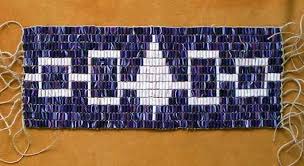
The first two articles, from a Native American perspective, were clearly the best of the bunch.  I learned so much and what sticks in my mind most is the original reason for wampum belts.  If you thought, as I had, they were currency, well, you just have to read the article.  I was blown away by truth.  (Hint:  read page 27!)  I was aware of Native American’s culture that honors the elderly and ancestors but I had no idea the artistry in the remembrances that was involved.  The deep symbolism in a wampum belt will remain with me forever.  

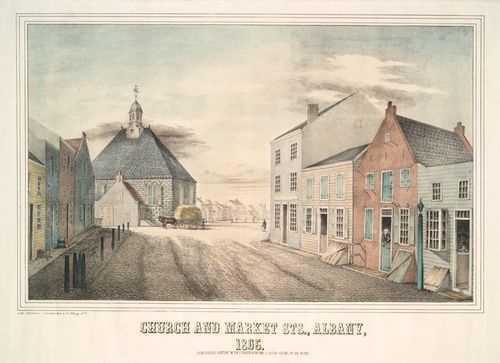
Reformed Dutch Church Records


Photo courtesy of https://www.newnetherlandinstitute.org

A few weeks ago, I wrote about free genealogy newsletters I receive.  I failed to mention I also read other genealogy blogs.  Recently I read a wonderful article about New York Reformed Dutch church records.

Both my husband and I have ancestors who resided in New Amsterdam.  Although I haven’t extensively researched those individuals, the blog article gave me new insights.  Here’s what really stands out to add to my knowledge base:

  • Before 1664, the Reformed Dutch was the ONLY denomination permitted so if  your ancestor was not of that religious persuasion and wanted to marry or attend a church service, the records are most likely held by the Reformed Dutch.  Who knew?! 
  • Although the church in Manhattan founded in 1628 is still in existence today, records are only available from 1639.  That’s interesting because the physical church was erected in 1642.  That same year a second church was erected in Albany.  
  • Collegiate churches had 1 minister that traveled between several locations and all the records were maintained by the 1 minister.  I have found that happened in New Jersey in the early 1700’s also.  
  • Many Germans came to New Amsterdam and attended the Dutch church.  Even after the city changed hands and became New York, Germans who immigrated continued to attend the Dutch church so make sure you look over Dutch church records.
  • The two databases on Ancestry.com for Dutch Church Records are NOT the same, even though they appear to be.  There are a few names missing in one database so check both.  As is always a good practice, go beyond using the index and browse the records as the transcription may be in error or the spelling may have been slightly changed from what you are seeking.
  • Check out the New York Genealogical and Biographical Society’s databases. I neglected to mention in my last blog that I also get their free weekly newsletter.  

Old Letters

Yesterday, we had a beautiful fall day and the change in temperature was such a welcome relief from summer’s heat.  I remarked to a passerby how delightfully cool the morning breeze felt and our brief conversation about the weather turned to his place of origin, Trinidad and Tobago.  I mentioned my family was indentured in Barbados in the 1700’s and that I’ve traveled to Grenada several times and love the island.   The gentleman laughed and said his mother was from Grenada and his father from Barbados.  Such a small world!

Then I listened to an interesting podcast, Sarah Gray Cary From Boston to  Grenada that I highly recommend.

Don’t you just love reading old family letters?  I certainly do!  We don’t often think about all the valuable information that an old letter contains.  Primary sources, names, places, dates and events that are recorded can provide us with clues to find other historical records, such as wills, journals, diaries, passenger lists and perhaps, even more letters.

The podcast discusses letters written by Bostonian Sarah Gray Cary who had relocated to Grenada in the Caribbean.  Grenada has had an interesting history as it went from French to British ownership.  The letters were written at the start of the American Revolution as Sarah took the last ship out of Boston after the tea party to join her husband who had taken a job on the island.  She left behind her infant son due to the hardship of the trip thinking they would be reunited soon.  Due to war, however, they did not see each other again for 10 years.   

The letters are Sarah’s only way to connect with her child and other family members.  Not only must she persevere over the unexpected length of her separation, she must learn to embrace three cultures.  

After listening to the podcast, I plan on getting the book to read this fascinating true life story.  Enjoy!

Even on Vacation Genealogy Abounds

I’m back from my dream vacation in Peru.  Ever since I was in the 3rd grade, I’ve yearned to travel there thanks to a National Geographic for Kids article.  Finally got the opportunity and even though it was a bucket list item and not for genealogical purposes, I’m sure you’re not surprised that genealogy related happenings occurred.

Our guide, Washington, related on our first meeting that he was 50% Incan and 50% Spanish, known as a mestizo.  He introduced us to one of sixty remaining shaman who lives in the Andes and speaks Quechuan.  Thankfully, Washington was an awesome translator as the shaman doesn’t speak Spanish or English.  Washington learned Quechuan as his mother’s side has passed it down for centuries.  The shaman had his DNA done and reported he was between 96-98% Incan, depending on the test.  Nice reminder that the test pool determines the percentage, even in the most remote areas of the planet!

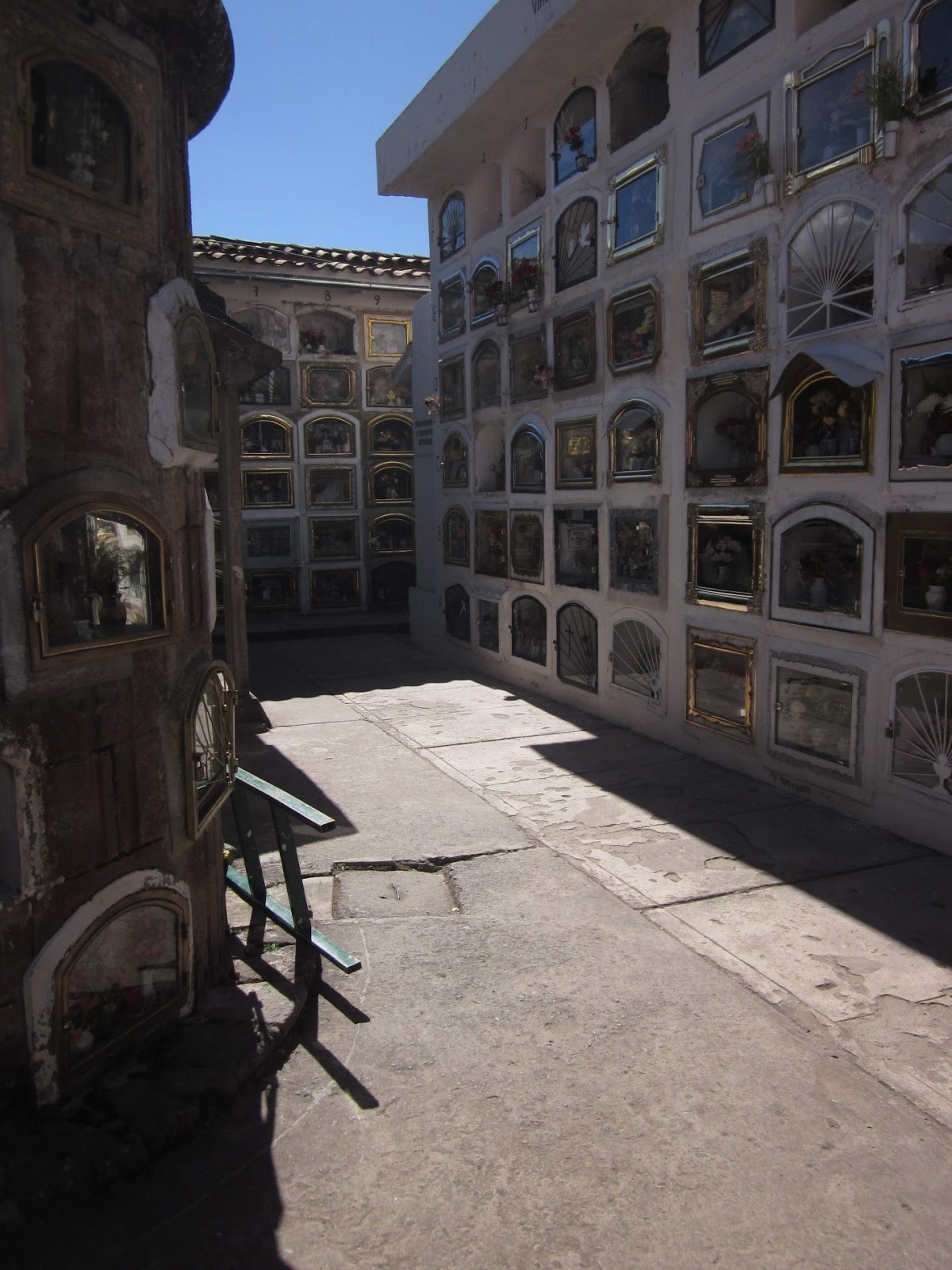
One of our stops was to visit a cemetery in Cuzco, pictured above.  Families may “rent” a burial site and if the rent is not renewed or the space purchased, the body is cremated and interred in another portion of the cemetery.  Families visit the cemetery often and remember the dead by displaying memorabilia from their life in a niche in front of the coffin that had been plastered into the assigned space.  Items for purchase – such as flowers, vases, alcohol in tiny bottles, and career related articles – a small truck for a former truck driver, for example – may be purchased by vendors lined up outside the grounds. 

Remembering ancestors is so important to this culture that high school honor students are selected to intern in the cemetery to serve as helpers to families who have come to visit their loved ones.  As young people, they climb the ladders to change the flowers, tidy the memorial and clean the glass that keeps out the dirt.  Washington translated for us a conversation with one of the students who was hoping to earn a spot in a technical college to study tourism.  He demonstrated how he takes care of a niche. 

As a genealogist, I’ve spent a lot of time in cemeteries so I guess it was not surprising that I recognized Washington’s surname shortly after arriving.  I asked him if he was related and he said he didn’t know.  I then asked if his surname was considered common.  He said it was not.  I recommended he ask his mother about the relationship as he had mentioned, as the family matriarch, she knew the family’s history.  Made me laugh when he said he often wondered about the relationship; just like clients in my area who never think to ask until it’s too late.

The Inca’s probably had a written language, however, most records were destroyed by the Spanish.  If you’re looking to discover your lineage, the oldest records will not be found in Peru.  Just like the oldest records from Florida and Cuba, where I traveled last summer, the earliest documents were returned to Spain. 

Where to Search for Your Immigrant U.S. Ancestors

If you are researching when your ancestors arrived in the U.S., it’s important to know what documents were available to show immigration status.  Although it’s possible your forefathers didn’t become naturalized citizens, meaning they were granted citizenship, it’s wise to check records to gain family insights.

Before the break with Great Britain, immigrants to what is now the U.S. were considered subjects of the crown.  In 1776, every man, woman and child, excluding Native Americans and African Americans, were granted “collective” citizenship.  No documents exist to state that status, however.  It was a right earned by merely being in the country at the time it separated from Great Britain.

Between 1776-1789, an immigrant who purchased land could become a citizen through denization.  Check land records, if available.  Citizens who became naturalized through denization, however, could not hold public office.  An “oath of allegiance” was required to obtain voting rights and to hold a public office.  Oaths were recorded in court records. Even if your relative did not seek naturalization, they were required by law to report to the nearest court and register that they were residing in the country.  Check Report and Registry logs between 1798-1828. 

Although the laws changed between 1790-1906, typically 3 steps must have been completed for an individual to be considered naturalized.  After having a Declaration of Intention filed with the local court, a final petition 1-2 years later would need to be submitted in a court in the nearest town.  You may have to check various towns as settlers could complete the paperwork where they currently resided.  After the petition was accepted, a Certificate of Naturalization was provided by the local court.

Prior to 1906, immigration records were not as complete as in later years.  Only the country of origin and not the city/town may have been listed as people were on the move.  Typically, parent information was excluded but you may get lucky.  For these later records, you will need to file a request with the U.S. Citizenship and Immigration Services.  Prepare for a long wait – I have had to wait over a year to obtain my grandparents paperwork but it was well worth it.  The photo alone was a gem!

In Honor of Veteran’s Day

Today, the world remembers the end of World War I. Although no veterans or civilians are with us to recall the atrocities, the record of their experiences lives on through letters, diaries and recordings. I am in possession of a collection of letters and wanted to mark the 100th anniversary by sharing one with you.

With the United States Congress declaring war on Germany on April 6, 1917, 2.8 million American men were soon to be drafted to serve in what was then called “The Great War.” Hoosier born George Bryant Harbaugh, a 22-year-old Deputy Sheriff with the Elgin, Joliet & Eastern Railway in Gary, Lake County, Indiana, was sent to Camp Taylor, Kentucky for basic training. Army Private George left behind his sweetheart, Elsie Wilhelmina Johnson, a 21-year-old Mother’s Helper living in Miller, (now Gary), Indiana.

Elsie saved every letter and postcard received from George. Only 3 letters from Elsie to George survive. The following is a scan and transcript of the letter detailing his experiences when the Armistice was called on November (11) 11th at 11 AM:

ON ACTIVE SERVICE
WITH THE
AMERICAN RED CROSS
AMERICAN EXPEDITIONARY FORCE

NAME
Geo B Harbaugh D

Infantry
U.S. Army.
Dec. 16, 1918
Allerey, France

My Dearest Elsie.-

Your most welcome letter of Nov. 17 received about an hour ago and I can’t tell you how tickled I was to get it. I am expecting a lot more soon for the last one I got before this was dated Aug. 24 so I must have lots more somewhere. I expect though, that they are at Tours at the Central Office and I’ve notified them of where I am so maybe they will reach me after awhile

You ask when you may expect me back. That is hard to tell. We may leave here tomorrow and may be here a month yet. My Division the 28th , is in the Army of Occupation and is in Luxemburg I believe, but they say we can’t get back to our old companies anymore but are to go in Casual Companies and go home but just how soon, we don’t know. But I think I’ll be back before March and when I get to New York, I’ll send you a telegram about when you can expect me.

I’m sure anxious to get back and I’m sure we can be nicely settled in that little cottage of Ours before next winter. I’m glad you got the money all right as I didn’t get to see the chaplain after I gave it to him. You see, we got paid off one day and we went into battle in a couple of days. I didn’t know what might happen so I thought it best to send it to you. I’ve got 5 months’ pay here now and if I get it before coming back, I’ll send it to you as I don’t want to spend it over here. I wanted you to get something for your Xmas, though.

So, you are looking for a house for us, are you? ha. ha. The place below Gertie would be fine. I didn’t suppose you would tell Gertie our happy secret but my only regret is that you haven’t the ring, too. So Gertie was willing to have us for neighbors, was she? Tell her for me that when Bob and I get together there will be some stories to hear. I never heard where any of the other Miller boys were, but Bob was in the 26, or “Yankee Division”, from the New England states and the 28th was from Pa. We relieved the 26 Div. on July 25 and they went to St Mihael, then Argonne Forest so I never got a chance to see Bob. I hope he came through the war all right.

You speak of getting a letter from Ed Lemert. Yes, Dear, he’s an awful good friend of mine and is almost as much as a brother. I wrote to him quite often but I haven’t wrote for several weeks so guess I will write tonight. I expect lots of my letters get lost but there was times it was impossible to write for a week or two at a time. Conditions here are not what you folks imagine they are. I haven’t saw any real American Y.M.C.A. huts and as for a Y.M.C.A entertainment for the Infantry at least, is something unheard of. I believe there is a nice Y.M.C.A.in Paris but we aren’t allowed there.

I haven’t heard from Raymond Clemons since about Aug 1 and I believe I’ll have to write and see if he’s still alive. I’ll have to write to Mrs. Clemons, too, I guess. The 111th Regt. lost lots of men at Chateau Therrey. The Huns used liquid fire on them and that is horrible. We got gas, shells, grenades and machine gun fire but the 112th never got any liquid fires used on us. Did you ever get the letter I sent that had a little pressed pansy in? I picked it in the city of Fismes and the Germans were shelling it to beat the band. We had two companies of our regiment captured there but they sure did pile up the dead Huns before they were overpowered.

Guess you must have had a grand time Nov. 11 from the clippings you sent. We did here. They have a bulletin board and on Nov. 11 it read “At 4 P.M raise H-l and I guess they did. I was in bed yet then but we sure yelled 4 P.M here would be about 6 A.M. back there. Bells all over France rang and everybody was happy, believe me. I’ve only been here 7 months but that seems an awful long time but the other Allies have had 52 months of it so they sure was cause to rejoice.

Well, Pres. Wilson got a big reception when he came here and if it wouldn’t have been for the Yank soldiers. He would never have come to France for it would have all been Germany by now. But that will wait till I get back. I won’t tell you too much else; I can’t tell you anything new when I get back.

Well, I will have to close, Dearest, if I am to write another letter tonight so I’ll close hoping I may get more of your ever welcome letters real soon.

With Oceans of Love and Kisses and hoping I’m back with you by Feb. 22.

Your Own and Always,

George

Convalescent Camp
A.P.O. 785
G .Company

A.J. Bruggeman
(unreadable)

I am currently compiling the letters into an eBook with the working title, Thanks to the Yanks – World War I Letters from a Soldier Boy to his Sweetheart.

Hunting Down a Harbaugh


I was catching up on my reading last week when I came across an article in the May 2018 Smithsonian magazine mentioning a George Harbaugh, an oil magnate from Cleveland who was involved in an automobile accident with a streetcar in 1913. This led to an engineer, James Hoge, inventing traffic lights.

Now when you do genealogy for awhile and you’re reading for pleasure, surnames are certain to pop up from time to time and you just lose the drift of the story to think, “How is that person related to me?” or “Do I have that individual in my tree?” I have entered every Harbaugh that I’m aware of in my Main Tree on Ancestry.com and MyHeritage.com so I decided to try to hunt down this George Harbaugh and attach the citation.

I thought this would be a quickie find but it took a few minutes longer than I anticipated. My first problem was that I have 132 George Harbaughs in my tree. I tried to eliminate by location and death dates but it was still a lot to go through.

Seeking a shortcut, I went to the Library of Congress’ Chronicling America site in an attempt to find the newspaper article the story mentioned. Couldn’t find it. And of course, they didn’t reference it in the magazine.

I could have checked other newspaper sites but I suspected the article didn’t have much more information I could use to identify George so I simply googled “George Harbaugh” oil Cleveland. Interesting, what came up was a pdf from the Cleveland Landmarks Commission of all of the demolished homes. Sure enough, there were 4 residences for Harbaughs and that gave me a clue. The first was for a A. G. Harbaugh. The home had been built in 1888 at 2022 E 89th Street. I guessed that the “G” might have been George and I had been looking for a first name George and not a middle name of George. George is a favored name with the Harbaughs and I should have remembered that many of them use their middle name as their first name. I have no idea why they do this. The family isn’t German, however, they did live among the Pennsylvania Germans for many years and maybe that’s where it started.

The 2nd Harbaugh on the pdf was George Harbaugh and his home had been built in 1898 at 2021 Cornell Road.

The 3rd Harbaugh was entered as Harbaugh Residence. Built in 1903, it was located at 11402 Bellflower.

The 4th residence was of most interest; it belonged to Charles Harbaugh who built it in 1904 at Euclid near Cornell.

I knew I was on to something as Euclid was the street where the accident occurred. I might be able to find a connection between Charles, the mystery George and A. G. Maybe that dinner party had been at Charles’ home!

Back to my list of people in my tree, I decided to check out A. G. first. Aaron George Harbaugh (1845-1897) was born in Ohio and died in Cleveland. He had 1 daughter, Malinda, and 3 sons, George Edward, Charles Reiber and Frederick. My mystery George was George Edward.

Born in Cleveland in 1871, he eventually moved to San Diego, California where he died in 1940. Which is why I didn’t quickly find him. I erroneously thought he would have remained in Ohio.

This fun little exercise reminded me of the importance of not making assumptions; I had wrongly excluded George Edward based on his death location.

It also reminded me of how impatient I often am waiting at traffic lights. I’ve often joked my favorite country in the world is Belize because UnbBelizably, they only use 3 of their 7 traffic lights and I’ve never had to wait at any of them.

So the next time you’re waiting for that light to change, think of my husband’s 5th cousin, 3 times removed. Because of George Edward Harbaugh’s lack of paying attention, the world’s a little safer (and slower) today.

A Little Bit of Truth in All of Those Passed Down Stories


I love family legends even if they are tall tales. Last week I trekked to New Mexico, where I have no family ties, and learned of a passed down legend that was quite interesting. While visiting the Oldest House in Santa Fe, I heard the story of two elderly Native Americans who once lived in the dwelling. Supposedly, they had made a love potion for a Spanish soldier, Juan Espinoza, and when it didn’t give him the results he had wanted as his love had married another, he returned to seek his money back. An argument ensued, he fell and was beheaded. The ancient wooden casket in the home supposedly contains his body; over the years a plaster cast was enclosed to represent his missing head.

The next evening, on a ghost tour, the guide told his version of the story. He believed the women were sisters and these witches had been threatened by the soldier. As the soldier attacked one of the women, the other took out a saber and sliced off his head. The women then dragged his body outside and left it. No one knows where the head went. The soldier’s ghost reportedly roams looking for his head. The sister’s punishment was to keep the coffin in their home.

Two days later I was in Taos at the Pueblo village and my tour guide there told the same tale with a slightly different twist. The two women were not elderly and were local healers specializing in matchmaking. The soldier was inpatient and violent when his request for a wife wasn’t fulfilled quickly. The townspeople misunderstood the situation; it was clearly self defense on the part of the sisters.

When I returned home I looked online and found many other versions of the tale. Some say Juan was shot in the leg by the women who later cut his head off. Others say he fell on his saber and cut his own head off.

And like the various versions, there’s no agreement on when the death occurred. According to the Taos guide, the event happened before the Pueblo Revolt of1680. Information at the house states that there was a dwelling on the premises for at least 800 years. The website states that there is no deed record but analysis of lumber used in the building construction was from 1740-1767.

Since none of us were there we will never know what really happened. Unfortunately, no records remain of the event so the passed down stories are the closest we’ll ever get.

If you have a tall tale passed down in your family, get as many versions as you can and record them . Then, search historical records to narrow down the “facts.” For example, it is most unlikely that the event in Santa Fe occurred before 1692. Why? The house was used during the Pueblo Revolt in 1680 to fire upon the Oldest Church across the street. The area was resettled after 1692. It would be unlikely that the Native Americans residing in the Santa Fe between 1680-1692 would leave the coffin in the home; that punishment by the Spanish would have been rid of quickly after they succeeded in retaking their ancestral land. This helps us narrow the story to between 1692-1836 when the area parted from Mexico. The house was remodeled many times over the years so there is no telling if the event occurred prior to the new beams being installed in the mid 18th century or after. I personally think the coffin was added by later owners who wanted an interesting tourist attraction. I find it hard to believe that the coffin would remain in the home after the Native American women’s death.

Next time I’ll blog about other genealogical gems I uncovered on my trip.