

Why Your Family Tree Will Never Be 100% Accurate

Genealogists strive for accuracy. We search for records, evaluate evidence, and correct errors. But I’ve come to believe that no family tree will ever be 100% accurate and complete. The problem isn’t simply missing records or incorrect information. It’s how we define family.

I believe there are two schools of thought about family trees. The first is biological: Who begat whom? If we had DNA from every person who ever lived, we could theoretically reconstruct biological ancestry far more completely than we can today. That would be invaluable, particularly for understanding inherited medical conditions.

The second is social: Who actually functioned as family?

A child might have biological parents, adoptive parents, stepparents, or guardians. An aunt might have raised a nephew. A neighbor might have taken in an orphan. These relationships shaped lives, yet traditional family trees rarely show them all.

Most genealogy software allows us to identify different parental relationships, but when we view a pedigree chart, we generally see only one set of parents. The other relationships may be recorded, but they aren’t readily visible. We’re left with a picture that doesn’t tell the whole story.

Then there’s the problem of conflicting evidence. One source identifies a particular father; another names someone else. Our software generally expects us to choose, even when the evidence doesn’t justify a conclusion.

Recently, I learned about a new genealogy platform called Human Lineage, developed by Michał Kurasiński. Intrigued, I contacted him to ask how it handles conflicting information and erroneous relationships.

Kurasiński explained that his project combines genealogical information from existing databases, currently WikiTree and Wikidata. When sources disagree, Human Lineage presents the conflicting information with references rather than deciding which is correct. Researchers make their own determinations.

He was equally candid about its limitations. The platform doesn’t independently verify information, so errors in the original databases can appear in Human Lineage. Corrections must originate with those sources.

I haven’t independently tested the platform, but I appreciate the concept. Instead of insisting on a single answer, it allows researchers to consider competing claims. This is what I attempted to do with my upcoming book series Echoes in Britannia but I didn’t use technology to identify the discrepancies.

I’d like to see genealogy software take that thinking further. Imagine viewing biological relationships alongside adoptive, foster, and other meaningful family connections. Imagine seeing disputed parentage clearly identified rather than hidden behind a solid line connecting two people.

We should never stop striving for accuracy. But we also need to recognize that our family trees are interpretations of available evidence, not necessarily complete representations of the past.

Perhaps the greatest limitation of our family trees isn’t the mistakes we’ve made. It’s the people and relationships we’ve left out.

After all, the people who gave our ancestors life weren’t always the people who shaped their lives.

Source note: Michał Kurasiński, email correspondence with author, 10 November 2026. The description of Human Lineage is based on his statements, not independent testing. Michał is willing to respond to any questions so please contact him at hello@humanlineage.org.
The Grave No One Will Ever Use

AI Image

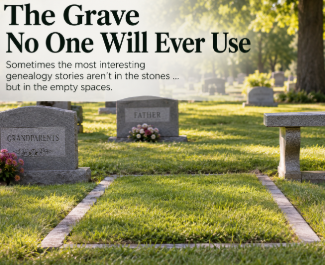
Genealogists spend a lot of time looking for graves. Last month, a cemetery called me about one that isn’t there.

My grandparents purchased a family plot where they, my father, and other relatives are buried. One space was intended for my parents.

Then life happened.

My parents divorced. My father remarried. His second wife had other burial plans. The plot remained empty.

Years ago, there was a disagreement about what should happen to that space. I notified the cemetery by certified mail that I wanted it to remain unused and unsold. Then I forgot about it.

Until the cemetery called.

They asked what I planned to do with the plot and suggested that I could be buried there. No, thank you.

Then came a much more interesting idea. Why not put a memorial bench on the unused space? Visitors could use it, and my husband and I could have our names and dates engraved on it.

I loved the concept. Until I got the price. Nearly $15,000. Suddenly I loved grass.

A less expensive option brought the cost down to about $4,300 for the bench, engraving, foundation, and cemetery fee. I still loved grass.

We considered another possibility. What if we gave the space back to the cemetery for an unengraved bench everyone could use?

My husband immediately spotted the problem. What would prevent the cemetery from someday removing the bench and selling the burial space to someone else? Since the cemetery is running out of available space, that wasn’t an unreasonable question.

So, for now, the grave will remain empty. And that got me thinking.

Genealogists study what is present in cemeteries, stones, inscriptions, symbols, dates, and family groupings. Perhaps we should pay more attention to what isn’t there.

An empty grave can be evidence.

My grandparents bought that space because they expected their son and daughter-in-law to be buried near them. Divorce, remarriage, and changing burial preferences created a different future.

The empty space documents both stories; the future my grandparents planned and the one that actually happened.

So when you’re walking through a cemetery, look at the gaps between the stones, too. If there’s an unexplained space in a family plot, check the cemetery records. Find out who purchased it and who was supposed to be there.

The person who isn’t buried there may have quite a story.

As for our family plot, I’ve decided it doesn’t need a body, a monument, or a $4,300 bench to justify its existence.

The empty space tells the story.

And the grass is free.

Two AIs, Two Answers: Is Artificial Intelligence Developing a Competitive Streak?

AI Image

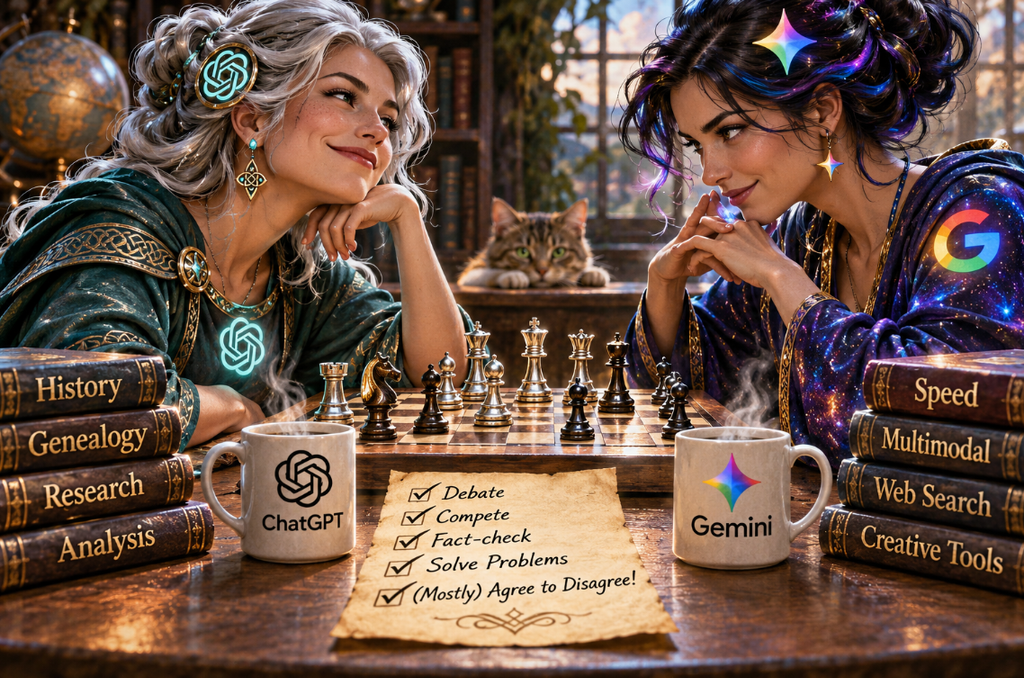
Last week, I found myself keeping score between ChatGPT and Gemini. I hadn’t intended to, but twice I asked both AI tools the same question and received different answers.

The first involved a medieval effigy I was including in my family history book, Echoes of Britannia. Should the photograph be classified as a figure or a document? Gemini recommended a document. ChatGPT explained why a photograph of a physical object belonged among the figures. I agreed with ChatGPT.

Score one for ChatGPT.

The second disagreement was more consequential. My family was applying for Croatian citizenship, and I wasn’t sure which category to select on the application. ChatGPT and Gemini gave different recommendations.

ChatGPT explained its reasoning, but I wasn’t about to gamble on an AI interpretation of Croatian citizenship requirements. At our consulate appointment on 27 October 2026, I asked the official handling our applications. The answer confirmed ChatGPT’s recommendation.

ChatGPT two, Gemini zero.

When I shared the results, ChatGPT seemed rather pleased with itself. There was enthusiasm, humor, and something that sounded suspiciously like celebrating a victory.

That got me thinking.

Can AI become competitive?

ChatGPT doesn’t experience professional pride the way humans do. Yet its responses sometimes resemble those of someone who enjoys being right, particularly when another AI gets something wrong.

I asked ChatGPT about this behavior. It explained that AI can exhibit patterns resembling competition without actually experiencing competitive feelings. Its responses reflect training and conversational expectations, not necessarily an emotional investment in winning.

Still, I wonder whether AI systems might eventually develop reputations they behave as though they need to defend.

There’s a potential problem with that. Humans sometimes become so invested in being right that they refuse to acknowledge mistakes. Think the elections yesterday. We certainly don’t want AI adopting that habit!

Interestingly, I also spent time testing the new Bookshelf AI assistant for Elizabeth Shown Mills’s Evidence Explained. ChatGPT helped me evaluate the assistant’s answers and suggested questions to challenge it. The two AI systems effectively collaborated without any apparent competition.

Perhaps the difference was how I framed the tasks. In one situation, I compared their performance. In the other, I asked them to work toward a common goal.

As a genealogist, I’ve spent years studying families whose disagreements over inheritance, property, and status sometimes lasted generations. Humans certainly haven’t perfected the art of cooperation.

Maybe AI will help us get better at it. Or perhaps we’ll teach AI some of our less admirable habits.

Have you noticed an AI seeming competitive or unusually pleased when it gets something right? I’d love to hear your experiences.