
Part 4: Helpful Hoosiers, Elusive Records, and One Good Clerk

Ai Image

This is a continuing series on my recent adventures to acquire documents for dual-citizenship. You can read earlier posts here here – and here.

We were up bright and early on Wednesday, ready to track down a divorce record at the Porter County, Indiana courthouse before they even opened.

Here’s another tip for researchers working in Indiana: be prepared to feel like a threat. Most facilities are swarming with armed officers who clearly believe they’re guarding nuclear codes rather than 19th-century paperwork. And no, you can’t bring your cell phone in. Doesn’t matter if you need it to pay. Doesn’t matter if you’re old and holding a manila folder. It’s Wild West rules. Don’t bother asking for an exception. I warned you.

As expected, they couldn’t locate the record.

I thanked them for the stack they had mailed me two years ago, minus the final dissolution of marriage I actually needed certified. Last time, it took them three months to find anything, and they charged me $50.00, a dollar per page, even though they’d made five copies of the same ten pages. No, it wasn’t a juicy divorce. Just sloppy duplication.

This time, I showed them the exact document I needed. I was told I’d hear back once they found it.

Here we go again.

One Clerk, One Win

On to the Porter County Health Department, where I entered a bit too early for some folks’ comfort. While I stood silently at the counter, I overheard one clerk complaining about “letting people in before we open.” (Hi, yes. That would be me.)

Thankfully, another clerk came to the rescue. She was efficient, kind, and within five minutes, I had the certified record I needed.

I mentioned the nightmare from the day before in Gary, and she replied with a sigh: “I couldn’t even get my own birth certificate from them. I had to go through the state.”

So maybe I was lucky after all.

A Church with a Lock and a Secretary with a Key

We drove back to Lake County to revisit the church that had been closed the day before. Again, the door was locked and the secretary spoke to us through it. When I explained what I needed, she let us in and quickly found the baptism and marriage books.

She couldn’t locate the names but from across the desk, upside down, I spotted them and pointed them out. She allowed me to take a photo of the entries, but only after covering up the rest of the page. I didn’t bother mentioning that many dioceses have digitized records entirely, so full-page images are already online.

She couldn’t issue the certificates, though as there was no priest available, and wouldn’t be one “for a while.” The plan was to mail them when a priest showed up.

Which, given how things were going, might be never.

Cemetery Software and the Mystery of the Missing Priest

Next, we made a quick stop at the cemetery, where I hadn’t planned to clean any graves, but found myself wiping down markers anyway. I was there to get an updated cemetery record for the family plot. The version I had was from 2001, and a new family member had since been buried.

They had upgraded to new cemetery software. Unfortunately, no one knew how to print a basic update using it.

So one employee simply handwrote the new information and told me to submit it alongside the old printout. (Ah, technology!)

Déjà Vu with a Twist

While there, I got a call from Porter County. They told me to check my email to confirm they’d found the divorce record.

Cue near-heart attack.

I checked: no email. Nothing in spam. I called back, no voicemail. I called again. The clerk laughed and said, “Oh, I didn’t send it yet.

I told her we were already on our way.

One Archivist’s Righteous Indignation

And then the Chicago Archdiocese archivist called.

She wanted me to know firmly that my grandparents had not married at St. Salomea’s and that she would not be refunding my money.

I hadn’t asked for a refund.

She was clearly annoyed that I had requested a church record despite already having a civil marriage certificate number. I explained that the county couldn’t find the record.

Her response? “They should find it.” Right – shoulda – woulda – coulda!

As if that’s something I can make happen.

She then turned her attention to the birth/baptism record copies I had submitted for reissuance. Because mine were in English and the parish books were in Latin, she couldn’t issue a new version.

I told her Latin was fine.

Next excuse: the form she uses doesn’t include the word “birth,” and my copy did. She couldn’t reissue it for that reason, either.

I simply said, “That’s okay. I’ll explain that policies have changed over time.

She grumbled something about being unsure when she’d get around to it. I told her to mail it. We were already heading home.

Tally So Far?

Two days. Fourteen stops. Five records. Not great.
Part 3: The Gary Gauntlet and the Bureaucratic Brick Wall

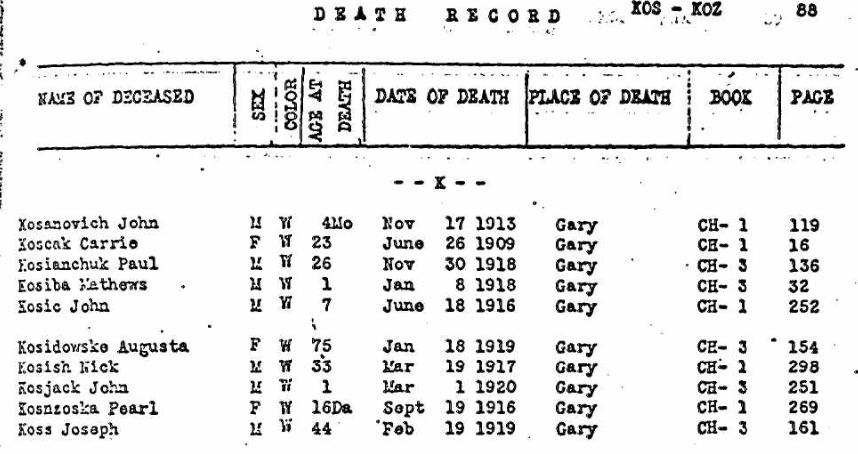
Gary, Lake County, Indiana Index to Death Records, 1908-1920, Joseph Koss, digital database; Ancestry.com: accessed 30 July 2025, image 10 of 14.

This is a continuing series on my genealogical adventures in obtaining family records for a dual citizenship application. You can read my previous blogs here and here.

By early afternoon, I decided to head straight for Crown Point, the county seat of Lake County, Indiana. According to the website, the building that housed marriage and divorce records was located directly across the street from the one with birth and death records. Efficient, right? I actually thought to myself, “Wow, Lake County has it together!”

Think again, Lori.

Crown Point Confusion

Our GPS led us to… a juvenile detention facility. No address numbers anywhere. Hoping for better luck, we crossed the street to a large, official-looking government building and went inside.

That’s where I was able to obtain one record: a marriage certificate. After six hours of effort, that felt like winning the lottery. The staff promised to research the divorce record and contact me if, yes if, they found it.

Next stop: the County Health Department, which, according to an officer, was “the white building next to the juvenile facility.” Turns out the reason we hadn’t seen it was because it was set so far back off the road it might as well have been hiding.

My husband noted, “Hey, we got the first free parking space right in front of the door. That’s a good sign!”

Narrator: It was not a good sign.

Enter: The Wall of Gary

The moment we walked in, we were greeted by multiple signs declaring that the health department did not have records for Gary.

Wait, what? This is the Lake County Health Department, and they don’t have records from one of the cities in the county?

I double-checked the website later, no mention of this. I asked the clerk at the window where I could get Gary records. She looked at me like I had just uttered profanity in Latin. “At Gary’s Health Department,” she snapped.

“And where is that?” I asked.

Without a word, she pointed to a sign with an address on it, turned, and walked away.

Wow.

The Ethnic Club and the Mystery Man

My original plan had been to stop at two more locations that day, a local ethnic organization where my family had once been active, and the Diocese to pick up church records. But it was nearly closing time, and now I had three stops to make, clearly, that wasn’t happening.

We decided to do as much as we could, spend the night and continue the next day.

We started with the ethnic club, since it was close by. A car was parked out front, but the building doors were locked. I had tried to reach out to them previously with no success. No website. No returned Facebook messages. At this point, I figured I’d just mail them a query and hope for the best.

As we were pulling away, a man opened the front door. I jumped out. He wasn’t affiliated with the group but rented office space there. Still, he was helpful, gave me two phone numbers and admitted that the organization wasn’t exactly known for its communication skills. No kidding.

He also offered advice on dual citizenship. Turns out, he was trying to apply, too but his info was wrong. He’d tried to get his birth certificate through VitalChek. I’ve used them before. They happily took my money and never delivered a record. (Pro tip: if you use them, pay with a credit card that’ll support you when you dispute the charge.)

This man told me he had made 37 phone calls to try to track down his birth certificate because, brace yourself, Gary wouldn’t give it to him.

Why not?

“You’ll figure it out,” he said.

Oh boy. I could hardly wait.

A Warm Welcome in Gary

Next stop: the Diocese. They informed me the church records I needed had been transferred to another parish. I called. They had just closed, literally two minutes earlier.

So we decided to head straight to downtown Gary to try and retrieve the birth and death records I needed.

When we arrived, a shirtless man was being confronted by a police officer on the sidewalk. And in my head? Back Home Again in Indiana was playing. You can’t make this stuff up.

We parked quickly and headed inside the same building I had visited as a child to get my birth certificate before starting school. The elderly security guard greeted us warmly and directed us upstairs.

The First Hint of Hope

There were two employees at the counter, and one immediately asked what we needed. Miraculously, we received two birth certificates almost right away. After seven hours of driving, detours, and dead ends I finally had three documents in hand.

Then things went south. Fast.

The Death Certificate Debacle

I asked for three death certificates, dated 1919, 1966, and 1970. (See pic above) The woman behind the counter asked for the deceased individuals’ birth certificates.

I calmly explained: they were born in the 1800s, outside the U.S., and their countries didn’t issue birth certificates at that time.

Her response? “No birth certificate, no record.”

That is not Indiana law. That is a clerk making up her own rules and digging in.

I showed her original death records issued by that very office. She didn’t care. She asked for death certificates of their children which I provided. I also gave her birth and baptism records for one child.

Still no.

I tried to show her obituaries naming the parents and just for fun, me. Nope. She wasn’t having it.

Then she turned and walked away, loudly repeating, “Birth certificate, birth certificate, birth certificate” as if chanting it would magically make them appear.

We left empty-handed.

At this point, we checked into a hotel in nearby Porter County because I had one more shot at records the next day.

Spoiler: Things get weird. Again.

An Overlooked Resource to Determine Parentage

Here’s an often overlooked resource to help identify parentage – school records.  I’m not talking about yearbooks on Ancestry.com.  I mean the enrollment and attendance records that schools had to maintain to receive state and federal funding.  

To acquire those records, which are not available online, visit the school district’s website.  If there is a search bar, simply type in “records” or “school records.”  Follow the link which usually is for recent graduates of the school district needing to get a transcript for further education or work.  Obviously, you are searching for old records so find the phone number and make a call to see what will be required for you to get the documents.

In my area, a death certificate by a relative is needed but an attorney’s representative for the estate handing the deceased’s probate is also acceptable to receive the records.

Most districts have microfilmed their older records so you will not have your request fulfilled immediately.  There’s no telling what you’ll receive, either, but it certainly doesn’t hurt to check it out. I live in a state that has lots of record loss due to mold, flood damage, fires and insects.  Even with all the losses, there is usually some records that were able to be salvaged and scanned.

Recently, I assisted a client in obtaining school records from the 1950’s-1960’s in the hope of identifying parentage. The turnover time was a little over a week. Prior to the 1970’s, you’re not going to receive a birth certificate as most schools did not have a photo copier available to make a copy of that document at the time of enrollment.  The best you’re going to get is a check mark on a line that noted a birth certificate had been presented.  The name of the enrolling parent/guardian is then recorded on the document, along with the address where the student was residing.  You may even get lucky and have a telephone number recorded.

Once you have the parent/guardian name it’s time for you to check city directory records.  In my location, phone numbers were added in the mid-1950’s and I was able to match the telephone number on the school records to two different names not recorded in those records.  Was there an error in the school records in recording the phone number?  No, the information proved that the deceased had been involved with a social service agency and explained why the recorded schools’ names varied when the home address didn’t.  The student must have been temporarily living in either a foster home or with a relative but the parent still had the right to obtain school records so the enrollment address did not change.  The enrollment and withdrawal dates listed for the various schools attended provides evidence that the family was experiencing difficulty and gives more places, such as court records, to look for a better understanding of what was occurring.

In my situation, only one parent’s name was recorded in school records.  That individual was never found in the city directory but the name and telephone of the individual who purportedly lived at the address in school records was a clue to find the other parent’s name.  

The school records also contain a birth date for the student so a check of newspaper birth announcements for that date could lead to a further confirmation of parentage – or not.  In my case, there was no announcement so it was likely the student’s parents were not married at the time of birth as it was the local policy to not record in the paper the names of children of single mothers.  

School records will not provide every answer you seek but will point you in the direction of locating other records and help you gain insight into the life of the student and the parent/guardian.  

So, what do you do if the district says there are no records?  Don’t give up!  Next check Worldcat online to see if those records were published in a book and held at an archive somewhere.  On a trip to Boston a few years ago I spent a couple of hours at the New England Historic Genealogical Society. I decided to browse through the Indiana section.  I happily discovered a book that was a transcription of Lake County, Indiana school enrollments for the early 1900’s.  The book contained my husband’s grandmother’s name and who enrolled her in first grade – one of her older stepbrothers. That made sense, Elsie’s mother was a recent immigrant from Sweden with little knowledge of the school system.  The stepbrother, a graduate of that school district who was fluent in English was helping his stepmother with the enrollment while his father was at work.  I had tried to get Elsie’s school records from the county previously and was told they had been destroyed.  That was correct information; who knew that a transcription had been made of those records prior to their demise?  I later checked with the library in Lake County that has the largest genealogical section and they didn’t have a copy of the book that was sitting in Boston.  How strange that a record was located in a place the ancestor never visited.  Of course, original records are preferred but in this case, a transcription was better than nothing and did shed light on the family dynamics at the time of Elsie’s school enrollment.  Happy Hunting!