
Hints for Family History Travel in Chaotic Times

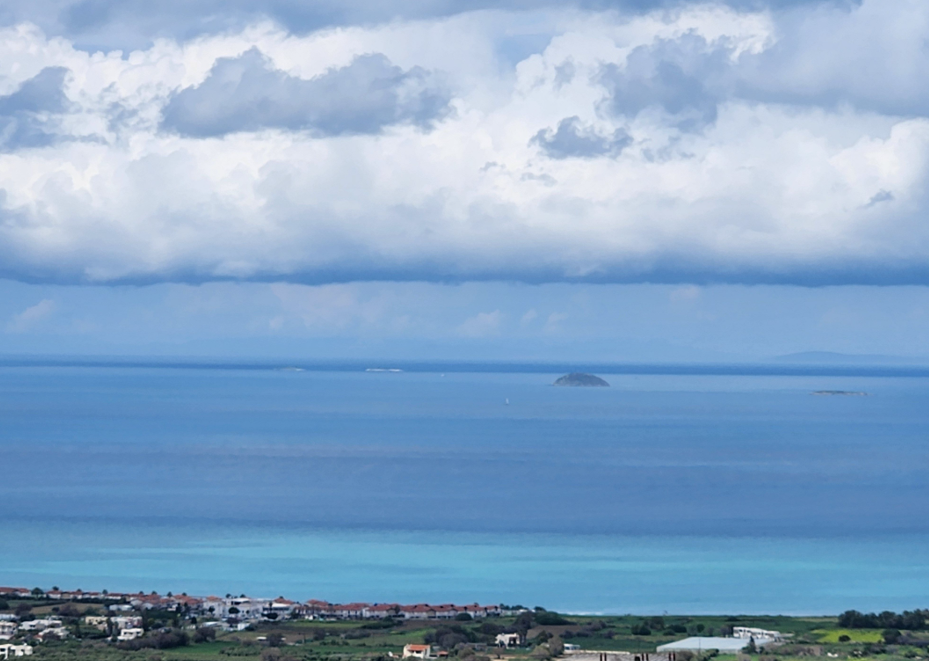
The Agean Sea from Kos Island, 4 Apr 2026, photo by Lori Samuelson.

Last week I shared the story of our trip to Greece including my long-awaited journey to Kos Island, where my family lived some 2,000 years ago, based on mtDNA and family tradition. This week, I’m answering the questions I’ve been getting and offering a few practical tips if you’re planning a similar trip to anywhere in the world.

Let’s start with the obvious, how do you even get to a remote place like Kos?

Your first step is to determine a route. Kos is not on the standard cruise circuit. You have two options: fly from Athens (about 55 minutes) or take a boat from Bodrum, Turkey (roughly 15 minutes). We flew from Athens since we were already returning there from Crete.

Once you’ve figured out how to reach your ancestral location, the next step is getting around. You can rent a car if you’ve secured an international driver’s license or you can hire a driver.

I hire a driver. Every time.

Why? Because I don’t need the added stress of navigating unfamiliar roads, signs, and driving customs while trying to absorb a place that actually matters to me. A good driver knows exactly where to go, how to get there efficiently, and more importantly, what you shouldn’t miss. They often become your best local resource for food, history, and those small, meaningful stops you would never find on your own.

People always ask how I manage to find trusted drivers around the world. The answer is simple: I build relationships. Conferences, professional networks like Association of Professional Genealogists and LinkedIN, and years of working with people in different regions.

In Sweden, I hired a genealogist who also worked as a part-time tour guide for Gate 1 Travel. In Croatia, I was connected with a genealogist/archaeologist. In France and Germany, a sixth cousin I met at a conference volunteered.

Kos was different, I had no contacts. So, I took a chance through Travelocity, and it paid off. GetTransferKOS was excellent. Once the driver understood why I was there, he went beyond the standard route to our hotel and showed us sites my ancestors would have known. That’s the difference between transportation and experience.

Next question: hotels.

If I’m traveling with a company like Gate 1 or Trafalgar, I let them handle accommodations. But I almost always add extra days, before or after the tour, to explore independently. Our ancestors rarely lived in postcard destinations. They lived off the beaten path, and if you want to understand their lives, you need to go there too.

Ask your hotel concierge or desk clerk for off the beaten locales you should visit. When my Travelocity half day tour didn’t show up, the desk clerk called a colleague who arrived within 20 minutes to show us his beautiful homeland, along with fresh baked cookies his wife was making for Easter. He knew where the vineyards once grew on Kos and took us there. This was important to me as no physical records have been found to mark the location which was where my ancestors once lived:
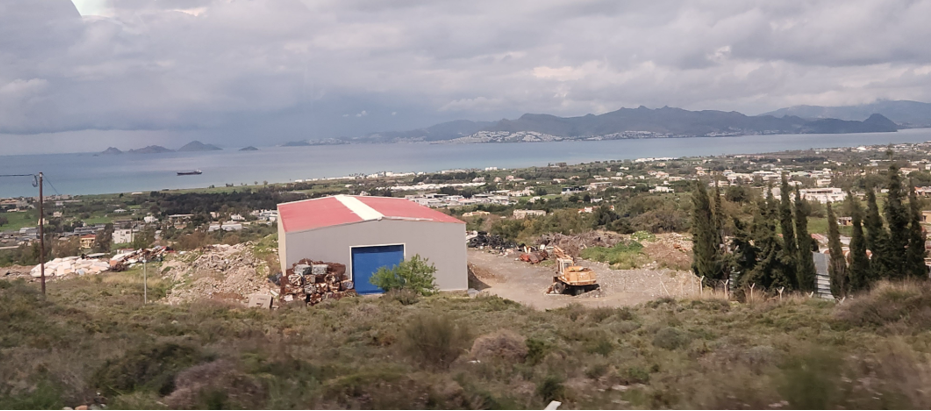
Former Vineyard Site, Kos Island, Greece, 4 April 2026, photo by Lori Samuelson.

Money is another practical issue people overlook. If your family came from rural areas, carry some local currency. Credit cards aren’t always accepted, I ran into that repeatedly in Ireland and once in Greece when roadwork brought the internet down at the restaurant.

That said, I still prefer using a credit card whenever possible. With the right travel card, you’ll get a better exchange rate than most banks offer, and it gives you a clean, trackable record of your spending.

Now, let’s talk technology.

I use a phone plan that supports international travel. No roaming. I keep calls to a minimum, rely heavily on texting, and use my phone constantly for photos. Each night, I connect to hotel Wi-Fi and upload everything to Dropbox.

Why? Because I once lost photos in the backwoods of Mexico when I crushed my phone, and I don’t make the same mistake twice.

I also use Geni, my ChatGPT research assistant to help me identify photos when I get home. What was the name of the location of a statue of Leonis? The best part with this trip was the translations.
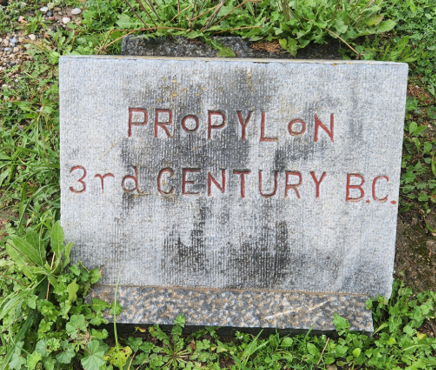
Asklipieio Archeaological Site, Kos Island, Greece, 4 Apr 2026, photo by Lori Samuelson.

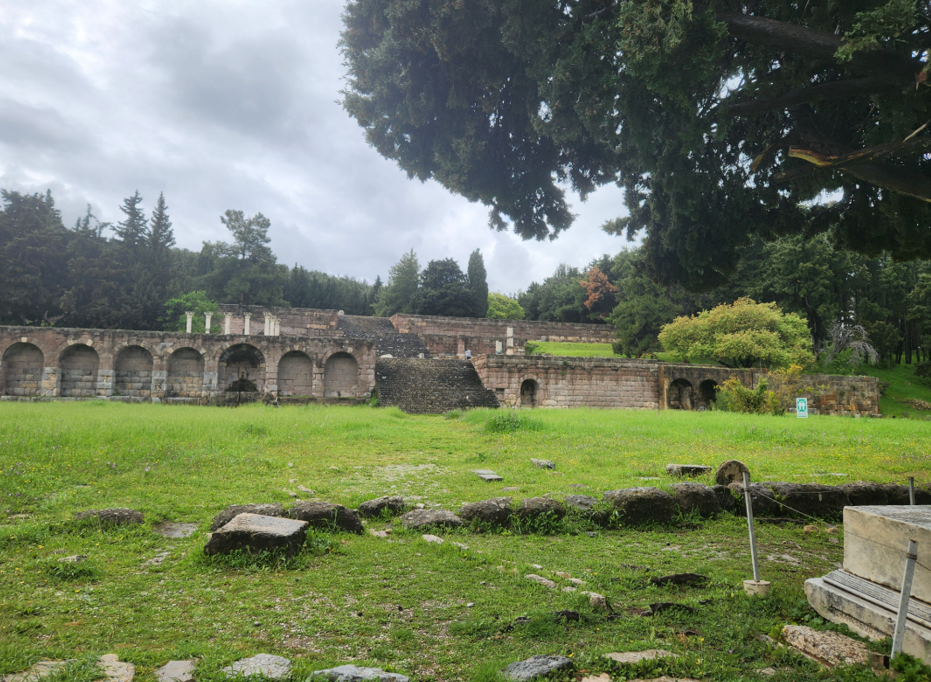
There were no English markers as we toured Asklipieo so I took photos so I could later discover what we were looking at. Geni told me this means memorial markers, which makes sense as the next photo (below) shows recesses in a wall that likely once held those markers:
Security and customs were another big concern people raised.

We had no major issues though I’ll admit O’Hare International Airport tested my patience.

Coming back into the U.S., you have to retrieve your luggage, clear customs, recheck your bags, and then go through security again if you have a connecting flight. It’s inefficient, but it is what it is.

Customs itself took about 15 minutes. United Airlines had staff ready to help recheck bags quickly, and there were helpful Traveler’s Aid volunteers guiding people to their gates. Thankfully, there were no ICE agents in sight, just people actually trying to help travelers get where they needed to go. No chaos, just a system that could be better.My only issue? Exhaustion.

I forgot I had a tiny bottle of water in my bag, security flagged it. Then they asked if I had a laptop. I didn’t but I did have Kindles. That triggered another rescan.

Here’s the irony: every other airport we passed through: Fort Wayne, Vienna, Munich, Athens, Crete, Kos handled this without issue. Chicago? Not so much. You’d think one of the busiest airports in the world would have updated equipment by now.

Stateside, things can be just as odd. Earlier in March, we had “enhanced security” in Fort Wayne; meaning we had to walk past a dog just to enter the bridge. Two weeks later, nothing.

Welcome to consistency, American-style.

We do have TSA Pre Check but not Global Entry. I try to fly into Detroit rather than Chicago which has a much smoother customs with shorter lines. I’ve tried several times using the Mobile Passport Control app (free) but it never works for me.

Another question I’ve been getting: where next?

Honestly, nowhere overseas for now.

I’m not booking international travel until there’s a change in “leadership” in the U.S. I’m not interested in last-minute cancellations or absorbing costs because someone decides to escalate tensions. Add in rising oil prices and airlines cutting routes, and it’s just not worth the gamble at the moment.

Otherwise, I’d already be planning a trip to Barbados to walk in the footsteps of family lines from the late 1600s into the early 1700s.

For now, that one waits.

As for anti-American sentiment, no, I didn’t experience any hostility. What I did hear, repeatedly, was: “What’s wrong with Donald Trump?” Excellent question!

To their credit, people I met didn’t assume I represented every American viewpoint. That’s something we could learn from.

In the meantime, I have plenty of travel ahead, just closer to home. I’ll be presenting at the National Genealogical Society conference in Fort Wayne (hardly a trip for me!), along with events for Palatines in America and several venues across Texas, Utah, Minnesota, Kentucky, and the Midwest.

So no, I’m not slowing down.

Just adjusting the map for now.

The Results Are In!


On Amazon Prime Day, I purchased 3 autosomal DNA kits – two from 23andMe and 1 from Ancestry. Seven years ago, hubby and I tested through Ancestry. He completed mt and y; obviously I just could do mt. Ancestry has long since stopped supporting those test results although they are still available to view on their site. Back in those days, I never connected with anyone. My “closest” match was Marie Antoinette of “let them eat cake” fame. I was so unimpressed I decided not to upgrade when autosomal became available.

A second cousin of mine reconnected with me via Find-A-Grave and in our back and forth emails, had tested with National Geographic. We compared maternal Hapogroup and not surprisingly, were the same.

The more I read about dna, which was my genealogy goal this year, and since I am an only child I thought I could gain some additional info on my paternal side by taking an autosomal test. I also was interested in comparing my husband and his sister and then to our children. My plan was to purchase 5 autosomal kits. Sales had come and gone earlier this year – DNA Day in April, Mothers Day in May, Fathers Day in June. Due to our major remodel I figured I’d wait til November and give the kits as Christmas presents, thinking they’d be on sale. You can just imagine the excitement of my family members when I told them this was my plan. (I’m being facetious).

When I saw the price for 23andMe on Amazon Prime Day I decided I’d buy 2 kits for hubby and me since I had read it’s a good practice to compare results from different companies. I had wanted to do the full health tests but they were sold out. Later that day, Ancestry’s kits went on sale with a limit of 1 so I purchased it and offered it to my kids. My son lost the rock-paper-scissors (I am not making this up) so he took the test.

Two days after purchasing, the Ancestry kit arrived and son completed it the following day. The 23andMe kits arrived three days after purchase and my husband and I completed them immediately. Hubby took them all off to be mailed at the same time.

All of these kits were spit kits; our older tests had been cheek swabs. Personally, I like the cheek swabs more as they were quicker to complete.

On Thursday, Ancestry emailed that our son’s results were ready. Although the instructions said it could take as long as 6 weeks, the results were back in less than 2 weeks. I was quite impressed!

The results were interesting but not startling. Now I always knew he was our biological child so I didn’t anticipate any conflicts there. He had a unique look at birth so I knew he hadn’t been switched by the hospital. I just didn’t know if our ancestors had been faithful. I know that sounds awful but I always had a funny feeling that something was not quite right with a family member’s tale. One of my direct line ancestors had gone out west for 6 months. I personally felt that there was a child born out of wedlock but no one would ever confess to knowing more. Reading so many books and journal and newspaper articles lately about DNA surprises I thought I may have one of my own. If my hunch is correct the test results didn’t reveal it, possibly because no one has yet taken a test.

What we found interesting in the results was that it made our son eager to learn about his heritage. My kids grew up visiting cemeteries and old houses that ancestors had lived in long ago. We have many customs and foods that have been handed down, along with things that belonged to those long gone. None of that interests either one of my kids. What hit him was the DNA Matches. The closest match stating it was a 1st or 2nd cousin was his godfather’s brother. He recognized the name immediately and said, “Wow, now I know why you picked such a close family member.” The results were accurate – the individual was his 2nd cousin and we’ve always said our son favors that side of the family more than any other. It’s not just how he looks, it’s what he like and how he acts. He grew up far away from anyone on that side and only knows about them from occasional holiday notes. He is more open to learning about that line now that he has the results. Why? Because he’s the kind of person who is logical, analytical and very scientific oriented and the results proved what I’ve said for years.

The next closest matches were for two other second cousins on his dad’s side. Surnames of third cousin matches were also familiar and a mix of both my sides and his dads. He recognized the names and just kept saying, “Wow.”

The only Community Circle that he had was Pennsylvania which would be his dad’s side. You know I’ve blogged extensively about the Harbaughs and that would be them. Those lines came in the mid-1700’s and intermarried for several generations. It wasn’t until 1869 that they relocated from Pennsylvania to Indiana.

I should have expected the percentages of ancestry to be what they were – predominately Great Britain with lesser amounts of Scandinavia and Eastern European. Back in the day my husband’s results on his y included Chad but our son’s results did not. My husband’s old mt also showed Asian ethnicity and again, this didn’t show up in our son. We’re thinking that was the reference groups that had been used that are more refined now. Also, my husband’s haplogroups did have lines going from those areas.

Yesterday I uploaded the results to FTDNA and MyHeritage. It takes 24-48 hours to get matches there so I’ll write more if anything exciting is discovered.

Was spending $49 worth it? You bet! I’m looking forward to receiving my results soon.

MyHeritage DNA Upload Trouble Shooting


I took a wonderful webinar through the Association of Professional Genealogists on Thursday evening on DNA and Ancestry given by Jennifer Anderson Zinck. Although my husband and I tested through Ancestry before their new tests became available in October 2014, our earlier results are still available through the DNA tab on the ribbon. I had thought Ancestry was no longer supporting their older tests so I was pleasantly surprised.

Understandably, the old results aren’t going to be a part of their new communities and circles. I decided to upload that old data into MyHeritage.com’s new DNA feature as they recently began accepting data from other companies.

To upload, click on the MyHeritage DNA tab’s dropdown “Upload DNA data NEW.” Click the pink box “Start.” Click if you are uploading your data or someone else’s. In my case, I was trying to upload my mtDNA. Then, click the Service Terms and Consent Agreement. Next, click the pink box “Upload.” Ancestry downloads the results as a csv file which my computer didn’t like. I converted it to an Excel file as that is what it is and uploaded it.

The pop up told me “DNA uploaded successfully.” Good thing I decided to click “Manage Kits” before I uploaded hubby’s data. Surprise, surprise – my kit was marked “Invalid.” I thought that might be because I had changed formats so I went back through the steps and uploaded the csv file. Again, I got the “DNA uploaded successfully” but in checking further, it was marked as “Invalid.”

I called MyHeritage at 1-877-432-3135. Don’t get confused by the voice mail options! I wasn’t needing billing or accounting (1) or sales (2) and the third option, tech support, says to call back between 7 am -5 pm. Since it was 9:15 AM I thought the phones might be down. The message repeats twice but just hold on because you’ll eventually be placed in the queue for assistance. I was number 9 and the wait time was about 15 minutes.

I told the tech guy the process I had followed and it turns out that MyHeritage does not accept mtDNA or yDNA, only autosomal, which we hadn’t taken. I suggested that the type of test be written on the site to save phone calls and wasted time though autosomal is the way to go now and there probably aren’t a lot of folks like us who have older tests.

So, if you have an autosomal DNA test done at a competitor’s site, you might want to take advantage of MyHeritage’s free offer. Getting your data out to another site just might unlock secrets you never knew existed.