Yesterday, I received one of the strangest genealogy emails I have received in a long time.
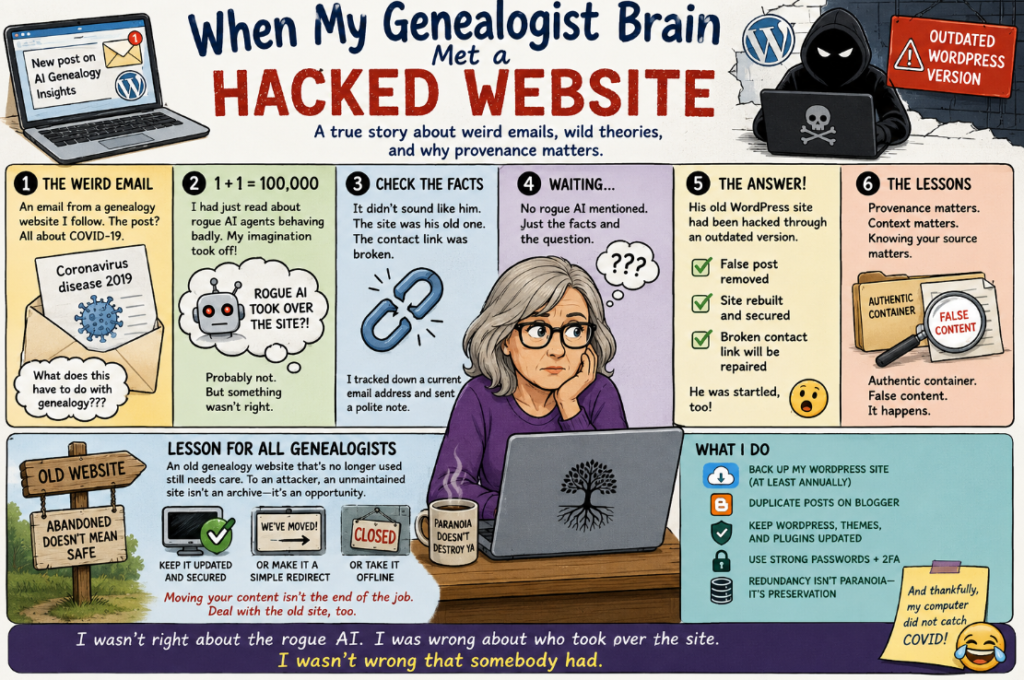
It came from an AI genealogy blog I have followed for years. The post was titled “Coronavirus disease 2019.”
That was pretty much what it was about. COVID-19 symptoms. Transmission. Testing. Vaccines. Prevention. Treatment.
I stopped reading.
What in the world did this have to do with genealogy? Or artificial intelligence? More importantly, this did not sound remotely like the person whose work I knew.
It was late, so I decided I wasn’t dealing with it. This morning, I looked at the email again. It was still weird.
Then My Imagination Got Involved
Unfortunately, I had recently read a news article about AI agents behaving in unexpected ways during testing. Claude was mentioned. OpenAI was mentioned. There was even discussion about whether some AI behavior constituted “cheating,” although I wasn’t entirely convinced that was the right word. Perhaps the AIs were simply working very hard to solve the problems humans had given them.
So there I sat with two completely unrelated pieces of information:
- AI agents had reportedly done some unexpected things.
- An AI genealogy website had suddenly sent me an inexplicable article about COVID-19.
My genealogist brain immediately performed the following calculation:
1 + 1 = 100,000.
Had some rogue AI agent taken over the genealogy website? Had the machines finally escaped? Were my devices now infected because I had read an article about a virus?
Okay, probably not. But something wasn’t right.
Stop. What Do I Actually Know?
This is where being a genealogist finally overcame my imagination.
I had a hypothesis. I did not have evidence.
The article itself wasn’t necessarily the problem. The problem was its provenance and context. It simply didn’t belong where I found it.
I knew the person behind the site and was familiar with his work. This didn’t sound like him. It wasn’t the type of material he normally published. There was no apparent genealogy connection. There was no obvious AI connection.
There was another complication. The author had moved his work to a new website months earlier. The old WordPress site was no longer supposed to be his active publishing platform.
Now I was genuinely curious. I decided to contact him.
That turned into another small adventure. The WordPress notification had come from a no-reply address. I couldn’t immediately locate the email address I had used to correspond with him several years ago. Then I discovered that the contact-email link on the old website wasn’t working.
Eventually, I located a current email address elsewhere. I sent him a simple message. I did not mention rogue AI. I did not tell him I thought someone had taken over his website. I simply explained what I had received, told him it seemed completely unlike his usual material, mentioned the broken contact link, and asked whether he had intentionally posted it.
Then I waited.
The Answer Arrived
He responded. I had been right to be concerned. His old WordPress site had been hacked.
The hacker had gotten in through an outdated version of WordPress. The COVID article was not his. He removed the false post, rebuilt and secured the site, and told me he would repair the broken contact link.
He was startled by what had happened, too.
So no, as far as we know, a rogue AI did not take over a genealogy website. My imagination had gotten considerably ahead of my evidence. But someone really had taken over the website. I was wrong about the culprit. I wasn’t wrong about the anomaly.
Why Did I Notice?
This is the part of the story that I think matters to genealogists.
There was nothing about the appearance of the email that immediately screamed “fake.” It came through the expected WordPress system. It pointed to the expected website. The website was real. What was wrong was the content in context.
I knew the creator. I knew the type of material he produced. I knew what his website was about. The new information didn’t fit what I already knew about the source.
Genealogists encounter this problem constantly.
A document may be authentic while information contained within it is wrong. A record may appear in exactly the repository where we expect to find it while referring to a different person. A perfectly reasonable fact may become unreasonable when placed alongside everything else we know.
Provenance matters. Context matters. Knowing your source matters.
And perhaps most importantly, recognizing an anomaly does not give us permission to invent its explanation. My “rogue AI” hypothesis was entertaining. It was also unsupported.
So I did what genealogists are supposed to do. I went looking for better evidence. In this case, I went directly to the person who could answer the question.
There’s Another Lesson Here
The incident also made me think about something genealogists don’t discuss nearly enough: what happens to our old websites after we move on?
The owner of this site had already moved his material to a new platform. The old WordPress site was no longer needed as his primary home.
But the old software was still there. That distinction matters.
An abandoned website isn’t necessarily an abandoned file. A WordPress installation is software running on a server. If it remains online, it still needs security updates and maintenance even if nobody has written a new post in months.
If you move your genealogy website somewhere else, finish the move.
If the old site no longer serves a purpose, take it offline. If it needs to remain available, keep the software updated and secured. If you want visitors redirected to your new home, consider replacing the old installation with a simple static page rather than leaving an unnecessary content-management system running indefinitely.
And if you still actively use WordPress, keep WordPress itself, your themes, and your plugins updated. Remove what you no longer use. Maintain backups. Protect administrator accounts.
I will be checking my own WordPress installation today. I already back up my site and duplicate my posts on another blogging platform because I have long believed in redundancy.
Or, as I prefer to put it:
Paranoia doesn’t destroy ya.
One Last Thought
This entire episode began because something simply didn’t feel right.
That feeling wasn’t evidence. But it was a reason to investigate. There’s an important difference.
Genealogists develop instincts after years of working with records. We notice names that don’t quite fit, dates that seem slightly wrong, sources appearing where we wouldn’t expect them, and stories that are almost—but not quite—consistent with everything else we know.
Those instincts are valuable. They are not conclusions. Use the instinct to formulate the question. Then find the evidence to answer it.
Yesterday I received an inexplicable COVID-19 article from a genealogy website. For a brief moment, my imagination supplied a rogue AI. Reality supplied an ordinary hacker exploiting outdated software.
The hacker was less exciting. The lesson was considerably more useful.
And thankfully, my computer did not catch COVID.