On Tuesday, a new FREE database became available – Enslaved: People of the Historic Slave Trade lists 500,000 individual names of the once enslaved. You may browse by entering a person’s name, place, event or source. I gave it a whirl yesterday and although I didn’t find what I was looking for, think it’s a wonderful source to add to every genealogists’ tool kit.
The site is definitely a work in progress but then, so is every genealogical database. The goal is to enter as many names/places/events that documented an enslaved individual. With many records held in private hands, that has made the endeavor all the more difficult.
It’s been estimated that there were over 10 million Africans who survived the passage to the new world in bondage. The majority were transported to South America, Brazil in particular.
The enslaved who resided in Roman Catholic areas were often Baptized. Hence, names are more likely available. Unfortunately, that was not always the case. Entering the search term “Brazil” in the database provided me with 45,753 responses but the majority do not provide a name for the enslaved. Instead, a name of the seller or purchaser is given with a date.
I have been trying to identify the names of the enslaved individuals who were probably brought from Barbados to the New Jersey Colony by my 7th “great*” STEP grandmother, Thomasin Hassell Holinshead about 1720. Thomasin’s father was a sugar planter in Barbados. No records have been found of his death or the sale of his plantation although the location has been discovered on island maps.
Thomasin’s husband, my 7th great* grandfather, Daniel Hollin[g]shead was not a man of means but happened to marry for the second time the sugar heiress’ daughter. Within four years of the marriage they had relocated to New Jersey where Daniel sold vast tracks of wilderness. He died intestate (of course!) in 1730.
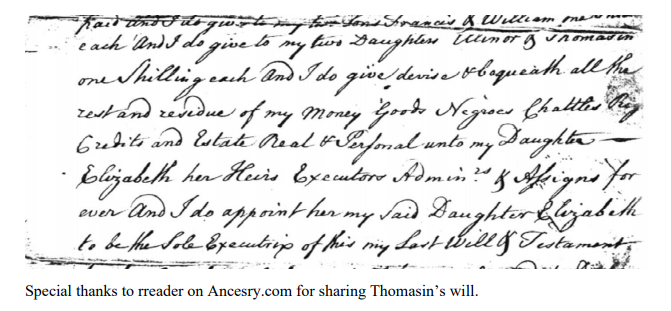
I only know of the enslaved individuals from Thomasin’s will of 3 Jan 1757 made in Somerset, New Jersey. She interestingly selected her youngest daughter, Elizabeth, to serve as administrator. Records exist that Thomasin was not pleased with her oldest son, Francis, who had served as administrator for his father, Daniel’s estate as he squandered most of the funds. Thomasin left him and her other surviving children 1 shilling, about $15.30 in today’s money. Says alot!
The clip above shows the part of the will that provides me the clue that Thomasin had enslaved individuals. I do not know:
How many?
Ages?
Gender?
Names?
How long they had been with her?
I have tried to find a will for administrator Elizabeth but her life is sketchy. Mug books mention that she married late in life and had no children. Her husband’s name has been recorded as Thomas Dean of Abington but that, too, is odd. Elizabeth’s brother, William, had relocated to Bucks County, Pennsylvania and named a daughter Elizabeth. That Elizabeth was the second wife of Thomas Bean of Abington. I’ve seen dates of birth for Thomas Bean ranging over 20 years so maybe there was more than 1 as there was more than 1 Elizabeth Hollinshead. No record for a Dean was ever found.
I tried the enslaved database to see if I could find any sale for a Holinshead (with multiple spellings) for New Jersey or Pennsylvania. Zilch. Then tried for New Jersey which lists 78 people and Pennsylvania, showing 244. None were in the areas I was looking for – Somerset County, New Jersey and Buck’s County, Pennsylvania.
Although I wasn’t successful I applaud the site for it’s compilations so far, ease of use and making it free which ironically, lists all those who weren’t.
*NOTE – clearly they weren’t so great enslaving individuals and other records found show Thomasin wasn’t so great to my 6th great grandmother, her only stepchild, but that’s another story.
With the holidays around the corner and the zingers of 2020 impeding the typical holiday shopping spree, I’m providing my guide early this year to insure the shopper stays safe and the receiver gets the gift on time.
Most of these items can be purchased locally so do try to support your small businesses and organizations. Others can be purchased online but please buy soon so that the chain of folks that helps you get the item aren’t stressed even more than they already are. Let’s show some gratitude we’ve survived this wretched year and spread the kindness!
My gift guide includes items for a few dollars and up into the hundreds as I understand it’s been a tough year financially for just about all of us. As my mom used to say, “It’s the thought that counts.”
1. A comfortable desk chair – Hubby and I purchased two in May as we were spending so much time in ours and mine refused to let me adjust the height. We had it delivered and assembled ourselves but if that’s not an option use NextDooor to find a local handyperson who can do the assembly on the porch. Your genealogist’s back will thank you.
2. A Second Computer Screen – If your genealogist is using only one screen it’s time to add another; I’ve had two for years but I honestly could benefit from more. Sometimes I put the laptop next to my work area for a 3rd view when needed. Sure, we know how to change the size of what we’re viewing but with old documents, sometimes we just need the whole screen. Your genealogist’s eyes will thank you!
3. A Magnifying Glass – If the To Do list includes going through boxes of old family letters or photos, a magnifying glass, with or without a light, is a must. Think Sherlock Holmes, here – the smallest clue might be missed that could solve the mystery so an inexpensive magnifying glass might just save the day.
4. Assorted Coffee/Teas or a reusable water bottle – whatever is the preferred non-alcoholic drink is a well received gift for anyone but especially the genealogist who needs a quick caffeine jolt or calming tea. I stress the non-alcoholic for a reason – your genealogist needs clear analytical reasoning so skip the booze. A reusable water bottle with a tight fitting lid is also a great idea to stay hydrated without risking a spill.
5. A foot massager – which can fit nicely under the work area. If it has a heat feature it makes it even better on those long cold winter nights of researching.
6. An elliptical for sitting – When in the researching zone, we often forget to get up and move. This handy exercise device allows for individuals to sit and move the lower legs. I love to see how many “miles” I’ve gone without leaving my desk. If your genealogist has a standing desk, the device still works. Until we’re able to go back to running up archive stairs or parking in remote and walking to the library, the sitting elliptical will get a lot of use.
7. Gift Cards – to your genealogist’s local restaurant, grocery or office supply store. If you aren’t sure what your favorite genealogist’s office needs are, know they have to eat! Less time cooking means more time researching and you’re supporting the local economy which makes this a win-win for all.
8. An annual subscription to a new site – This year I joined Academia.edu and I absolutely love it! I was trying to research Barbados in the 1600’s and there isn’t many records that I found useful. I wanted to better understand what life was like there and Academia.edu helped me with that goal. Journal articles are available on a wide range of topics and the site also hosts members to have a webpage so others can connect with them. JSTOR.org is another awesome site that provides journal articles and books that may be of interest. Plans start at $19.50.
9. Donation to a local genealogy/history society – with long term closures and the deaths of members, many organizations are suffering. If your genealogist says – “Don’t get me anything!” then follow their directive but give in their name to an organization that they support. Typically, I’m a doer and not a donator but this year I have given to several organizations that I wasn’t able to support in person.
10. Last but not least – Give the recipient time by listening. I’m serious. Although this monetarily costs nothing it is probably the most valuable gift that can be given. We know you could care less about your fourth cousin twice removed who married your third cousin once removed. Just try to look like you care. Back in the day when the world was “normal” we could attend conferences and meetings to share with others the great discoveries we made. Simply listening is a wonderful gift to give!
Skipped blogging last weekend because I was consumed by work from my other job – lots of teaching units were cut in my district and I was tasked with making new schedules for students. Planned on blogging yesterday and got attached by wasps so my hand is swollen and I’m typing with only one hand now so this will be short!
Did the Tombstone Cake work in helping me find new info on my brick wall ancestors? Sort of! I ended up selecting Hannah Byrd, one of my paternal 4th great grandmothers, who was born in New Jersey and died in Ohio.
With all the way to spell Byrd – Bird – Burd – Berd, it’s always made the search difficult.
My mistake was thinking that she was born in Sussex, New Jersey as that is where her husband’s family was from. I decided to research the only other Bird that lived in Trumbull County, Ohio at the same time she did and discovered he was born in New Jersey but not Sussex. Looks like his father was born in Sussex but moved shortly after marrying to southern New Jersey. So I’ll be following the trail to see if I can connect the two as they are about the same age and could be siblings or cousins or not.
Funny, though, I decided to randomly pick a Kindle free book for October and chose Spellbreaker, a fiction story about a young witch in London who does not cast spells but breaks them. Sort of like a female Robin Hood who helps the peasant farmers when the Baron claims they never paid rent and have to repay. Had to laugh as one of the main characters just happens to be from Barbados. My goodness, those Hollingsheads just won’t let me move on!
Had a strange Sunday morning courtesy of my family.
I got a wake up call from one of my adult kids asking me to list my top 12 dead ancestors that I needed info on. That made me laugh as I was thinking yesterday I need to move on from my Duer-Hollingsheads who I found a wealth of info for over the summer and now things have dried up. Like most of the world, I’m over the pandemic and am starting to make plans for when we can travel again. While gardening, I thought I would list relatives I planned on researching by geographic region so that I could identify areas for trips in 2022 (yeah, I’m being overly cautious here.)
Within minutes I emailed my kid a list of 24 ancestor brick walls – 12 on my side and 12 on my husband’s side.
A few minutes later I got another call that said, “Mom, you have to pair that list down to 12 total!” Okay, sigh, 6 from each list.
Since I was already on email I started reading and found I had two Ancestry messages over night and one email message addressed to my website. Two were regarding Leiningers and one was Harbaugh. People who discovered books and photos as they were cleaning and looking on Ancestry or my blog, found the named folks on my tree. They were hoping to give the items a new home. Since I didn’t list one Harbaugh or Leininger on my brick wall list, this was personally hysterical as those two lines always seem to nudge me when I am working on other family.
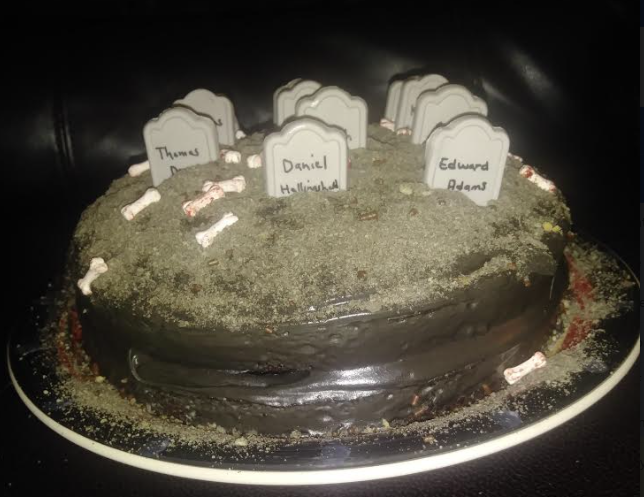
Minutes later, my kid brings over the cake pictured above. On each tombstone is one of the names I had supplied that are a brick wall. The chocolate pudding cake with cream cheese frosting was delicious. The “dirt” on top is crushed Nilla wafer cookies dyed with food coloring. Child had bought the cake mix at the start of the pandemic and said, “Let’s bury this thing and move on.” I agree!
I also got a homemade awesome Ancestor Hunter T-Shirt. Neither of my kids have interest in genealogy but they are crafty and when the mood strikes, no telling what they’ll come up with.
The weather was beautiful so we decided we’d have cake and coffee outside. I was walking down the cobblestone path my husband had installed several years ago and took one step off onto the “grass.” Unbelievably, my right leg sunk to mid calf. My kid grabbed me as I sunk, originally thinking I had lost my balance and was about to fall.
There is a reasonable explanation of why the ground gave way in that spot – we had a heavy rain last night and several years ago, a 200 + year old oak tree had been growing there. We had to have the tree removed after a third of it blew down in a hurricane. The roots have been decaying for years and we guess, with the heavy rain, the ground just collapsed.
I’ve never been stuck in quick sand but it was a creepy feeling to all of a sudden just sink into the ground. I had difficulty pulling my leg back out of the hole. Don’t know if my ancestors were ticked off or not but it was weird to be holding Daniel Hollingshead’s candy tombstone while I sunk over a foot into the ground. Yes, I know I need to move on from Daniel but I am still searching for his lost Bible so he remains up on the top of my list.
We settled down to eat a slice of cake and child says, “I had real trouble with one of the tombstones. Catherine Jarvis’s keeps falling over and hitting Wilson Williams.” Umm, Catherine was Wilson’s daughter-in-law! They lived near each other in Long Island, however, Wilson’s “stone,” which I have blogged about in the past, is no longer in the cemetery next to his wife, Margaret Hicks. It was this same child of mine that had discovered that at the Family History Library several years ago. Of course, with no interest in genealogy, there was no remembrance of the names and the finding.
If there’s a message in all this I have no idea what it would be. I re-read my original Wilson and Margaret posts you can find here and here. They are still on my brick wall list as I need further proof of their parents. Family lore gave me the parents’ names but I have no proof of that. I’m thinking that’s who I need to research this afternoon, along with Catherine Jarvis.
If I find something wonderful I will definitely share it and use this unique approach again! Since the world has certainly gone insane a novel way to research just might be what’s needed. Consuming the name of a dead relative on a candy tombstone is weird but fits right in with the spirit of the month. Happy Hunting!
Ancestry.com has again updated their DNA Results Summary. Sure, it’s only as accurate as the number of people who have tested. What my latest results tell me is that Ancestry has had a whole lot more Swedish, German and Slavs testing and not many Balkans.
I know this because the updated results show I am 42% Eastern European and Russian and 41% Germanic Europe.
In Ancestry’s last update, I was considered French; today I am of German ancestry.
My paternal line would not have thought much of that finding; with a name like Leininger they would have accepted the Germanic Europe as fact. The truth is more complex – the ancestors that were forgotten most likely would have been livid with the designation as they considered themselves French. My two times great grandmother was christened as Marie Marguerite not the Germanic Maria Margarette. Her spouse was christened Jean Leininger and not Johan. They resided in the Palatinate, the region that flipped several time between what is now Germany and France. They wisely spoke both French and German. Funny that the land has stopped switching but the ethnicity indicators haven’t. Ancestry would be smart to have a Palatine region noted instead of moving ethnicity results every update.
Interestingly, the results do include 5% of an ethnicity estimate as French and the region is the Riviera, where my Lamphere’s (Landfairs) did reside in the 1600’s prior to fleeing France for London and then Ireland and then Virginia. It appears they intermarried with relatives and others who fled with them and that is somewhat supported in that I now have no Irish identified. Well, that’s not quite true, either…
My Irish is encompassed under my Scottish designation.
I also find it interesting that I have Welsh separated from England (which encompasses Northwestern Europe now). I am most definitely Welsh with my people moving to Cheshire for a time. That is shown in the map, along with the northwest section of France. That is also correct as I have some William the Conqueror folks originating in that French region.
My maternal line, though, would have my grandmother in requesting her money back.
Family stories shared by my grandmother say her side moved to the what is now the outskirts of Zagreb, Croatia around the time of Christ because of overpopulation on the island to the south where they once resided. That would most likely have been Kos Island, part of Greece today. The now defunct National Geographic project did route my ancestry on that trail. Grandma said my grandfather’s people had already been in the Zagreb region when her people arrived and they had been Gypsies. National Geographic’s results showed that, too. Using records, I can show that my maternal line was in the Zagreb region as far back as the 1600’s. Based on a title the family was awarded, I can show some were in the region as early as the 1100’s. For 900 years, they resided in a small area in what is now known as Croatia. According to Ancestry, I’m 3% Balkan.
Explaining to my grandmother how Ancestry obtains their results would have been maddening. I’m sure some of you are going to have to try with an older relative. I send you good thoughts in doing that!
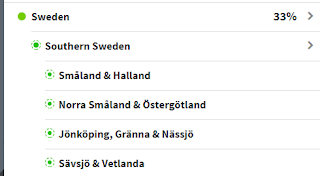
I am quite impressed, though, with Ancestry and their Swedish results. Look above as I have shown how Southern Sweden is shown by region. I have worked very hard to get most of my husband’s Swedish lines identified and they are from the area Ancestry identified. I’m looking forward to someday seeing a trend like this for my other ethnicities.
Ancestry has also released a section called StoryScout. It’s housed under DNA and includes information that you may have provided in a tree. I didn’t spend much time on this but I did take a look and it reminded me of something that is important to do and I honestly fail at it.
The section is based on census and military records from the 20th century. Sure, I’ve saved those records to my ancestors 20 plus years ago. I know where they lived, who they lived with, blah blah blah. What gave me pause, however, was that it correctly showed my maternal grandfather and noted that his income was nearly twice that of an average man at the time. He made $1400.00 per year when the average was in the mid $700.00’s. Wow. This explained to me why my immigrant family could afford a car in the 1920’s, a phone in the 1930’s, travel to California in the 1940’s and to Europe in the ’60’s. Now I understand why grandma, when babysitting me, would drag me to the nice stores and dress shops and had her hair done each week. Duh! They never flaunted their wealth and dutifully shipped supplies several times a year back to the old country. Thanks, Ancestry, for taking one small data point in the census and giving me an insight I hadn’t he thought about. Try it, it might work for you, too.
Last week I blogged about my Evernote account being hacked. I reached out to some tech savvy colleagues for advice and wanted to share something with you that might be helpful.
An IT engineer recommended that I check my email accounts for hacks by visiting https://haveibeenpwned.com
That’s not a typo – it is pwned and not owned!
Enter your email address on the page and click pwned?
I have several email accounts and I entered all of them to check. I was surprised to find that one had been breached. It was a government site from last summer that I use for genealogy research. I changed the password on that site and just to be more secure, changed my email password.
While changing my password I had another “Aha!” moment; I never took the time to really check out my email Security settings. The devices I have connected to the email are shown but I had to pause at the Third-party apps with account access. My bad for not reading the small print and clicking “I accept” when visiting an organization’s website! I had given permission unknowingly to two retail organizations to have access to my calendar and contacts. It was quite easy to disable that! I’ve begun my holiday shopping so after I’m done, I plan on rechecking my email account to see if I somehow give permission for access that is unwarranted.
Just like covid, behind the scene activity to your tech tools can maliciously effect you! Take a few minutes to check it out and stay safe!
I haven’t used Evernote in awhile, so imagine my surprise this morning to receive an email that someone with a Mac in India signed on to my account 7 hours earlier. Definitely wasn’t me or anyone I know!
Being somewhat paranoid, I tend to not click on links sent to me in emails. Instead, I used my current Kindle to go directly to Evernote online as I haven’t downloaded the ap to that Kindle.
Another surprise – I was unable to disable the device as my account was accessible only from the Kindle that I had the ap downloaded to. I’m really not understanding that since the hacker didn’t have the Kindle with the ap on it! Unfortunately, I’m not tech savy enough to figure out how to access my account on a different device so I then spent time on a Kindle hunt to find the device with the ap.
Took me a few minutes to figure out where the old Kindle was and to fire it up. After getting through the ad to purchase more Evernote services, I clicked on Settings and Devices. Sure enough, there was the hacker’s device. Clicking “disable” hopefully blocked the hacker from having some afternoon fun with my account.
The hacker didn’t find anything useful as after taking notes, I transfer them to whatever computer I’m using as soon as I’m done with a meeting or archive visit. I keep nothing on Evernote. That practice wasn’t established because I didn’t trust Evernote to keep my documents safe; it was my process to use Evernote in settings that aren’t conducive to paper and pens/pencils, such as in a library stack or outside at a cemetery with the wind blowing. Now I’m glad that was how I used the ap!
I decided it would be wise to change my password. I’m a little miffed with Evernote as you cannot easily do that. The directions online say to go to Account Settings and click Security Summary. I don’t have that, possibly because I never purchased an updgrade package. My only option to update a password is to email them and then they send me an email and then I go back to their site and change the password. All this for a device I don’t even use any longer.
So, adieu, Evernote. I’ve uninstalled the ap on the old Kindle after clearing the cache and signing out of the account. I won’t be downloading it to my new one, either. When the pandemics over I’ll be using the note ap on my cell instead.
With only 3 days left before Ancestry.com pulls the plug on your access to old messages sent to you in their system, you’ll need to follow the instructions below soon or your old correspondence will be lost.
It’s quick and easy but times a wastin’!
First, after logging in, click on the envelope icon on the right side ribbon next to your sign on.
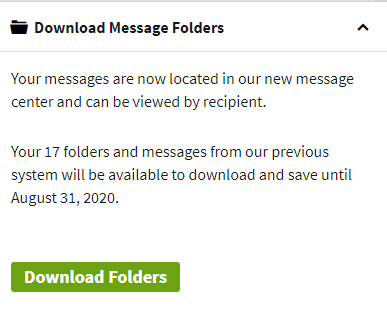
Next, you’ll see swirling circles while the page loads. On the bottom left the following message will be displayed:
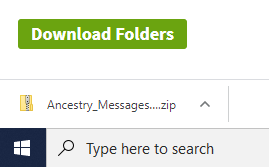
Click the green button “Download Folders” It doesn’t take long. Underneath the button your messages will be downloaded to your computer as a zip file:
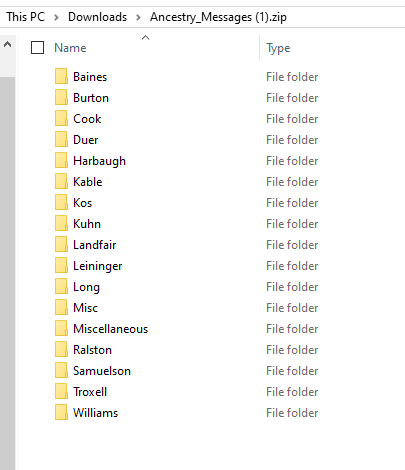
Clicking the zip file will display any folders you may have created to save correspondence. Mine looks like this:
It is saved to your computer’s download file. Go to the Download Folder on your computer, find the file and drag it to where you want to save it. For the purpose of this blog, I just moved it to my desktop but will be placing it in a Cloud.
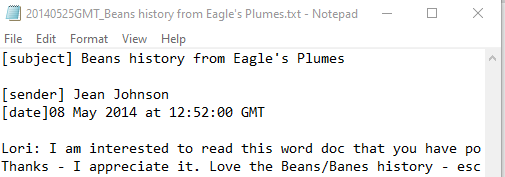
To view a message, simply click on it. In the Baines folder, the message will be saved to look as follows:
Yes, just like the comedian “Mr. Bean,” I have Beans in my family!
This simple task will take you less than 5 minutes. Why would you not want to save information from far flung family members? It’s also a good way to go back through old correspondence as a missed clue may be unveiled. Many of my messages contain email addresses and if I haven’t written to the individual in awhile, I might not be able to locate the address quickly if I need to in the future. Since you just never know where genealogy is going to take you, I’d rather be safe then sorry by saving the data today.
I’ve been consumed with my Hollingsheads for the last two months so I’ve not blogged about a few awesome resources I’ve come across that may benefit you. Some are free, some are not. Here they are:
MyHeritage Photo Enhancer is a wonderful tool not just to fix blurry photos but also get a better view of fuzzy documents. I tried this out in June when I was having difficulty transcribing handwriting from a Quaker document. I also tried it on an extremely blurry group photo I had of my husband’s Harbaughs but the original photo was too small so it didn’t work well. You can read more about this here.
New York Genealogical and Biographical Society began Beta testing in March their new online collections. I was not a participant due to other commitments though I did use it briefly in June and July when I was in need of New York records. Here’s more info about the update.
Want to attend a training/conference/Zoom/GoToMeeting, etc. session but know you’re not available at the day/time it’s being presented? No worries – most organizations will record and make the session available for viewing later. Go ahead and sign up anyway. You’ll probably get an email with a link to view later. I had to miss an APG Virtual Chapter meeting in June and an American Ancestors class in July but was able to watch what I missed at my convenience later. So, go ahead and sign up for the event even if you can’t attend!
Academia.edu is a new tool in my toolbox and I honestly couldn’t have analyzed my Hollingsheads in Barbados as I did without it! There is a membership fee, ballpark about $50 annually, that I’ve more than gotten my money’s worth in the last two months. The site allows you access to unlimited journal articles and papers by educators on a wide variety of topics. I selected history and the Caribbean in particular to learn more about the time period I was researching (1650-1750). That allowed me access to archaeological studies recently done to gain a better perspective of what life was like then, historical works revisited (so I could easily find primary sources), and opportunity to contact social scientists with questions directly. The site is not just for history enthusiasts but that’s the only part I’ve used. Membership also provides you your own website, which I have not set up since I already have my own, but it’s a nice feature and looks like it’s quick and easy to use if you’re new to webdesign. If you’ve used JStor, this is similar but I’ve found that it contains more info if you’re focusing on a sliver of time and place.
Don’t forget YouTube and your local Genealogy Society! I recently watched a wonderful video about River Pirates. I had no idea there was such a thing in the Midwest, nor was I aware of some of the terror that reigned in small communities due to deranged families. It also never occurred to me that there was poor workmanship back in those days that resulted in lives and supplies being lost. I heard about the topic from my local genealogy society; one of the member’s brother was the speaker and I’m so glad I viewed it. Hubby and I went to school in Indiana and that topic was never addressed in the curriculum!
Last but not least, and probably more important than everything mentioned – if you haven’t noticed Ancestry.com has updated their messaging system. Gone are the folders you may have previously used to save correspondence with other members. You can download it so you don’t lose anything. I strongly urge you to do so TODAY as it will be gone this month. I don’t know what they did yesterday but I had 11 messages. I had recently reached out to several folks who had some Hollingsheads in their trees but it wasn’t 11. In reviewing the messages, I discovered most were not new (9) and the two that were were old – one was from November 2019 and the other from June 24, 2020. Guess they got lost in cyberspace but it did make me look bad as I try to respond within 48 hours! Check out this feature to see if the update they did before dawn’s early light this past week affected your messages.
Ever wonder what happened to an object that was once held in high regard in your family but has since disappeared? Maybe you aren’t sure if there ever was such an item but you’d like to explore the possibility. This blog is for you… When I began internet genealogy back in the 1990’s we still had dial up service. Remember that? Going through your home phone line to connect resulted in no one being able to get a phone call while someone was surfing. With all the junk calls I get daily, I’m thinking that wasn’t such a bad option, but I digress. Back then, my husband would joke that it was okay he couldn’t make a phone call because I was hunting down the family jewels. Clearly, our families never had much jewels but I did wonder whatever became of the muskets or hoop skirts or Bibles. Most likely, the muskets broke and when the hoop skirts were no longer haute couture they were either repurposed or trashed. The Bibles, however, never went out of style so what happened to them? Your first step in locating the long lost item is to research if it ever was. Start by asking your oldest living relative. I know that no Bible was brought from the old country by my maternal side because I asked my grandparents, who were the gateways, if they brought it with them. Both said they brought one suitcase filled with clothes. Case closed, pun intended! I never asked my paternal grandparents that question, though, because my grandmother died when I was a child and my grandfather remarried, moved away and we never had contact again. My father then became the oldest relative and his reply was, “You’ll get the book when I die.” Huh? I questioned further and he meant there was a family history book that had been written in the 1970’s and he intended for me to have it. Except that didn’t happen. Since my step-mother would not give it to me, my second step became casting a wider net. I had two aunts but neither responded to a letter I wrote (this was before wide use of email) so I posted on a genealogy website that I was looking for a copy. Two people responded that they had copies and provided me a look up. One even reached out to the author who was living in Europe and he sent me an electronic database of his book. Today, you can easily accomplish this by messaging distant family members who have online trees that contain the ancestor whose information you’re seeking or you can check worldcat, Google Books, Hathi Trust, Internet Archives and Archive Grid to see if the whereabouts of what you’re hunting is listed there. Facebooks’ Family Treasures Found would be another site to check. One of my aunts eventually responded and sent me her copy. Patience is key here for lots of reasons; perhaps the site you messaged isn’t used much by the recipient or life just happened to get in the way. In my case, my Aunt wanted to check with her two daughters to make sure they had no interest in the book. They didn’t so that’s how I ended up with a copy. Actually, I ended up with two copies because my step-mother took pity on me after my mother died and gave me the book. So now, I have two – one for each of my kids or for another family member that may sometime in the future contact me with the same request. Getting the information through look up was wonderful, however, if what you’re seeking is a one of a kind item then this approach may get you closer but not really fill your need. Step 3 will save you time and it’s quite simple – just go online and research if what you’re seeking is documented to have existed and if so, when and where was it’s last location. If you’re following me, you know that I’ve been working all summer on my Hollingshead line. In my research to verify the identify of Daniel Hollingshead in three locations (England, Barbados, New Jersey Colony) I looked everywhere online and emailed numerous archives to check for information that hasn’t been digitized. It was during the online portion of the research that I discovered Daniel had brought a Bible with him from England as it was noted in old biographical books highlighting descendants in the late 1800’s. To aid in keeping the whereabouts of the Bible’s locations known, I went to Step 4, I created a timeline. For simplicity here, I’m not including the source citations but my timeline in Excel notes exactly where the information came from so I can analyze it later: 1683 Leicestershire, England – Daniel’s birth as reported in 5 books (1965, 1911, 1900, 1886, 1882) Lancashire, England – Daniel’s birth place as reported in 2 books (1870 & 1857)1686 Leicestershire, England – Christening record for the 2nd Daniel born (1st Daniel 1679-1685)1688 Bible printed in Oxford, England You can clearly see the problem with the conflicting place and dates. Further research shows no Daniels born in Lancashire during this period. Only two Daniels were born in Leicestershire during this time, both to the same parents. Probably every book is wrong with the birth year as there would be no reason for the family to name a 2nd child Daniel until the first one was deceased. Yes, some families do that but this line hasn’t shown that to be the case although they often reuse names when a child dies. More likely, Daniel 2 was born between 1685 (1st Daniel’s death) and 1686 (christening record). Typically infants are baptized soon after birth but that might not have been the case. A family member may have seen the 1683 recorded but was really written was a sloppy last digit that should have been a 5. Here’s another problem the timeline unveils – the published date of the Bible would be AFTER Daniel’s birth, no matter what year is correct. Still, I want to locate it as it would hopefully confirm the birth location and would have been the next closest document made to Daniel’s real date of birth. Here’s the next problem – The Bible mentioned in some of the books state that Daniel brought the Bible with him when he came to New Jersey. I need more info to further develop the timeline. If you’re wondering why I would need to know where the Bible was kept that long ago it’s simply because if it is found, I need to understand how it was passed along. Since I don’t know if the Bible contains any genealogical information as many Bibles exist and families don’t record vitals in them, I need to know where it’s been so I can validate the information it contains, if any. Ship manifests haven’t been found for him so it’s not known exactly when Daniel emigrated. The books mention he, along with several brothers, were in the Battle of Blenheim. So, did Daniel take the Bible with him in battle (August 1704)? No clues there. Did Daniel return to England after the battle? Don’t know! At the time of the battle Daniel was not the oldest son so the Bible would have likely been in the possession of a brother who died in battle. If the Bible had been brought to Blenheim, Daniel would have assumed ownership of it at that time. It’s probable he did return to England after the battle and took the Bible with him when he decided he was permanently leaving England so that would have been between 1705-1711. The last date is when his first child was born in Barbados; since he met his wife in Barbados he probably arrived between 1705-1710. So my timeline continues: 1705 Battle of Blenheim (now Germany)1711 Daughter born in Barbados1714 Wife dies in Barbados1715 Daniel listed in Barbados census1716 Daniel remarries in Barbados1717 Daniel purchases land in New Jersey Colony1717-1718 Two children born to second union in Barbados1721 Beginning of numerous land sales in New Jersey Colony1730 Daniel dies intestate in Somerset, New Jersey Colony Step 5: To determine where the Bible went after Daniel’s death is to expand the tree to include all of Daniel’s children from both of his marriages. You also must keep in mind customs from the time period. Understanding how the family thinks is key to finding the current location of the item. My line follows Daniel’s first child, Mary. She would not have inherited the Bible for several reasons – she was from the first union and she was a female. Clearly she was not a favored child by her step mother as she was not named in the will. Daniel had older sisters in England so if the family was unconventional for the times, an older sister and not Daniel would have kept the Bible after the oldest sibling died. I know that Mary did not have the Bible as there was no documentation found in her line to ever note she had it. There is no documentation that any of the female children ever had it. Daniel’s eldest son, the second child, would seem the person to have inherited it but that does not seem to be the case. Numerous books and documents show that Francis did, as the oldest male, manage the assets after Daniel died intestate and quickly lost them. From the will of Thomasin, Daniel’s second wife, she acknowledges his ineptitude by naming one of her youngest daughter’s as administrator to her estate and gives each of her adult children only a shilling. Her manumitted slaves receive most of the proceeds from the remaining estate. You may think that the administrator would have received the Bible, since she was given the responsible task of handling the final paperwork, however, she had married late in life and had no children so she did not get the Bible. Two of Daniel’s male sons had died before his second wife. They had no children so we can eliminate them from the hunt. That leaves one line – 6th child, 3rd son William. Oh joy, William had 9 children. This may seem overwhelming but following what we know – most likely to be passed to a MALE with CHILDREN, we can quickly eliminate who got it. It appears that son James inherited it as books from 1882 & 1886 state his son, Stroud Jacob’s wife, had the Bible in her possession after Stroud died, along with “old family papers.” So now I want to find both the Bible and the papers. First, I want to understand why Stroud had the Bible. He was the third son and fourth child. The eldest died with no children, we can skip the female (sigh) and the next son left to go out west and never married. Makes sense why Stroud would have it. Fast forward to 1900 when the Bible was known to be in the possession of one of Stroud’s grandchildren, a Jeannette Jackson. WOW! How did a female get so lucky? Times were a changing and it seems everyone of the now fewer children got something. Harriet, the oldest, had died but her oldest daughter was Jeannette who got the Bible. Stroud’s second child had died childless. The third child, James’ son received a breast pin that was passed down to Edgar Pinchot Hollingshead. The eldest, a daughter, received a painting on ivory of one of Daniel’s sons, William (same line). Now this should be easy, right?! 1900 wasn’t that long ago and so we just need to track Jeannette and we’ve found the Bible. Not so fast…Jeannette died unmarried and childless in 1923. Two brothers predeceased her. Her sister married but had no children. Now we’re at a dead end. Not! STEP 6 is to research further in new areas. Since we’re looking for a record from less than the last 100 years newspapers are the way to go. Thanks to a “cousin” helping me with the search, a record was found in a Pennsylvania paper (and the Bible came to New Jersey first, remember!) that said an Elizabeth Malvern Hollingshead was going to “loan” the Bible to a local historical society in 1924 for an event that was to be held. Loan is the key word here but still, I reached out to the historical society to see if a) they still have it on loan or b) they reborrowed it sometime since and know where it is. Alas, they do not but they do have the “old family papers.” Bingo! I’ve at least traced part of the missing items. I’m awaiting their lookup for confirmation of vitals. Now it’s time to go back to Step 5 and trace Elizabeth’s line to the present. That was done and the most likely candidate was emailed at his work email. He hasn’t responded. I know he’s reading his work email because it was an interesting system – it notified me that he had been on the site the previous day to my email. Finding a long lost heirloom is a matter of patience and persistence. Keep notes, enlist others to lighten the load and you will hopefully find what you seek. Happy Hunting!