
The Mystery of Mary Harbaugh

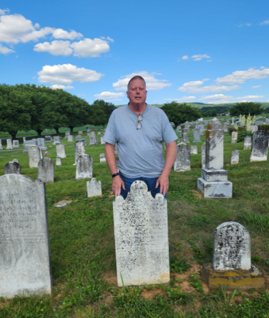
Jim Samuelson in front of Mary Harbaugh’s grave, Harbaugh Church Cemetery, Rouzerville, Franklin, PA Photo by Lori Samuelson 16 June 2026.

Every genealogist knows the thrill of finding a gravestone that has been hiding in plain sight and every genealogist knows the disappointment that sometimes follows.

Recently, while visiting Harbaugh family cemeteries in Pennsylvania and Maryland, I experienced both emotions on the same day.

The discovery began in Harbaugh Church Cemetery in Rouzerville, Franklin County, Pennsylvania.

I had visited the cemetery nearly ten years earlier while researching my husband’s Harbaugh family. During that visit, I failed to notice a weathered stone marking the grave of a woman named Mary Harbaugh who died in 1843.

This time, however, my husband Jim spotted it. I should not have been surprised.

Over the years, Jim has developed an uncanny ability to notice things I overlook. Whether it is a partially hidden gravestone, a faded inscription, or a clue buried in plain sight, he often finds what I miss.

Standing in the cemetery, I was delighted by the discovery.

The stone was difficult to read, weathered by nearly two centuries of exposure to Pennsylvania winters and summer heat. Yet enough remained visible to identify the woman as Mary Harbaugh and to establish that she died in 1843.

Naturally, my mind immediately began searching for an identity.

Genealogists are problem-solvers by nature. When presented with an unknown individual, we instinctively begin fitting pieces together. Who was she? How did she fit into the family? Why was she buried here?

Almost immediately, I convinced myself I had the answer.

I recalled that my husband’s third great-grandmother, Mary Garver, had died in 1843. She and her husband had lived in nearby Waynesboro. The dates seemed reasonable. The location appeared plausible.

For a brief moment, I thought the mystery was solved.

Then I looked more carefully. Genealogy has a way of humbling us. The Mary I had in mind was not Mary Harbaugh at all. She was Mary Garver Eyster.

Her gravestone still survives, not in Pennsylvania, but across the state line in the Harbaugh Family Cemetery near Sabillasville, Frederick County, Maryland.

The woman in Rouzerville was someone else entirely. Back to the drawing board.

At first, I was frustrated. After all, identifying an unknown individual is much more satisfying than admitting uncertainty. But the more I reflected on the experience, the more I realized it illustrates one of the most important lessons in genealogy.

A wrong answer is not better than no answer. In fact, one of the greatest dangers researchers face is the temptation to accept a convenient explanation simply because it appears to fit.

Dates align. Locations seem reasonable. Family names match.

Before long, a theory quietly transforms into a fact. Then the mistake gets copied. And copied again. And copied again. Eventually, nobody remembers where the conclusion came from. All they know is that everyone else believes it.

Fortunately, I caught myself before making that mistake.

The truth is simple. I do not know who Mary Harbaugh was.

Not yet.

She does not appear to have a memorial on Findagrave. No immediately obvious record identifies her. The weathered stone provides only a name, a death year, and a question. Yet that question may prove valuable.

Who was she? A wife? A daughter? A widow? A sister? Why was she buried in Harbaugh Church Cemetery? What relationship did she have to the surrounding families?

Somewhere, the answer may still exist. Perhaps a church register survives. Perhaps a probate record remains hidden in an archive. Perhaps a distant cousin will recognize her story. Or perhaps the answer will emerge from a completely unexpected source years from now.

That possibility is one of the reasons I love genealogy.

Not every cemetery visit produces a breakthrough. Not every mystery is solved before we leave the gate.

Sometimes we return home carrying more questions than answers. And that is perfectly acceptable.

Good genealogy is not measured by how many mysteries we solve. It is measured by how honestly we evaluate the evidence.

For now, Mary Harbaugh remains a mystery.

Her weathered stone stands quietly among the graves in Rouzerville, waiting for someone to tell her story. Perhaps one day that someone will be me.

Until then, I am content to leave her where she belongs. Not in the category of “solved.” But in the much more honest category of “still researching.”

Thus ends my cemetery series for the summer. Next week I’ve got some important info to share with you on making your AI experience more effective and efficient.
When the Tombstones Disappear

Genealogists spend much of their time searching for things that have been lost.

Missing records. Forgotten stories. Unmarked graves. Destroyed courthouses. Faded photographs.

We become accustomed to loss because loss is woven into the very fabric of family history research. Yet nothing prepared me for returning to a cemetery and discovering that the evidence I had once photographed had disappeared.

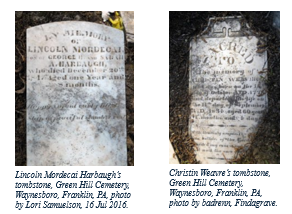
Ten years ago, I visited Green Hill Cemetery in Waynesboro, Pennsylvania, in search of several members of my husband’s Harbaugh family.

Their tombstones had not originally stood there.

The family had first been buried in Old Union Cemetery adjacent to a church. In 1923, after the property changed ownership, the graves were disinterred and reinterred at Green Hill Cemetery. According to cemetery staff, efforts had been made to notify descendants through notices published in local newspapers. Whether family members living elsewhere ever learned of the move is unknown.

By the time I visited in 2016, the stones had already endured one relocation.

They were worn; no longer standing they were placed flat on the earth. I photographed each one carefully.

At the time, I viewed the images as routine documentation. Like many genealogists, I had become accustomed to photographing tombstones whenever I encountered them. The task felt important, but not urgent.

After all, the stones had already survived for more than a century. Surely they would remain there for future visitors. Or so I thought.

This summer, while returning from a genealogy conference, I decided to revisit Green Hill Cemetery. I wanted to see the stones again.

Perhaps I would notice details I had overlooked a decade earlier. Perhaps advances in photography would allow me to capture inscriptions more clearly. Perhaps I would simply enjoy reconnecting with ancestors whose stories I had spent years researching.

Instead, I found an absence.

The hillside where the stones had once stood had been altered. The markers were gone. Completely gone. For several moments I simply stared at the space where I expected them to be. Had I remembered the location incorrectly? Had the stones been moved again? Had they been damaged? Had they been placed in storage?

I had no answers.

The cemetery office was closed, leaving me with questions and a growing sense of unease.

What troubled me most was not simply that the stones were missing. It was the realization that physical evidence we often assume will remain forever can disappear without warning.

Genealogists sometimes treat cemeteries as permanent repositories of history. In reality, they are vulnerable places. Weather damages monuments. Trees fall. Floods occur. Maintenance priorities change. Ownership changes. Records are misplaced. Occasionally, markers simply vanish.

The experience reminded me of the countless records I have searched for over the years that no longer exist. Probate files that disappeared from courthouse shelves. Church registers lost to fire. Family Bibles discarded during estate sales. Letters thrown away by descendants who did not recognize their value.

Every generation inherits responsibility for preserving the evidence left behind by those who came before. Sometimes we fulfill that responsibility. Sometimes we fail.

Fortunately, I had photographed the stones during my earlier visit. What once seemed like routine documentation now feels considerably more important.

Those photographs preserve information that may no longer be accessible in the cemetery itself. That realization changed the way I think about every cemetery visit.

Take the photographs.

Record the inscriptions.

Capture the surrounding landscape.

Document the location.

Don’t assume someone else already has.

Don’t assume the information will still be there next year.

Most importantly, don’t assume that stone is permanent simply because it has already survived for generations.

Family history exists in a delicate balance between remembrance and forgetting. As genealogists, we often focus on discovering the past. Perhaps an equally important task is preserving it.

The missing stones at Green Hill Cemetery reminded me that our ancestors’ stories are not guaranteed to survive. Their preservation depends upon ordinary people who care enough to record them before they disappear.

Sometimes we search for evidence. Sometimes we become its last caretakers. And sometimes, without realizing it, the photograph we take today may become tomorrow’s only surviving record.

An Ancestry.com Thank You and A FAN Club Hint

Mill’s Identity Triangulation

Before I begin with what I had planned to share today I want to give a shout-out to Nordia, a Customer Service Rep with Ancestry.com. Yesterday afternoon I discovered that, although I was signed on to Ancestry, I could not access complete information when I was researching. Some of the information was a blurry gray and when I clicked to view or save, I would get a pop-up telling me I needed to pay for membership. Umm, I took care of that back on February 4th when I renewed. Evidently, the individual I spoke with did not provide me with a seamless transfer as I had asked. My “gift” membership expired on the 23rd and he began the renewal on the 25th leaving me in limbo on the 24th.

I was in a panic as I had work for a client to do and Nordia saved the day. She canceled the original renewal and re-entered it with the date of the 24th. By the way, if you are using a gift membership, you should get an email with a code. I hadn’t received that.

Personally, I’m not recommending Ancestry gift memberships. In 2021, I renewed that way as there was a Black Friday discount available. So, it was a gift I bought for myself. Ancestry changed its policy in 2022 so there was no gift membership discount for current members. After I received a renewal notice I called to ask if I should continue my membership as a gift or as a regular customer. That gentleman told me it was simpler to keep it as a gift so I did. Apparently, it wasn’t but I do appreciate the quick support and professionalism of Nordia.

Now, for my regular blog. . .

I reviewed the relationship analysis for John as the father of Thomas Duer that I blogged about last week and it struck me that there were two names that I did not have in my family tree – John Piersol and Robert McClelland. Both individuals were named in documents for both John and Thomas Duer. Who were these folks?

I quickly looked at who John Piersol married and discovered it was Anne Morrison. I have a bunch of Morrisons as Jane Morrison married Thomas’s son John Duer. Jane was noted to have received money from the guardian of one of Thomas’s children while her father, John Morrison, served as an appraiser for John Duer’s will.

I knew the names of Jane’s siblings but Anne wasn’t one of them. Was she related? Morrison is a very common name but interestingly, the only male was Jane’s father, John, in any record, I found in Trumbull County, Ohio through 1830. In the 1850 US federal census, Anne reported that she was born in Pennsylvania.

I looked for online public trees on Ancestry, FamilySearch, MyHeritage, Geneanet, and FindMyPast but did not find one tree that had information about Anne. Now that was startling!

Time to investigate Anne’s husband. I quickly discovered a county history that told his story. Born in Fayette, Pennsylvania, he traveled with his mother and step-father to what is now Bellaire, Ohio but he returned to live in Pennsylvania with an uncle. Hmm, John Duer had sold land that is now in West Virginia and across the Ohio River in Bellaire, Ohio. Did the Duers meet John Piersol on the frontier?

Another county history stated Anne was the daughter of Joseph Morrison of Fayette, Pennsylvania. Again, no public online family trees for Joseph. Honestly, I can’t remember the last time I didn’t find a public tree for someone I was searching for – I’m thinking it was back in the early 2000s.

John and Anne, as a tic mark, were in Trumbull County, Ohio by 1820 and remained there in the 1830 US federal census. John Piersoll signed as a witness to John Duer’s land purchase in 1826; the other witness was Thomas Duer. After Thomas’s death, Piersoll became the guardian of three of Thomas’s children.

Only identified family members, including in-laws, were involved in court guardianship records. It’s likely that the relationship between Piersol to the Duers was through his wife, Anne. I still have a long way to go but I just might have identified a brother of John Morrison. Love the FAN Club and using Mills’ Identity Triangulation method. Best of all, this took less than an hour to discover.

Solving Broken Connections by Connecting With the Living

Happy Memorial Weekend! Although I won’t be spending time caring for family members’ graves this weekend because no family member is buried close to where I currently reside, I have memories as a child of going to the grave sites of long dead relatives at this time of year.  Grandma Koss would keep a small gardening kit in her car trunk so whenever she passed the cemetery during the warmer months of the year, she could tend to the graves.  It contained gardening gloves, small grass clippers, a bakery paper bag to put weeds in, and a small spade to help dig up flowers and replant.

Last weekend I was reminded of a genealogical family mystery.  My great grandfather, Josip “Joseph” Kos[s] died in 1919 in the Spanish flu epidemic. He was buried in the old part of Oak Hill Cemetery in Gary, Indiana.  His gravestone, in Croatian, was next to a Tony Kos.  I asked how we were related to Tony and I never got an answer.

Out of the blue last week, I received an email to my Ancestry account from a possible relative whose father had been orphaned in Pennsylvania in the 1930’s.  Since both his parents died when he was young, the family has no stories.  His father’s place of birth was in the same general area in Croatia that my Kos’ were from.  I had placed him in my tree years ago in the hopes of locating a living relative who might have some knowledge.  We’re awaiting DNA results to see if we match.

We all have genealogy mysteries but the most vexing are those that are fairly recent.  I don’t know about you, but I tend to jump to a dramatic conclusion – must have been an out of wedlock birth, an against the then norms of society situation or a major disagreement that makes the information remain secret.  Never dawned on me it could have been as simple as two early deaths of parents that had moved from the area and family lost touch with the remaining children.

Hopefully, I’ll soon have an answer to how the mysterious Tony was related to me and why the Pennsylvania branch of the family was disconnected.  Now if I could just discover someone who knows how the Massachusetts branch lost touch I’d hit the trifecta.