

How much can genealogists trust the relationship labels in their online family trees?
I’ve spent considerable time reviewing the medieval pedigrees for my multivolume family history, Echoes of Britannia. The process involves checking parent-child relationships, comparing dates, identifying duplicate individuals, and correcting ancestral lines that have become tangled over centuries.
Recently, I discovered something peculiar in my Ancestry.com family tree.
Thomas Grosvenor (1377–1429) appeared as my 21st great-grandfather. His father, Robert Grosvenor (about 1342–1396), however, was identified as my second cousin 19 times removed.
Wait. What? If Thomas is my 21st great-grandfather and Robert is his father, Robert should be my 22nd great-grandfather.
The two men were correctly connected in my tree. So why was Ancestry identifying one as a direct ancestor and the other as a distant cousin?
It gets stranger! My husband and I share ancestral families, although we descend from some of them through different lines. I wondered whether Ancestry was selecting an alternative relationship path rather than following the direct ancestral line.
I changed the home person in the tree from myself to my husband.
The results were even more convoluted.

Thomas Grosvenor was now identified as the husband of my husband’s 10th cousin 16 times removed.
His father, Robert, became the husband of the mother-in-law of my husband’s 4th cousin 20 times removed.
Try putting that on a pedigree chart!
The relationships weren’t merely different. Ancestry was now describing connections through marriage rather than displaying the father-son relationship as part of a single ancestral line.
I decided to do one more experiment
I decided to make Thomas Grosvenor the home person.
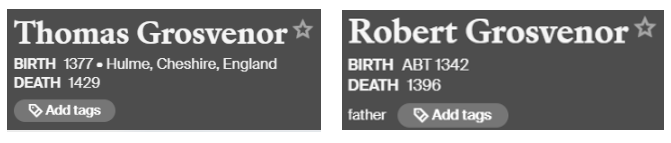
This time, Thomas had no relationship label, as expected. More importantly, Robert Grosvenor appeared simply as father.
That was correct. The software recognized the immediate parent-child connection. The problem appeared when Ancestry calculated relationships across many generations.
I had not changed the parent-child link between Thomas and Robert. Yet depending on the home person, Ancestry displayed dramatically different relationships.
So, why does this matter? Genealogists working with medieval ancestry frequently encounter pedigree collapse. The same individuals may appear in multiple ancestral lines because distant relatives married one another over generations.
A person might be a direct ancestor through one line, a distant cousin through another, and connected by marriage through still another.
That is not unusual.
What concerns me is that Ancestry displays a single relationship label without making it clear, in these screenshots, that other relationships may exist.
When a correctly linked father and son are identified as a great-grandfather and a distant cousin, a researcher might reasonably conclude that something is wrong with the tree.
Worse, someone attempting to correct the apparent discrepancy might change an otherwise valid genealogical connection.
That is a genuine research concern. In my first 5 volumes, I’ve noticed 92 wrong relationships.
Is This a Software Glitch?
I cannot determine from these examples whether Ancestry’s relationship calculator contains a programming error or is simply choosing one relationship path according to rules that aren’t apparent to the user.
But I can demonstrate that the displayed labels do not consistently follow the direct ancestral path.
And that distinction matters.
The father-son relationship remained intact. It was the description of each man’s relationship to the selected home person that changed.
For researchers who use Ancestry’s labels to help identify direct ancestors, this behavior can be misleading.
A Warning for Researchers
My experience suggests several precautions:
- Don’t assume Ancestry’s displayed relationship is the only relationship you have with an individual.
- Verify direct ancestral lines generation by generation.
- Be particularly cautious when working with interconnected families or pedigree collapse.
- Don’t alter documented parent-child relationships simply to make Ancestry’s relationship label appear correct.
- Remember that a software-generated relationship is not genealogical evidence.
For Echoes of Britannia, I will continue relying on documented relationships and carefully constructed pedigree charts rather than Ancestry’s automatically generated labels.
But I would like Ancestry to address this issue.
When multiple relationships exist, how does Ancestry determine which one to display? And why isn’t the direct ancestral relationship given priority when one exists?
Those seem like reasonable questions for a product used by millions of family historians. Especially one that costs a lot each year AND KEEPS WANTING MORE OF OUR MONEY FOR PRO TOOLS WHICH IMHO, SHOULD BE PART OF THE PACKET TO INSURE INFORMATION IS CORRECT.
After all, genealogy is complicated enough without software turning your great-grandfather into your cousin.
Have you encountered similar relationship discrepancies in your Ancestry family tree? I’d be interested in hearing what you’ve discovered.