While in Sweden I hoped to discover more about my husband’s maternal great grandmother, Lovisa Carlson. Her father was Carl Gustaf Johannesson, a widower, who emigrated with Lovisa to Chicago in 1887.
Lovisa is something of a mystery even in Sweden as several genealogists could not understand her movements in the country. She was born in Gränna, Jönköping but followed her sister to live in Ostergötland. That was according to church records in Gränna, however, she never shows up in Ostergötland church records.
Lovisa’s mom, Stina Jonsdotter, died in 1866. Lovisa’s sister returned home and Lovisa followed her in 1867. Lovisa is found living in her father’s household until they both decided to depart Sweden from Jönköping on 11 May 1887.
By this time Chicago had a very established Swedish district so it is not surprising that they relocated there. Probably they knew of others from their area who had gone before them.
The problem is where did they live and what did they do while in Chicago? I was hoping to find church records as there was only one Lovisa Carlson in city directories during this time but it wasn’t my Lovisa, the other woman was a widow.
Two years after arriving Lovisa married in Chicago widower Anders Johannesson. I have the original church marriage record with the pictures of the couples sadly removed. The problem is that she was recorded as Miss Lovisa Johannesson. All other records show her as Carlson. Also missing on the record is the name of the church. I do have the pastor so I had hoped to link him to a church and possibly discover more info. The governmental records provided no answers.
The couple then moved to Porter County, Indiana where Anders had been living with his children from his first marriage.
When my husband and I went to Sweden in April we visited the family home and church for ancestors who were on both his maternal and paternal sides.
Kris and Mangus, of MinnesotaSwede.com, mentioned they were intrigued by how early Samuel August Samuelson and his parents had emigrated to the US and settled in Chicago – 1851! I never thought much about that date but knew from a mug book account that the family only remained in Chicago for one year and then relocated to Porter County, Indiana.
I discovered in Sweden the reason they first went to Chicago. Sam’s older half-brother, Carl Gustaf Johnson, had left Sweden for Chicago in 1849. Why? Samuel Eriksson was a tenant farmer who had married Anna Elisabet “Lisa” Torstensdotter after she had birthed Carl. The family stayed together working for an estate for years but in 1849 the estate let the family go as it appears that the property was sold and the new owners had their own tenants that they wanted to hire.
Samuel, Lisa, and their four surviving children moved to work at a smaller estate as tenant farmers. Perhaps there wasn’t room for Carl or he decided to set off on an adventure in America. According to Kris and Mangus, this wasn’t the time that most Swedes left the country. Only those who believed there was nothing left for them in Sweden took the long and dangerous route to North America. This was the era of sailing ships.
By 1850, Samuel had to move on to another tenancy. From visiting it became apparent that the family was on a downward slide. Each home was smaller, the land surrounding it was tiny, and the estate where they worked was not as prosperous as the former ones. It is no surprise that the family decided in 1851 to join Carl in Chicago.
But where in Chicago? Carl does not appear in the 1850 federal census. Samuel and family arrived after the census. I searched city directories for the time period but they are not found. I stopped at the Swedish Museum hoping their archive might hold some clues. Unfortunately the archivist was not in so I had to follow up with an email. Got a response that she was busy with setting up a new exhibit and would get back to me when she had time.
I then asked at the Chicago History Museum if they knew of Swedish churches in Chicago during that time period. There weren’t any as there were too few to form a congregation.
So, this mystery remains – where did they live and what did they do for the short window when they lived in Chicago?
What I did finally understand was why Samuel’s son, Samuel August Samuelson, volunteered as a Union Soldier and became a lifelong Republican (not to be confused with the current party’s belief systems). Samuel had experienced life as a child of a tenant farmer. He likely empathized with the enslaved which resulted in his joining the Civil War. I would never have figured this out unless I had stood in his former homes and saw for myself what the family had experienced.
Next week, I’ll write about another Swedish mystery that I’m still working on.
Try as I might to have a simple vacation the universe seems to plan weird and wonderful for me!
I’ve blogged before about the odd happenings when I go boots on the ground and my recent Swedish heritage trip to explore my husband’s roots was no different.
Our tour guides, Kris and Mangus, had stopped at one of my husband’s ancestral churches in Sjöhester which was supposed to be open but unfortunately was not. Husband and I were fine with the missed stop as we are used to being flexible when traveling. The guides, however, were disappointed.
Since there was no contact info for the church we went onward to the next stop. As Mangus drove up to the property, Kris excitedly remarked that there was a car in the driveway.
Now for my U.S. readers, I know this is shocking to you but in Sweden no one shoots you when you knock on their door or turn around in their driveway. Instead, they invite you inside. Yes, I realize they are letting perfect strangers into their homes but they are fine with that. We can all learn a lesson here!
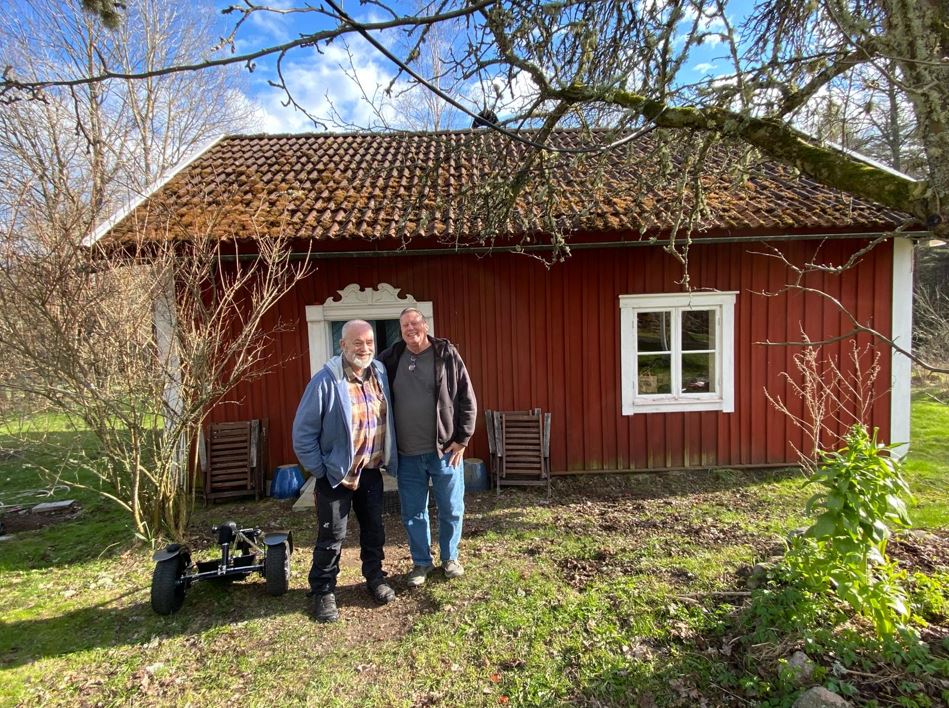
We could see two large dogs, a lab and German shepherd, through the window but there was a lag between the knock and someone coming to the door so we didn’t expect the door to open. Open it did and Bo, seen above, appeared. Kris explained why we were at his property, explaining that Jim’s ancestors, Amund Jonsson (1655-1741) and Anna Nilsdotter (1672-1743) lived and raised their family there. This was two generations back from where I had ended my research so I knew nothing about this couple and their children.
Unbelievably, Bo knew all about them. For forty years he rented the cottage as a summer residence. Interested to know about former residents he had painstakingly researched them. He had even written a biography that was on his website.
He kindly invited us in and we sat around his kitchen table as Kris translated the family story. But of course, that’s not all…
Bo asked if we had visited the family church. Kris mentioned that it had been locked. Bo just happened to have the key. We agreed to meet him at the church the following day at 3 for a tour.
That’s not all – Bo mentioned he was glad we came when we did as he had just returned two days before for the summer. Originally, we had scheduled our trip for two weeks earlier but had to change due to my lecture schedule. If we hadn’t, we would have missed him, the opportunity to see the inside of the home, and probably the church, too.
Bo wasn’t the only individual to allow us to photograph their homes. Earlier that day in Sonarp, the birthplace of Maja Olofsdotter (1736-1826) the family invited us in the see their lovely home. The current owner remarked that the dining room always feels happy and I agreed. It was a beautiful bucolic setting; the family has farmed the land for five generations since they first rented in 1900. Sadly, the farmer’s father had been buried just two days prior to our visit with services held in the church where Maja had been baptized and likely married. The couple shared an old photo of what the farm had looked like back in the day – not much different from the present.
The Johannesson family of Närvehult also shared a photo of their home from 1921. Birger Ingesson (1715-1795) and Maria Borjesdotter (1722-1776) raised their family there. Birger and his son, Inge (1763-1843), were both once members of Parliament representing the region on behalf of farmers.
Current owner Stephanie of Hamburg, Germany, kindly let us photograph her spacious yard. In Kjölamälen, Inge Börjesson (1763-1843) and his wife, Margareta Eriksdotter (1765-1839), lived there with their children. It remained in the family for three generations and was the birth location of my husband’s great grandfather Anders L. G. Johannesson Johnson (1839-1906) who emigrated to the U.S.
In Hammershult, current owners stopped their yard work to allow us into the grain mill that Gudmund Svensson (1767-1814) and his wife Judith (1779-?) once operated. Their daughter, Sophia (1807-?) was born in the home on the property. We had no idea that there was a miller in the family!
Was is plain luck that all of these folks just happened to be home when we showed up unannounced or not? You decide!
I’m thinking we should add another reason to last week’s blog about why you must take a heritage tour – you meet the nicest people who are living their lives in the same place that your ancestor’s did. Celebrating birthdays, graduations, and new offsprings; mourning job losses, injuries, and deaths. It is an amazing experience to visit where your forefather’s experienced the cycle of life and if they hadn’t – you wouldn’t be here hunting their stories! Do plan a heritage trip to explore your ancestry.
Next Friday, 7:15 PM Eastern time, I, along with 6 other genealogists, will be presenting at the online only National Genealogical Society (NGS) conference. I am part of Rapid Roots: 7 Share Their Secrets in 7 Minutes. Please attend as I’ll be live for the Q&A – let’s chat!
Hubby and I are back from a world wind tour of Sweden, his ancestral homeland. The best way I can describe it was MAGICAL! Here’s why I think you need to plan a trip to your ancestral home:
Get to Know Your Ancestors – they are more than just names, dates, and places on a pedigree chart. In order to understand their lives you must follow in their footsteps. Considering their educational experiences, jobs, religion, home type, and climate will enhance your understanding of your family today. Have you stopped to think why your family eats a specific holiday meal? Visiting may unlock the mystery of your family’s customs.
Gain Historical Perspective – We didn’t learn the history of the countries our forefather’s left in school so we are lacking in understanding what made them tick. I had no idea that the Vikings roamed as far as Egypt and traded with the Greeks! Geez, my people were in Greece during that time period. I never considered that my people and my husband’s people could have possibly met 2000 years ago!
Unexpected Discoveries – It was news to me that in medieval times, brides in Sweden wore jeweled crowns maintained by the church. The custom has largely gone out of practice but in many churches, the crown remains. A kind church member allowed me to wear a crown that was likely worn by one of my husband’s several times great grandmothers. It is a tremendously memorable experience to bond with those from the past.
Connect With Others – I was able to meet up with an APG colleague I’ve only previously met virtually. We also met many homeowners and renters who were living in houses once inhabited by my husband’s family. So many wonderful ministers and parishioners took the time to provide us with the history of churches where family members had once attended. We greatly appreciated that they took the time to share their knowledge with us.
It Won’t Last Forever – It is amazing that structures have survived for centuries but that doesn’t mean they will always be there. Don’t let climate change steal your past from you! Taking photos will preserve the family story.
Make the Most of Your Trip – Although I am a professional genealogist I am not an expert in everything. Reaching out to other genealogists for help is vital. For our trip, we contracted with MinnesotaSwede.com. Kris and Mangus verified my research, extended it, and planned the day to day itinerary. They booked the hotels, arranged stops for food, picked us up and dropped us off at the airport, and drove us to 14 ancestral churches and over 20 ancestral sites in Östergötland and Småland. They also provided us historical background by visiting sites in Sigtuna and Stockholm, Sweden and in Copenhagen, Denmark. They are genealogy guides extraordinaire!
For my long time readers, you know wherever I roam the strange and unusual occurs. Sweden was no exception so next week I’ll be writing about those experiences.
Recently I helped a community member scan old photos from the late 1800s to the 1950s, along with some school records, a marriage license, and an old typed family genealogy. Some of the photos were of historically important pictures from buildings that no longer exist in our town, like the first YMCA.
Check out your local library to see if they have a scanner you can use. Ours has a large flatbed which was wonderful for some of the oversize documents. Speak with the staff to get their tips and tricks so your results will be the best they can be. This is especially important if you want to share your items with a local historical society, museum, or library. I typically save in .jpg but that degrades quicker than .tiff, though it takes up less space. Ask before you begin what their preference is and if they are interested in the scans.
Bring a thumb drive to store the scans on. It’s easy to share through Google docs or Dropbox. To save time, you can just let the scanner assign a number to the photo but do go back and rename to what it was you scanned, such as 1892.Smith Family Picnic.Glen Park Indiana. If you don’t know the info, that’s okay, there are GPTs that I wrote about two weeks ago that will help you identify more information about the picture or you can use MyHeritage.com’s Photo aids.
Now share with family! Sure, some time is involved but the knowledge that you have preserved your family history is a big plus.
I will be taking the next two weeks off from blogging as I hit the road with family to go on an ancestral quest. I’m so excited to be traveling again and will be sure to share all the wonderful finds I anticipate will occur. Type with your soon!
Spring has sprung in the Midwest and last Saturday was the first cemetery walk of the year. The old cemetery in a small northeastern Indiana town held a plaque dedication ceremony. That was followed by portrayal of 10 notable families that were buried there.
It just so happened that the woman I was talking about was having her 153 birthday that day. She had been such a powerhouse locally in the late 1800s; upon her last illness, which kept in her bed with a nurse for 8 months, her many friends bought her fresh flowers daily. In keeping with that tradition and because it was her birthday, I brought a bouquet in remembrance.
Now is the time to plan your cemetery excursions for the next few months.
First, make a list of what cemeteries you hope to visit this year. Then, group them using Google Maps to make the most out of your trip.
Next, get into your shed, garage, basement, and make sure your tool are ready to go. I usually take a shovel to right a leaning headstone, garden gloves, a hand rake, small broom, and clippers. I personally like to use Krud Kutter, available at the big box stores.
Also to include are rags, water, and a bucket. The bucket makes a nice transport for all the items. Don’t forget bug spray! A garbage bag is also helpful to cart away dead leaves and clippings.
Now, look at your calendar, speak with family and friends, and try to convince someone to go with you. Sure, you can do it alone but in some cemeteries it’s safer to have a buddy.
Dress appropriately – you’ll be getting dirty, wet, and either hot or cold.
Fill up your gas tank, put the address in your GPS and head off. I like to bring a snack but if you aren’t going to be too far out from civilization you can always stop for lunch.
After you’ve cleaned the stone, make sure to take a picture. I upload mine to Findagrave.com, even if there already is a picture because the difference in stones over time is truly remarkable. It will be helpful if you can add GPS coordinates, too, as many of those are lacking on that site.
I’m off to Noble County for to present at the society’s annual conference. Hope to see you there!
I’ve been blogging alot about AI and genealogy and today I’d like to introduce you to some tools that can help you get the most out of AI and your research.
Enter GPTs! GPT is the acronym for Generative Pre Trained Transformers. All that means is this is a tech way to communicate with artificial intelligence. Other terms that are sometimes used instead of GPT are bots, assistants, and agents.
You’ve been using bots for several years though you probably didn’t know it. When you are on a website for your bank or credit card company and can’t find the info you want, you may have clicked on the Chat box. You typed in your question and hopefully, got the information you requested. If not, it usually directs you to a human.
Enter chat boxes for genealogy! The recent class that I completed on AI through the National Genealogical Society tasked us with creating GPTs for genealogy. Here are my favorites through open.ai:
GenealogyAtHeart – Yes, I created this and I’m shamelessly listing this as my favorite because I have linked it to my website. This means that all the useful hints, heartwarming stories, and recommendations to get the most out of your genealogy can be quickly accessed by you on open.ai. Yes, I do have a search box on my website but the search box will only find the terms I’ve entered into it. Through ChatGPT’s Genealogy At Heart you can find EVERYTHING I’ve entered. Side note: If we share an ancestor you’ll be able to find everything I’ve written about the individual quickly and in a summary format. If we don’t share a relative, you can still find all the hints, helpful links, and recommendations I’ve made in the over 500 blogs I’ve posted in the last 9 plus years! Have a brick wall? Need help in planning a project? Thinking of planning a genealogy research trip and don’t know where to begin? This GPT is for you!
DeKalb County, Indiana Resources – Okay, I get it! Most of you don’t have any interest in DeKalb County, Indiana but I am the county genealogist so this is very important for those people who do need this resource. I created this GPT for those folks.
I’m working on a census GPT for U.S. federal census records. Hopefully, that will be available for you your use soon. This will help you access quickly the enumerator directions, dates of the census, compare quickly census results from decade to decade, and so on.
I am not the only person creating genealogy GPTs so here are my other favorites from colleagues:
Diagrams: Show Me – for creating mind maps or showing relationship commonalities with Venn Diagrams, this is the way to go! It is a little slow so be patient. Not so good for creating a family tree.
Genealogy Eyes: Designed by Steve Little, NGS AI Director, this is an awesome one for you to try if you have a picture of a tombstone you are having trouble deciphering or an older family pic you need more info about, such as time period or event. MyHeritage does offer something similar but I’ve found Genealogy Eyes to provide more info and be more accurate (I always try something with AI that I already know the answer for first, to test for accuracy).
GPTs aren’t just about genealogy. I’ve created one for native plants, Native Green Thumb, which is another passion I have. Remember that old commercial that repeated, “There’s an ap for that!” Well, GPTs are the new aps. Everyday more and more are being developed.
Have an idea for one that hasn’t been created? It’s simple to do as AI will help you formalize your thoughts. Just log onto ChatGPT. Click “ExploreGPTs and on the upper right side, click the green +Create box. It defaults to Create which is the simple way; it’s like computer coding in English. If you are a techie than by all means select Configure. Under Create, give the AI your thoughts in the Message GPT Builder and press enter. It will ask you questions and you provide your thoughtful responses. Don’t like what it created? No worries, you can delete it. Want only family and friends to see it? Just select the link option when saving. You can then share the link with them. Or, you can have the link publicly visible to everyone or just yourself.
Want to find more GPTs that can be useful for you? Click “Explore GPTs” and in the “Search public GPTs” type what you’re looking for. It will save your favorites on the bar on the left so you can refer to them quickly anytime. I’m working on one now to help analyze U.S. federal census records quickly.
Please let me know if you see a problem with Genealogy At Heart or DeKalb County, Indiana Resources. Email me at genealogyatheart@gmail.com.
Last week I blogged about how to print your family tree from the three genealogy giant sites – Ancestry.com, FamilySearch.org, and MyHeritage.com. If you don’t pay for a subscription or you don’t want to rely on FamilySearch’s free site because of other people changing the tree for the worse, there are more options for you. Many genealogy software companies that will allow you to purchase their package for under $50.00. Sometimes, you can even get it for as low as $20.00! Those specials are usually available for a limited time, especially during a major conference, like RootsTech. The next one coming up is the National Genealogical Society conference in May. This would be a great Mother’s Day gift or early Father’s Day one, as well! I recommend you check out the ones I’m mentioning below by visiting their website. They have cookies so will know you visited. These cookies don’t add pounds, they’ll just save you money as you’ll get offer discounts sent to you.
RootsMagic9 synchs with Ancestry.com. This means, if you decide someday to get a subscription to Ancestry, you can upload the tree you are building on RootsMagic9 quickly. If you have no intention of ever getting an Ancestry account, no worries! You still have a means to build a family tree, print it, save photos and records to individuals, create narratives, and share with family if they have the program.
FamilyTreeMaker (FTM) also synchs with Ancestry.com. This program does everything that RootsMagic9 does. So, which should you get?
I have both because they have slightly different options. What works for me might not be what works for you so my advice is to go to both websites and download a free version, though usually FTM doesn’t have a free version. They may be getting ready to put out a new edition so keep visiting as that’s usually the time for freebie or lost cost to purchase options. Play with it. If you like it and it meets your need, purchase it.
Legacy Family Tree does not synch with Ancestry.com. I can download a gedcom file from Ancestry and upload it to Legacy. That saves time in not having to type everything in my tree again but it DOES NOT SAVE MEDIA! This means, all photos will not be available to view on Legacy. If you think you might want to someday purchase a MyHeritage.com subscription, though, Legacy is for you because it does synch with MyHeritage. I really like some of the charts that Legacy has that the two others don’t have so yes, I have this software, too. Like with RootsMagic, try it for free.
There are other companies out there but these are the ones that are most used and which I am familiar with.
When you decide on a software program, PLEASE DO NOT save it only to your computer. If your computer crashes you have lost everything. That’s one of the perks of paying for a subscription – your tree info is saved in the cloud. So, save to a thumb drive if your tree is small, or a stand alone hard drive if your tree is large. Another option is to purchase your own cloud storage through Dropbox, Google, or Amazon. I personally recommend making a copy on a stand alone hard drive and giving it to a family member. In case something happens to your home, there is another copy somewhere safe. Periodically, you can get it back and update it.
Lots of options to think about! Whichever you decide you can always make another choice if it isn’t working out.
I received a great question from reader Molly a few weeks ago that I think many of you might benefit from. Are you frustrated with the cost of subscription based genealogy sites that aren’t so great for graphically representing your tree? Maybe you are keeping all your finds in a notebook because of the high cost or perhaps, worry that the site will close taking your hard work with it.
I share the concerns as I want to have control of my research. That being said, I do pay for subscriptions to many sites because I need that for my work as a professional genealogist. Here’s some options if you do pay for a subscription to:
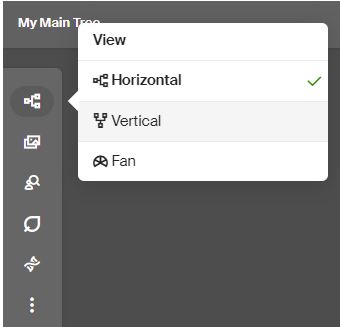
Ancestry.com – Click on “Tree” on the ribbon, then click on the tree you want to print (if you have more than one tree). I personally like the Horizontal View but you can switch views by accessing the tool bar on the right side of your screen that looks like this:
If you prefer a Vertical tree view just click Vertical. Your other option is a Fan Chart.
I then use my Snipping Tool and clip the tree. I can’t say it will look pretty but it works in a pinch. I take copies with me when I travel to share with family I meet or when I’m going to an archive that I’m not sure I can access my online tree.
FamilySearch.org – you know the site is free, however, everyone and their brother has access which can sometimes be frustrating when a well meaning person insists on adding wrong info to the shared tree. I recommend you clean up what is wrong and then print a fan or pedigree chart. The following is the steps from FamilySearch’s website on how to do that:
“How do I print fan charts and pedigree charts in Family Tree?
You can print fan charts and pedigree from Family Tree. FamilySearch converts the information into a PDF file, which you can save to your computer.
Fan chart and pedigree chart options on the website or the mobile app
Seven-generation fan chart.
Five-generation portrait chart.
Four-generation pedigree chart.
The default print orientation is portrait. However, the landscape orientation better optimizes the presentation of your fan chart. When you send the request to the printer, you can change the orientation.
Steps (website)
From Person Page
Sign in and click Family Tree.
In the drop-down menu, click Tree.
Navigate to the person that you want to use to begin your chart.
Click that person. Click their name to be taken to their person page.
Click the Details tab.
On the right, find the Tools section.
Click Print Options.
Click what you want to print.
A PDF opens in a new tab. Use your browser’s print feature to print it. If your computer has trouble with the PDF file, clear your cache and cookies, or use a different browser.
From Family Tree
You can print from the portrait, landscape, and fan chart views.
Sign in and click Family Tree.
In the drop-down menu, click Tree.
Navigate to the person that you want to use to begin your chart.
Click that person. In the pop-up menu that appears, click Tree. The tree opens with that person as the person-of-focus.
Open the kind of chart that you want to print: Portrait, Landscape, or Fan:
In the top-right, click the chart on display (Portrait, Landscape, Fan Chart, Descendancy, or First Ancestor).
From the menu, click the chart that you want to print. If you select Fan Chart, use the Options icon to specify what information to include. The information is visible in the printed document.
If anyone on the chart has more than one spouse or set of parents, you can change which shows on the printed chart.
Click the Options icon .
Click Print.
The chart opens as a PDF in a new tab. Use your browser’s print feature to print it. If your computer has trouble with the PDF file, clear your cache and cookies, or use a different browser.
On the FamilySearch website, Family Tree generates interactive PDF files for the 4-generation pedigree. You can add or modify information in it.
Changing the PDF file does not change the information in Family Tree. We recommend that you change the information in Family Tree and then print.
Below each name on the chart is a box with the letter F. You can enter an alternate identifier in the box and coordinate the people on the chart with printed family group records.
You cannot alter the width of each generation on the chart.
Steps (mobile)
If your mobile device is set up to print, you can print the pedigree chart or family group records from the Family Tree mobile app.
From within the Family Tree mobile app, tap Tree.
Find the person that you want, and tap his or her name.
If the person has more than one spouse or set of parents, you can change which shows on the printed chart.
Tap Spouses or Parents.
Tap the down arrow for the spouse or parents that you want to print.
Tap Preferred Spouse or Preferred Parents.
Open the charts option:
Android: Below the dark bar that includes the name, scroll to the right and tap Charts.
Apple iOS: Tap the three dots in the top-right corner and then tap More and tap Charts.
Tap the chart that you want.
Send the chart to your printer:
Apple iOS: at the top, tap the 3 dots and click Share. Then tap Print.
Android: tap the 3 dots and then tap Print.
The Family Tree mobile app does not generate interactive PDF files.”
I’ve been writing alot about AI but I’d like to let you know about another cool tech tool that is invaluable for your genealogy.
Best part – it’s free! I LOVE free!
Just click on WolframAlpha and you will find a variety of topics, such as Math, Science & Tech, Society & Culture, and Everyday Life.
How could you use this with genealogy? Well, Society and Culture would be a benefit if you are writing about the historical period in which your ancestor lived. The People section will allow you to see who was influential in your forebear’s time period.
The Dates & Times section can give you facts about a particular date. Want to quickly calculate that tombstone inscription from the date of death to determine the birthdate from 88 y. 3 m. 2 d.? It can do that, too!
Words & Linguistics is another option when you are trying to translate and get stuck.
This site was not developed for genealogy but can be helpful. There is a Genealogy section – first click “Hobbies” and it will be displayed under “Genealogy.” This section is designed to help establish family relationships.



 .
.